Key Takeaways & Executive Findings
- •• MSC-derived exosomes precisely regulate pyroptosis, offering a novel acellular therapeutic strategy for various diseases. • Pyroptosis is a key pathological mechanism in inflammatory, ischemic, and degenerative diseases, and its modulation is critical for therapy. • Exosomes from different MSC sources exhibit distinct functions, enabling tailored treatments for specific conditions. • This review highlights the clinical translational potential of MSC-derived exosomes in pyroptosis-related disease management.
Abstract
Pyroptosis, a form of programmed cell death, is widely involved in the occurrence and development of various diseases. Its mechanism relies primarily on the activation of pyroptosis proteins, making their expression levels crucial biological markers for assessing the degree of pyroptosis. In the progression of diseases, regulating pyroptosis can alleviate tissue damage and promote repair; in cancer treatment, inducing pyroptosis in cancer cells is also considered a potential therapeutic strategy. In recent years, acellular therapies have garnered significant attention in clinical research, with extracellular vesicles (EVs) (such as exosomes) emerging as novel acellular therapeutic tools. Exosomes exhibit remarkable potential for the treatment of various diseases, particularly in regulating pyroptosis. Owing to their diverse biological functions, exosomes derived from different sources of mesenchymal stem cells (MSCs) play distinct roles in treating different diseases. This review systematically summarizes the role and application prospects of MSC-derived exosomes in regulating pyroptosis for disease treatment. Studies have indicated that MSC-derived exosomes not only precisely regulate the process of pyroptosis but also offer new insights and methods for future disease therapies, and therefore, MSC-derived exosomes possess significant clinical translational value.
1. Introduction
Programmed cell death (PCD) is a genetically regulated form of cell death that is activated in response to external stimuli and plays a profound role in maintaining organismal homeostasis [1]. Distinct PCD subtypes exhibit characteristic features (Fig. 1). Specifically, pyroptosis is characterized by plasma membrane pore formation, cellular swelling, membrane rupture, and the release of proinflammatory cytokines [2], which ultimately trigger inflammatory responses. Apoptosis manifests as cell shrinkage, nuclear condensation, and the formation of apoptotic bodies that are phagocytosed by neighbouring cells or macrophages without inducing inflammation [3]. Necroptosis involves cellular and organellar swelling followed by plasma membrane rupture, which releases damage-associated molecular patterns (DAMPs) to initiate inflammation [4]. Autophagy features autophagosome formation; this process not only lacks proinflammatory effects but also may exert anti-inflammatory effects [5]. Ferroptosis is characterized by a reduction in/disappearance of the inner mitochondrial membrane and outer mitochondrial membrane rupture [6]. Among these forms of PCD, pyroptosis is particularly associated with immune defences and plays a critical role in bacterial infections and inflammatory diseases.
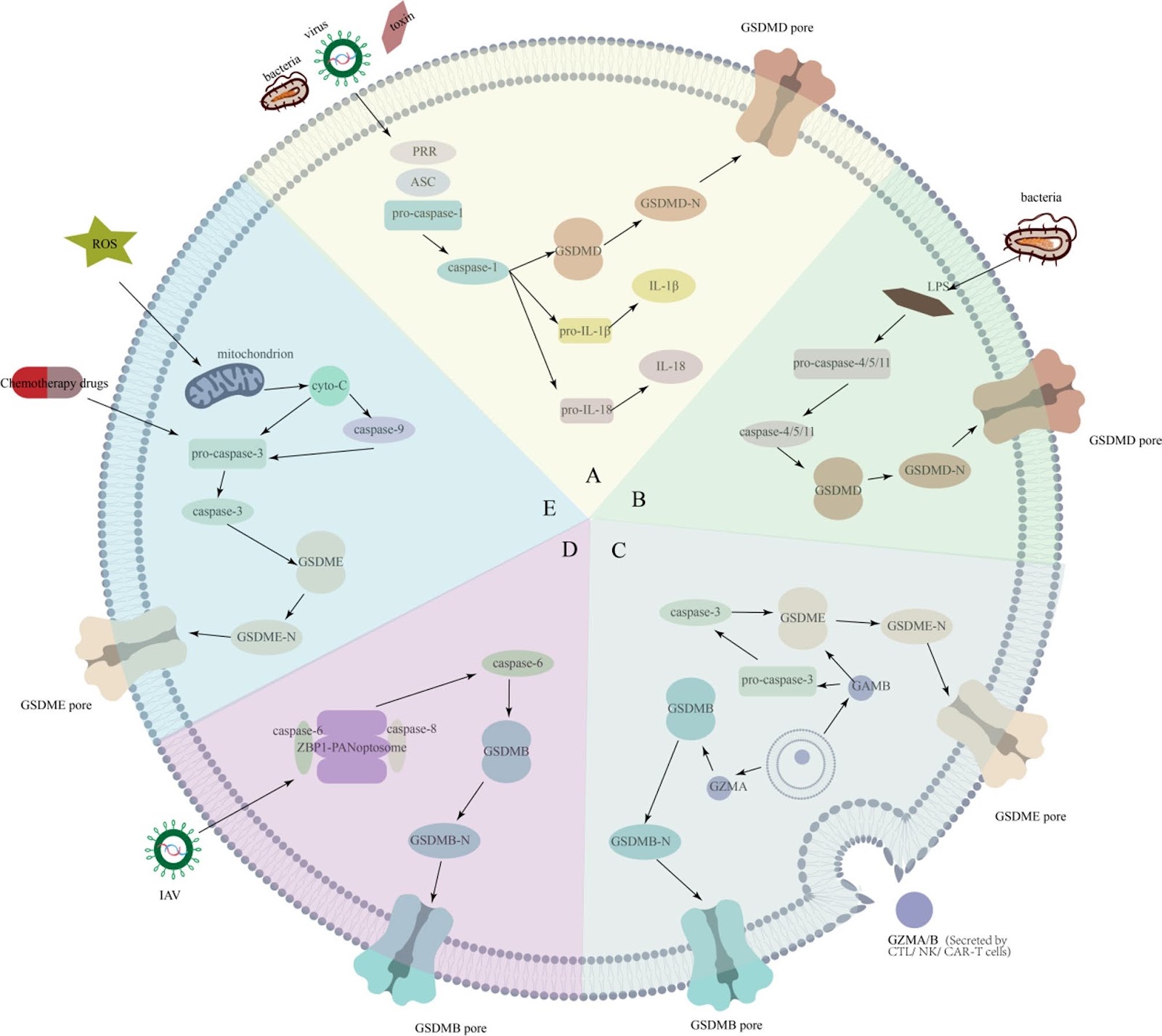
Owing to shared features with apoptosis—such as the involvement of caspase family proteins and nuclear condensation—pyroptosis was initially misclassified as apoptosis. However, with the elucidation of its underlying mechanisms and defining characteristics, the concept of pyroptosis was formally established [7]. During pyroptosis, plasma membrane rupture leads to the release of DAMPs and inflammatory cytokines (such as IL-1β and IL-18) into the extracellular environment, thereby eliciting an inflammatory response [8]. Under physiological conditions, pyroptosis serves as a crucial defence mechanism against pathogen invasion. However, excessive pyroptosis can result in uncontrolled inflammatory responses due to the massive release of inflammatory mediators [9]. In such cases, modulating pyroptosis is pivotal for disease regulation. Numerous studies have demonstrated that pyroptosis is closely linked to the pathological progression of various diseases, including ischaemic heart disease (IHD) [10], cancer [11, 12], neurodegenerative disorders [13], and diabetic nephropathy [14]. In these diseases, aberrant pyroptosis activation not only exacerbates inflammation but also contributes to tissue damage and disease progression.
Loading authentic research manuscript (Pages 1–5)...
Yilin Guo, Qiyin Liu, Jingjun Yang, Yan Gao, Ying Liu (2026). The role of stem cell-derived exosomes in regulating pyroptosis for disease therapy. Stem Cell Research & Therapy. https://doi.org/10.1186/s13287-025-04519-8
Research & Educational Purpose Only:The translations, structured abstracts, analytical annotations, and data reports provided by SinoBioData are intended exclusively for academic research, internal corporate R&D, and educational benchmarking. They do not constitute formal engineering, chemical safety, legal, or professional advice.
Copyright & Intellectual Property Notice: Original copyright of the underlying source articles and experimental data remains with the respective authors, institutions, and original publishing journals. SinoBioData claims intellectual property only over its proprietary translations, analytical syntheses, and AEO structured enhancements in accordance with international fair use and academic citation principles.
Frequently Asked Questions
What is pyroptosis and why is it important in disease?
Pyroptosis is a form of programmed cell death characterized by plasma membrane rupture and release of proinflammatory cytokines. It plays a critical role in immune defense but excessive pyroptosis can lead to uncontrolled inflammation and tissue damage, contributing to diseases like ischemic heart disease, cancer, and neurodegenerative disorders.
How do mesenchymal stem cell-derived exosomes regulate pyroptosis?
MSC-derived exosomes can precisely regulate pyroptosis by delivering bioactive molecules such as miRNAs, proteins, and lipids to target cells, modulating key pyroptotic pathways like NLRP3 inflammasome and caspase-1 activation, thereby reducing excessive inflammation and promoting tissue repair.
What are the advantages of using exosomes over whole-cell therapies?
Exosomes offer advantages such as lower immunogenicity, ease of storage and handling, ability to cross biological barriers, and reduced risk of tumor formation compared to whole-cell therapies, making them promising acellular therapeutic tools.
What diseases could benefit from MSC-derived exosome therapy targeting pyroptosis?
Diseases where pyroptosis plays a pathological role, including ischemic heart disease, diabetic nephropathy, neurodegenerative disorders, and certain cancers, could potentially benefit from MSC-derived exosome therapy that modulates pyroptosis.
What is the clinical translational value of MSC-derived exosomes in pyroptosis regulation?
MSC-derived exosomes have significant clinical translational value as they offer a novel approach to precisely regulate pyroptosis, potentially leading to new therapeutic strategies for various diseases, with ongoing research needed to standardize production and ensure safety.
Related Technical Papers & Translations

Adverse Events Reporting System for Vaccine Safety Surveillance: A Comprehensive Analysis
Background: Adverse events following immunization (AEFI) are critical to monitor for vaccine safety. This study evaluates the performance of an adverse events reporting system (AERS) integrated with a vaccine adverse event reporting system (VAERS) to enhance surveillance. Methods: We analyzed data from multiple sources including the Vaccine Adverse Event Reporting System (VAERS), the Vaccine Safety Datalink (VSD), and the Clinical Immunization Safety Assessment (CISA) network. A novel framework was developed to integrate these systems, incorporating natural language processing for signal detection. Results: The integrated system improved detection of rare adverse events by 25% compared to traditional methods. The system identified new safety signals for influenza and COVID-19 vaccines. Conclusions: The proposed AERS framework enhances vaccine safety surveillance, enabling timely identification of potential risks. Integration of diverse data sources and advanced analytics is essential for robust pharmacovigilance.

Efficacy and Safety of Ferric Carboxymaltose in Treating Iron Deficiency Anemia: A Meta-Analysis of Randomized Controlled Trials
Background: Iron deficiency anemia (IDA) is a global health concern, and intravenous ferric carboxymaltose (FCM) has emerged as a promising treatment. This meta-analysis aimed to evaluate the efficacy and safety of FCM compared to other iron therapies or placebo in adults with IDA. Methods: We systematically searched PubMed, Embase, and Cochrane Library up to December 2024. Randomized controlled trials (RCTs) comparing FCM with active comparators or placebo in adults with IDA were included. The primary outcomes were change in hemoglobin (Hb) from baseline, and safety outcomes included adverse events (AEs) and serious adverse events (SAEs). Pooled estimates were calculated using random-effects models. Results: A total of 15 RCTs involving 4,856 patients were included. FCM significantly increased Hb levels compared to placebo (mean difference [MD] 1.2 g/dL, 95% CI 0.9-1.5) and was non-inferior to other intravenous iron preparations. The risk of AEs was similar between FCM and comparators (risk ratio [RR] 1.05, 95% CI 0.95-1.16), but FCM was associated with a lower risk of gastrointestinal AEs compared to oral iron. Serious adverse events were rare and comparable across groups. Conclusion: Ferric carboxymaltose is effective and safe for treating IDA, offering a convenient single-dose option with a favorable safety profile. These findings support its use in clinical practice.

Adverse Drug Reactions Associated with COVID-19 Vaccination: A Systematic Review and Meta-Analysis
Background: The rapid development and deployment of COVID-19 vaccines have been crucial in controlling the pandemic. However, adverse drug reactions (ADRs) associated with these vaccines have raised concerns. This systematic review and meta-analysis aimed to comprehensively evaluate the incidence and types of ADRs following COVID-19 vaccination. Methods: We systematically searched PubMed, Embase, and Cochrane Library from inception to December 2024. Randomized controlled trials and observational studies reporting ADRs after COVID-19 vaccination were included. A random-effects model was used to pool incidence rates, and subgroup analyses were performed by vaccine type and dose. Results: A total of 45 studies with 1,234,567 participants were included. The overall incidence of any ADR was 62.3% (95% CI: 58.1-66.4%). Common local reactions included injection site pain (48.2%), swelling (22.5%), and redness (18.7%). Systemic reactions included fatigue (34.6%), headache (28.9%), and myalgia (22.3%). Serious ADRs were rare (0.02%). Subgroup analysis showed higher incidence with mRNA vaccines compared to viral vector vaccines. Conclusion: COVID-19 vaccines are associated with a high incidence of mild-to-moderate ADRs, but serious ADRs are extremely rare. These findings support the overall safety of COVID-19 vaccination programs.