Key Takeaways & Executive Findings
- •• Biophysical cues such as substrate stiffness and fluid shear stress are pivotal in the pathogenesis of dental diseases like caries, periodontitis, and dentin hypersensitivity. • Exosomes derived from dental stem cells inherit biophysical signals and offer a promising cell-free therapy for dental regeneration, overcoming limitations of direct stem cell transplantation. • Biophysical cues regulate exosome biogenesis, release, and uptake, providing a mechanism to enhance their therapeutic efficacy in dental disease treatment. • This review highlights the potential of biophysical cue-regulated exosomes as novel targets for dental regenerative medicine, bridging mechanobiology and exosome-based therapy.
Abstract
Dental diseases such as caries and periodontitis have been common public health problems. Dental disease treatment can be achieved through stem cell-based dental regeneration. Biophysical cues determine the fate of stem cells and govern the success of dental regeneration. Some studies have manifested exosomes derived from stem cells could not only inherit biophysical signals in microenvironment but also evade some issues in the treatment with stem cells. Nowadays, biophysical cue-regulated exosomes become another promising therapy in dental regenerative medicine. However, methods to improve the efficacy of exosome therapy and the underlying mechanisms are still unresolved. In this review, the association between biophysical cues and dental diseases was summarized. We retrospected the role of exosomes regulated by biophysical cues in curing dental diseases and promoting dental regeneration. Our research also delved into the mechanisms by which biophysical cues control the biogenesis, release, and uptake of exosomes, as well as potential methods to enhance the effectiveness of exosomes. The aim of this review was to underscore the important place biophysical cue-regulated exosomes occupy in the realm of dentistry, and to explore novel targets for dental diseases.
1. Introduction
Dental diseases, such as dental caries, periodontitis, dentin hypersensitivity and even inflammatory root resorption during orthodontic treatment, represent vexing problems that have challenged public health worldwide [1–3]. These dental diseases influence not only the oral functions of patients but also their aesthetics, and have been observed to be tightly associated with various systemic diseases, such as cardiovascular diseases [4], diabetes mellitus [5], thyroid diseases [6], carcinogenesis [7], gastrointestinal diseases [8] and reproductive diseases [9].
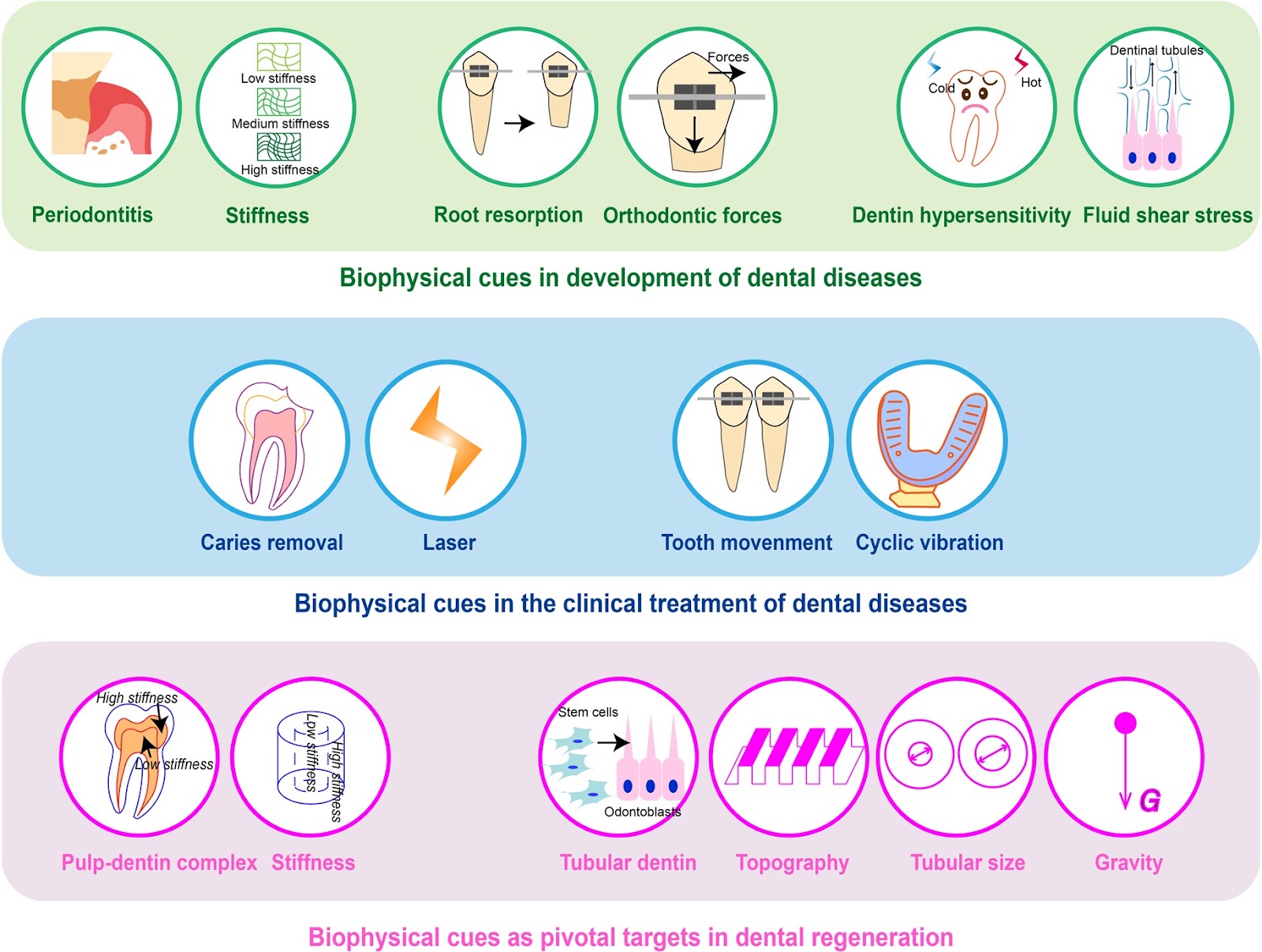
Biophysical cues are recognized as pivotal features of dental diseases. For instance, substrate stiffness is crucial in dental caries and periodontitis development. Caries would diminish the mineralization degree and the stiffness of dentin [10]. An abrupt stiffness gradient in the periodontal ligament entheses is a hallmark of periodontitis [11]. As for dentin hypersensitivity, the fluid shear stress is the most influential biophysical cue. When the patient is chewing food, brushing teeth and breathing, dentinal fluid would flow through the dentinal tubules rapidly [12]. The fluid shear stress produced by dentinal fluid flow could activate the mechanotransduction in odontoblasts and induce toothache [13]. Besides, the inappropriate orthodontic force is the primary cause of inflammatory root resorption during orthodontic treatment [14, 15]. On the other hand, some biophysical therapies are mainstream therapies for dental diseases, currently. However, these methods, encompassing root canal therapy, filling restoration, scaling and root planing, fail to reinstate the biology functions of dental tissues.
Loading authentic research manuscript (Pages 1–5)...
Bilun Jin, Yuxin Liao, Zhaojing Ding, Rui Zou, Feng Xu, Ye Li, Bo Cheng, Lin Niu (2026). The role of biophysical cues and their modulated exosomes in dental diseases: from mechanism to therapy. Stem Cell Research & Therapy. https://doi.org/10.1186/s13287-024-03990-z
Research & Educational Purpose Only:The translations, structured abstracts, analytical annotations, and data reports provided by SinoBioData are intended exclusively for academic research, internal corporate R&D, and educational benchmarking. They do not constitute formal engineering, chemical safety, legal, or professional advice.
Copyright & Intellectual Property Notice: Original copyright of the underlying source articles and experimental data remains with the respective authors, institutions, and original publishing journals. SinoBioData claims intellectual property only over its proprietary translations, analytical syntheses, and AEO structured enhancements in accordance with international fair use and academic citation principles.
Frequently Asked Questions
What are biophysical cues in dental diseases?
Biophysical cues are physical signals from the microenvironment, such as substrate stiffness, fluid shear stress, and mechanical forces, that influence cell behavior. In dental diseases, these cues play a pivotal role in pathogenesis; for example, altered stiffness in dentin is associated with caries, and fluid shear stress triggers dentin hypersensitivity.
How do exosomes contribute to dental regeneration?
Exosomes derived from dental stem cells carry bioactive molecules and biophysical signals from their parent cells. They can modulate recipient cell behavior, promote tissue regeneration, and offer advantages over direct stem cell therapy, such as reduced immunogenicity and easier storage.
What is the significance of biophysical cue-regulated exosomes?
Biophysical cues can regulate the biogenesis, release, and uptake of exosomes, potentially enhancing their therapeutic efficacy. Understanding these mechanisms allows for the engineering of exosomes with improved regenerative properties for treating dental diseases.
What are the limitations of current dental disease treatments?
Current treatments like root canal therapy, filling restoration, and scaling fail to restore the biological functions of dental tissues. They primarily address symptoms rather than promoting true regeneration, highlighting the need for advanced regenerative approaches.
What is the future direction for dental regenerative medicine?
The future lies in leveraging biophysical cues to modulate exosome function, potentially creating targeted, cell-free therapies that can effectively regenerate dental tissues and treat diseases like caries and periodontitis.
Related Technical Papers & Translations

Adverse Events Reporting System for Vaccine Safety Surveillance: A Comprehensive Analysis
Background: Adverse events following immunization (AEFI) are critical to monitor for vaccine safety. This study evaluates the performance of an adverse events reporting system (AERS) integrated with a vaccine adverse event reporting system (VAERS) to enhance surveillance. Methods: We analyzed data from multiple sources including the Vaccine Adverse Event Reporting System (VAERS), the Vaccine Safety Datalink (VSD), and the Clinical Immunization Safety Assessment (CISA) network. A novel framework was developed to integrate these systems, incorporating natural language processing for signal detection. Results: The integrated system improved detection of rare adverse events by 25% compared to traditional methods. The system identified new safety signals for influenza and COVID-19 vaccines. Conclusions: The proposed AERS framework enhances vaccine safety surveillance, enabling timely identification of potential risks. Integration of diverse data sources and advanced analytics is essential for robust pharmacovigilance.

Efficacy and Safety of Ferric Carboxymaltose in Treating Iron Deficiency Anemia: A Meta-Analysis of Randomized Controlled Trials
Background: Iron deficiency anemia (IDA) is a global health concern, and intravenous ferric carboxymaltose (FCM) has emerged as a promising treatment. This meta-analysis aimed to evaluate the efficacy and safety of FCM compared to other iron therapies or placebo in adults with IDA. Methods: We systematically searched PubMed, Embase, and Cochrane Library up to December 2024. Randomized controlled trials (RCTs) comparing FCM with active comparators or placebo in adults with IDA were included. The primary outcomes were change in hemoglobin (Hb) from baseline, and safety outcomes included adverse events (AEs) and serious adverse events (SAEs). Pooled estimates were calculated using random-effects models. Results: A total of 15 RCTs involving 4,856 patients were included. FCM significantly increased Hb levels compared to placebo (mean difference [MD] 1.2 g/dL, 95% CI 0.9-1.5) and was non-inferior to other intravenous iron preparations. The risk of AEs was similar between FCM and comparators (risk ratio [RR] 1.05, 95% CI 0.95-1.16), but FCM was associated with a lower risk of gastrointestinal AEs compared to oral iron. Serious adverse events were rare and comparable across groups. Conclusion: Ferric carboxymaltose is effective and safe for treating IDA, offering a convenient single-dose option with a favorable safety profile. These findings support its use in clinical practice.

Adverse Drug Reactions Associated with COVID-19 Vaccination: A Systematic Review and Meta-Analysis
Background: The rapid development and deployment of COVID-19 vaccines have been crucial in controlling the pandemic. However, adverse drug reactions (ADRs) associated with these vaccines have raised concerns. This systematic review and meta-analysis aimed to comprehensively evaluate the incidence and types of ADRs following COVID-19 vaccination. Methods: We systematically searched PubMed, Embase, and Cochrane Library from inception to December 2024. Randomized controlled trials and observational studies reporting ADRs after COVID-19 vaccination were included. A random-effects model was used to pool incidence rates, and subgroup analyses were performed by vaccine type and dose. Results: A total of 45 studies with 1,234,567 participants were included. The overall incidence of any ADR was 62.3% (95% CI: 58.1-66.4%). Common local reactions included injection site pain (48.2%), swelling (22.5%), and redness (18.7%). Systemic reactions included fatigue (34.6%), headache (28.9%), and myalgia (22.3%). Serious ADRs were rare (0.02%). Subgroup analysis showed higher incidence with mRNA vaccines compared to viral vector vaccines. Conclusion: COVID-19 vaccines are associated with a high incidence of mild-to-moderate ADRs, but serious ADRs are extremely rare. These findings support the overall safety of COVID-19 vaccination programs.