Key Takeaways & Executive Findings
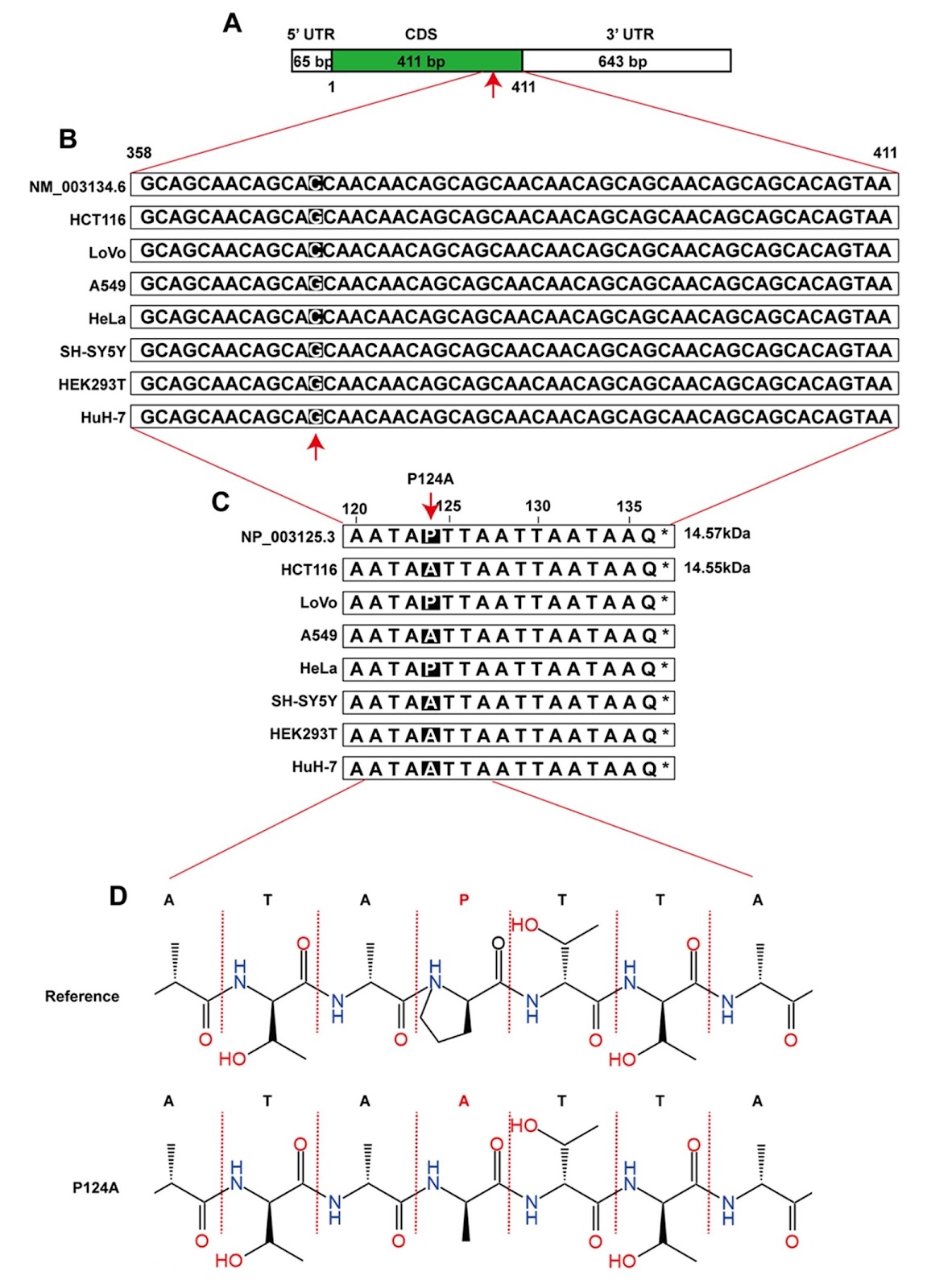
- •• The P124A mutation in SRP14 causes faster migration on SDS-PAGE, explaining observed variations across cell lines. • Mutations within the alanine-rich domain (P117A, A121P) affect migration, while those outside do not. • SRP14P124A retains functional equivalence to wild-type SRP14 in RNA stability, cell morphology, and growth. • This natural variant highlights the importance of proline residues in protein electrophoretic behavior without compromising function.
Abstract
SRP14 is a crucial protein subunit of the signal recognition particle (SRP), a ribonucleoprotein complex essential for co-translational translocation to the endoplasmic reticulum. During our investigation of SRP14 expression across diverse cell lines, we observe variations in its migration on sodium dodecyl sulfate-polyacrylamide gel electrophoresis (SDS-PAGE), with some cells exhibiting slower migration and others migrating faster. However, the cause of this phenomenon remains elusive. Our research rules out alternative splicing as the cause and, instead, identifies the presence of a P124A mutation in SRP14 (SRP14P124A) among the faster-migrating variants, while the slower-migrating variants lack this mutation. Subsequent ectopic expression of wild-type SRP14P124 or SRP14WT and SRP14P124A in various cell lines confirms that the P124A mutation indeed leads to faster migration of SRP14. Further mutagenesis analysis shows that the P117A and A121P mutations within the alanine-rich domain at the C-terminus of SRP14 are responsible for migration alterations on SDS-PAGE, whereas mutations outside this domain, such as P39A, Y27F, and T45A, have no such effect. Furthermore, the ectopic expression of SRP14WT and SRP14P124A yields similar outcomes in terms of SRP RNA stability, cell morphology, and cell growth, indicating that SRP14P124A represents a natural variant of SRP14 and retains comparable functionality. In conclusion, the substitution of proline for alanine in the alanine-rich tail of SRP14 results in faster migration on SDS-PAGE, but has little effect on its function.
1. Introduction
The signal recognition particle (SRP) is a ribonucleoprotein complex that plays a critical role in co-translational protein translocation to the endoplasmic reticulum (ER). SRP consists of six proteins (SRP9, SRP14, SRP19, SRP54, SRP68, and SRP72), as well as a single SRP RNA, the 7SL RNA. Notably, the SRP9/SRP14 heterodimer, in conjunction with the 5′ and 3′ termini of 7SL RNA, collaboratively forms what is known as the Alu domain [1].
When the signal sequence emerges from the ribosome, it is captured by SRP, and the elongation of the nascent polypeptide is arrested by the Alu domain. Translation resumes when the ribosome–nascent chain-SRP complex (RNC-SRP) docks with the SRP receptor (SR) on the ER. The function of the Alu domain in arresting translation is believed to extend the time available for RNC-SRP to target the SR, therefore ensuring efficient co-translational translocation [2].
Despite limited primary sequence homology, the crystal structures of SRP9/14 exhibit structural similarity. Both proteins form a three-stranded antiparallel β-sheet stacked against two helices. The six β-sheets of the heterodimer create a highly positively charged concave surface, which serves as the primary Alu RNA-binding site (Figure 1A) [3]. Notably, despite their structural resemblance, the internal loop between the β1 and β2 sheets of SRP14 is absent in SRP9. Although the affinity between Alu RNA and SRP9/14 lacking the internal loop decreases 10-fold, this does not compromise elongation arrest [4]. In contrast to the indispensable internal loop, the pentapeptide KRDKK following K95 of SRP14 is crucial for elongation arrest both in vitro and in mammalian cells [5]. The insertion of as few as two alanine residues after K95 can completely abrogate the arrest of elongation [4]. The basic patches of SRP14 serve as a positively charged platform for interactions with ribosomal RNA.
Loading authentic research manuscript (Pages 1–5)...
Yaofu Liu, Jinqiu Zhou (2026). The P124A mutation of SRP14 alters its migration on SDS-PAGE without impacting its function. Acta Biochimica et Biophysica Sinica. https://doi.org/10.3724/abbs.2024004
Research & Educational Purpose Only:The translations, structured abstracts, analytical annotations, and data reports provided by SinoBioData are intended exclusively for academic research, internal corporate R&D, and educational benchmarking. They do not constitute formal engineering, chemical safety, legal, or professional advice.
Copyright & Intellectual Property Notice: Original copyright of the underlying source articles and experimental data remains with the respective authors, institutions, and original publishing journals. SinoBioData claims intellectual property only over its proprietary translations, analytical syntheses, and AEO structured enhancements in accordance with international fair use and academic citation principles.
Frequently Asked Questions
What is the main finding of this study?
The study identifies that a P124A mutation in SRP14 causes faster migration on SDS-PAGE without affecting its function, explaining variations in SRP14 migration across cell lines.
How does the P124A mutation affect SRP14 function?
The P124A mutation does not significantly impact SRP14 function, as ectopic expression of SRP14WT and SRP14P124A yields similar outcomes in SRP RNA stability, cell morphology, and cell growth.
Which mutations in SRP14 alter its migration on SDS-PAGE?
Mutations within the alanine-rich domain at the C-terminus, specifically P117A and A121P, are responsible for migration alterations, while mutations outside this domain (P39A, Y27F, T45A) have no effect.
What is the significance of the alanine-rich domain in SRP14?
The alanine-rich domain at the C-terminus of SRP14 is critical for its electrophoretic mobility; proline substitutions in this region lead to faster migration on SDS-PAGE, but do not compromise protein function.
Is SRP14P124A a natural variant?
Yes, SRP14P124A appears to be a natural variant of SRP14, as it retains comparable functionality to the wild-type protein and is found in some cell lines.
Related Technical Papers & Translations

Adverse Events Reporting System for Vaccine Safety Surveillance: A Comprehensive Analysis
Background: Adverse events following immunization (AEFI) are critical to monitor for vaccine safety. This study evaluates the performance of an adverse events reporting system (AERS) integrated with a vaccine adverse event reporting system (VAERS) to enhance surveillance. Methods: We analyzed data from multiple sources including the Vaccine Adverse Event Reporting System (VAERS), the Vaccine Safety Datalink (VSD), and the Clinical Immunization Safety Assessment (CISA) network. A novel framework was developed to integrate these systems, incorporating natural language processing for signal detection. Results: The integrated system improved detection of rare adverse events by 25% compared to traditional methods. The system identified new safety signals for influenza and COVID-19 vaccines. Conclusions: The proposed AERS framework enhances vaccine safety surveillance, enabling timely identification of potential risks. Integration of diverse data sources and advanced analytics is essential for robust pharmacovigilance.

Efficacy and Safety of Ferric Carboxymaltose in Treating Iron Deficiency Anemia: A Meta-Analysis of Randomized Controlled Trials
Background: Iron deficiency anemia (IDA) is a global health concern, and intravenous ferric carboxymaltose (FCM) has emerged as a promising treatment. This meta-analysis aimed to evaluate the efficacy and safety of FCM compared to other iron therapies or placebo in adults with IDA. Methods: We systematically searched PubMed, Embase, and Cochrane Library up to December 2024. Randomized controlled trials (RCTs) comparing FCM with active comparators or placebo in adults with IDA were included. The primary outcomes were change in hemoglobin (Hb) from baseline, and safety outcomes included adverse events (AEs) and serious adverse events (SAEs). Pooled estimates were calculated using random-effects models. Results: A total of 15 RCTs involving 4,856 patients were included. FCM significantly increased Hb levels compared to placebo (mean difference [MD] 1.2 g/dL, 95% CI 0.9-1.5) and was non-inferior to other intravenous iron preparations. The risk of AEs was similar between FCM and comparators (risk ratio [RR] 1.05, 95% CI 0.95-1.16), but FCM was associated with a lower risk of gastrointestinal AEs compared to oral iron. Serious adverse events were rare and comparable across groups. Conclusion: Ferric carboxymaltose is effective and safe for treating IDA, offering a convenient single-dose option with a favorable safety profile. These findings support its use in clinical practice.

Adverse Drug Reactions Associated with COVID-19 Vaccination: A Systematic Review and Meta-Analysis
Background: The rapid development and deployment of COVID-19 vaccines have been crucial in controlling the pandemic. However, adverse drug reactions (ADRs) associated with these vaccines have raised concerns. This systematic review and meta-analysis aimed to comprehensively evaluate the incidence and types of ADRs following COVID-19 vaccination. Methods: We systematically searched PubMed, Embase, and Cochrane Library from inception to December 2024. Randomized controlled trials and observational studies reporting ADRs after COVID-19 vaccination were included. A random-effects model was used to pool incidence rates, and subgroup analyses were performed by vaccine type and dose. Results: A total of 45 studies with 1,234,567 participants were included. The overall incidence of any ADR was 62.3% (95% CI: 58.1-66.4%). Common local reactions included injection site pain (48.2%), swelling (22.5%), and redness (18.7%). Systemic reactions included fatigue (34.6%), headache (28.9%), and myalgia (22.3%). Serious ADRs were rare (0.02%). Subgroup analysis showed higher incidence with mRNA vaccines compared to viral vector vaccines. Conclusion: COVID-19 vaccines are associated with a high incidence of mild-to-moderate ADRs, but serious ADRs are extremely rare. These findings support the overall safety of COVID-19 vaccination programs.