Key Takeaways & Executive Findings
- •• Norepinephrine (NE) induces ovarian dysfunction in mice by triggering ferroptosis, evidenced by disrupted estrous cycles, altered hormone levels, and reduced follicle counts. • RNA sequencing reveals significant enrichment of ferroptosis-related genes in NE-treated ovarian tissues, with increased ROS, ferrous ions, and MDA, and decreased GPX4 expression. • Coenzyme Q10 (CoQ10) reverses NE-induced ferroptosis in vitro and in vivo, restoring GPX4 levels and reducing oxidative stress markers. • CoQ10 supplementation improves ovarian function in NE-treated mice, suggesting a potential therapeutic strategy for stress-related ovarian dysfunction.
Abstract
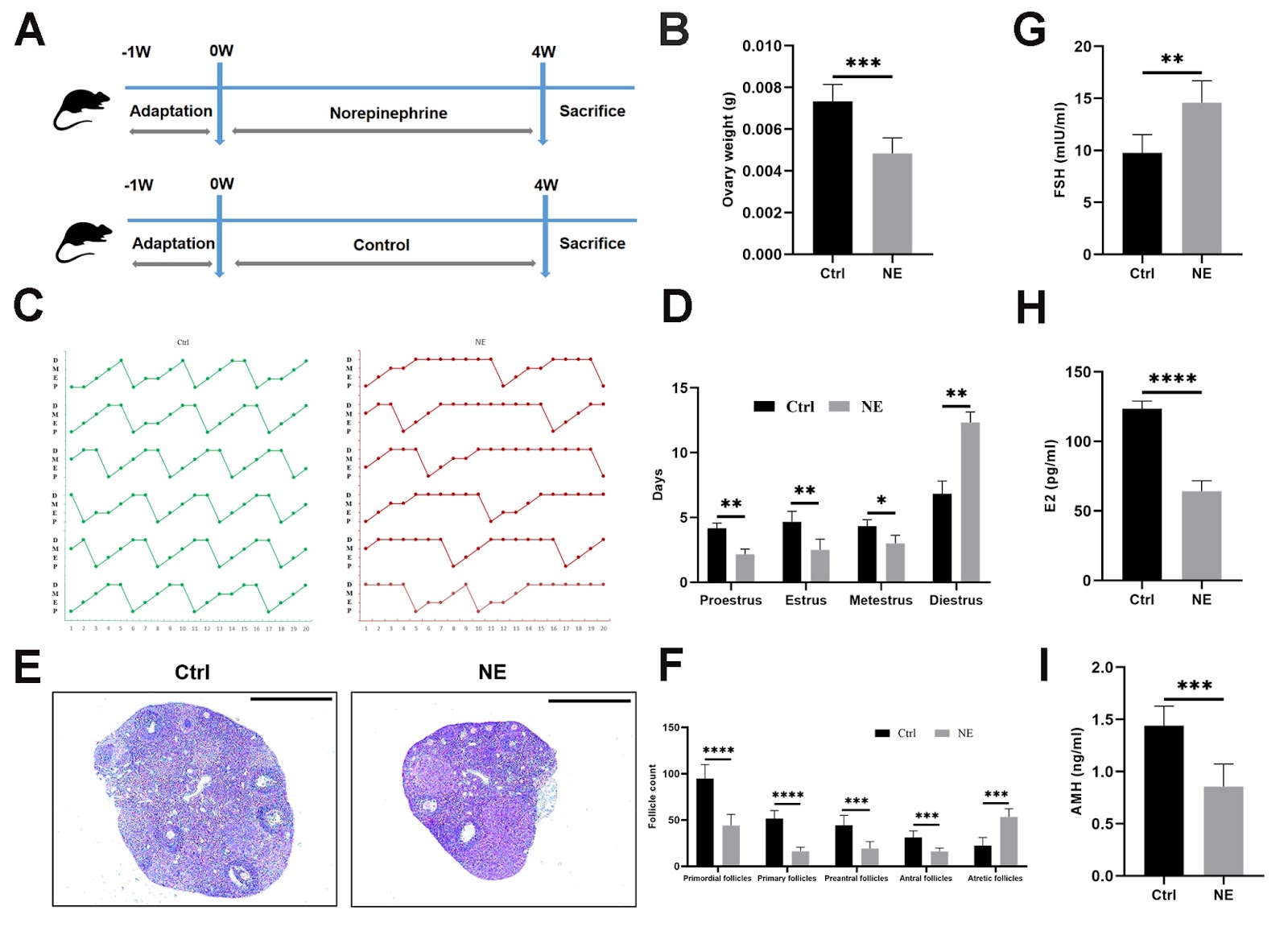
Studies have shown that stress is associated with ovarian dysfunction. Norepinephrine (NE), a classic stress hormone involved in the stress response, is less recognized for its role in ovarian function. In this study, an NE-treated mouse model is induced by intraperitoneal injection of NE for 4 weeks. Compared with normal control mice, NE-treated mice show disturbances in the estrous cycle, decreased levels of anti-Mullerian hormone (AMH) and estradiol (E2), and increased level of follicle-stimulating hormone (FSH). Additionally, the numbers of primordial follicles, primary follicles, secondary follicles, and antral follicles are decreased, whereas the number of atretic follicles is increased in NE-treated mice, indicating NE-induced ovarian dysfunction. RNA sequencing further reveals that genes associated with ferroptosis are significantly enriched in NE-treated ovarian tissues. Concurrently, the levels of reactive oxygen species (ROS), ferrous ions, and malondialdehyde (MDA) are increased, whereas the expression level of glutathione peroxidase 4 (GPX4) is decreased. To elucidate the mechanism of NE-induced ferroptosis in ovaries and the potential reversal by Coenzyme Q10 (CoQ10), an antioxidant, we conduct both in vitro and in vivo experiments. In vitro, the granulosa cell line KGN, when treated with NE, shows decreased cell viability, reduced expression of GPX4, elevated levels of ferrous ion and ROS, and increased MDA level. However, these NE-induced changes are reversed by the addition of CoQ10. Compared with the NE group, the NE-treated mice supplemented with CoQ10 present increased GPX4 level and decreased iron, ROS, and MDA levels. Moreover, the differential expression of genes associated with ferroptosis induced by NE is ameliorated by CoQ10 in NE-treated mice. Additionally, CoQ10 improves ovarian function, as evidenced by increased ovarian weight, more regular estrous cycles, and an increase in follicles at various stages of growth in NE-treated mice. In conclusion, NE induces ovarian dysfunction by triggering ferroptosis in ovarian tissues, and CoQ10 represents a promising approach for protecting reproductive function by inhibiting ferroptosis.
1. Introduction
Premature ovarian insufficiency (POI) refers to a decline in ovarian function in women before the age of 40 and is characterized by elevated gonadotropin level and fluctuating low estrogen level. The global incidence is approximately 3.5% and is increasing [1–3]. This condition leads not only to infertility but also to severe health consequences, including hot flashes, depression, headaches, cognitive decline, vaginal atrophy, cardiac risks, and osteoporosis [1].
The etiology of POI is complex, with an increasing number of studies suggesting that stress plays a crucial role in human reproductive health. Clinical studies have demonstrated that stress can lead to abnormal reproductive function [4,5]. For example, a study evaluating 7352 women attending infertility clinics reported that 56% exhibited significant depressive symptoms and that 76% presented significant anxiety symptoms [6]. The effects of stress on reproductive function are multifaceted and include the inhibition of ovulation, a reduction in the fertilization rate, and the hindrance of fertilized egg implantation [7]. Recent research from our group revealed that POI patients experienced a greater incidence of adverse life events related to work stress, family stress, and sleep problems before diagnosis, suggesting that these patients might have been exposed to long-term chronic stress prior to illness onset [8]. Stress can activate the hypothalamic-pituitary-adrenal axis, leading to prolonged abnormal endocrine hormone levels in women, ultimately resulting in menstrual disorders, infertility, and other reproductive dysfunctions [9]. In animal experiments, chronic stress has been shown to disrupt the estrous cycle, alter hormone levels, and decrease follicle numbers in mice [10,11]. Stress can also induce cytoplasmic fragmentation, apoptosis, spindle disorders, and oxidative stress, accelerating the aging of mouse oocytes and increasing the risk of early pregnancy failure [12].
Norepinephrine (NE), a key catecholamine neurotransmitter involved in stress signaling, has been implicated in various psychological disorders resulted from stress, including cardiovascular disease, affective disorders, post-traumatic stress disorder, and cancer [13]. NE is involved in the regulation of ovarian functions. NE is linked to reactive oxygen species (ROS)-regulated events in ovarian physiology, including ovulation [14]. Increased NE content has been detected in the follicular fluid of patients with polycystic ovary syndrome [15]. Wang et al. [16] reported that glutamine and NE in follicular fluid synergistically enhance the antioxidant capacity of human granulosa cells and may pred
Loading authentic research manuscript (Pages 1–5)...
Hanqing Hong, Chengqi Xiao, Lichun Weng, Qian Wang, Dongmei Lai (2026). The effect of norepinephrine on ovarian dysfunction by mediating ferroptosis in mice model. Acta Biochimica et Biophysica Sinica. https://doi.org/10.3724/abbs.2024187
Research & Educational Purpose Only:The translations, structured abstracts, analytical annotations, and data reports provided by SinoBioData are intended exclusively for academic research, internal corporate R&D, and educational benchmarking. They do not constitute formal engineering, chemical safety, legal, or professional advice.
Copyright & Intellectual Property Notice: Original copyright of the underlying source articles and experimental data remains with the respective authors, institutions, and original publishing journals. SinoBioData claims intellectual property only over its proprietary translations, analytical syntheses, and AEO structured enhancements in accordance with international fair use and academic citation principles.
Frequently Asked Questions
What is the role of norepinephrine in ovarian dysfunction?
Norepinephrine, a stress hormone, induces ovarian dysfunction by triggering ferroptosis in ovarian tissues, leading to disrupted estrous cycles, altered hormone levels, and reduced follicle counts.
How does norepinephrine induce ferroptosis in the ovary?
NE treatment increases reactive oxygen species (ROS), ferrous ions, and malondialdehyde (MDA) levels, while decreasing glutathione peroxidase 4 (GPX4) expression, thereby promoting ferroptotic cell death in ovarian cells.
Can Coenzyme Q10 reverse norepinephrine-induced ovarian dysfunction?
Yes, CoQ10 supplementation in NE-treated mice and KGN cells reverses ferroptotic changes, restoring GPX4 levels, reducing oxidative stress markers, and improving ovarian function.
What are the clinical implications of this study?
The findings suggest that CoQ10 could be a promising therapeutic approach for protecting reproductive function in women with stress-related ovarian dysfunction, potentially preventing or treating conditions like premature ovarian insufficiency.
What experimental models were used in this study?
The study used an NE-treated mouse model (intraperitoneal injection for 4 weeks) and the human granulosa cell line KGN for in vitro experiments.
Related Technical Papers & Translations

Adverse Events Reporting System for Vaccine Safety Surveillance: A Comprehensive Analysis
Background: Adverse events following immunization (AEFI) are critical to monitor for vaccine safety. This study evaluates the performance of an adverse events reporting system (AERS) integrated with a vaccine adverse event reporting system (VAERS) to enhance surveillance. Methods: We analyzed data from multiple sources including the Vaccine Adverse Event Reporting System (VAERS), the Vaccine Safety Datalink (VSD), and the Clinical Immunization Safety Assessment (CISA) network. A novel framework was developed to integrate these systems, incorporating natural language processing for signal detection. Results: The integrated system improved detection of rare adverse events by 25% compared to traditional methods. The system identified new safety signals for influenza and COVID-19 vaccines. Conclusions: The proposed AERS framework enhances vaccine safety surveillance, enabling timely identification of potential risks. Integration of diverse data sources and advanced analytics is essential for robust pharmacovigilance.

Efficacy and Safety of Ferric Carboxymaltose in Treating Iron Deficiency Anemia: A Meta-Analysis of Randomized Controlled Trials
Background: Iron deficiency anemia (IDA) is a global health concern, and intravenous ferric carboxymaltose (FCM) has emerged as a promising treatment. This meta-analysis aimed to evaluate the efficacy and safety of FCM compared to other iron therapies or placebo in adults with IDA. Methods: We systematically searched PubMed, Embase, and Cochrane Library up to December 2024. Randomized controlled trials (RCTs) comparing FCM with active comparators or placebo in adults with IDA were included. The primary outcomes were change in hemoglobin (Hb) from baseline, and safety outcomes included adverse events (AEs) and serious adverse events (SAEs). Pooled estimates were calculated using random-effects models. Results: A total of 15 RCTs involving 4,856 patients were included. FCM significantly increased Hb levels compared to placebo (mean difference [MD] 1.2 g/dL, 95% CI 0.9-1.5) and was non-inferior to other intravenous iron preparations. The risk of AEs was similar between FCM and comparators (risk ratio [RR] 1.05, 95% CI 0.95-1.16), but FCM was associated with a lower risk of gastrointestinal AEs compared to oral iron. Serious adverse events were rare and comparable across groups. Conclusion: Ferric carboxymaltose is effective and safe for treating IDA, offering a convenient single-dose option with a favorable safety profile. These findings support its use in clinical practice.

Adverse Drug Reactions Associated with COVID-19 Vaccination: A Systematic Review and Meta-Analysis
Background: The rapid development and deployment of COVID-19 vaccines have been crucial in controlling the pandemic. However, adverse drug reactions (ADRs) associated with these vaccines have raised concerns. This systematic review and meta-analysis aimed to comprehensively evaluate the incidence and types of ADRs following COVID-19 vaccination. Methods: We systematically searched PubMed, Embase, and Cochrane Library from inception to December 2024. Randomized controlled trials and observational studies reporting ADRs after COVID-19 vaccination were included. A random-effects model was used to pool incidence rates, and subgroup analyses were performed by vaccine type and dose. Results: A total of 45 studies with 1,234,567 participants were included. The overall incidence of any ADR was 62.3% (95% CI: 58.1-66.4%). Common local reactions included injection site pain (48.2%), swelling (22.5%), and redness (18.7%). Systemic reactions included fatigue (34.6%), headache (28.9%), and myalgia (22.3%). Serious ADRs were rare (0.02%). Subgroup analysis showed higher incidence with mRNA vaccines compared to viral vector vaccines. Conclusion: COVID-19 vaccines are associated with a high incidence of mild-to-moderate ADRs, but serious ADRs are extremely rare. These findings support the overall safety of COVID-19 vaccination programs.