Key Takeaways & Executive Findings
- •• KIF14 is upregulated in colorectal cancer and correlates with advanced tumor stage and poor overall survival. • KIF14 promotes CRC metastasis by regulating focal adhesion dynamics and cell-matrix adhesion signaling. • Mechanistically, KIF14 binds to vinculin and facilitates its delivery to the leading edge, while E2F1 transcriptionally activates KIF14. • The E2F1-KIF14-vinculin axis represents a novel therapeutic target for metastatic colorectal cancer.
Abstract
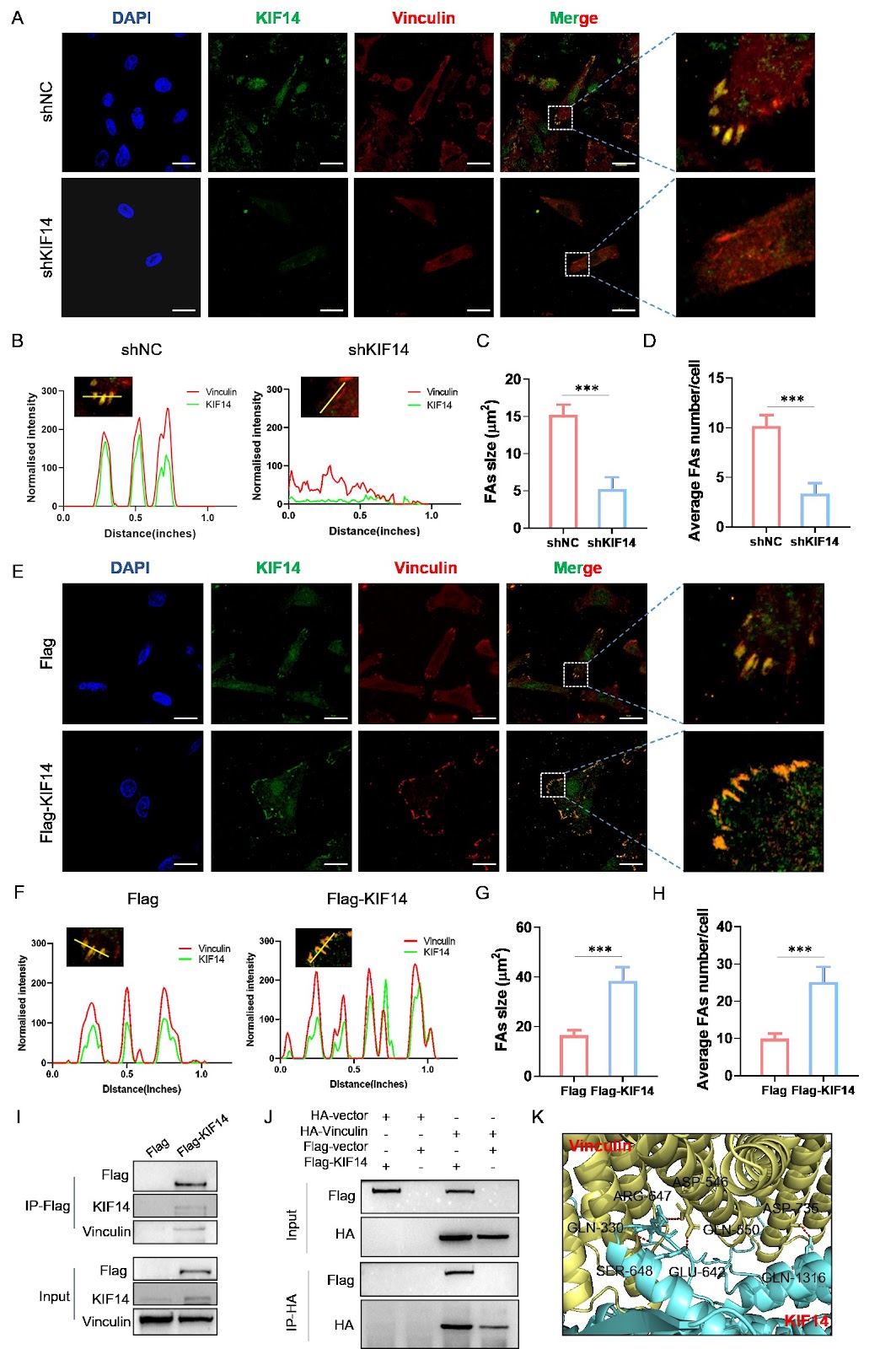
Kinesin family member 14 (KIF14) has been implicated in the progression of multiple cancer types, yet its role in colorectal cancer (CRC) metastasis remains undefined. Here, we assesse KIF14 expression in CRC specimens and explore its clinical and functional significance. KIF14 upregulation is frequently observed in CRC tissues and is correlated with advanced tumor stage and reduced overall survival. Functional assays reveal that KIF14 depletion in CRC cells inhibits migration, invasion, and in vivo metastatic colonization, whereas KIF14 overexpression induces the opposite effects. Transcriptomic and pathway enrichment analyses reveal that KIF14 functions as a critical regulator of focal adhesion and cell-matrix adhesion signaling. This finding is further supported by experimental evidence showing that KIF14 overexpression promotes focal adhesion assembly, whereas KIF14 knockdown disruptes this process. Mechanistically, we demonstrate that KIF14 binds directly to the focal adhesion protein vinculin and mediates its delivery to the leading edge of migrating cells. Moreover, bioinformatics prediction and chromatin immunoprecipitation confirm that E2F1 directly binds the KIF14 promoter to drive its transcription. Rescue experiments reveal that ectopic KIF14 expression restores the prometastatic phenotypes suppressed by E2F1 silencing, indicating that the effects of E2F1 are mediated by the E2F1-KIF14 axis. Collectively, our findings reveal a novel E2F1-KIF14-vinculin signaling axis that drives CRC metastasis by modulating focal adhesion dynamics, highlighting KIF14 as a potential therapeutic target.
1. Introduction
Colorectal cancer (CRC), a malignancy originating from the mucosal epithelium, accounted for 1.9 million new cancer cases and 903,000 related deaths in 2022 (IARC), ranking the third in incidence and second in mortality worldwide [1]. Two alarming trends have recently been observed for CRC: a dramatic surge in early-onset cases, with the incidence among individuals under 50 years rising by 50% over three decades, and an aggressive metastatic propensity [2,3]. Notably, 20% of patients present with distant metastases at initial diagnosis, whereas over 50% develop metastases during disease progression [3]. The dismal five-year survival rate of patients with metastatic CRC (less than 15%) underscores the critical need to decipher the molecular mechanisms driving tumor dissemination.
Kinesin family member 14 (KIF14), a microtubule-directed motor protein belonging to the kinesin-3 family, is increasingly recognized for its multifaceted role in cancer biology. Its distinctive structural features, including an N-terminal motor domain for ATP-dependent movement, coiled-coil domains facilitating dimerization, and a neck-linker region for directional transport, suggest that KIF14 may act as a critical regulator of cytoskeletal dynamics [4–7]. While it was initially found to play a role in cytokinesis, KIF14 is now recognized as an oncogenic driver in multiple malignancies, and its aberrant expression correlates with aggressive tumor progression, enhanced metastatic potential, and therapeutic resistance [8–10]. Previous studies have revealed diverse mechanisms through which KIF14 promotes cancer progression. In breast cancer, KIF14 promotes cell migration and invasion by modulating the Rap1–Radil signaling pathway [11]. In gastric cancer, it influences AKT-mediated epithelial-mesenchymal transition (EMT), and in esophageal squamous cell carcinoma, it maintains metastatic capability by interacting with mitochondrial proteins [12,13]. Previous studies have shown that KIF14 promotes CRC cell proliferation by activating the Akt signaling pathway and acts as a direct target of miR-200c [14,15]. However, its role in CRC metastasis remains unclear.
Focal adhesions play crucial roles in tumor migration and invasion by regulating cell-extracellular matrix (ECM) adhesion and transmitting mechanical signals that promote tumor cell motility and infiltration [16]. Various proteins within focal adhesions, including integrins, focal adhesion kinase (FAK), and Src, activate multiple downstream signaling pathways that orchestrate cell migration, matrix remodeling, and angiogenesis, thereby increasing tumor cell invasiveness [17–19]. Moreover, focal adhesions participate in remodeling the tumor microenvironment by promoting ECM degradation and reorganization, creating favorable conditions for tumor cell dissemination. The dynamic assembly and disassembly of focal adhesions further enable tumor cells to effectively traverse tissue barriers during metastasis, facilitating their directional movement and invasion. Intriguingly, previous studies have demonstrated that KIF14 colocalizes with supervillin (SVIL), a membrane-microfilament binding protein that regulates pseudopodia formation and cellular motility through its interactions with myosin II and cortactin [20]. This spatial association suggests a potential mechanistic link whereby KIF14 modulates focal adhesion dynamics to influence cell migration.
Loading authentic research manuscript (Pages 1–5)...
Yajie Wang, Xinyue Wu, Xiaofeng Li, Xiaoying Lian, Jiao An, Wenhua Cai, Jing Jia, Changjun Zhu (2026). The E2F1-KIF14 axis drives focal adhesion formation and promotes colorectal cancer metastasis. Acta Biochimica et Biophysica Sinica. https://doi.org/10.3724/abbs.2025158
Research & Educational Purpose Only:The translations, structured abstracts, analytical annotations, and data reports provided by SinoBioData are intended exclusively for academic research, internal corporate R&D, and educational benchmarking. They do not constitute formal engineering, chemical safety, legal, or professional advice.
Copyright & Intellectual Property Notice: Original copyright of the underlying source articles and experimental data remains with the respective authors, institutions, and original publishing journals. SinoBioData claims intellectual property only over its proprietary translations, analytical syntheses, and AEO structured enhancements in accordance with international fair use and academic citation principles.
Frequently Asked Questions
What is the role of KIF14 in colorectal cancer metastasis?
KIF14 is upregulated in colorectal cancer and promotes metastasis by regulating focal adhesion dynamics, enhancing cell migration and invasion, and facilitating in vivo metastatic colonization.
How does E2F1 regulate KIF14 expression?
E2F1 directly binds to the KIF14 promoter and drives its transcription, as confirmed by bioinformatics prediction and chromatin immunoprecipitation assays.
What is the mechanistic link between KIF14 and focal adhesion?
KIF14 binds directly to the focal adhesion protein vinculin and mediates its delivery to the leading edge of migrating cells, thereby promoting focal adhesion assembly and dynamics.
What is the clinical significance of the E2F1-KIF14 axis?
The E2F1-KIF14-vinculin axis is a novel signaling pathway that drives colorectal cancer metastasis, and KIF14 represents a potential therapeutic target for metastatic colorectal cancer.
What are the key findings of this study?
The study reveals that KIF14 is frequently overexpressed in CRC tissues and correlates with poor prognosis. Functional assays show that KIF14 depletion inhibits metastasis, while overexpression enhances it. Mechanistically, E2F1 transcriptionally activates KIF14, which then binds vinculin to modulate focal adhesion dynamics.
Related Technical Papers & Translations

Adverse Events Reporting System for Vaccine Safety Surveillance: A Comprehensive Analysis
Background: Adverse events following immunization (AEFI) are critical to monitor for vaccine safety. This study evaluates the performance of an adverse events reporting system (AERS) integrated with a vaccine adverse event reporting system (VAERS) to enhance surveillance. Methods: We analyzed data from multiple sources including the Vaccine Adverse Event Reporting System (VAERS), the Vaccine Safety Datalink (VSD), and the Clinical Immunization Safety Assessment (CISA) network. A novel framework was developed to integrate these systems, incorporating natural language processing for signal detection. Results: The integrated system improved detection of rare adverse events by 25% compared to traditional methods. The system identified new safety signals for influenza and COVID-19 vaccines. Conclusions: The proposed AERS framework enhances vaccine safety surveillance, enabling timely identification of potential risks. Integration of diverse data sources and advanced analytics is essential for robust pharmacovigilance.

Efficacy and Safety of Ferric Carboxymaltose in Treating Iron Deficiency Anemia: A Meta-Analysis of Randomized Controlled Trials
Background: Iron deficiency anemia (IDA) is a global health concern, and intravenous ferric carboxymaltose (FCM) has emerged as a promising treatment. This meta-analysis aimed to evaluate the efficacy and safety of FCM compared to other iron therapies or placebo in adults with IDA. Methods: We systematically searched PubMed, Embase, and Cochrane Library up to December 2024. Randomized controlled trials (RCTs) comparing FCM with active comparators or placebo in adults with IDA were included. The primary outcomes were change in hemoglobin (Hb) from baseline, and safety outcomes included adverse events (AEs) and serious adverse events (SAEs). Pooled estimates were calculated using random-effects models. Results: A total of 15 RCTs involving 4,856 patients were included. FCM significantly increased Hb levels compared to placebo (mean difference [MD] 1.2 g/dL, 95% CI 0.9-1.5) and was non-inferior to other intravenous iron preparations. The risk of AEs was similar between FCM and comparators (risk ratio [RR] 1.05, 95% CI 0.95-1.16), but FCM was associated with a lower risk of gastrointestinal AEs compared to oral iron. Serious adverse events were rare and comparable across groups. Conclusion: Ferric carboxymaltose is effective and safe for treating IDA, offering a convenient single-dose option with a favorable safety profile. These findings support its use in clinical practice.

Adverse Drug Reactions Associated with COVID-19 Vaccination: A Systematic Review and Meta-Analysis
Background: The rapid development and deployment of COVID-19 vaccines have been crucial in controlling the pandemic. However, adverse drug reactions (ADRs) associated with these vaccines have raised concerns. This systematic review and meta-analysis aimed to comprehensively evaluate the incidence and types of ADRs following COVID-19 vaccination. Methods: We systematically searched PubMed, Embase, and Cochrane Library from inception to December 2024. Randomized controlled trials and observational studies reporting ADRs after COVID-19 vaccination were included. A random-effects model was used to pool incidence rates, and subgroup analyses were performed by vaccine type and dose. Results: A total of 45 studies with 1,234,567 participants were included. The overall incidence of any ADR was 62.3% (95% CI: 58.1-66.4%). Common local reactions included injection site pain (48.2%), swelling (22.5%), and redness (18.7%). Systemic reactions included fatigue (34.6%), headache (28.9%), and myalgia (22.3%). Serious ADRs were rare (0.02%). Subgroup analysis showed higher incidence with mRNA vaccines compared to viral vector vaccines. Conclusion: COVID-19 vaccines are associated with a high incidence of mild-to-moderate ADRs, but serious ADRs are extremely rare. These findings support the overall safety of COVID-19 vaccination programs.