Key Takeaways & Executive Findings
- •• ILC2s are tissue-resident innate lymphocytes that play dual roles in lung homeostasis and pathology, responding to alarmins (IL-25, IL-33, TSLP) and secreting type 2 cytokines. • The function of ILC2s is highly context-dependent, with both protective and detrimental effects across various lung diseases including asthma, COPD, fibrosis, infections, and cancer. • Targeting ILC2 plasticity or alarmin-ILC2 signaling axes represents promising therapeutic strategies for inflammatory lung diseases. • Understanding ILC2 phenotypic markers and their interactions with other immune cells can lead to novel diagnostic and therapeutic approaches.
Abstract
Group 2 innate lymphoid cells (ILC2s), a subset of innate lymphoid cells (ILCs) lacking antigen-specific receptors and functionally mirroring T helper 2 (Th2) cells, are indispensable components of the innate immune system that lack antigen-specific receptors but phenotypically and functionally mirror T helper 2 (Th2) cells, particularly in their expression of the transcription factor GATA3 and the secretion of type 2 cytokines for mediating type 2 immune responses. ILC2s are tissue-resident cells in mucosal tissues, including the lung, where they play crucial roles in maintaining tissue homeostasis and regulating immune responses. ILC2s are poised to respond to environmental signals such as IL-25, IL-33, and TSLP, which activate and expand ILC2s. Their functions are highly context-dependent and influenced by interactions with other immune cells. In this review, we summarize recent findings on the roles of ILC2s in lung diseases, highlighting their typical characteristics and their responsiveness to environmental signals in the context of pulmonary pathology. We also discuss potential therapeutic strategies targeting ILC2s, which may offer new avenues for the treatment of inflammatory lung diseases. Understanding the mechanisms by which ILC2s contribute to lung disease progression will provide valuable insights for the development of novel diagnostic (e.g., ILC2 phenotypic markers) and therapeutic approaches (e.g., targeting ILC2 plasticity or alarmin-ILC2 signaling axes).
1. Introduction
Group 2 innate lymphoid cells (ILC2s) are tissue-resident innate lymphocytes characterized by the absence of antigen-specific receptors (e.g., TCR/BCR) and the expression of lineage markers such as CRTH2, ST2 (IL-33 receptor), and GATA3 (master transcription factor). Developmentally, ILC2s originate from common lymphoid progenitors (CLPs) in the bone marrow, where they differentiate into ILC2 progenitors (ILC2Ps) under the regulation of transcription factors, including GATA3 and RORα. ILC2s in most tissues are established during the perinatal period. In adulthood, ILC2s in the lungs, small intestine, and fat are replaced less frequently by circulating ILC2s and are maintained more through self-renewal. ILC2s in the bone marrow and skin are replaced more quickly by de novo ILC2s [1]. However, under conditions of parasitic, fungal, or allergen infection, circulating ILC2s of small intestine and bone marrow origin are recruited to the lungs [2–4]. In the lungs, tissue-resident ILC2s preferentially accumulate in areas surrounding larger airways and blood vessels [5,6]. Functionally, ILC2s respond to epithelial-derived alarmins (IL-25, IL-33, and TSLP) to secrete type 2 cytokines (IL-4, IL-5, and IL-13) and tissue repair factors (Amphiregulin and Areg). Additionally, ILC2s interact with other immune cells (e.g., Th2 cells, eosinophils) and neuroendocrine signals (e.g., dopamine, NMU) to regulate immune homeostasis and inflammation.
Under physiological conditions, ILC2s contribute to tissue repair and host defense, particularly against helminth infections, through amphiregulin production [7,8]. However, dysregulated ILC2 activation contributes to pathological inflammation in certain diseases. In asthma [9], it induces airway hyperresponsiveness (AHR), whereas in pulmonary fibrosis [10,11], it exacerbates collagen deposition and disease progression.
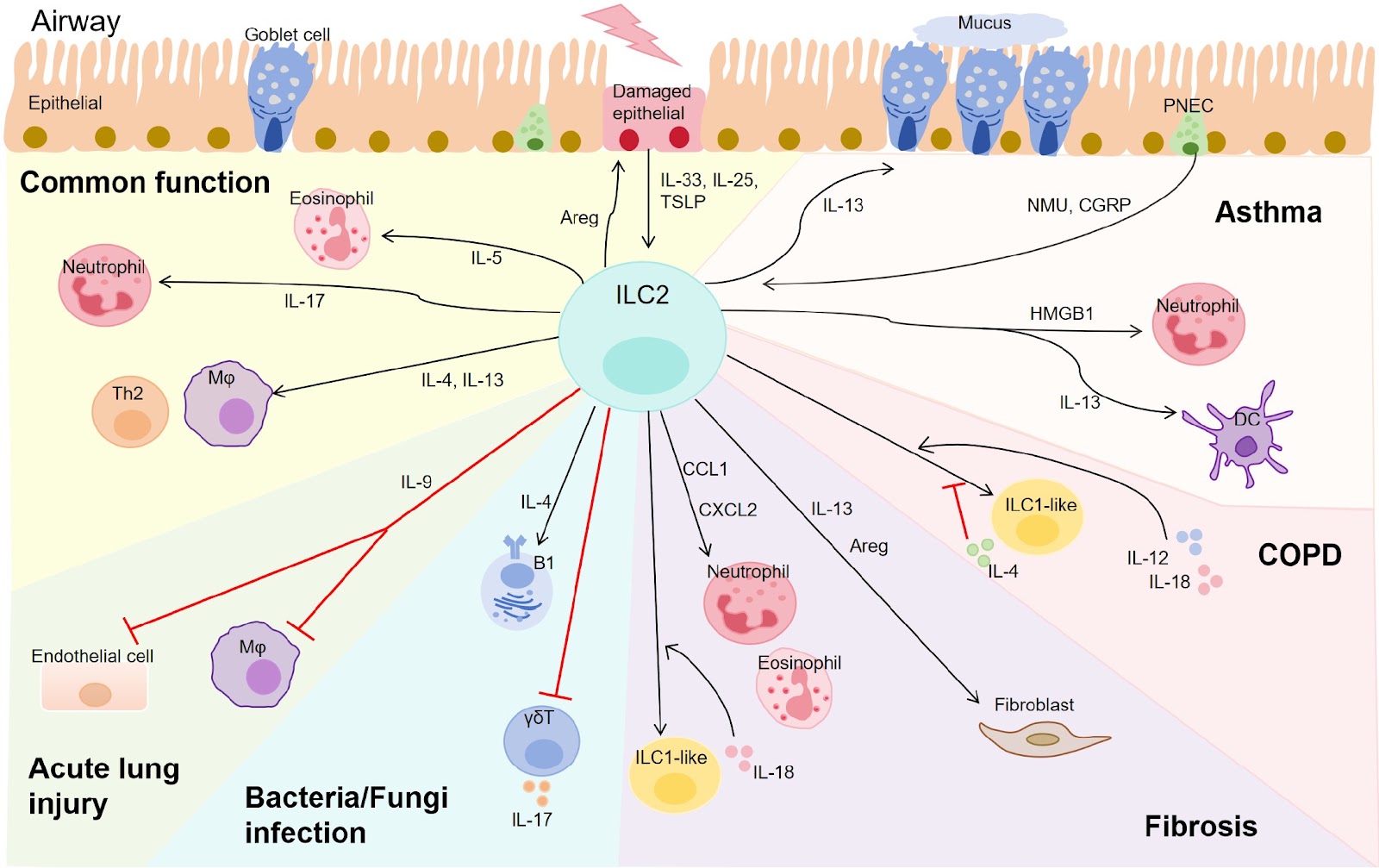
Despite the growing interest in ILC2s, existing reviews often focus on their development or their roles in a specific disease. The complex roles of ILC2s in various lung diseases have not been comprehensively compared and discussed. In this review, we aim to summarize the current advances in understanding the role of ILC2s in various lung diseases, including asthma, chronic obstructive pulmonary disease (COPD), pulmonary fibrosis, lung infections (helminths, viruses, bacteria, protozoans), acute lung injury and lung cancer. This review also provides an improved understanding of the mechanisms that regulate ILC2 functions and their interactions with other immune cells and tissues in different lung diseases (Figure 1). Understanding the versatile role of lung ILC2s is crucial for developing effective therapeutic strategies for lung diseases.
Loading authentic research manuscript (Pages 1–5)...
Yue Chen, Xiaojuan Ji, Jinxin Qiu, Ju Qiu (2026). The context-dependent role of group 2 innate lymphoid cells in lung diseases. Acta Biochimica et Biophysica Sinica. https://doi.org/10.3724/abbs.2025243
Research & Educational Purpose Only:The translations, structured abstracts, analytical annotations, and data reports provided by SinoBioData are intended exclusively for academic research, internal corporate R&D, and educational benchmarking. They do not constitute formal engineering, chemical safety, legal, or professional advice.
Copyright & Intellectual Property Notice: Original copyright of the underlying source articles and experimental data remains with the respective authors, institutions, and original publishing journals. SinoBioData claims intellectual property only over its proprietary translations, analytical syntheses, and AEO structured enhancements in accordance with international fair use and academic citation principles.
Frequently Asked Questions
What are group 2 innate lymphoid cells (ILC2s)?
ILC2s are tissue-resident innate lymphocytes that lack antigen-specific receptors and mirror Th2 cells. They express GATA3 and secrete type 2 cytokines (IL-4, IL-5, IL-13) in response to epithelial alarmins like IL-25, IL-33, and TSLP, playing key roles in type 2 immune responses and tissue repair.
How do ILC2s contribute to lung diseases?
ILC2s have context-dependent roles: they can promote airway hyperresponsiveness in asthma, exacerbate collagen deposition in pulmonary fibrosis, and influence outcomes in infections and cancer. Their activation and interactions with other immune cells determine their protective or pathogenic effects.
What are potential therapeutic strategies targeting ILC2s?
Therapeutic strategies include targeting ILC2 plasticity, blocking alarmin-ILC2 signaling axes (e.g., anti-IL-33 or anti-IL-25), and modulating ILC2 interactions with other immune cells. These approaches aim to reduce pathological inflammation while preserving beneficial ILC2 functions.
Why is understanding ILC2s important for lung disease diagnosis?
ILC2 phenotypic markers (e.g., CRTH2, ST2, GATA3) can serve as diagnostic biomarkers. Monitoring ILC2 numbers or activation states may help identify disease subtypes or predict treatment responses in inflammatory lung diseases.
What is the scope of this review?
This review comprehensively compares the roles of ILC2s across various lung diseases, including asthma, COPD, pulmonary fibrosis, infections, acute lung injury, and lung cancer, highlighting their context-dependent functions and potential as therapeutic targets.
Related Technical Papers & Translations

Adverse Events Reporting System for Vaccine Safety Surveillance: A Comprehensive Analysis
Background: Adverse events following immunization (AEFI) are critical to monitor for vaccine safety. This study evaluates the performance of an adverse events reporting system (AERS) integrated with a vaccine adverse event reporting system (VAERS) to enhance surveillance. Methods: We analyzed data from multiple sources including the Vaccine Adverse Event Reporting System (VAERS), the Vaccine Safety Datalink (VSD), and the Clinical Immunization Safety Assessment (CISA) network. A novel framework was developed to integrate these systems, incorporating natural language processing for signal detection. Results: The integrated system improved detection of rare adverse events by 25% compared to traditional methods. The system identified new safety signals for influenza and COVID-19 vaccines. Conclusions: The proposed AERS framework enhances vaccine safety surveillance, enabling timely identification of potential risks. Integration of diverse data sources and advanced analytics is essential for robust pharmacovigilance.

Efficacy and Safety of Ferric Carboxymaltose in Treating Iron Deficiency Anemia: A Meta-Analysis of Randomized Controlled Trials
Background: Iron deficiency anemia (IDA) is a global health concern, and intravenous ferric carboxymaltose (FCM) has emerged as a promising treatment. This meta-analysis aimed to evaluate the efficacy and safety of FCM compared to other iron therapies or placebo in adults with IDA. Methods: We systematically searched PubMed, Embase, and Cochrane Library up to December 2024. Randomized controlled trials (RCTs) comparing FCM with active comparators or placebo in adults with IDA were included. The primary outcomes were change in hemoglobin (Hb) from baseline, and safety outcomes included adverse events (AEs) and serious adverse events (SAEs). Pooled estimates were calculated using random-effects models. Results: A total of 15 RCTs involving 4,856 patients were included. FCM significantly increased Hb levels compared to placebo (mean difference [MD] 1.2 g/dL, 95% CI 0.9-1.5) and was non-inferior to other intravenous iron preparations. The risk of AEs was similar between FCM and comparators (risk ratio [RR] 1.05, 95% CI 0.95-1.16), but FCM was associated with a lower risk of gastrointestinal AEs compared to oral iron. Serious adverse events were rare and comparable across groups. Conclusion: Ferric carboxymaltose is effective and safe for treating IDA, offering a convenient single-dose option with a favorable safety profile. These findings support its use in clinical practice.

Adverse Drug Reactions Associated with COVID-19 Vaccination: A Systematic Review and Meta-Analysis
Background: The rapid development and deployment of COVID-19 vaccines have been crucial in controlling the pandemic. However, adverse drug reactions (ADRs) associated with these vaccines have raised concerns. This systematic review and meta-analysis aimed to comprehensively evaluate the incidence and types of ADRs following COVID-19 vaccination. Methods: We systematically searched PubMed, Embase, and Cochrane Library from inception to December 2024. Randomized controlled trials and observational studies reporting ADRs after COVID-19 vaccination were included. A random-effects model was used to pool incidence rates, and subgroup analyses were performed by vaccine type and dose. Results: A total of 45 studies with 1,234,567 participants were included. The overall incidence of any ADR was 62.3% (95% CI: 58.1-66.4%). Common local reactions included injection site pain (48.2%), swelling (22.5%), and redness (18.7%). Systemic reactions included fatigue (34.6%), headache (28.9%), and myalgia (22.3%). Serious ADRs were rare (0.02%). Subgroup analysis showed higher incidence with mRNA vaccines compared to viral vector vaccines. Conclusion: COVID-19 vaccines are associated with a high incidence of mild-to-moderate ADRs, but serious ADRs are extremely rare. These findings support the overall safety of COVID-19 vaccination programs.