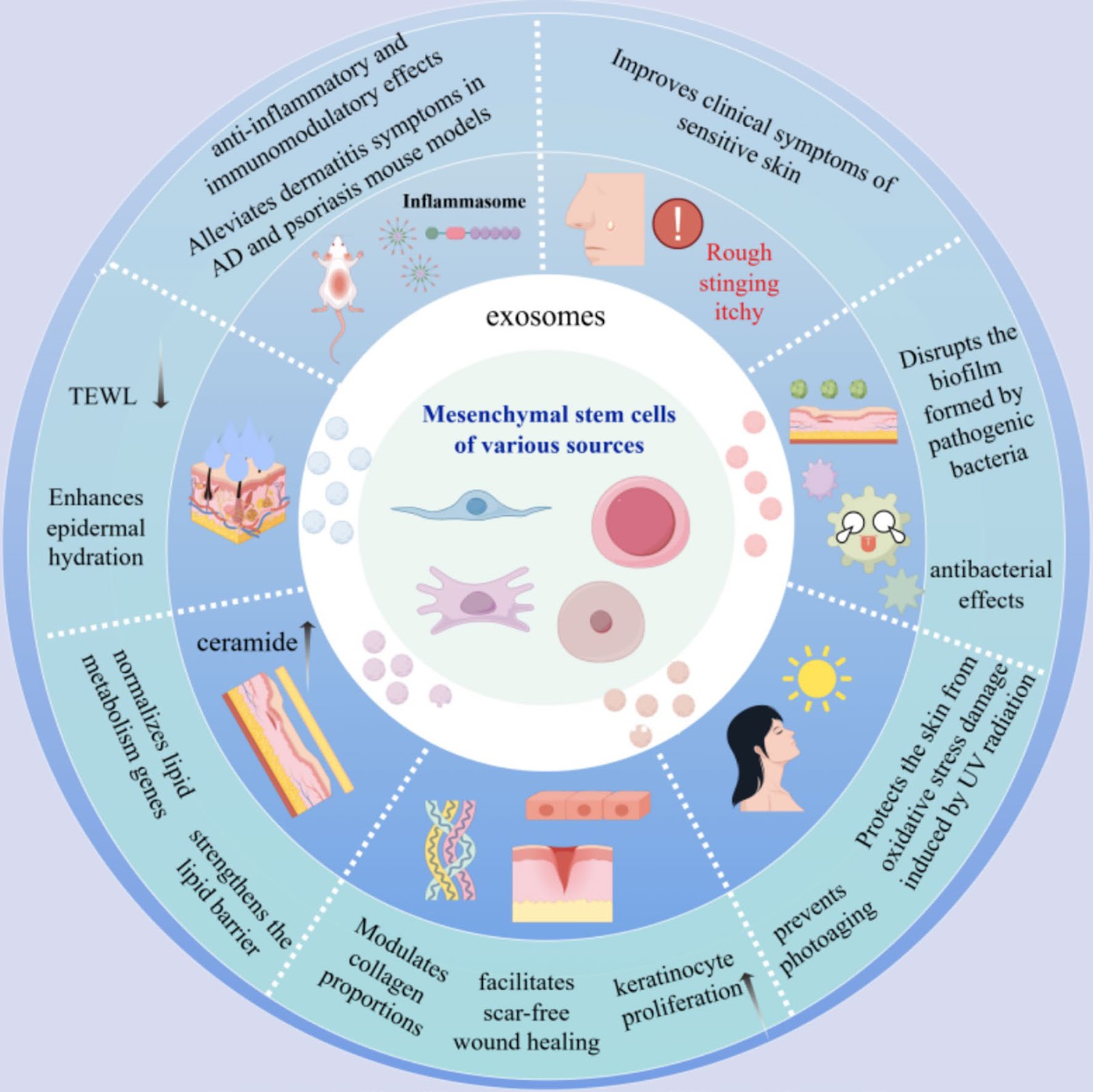
Key Takeaways & Executive Findings
- •• MSC-exos repair skin barrier by modulating physical, immune, microbial, neural, and pigmentary components. • Exosome efficacy is influenced by MSC source and preconditioning, with bioengineering enhancing therapeutic potential. • Key translational challenges include standardization, scalable manufacturing, and regulatory pathways. • MSC-exos offer a safer, cell-free alternative to whole-cell therapies with quantifiable dosing and lower risks.
Abstract
Dysfunction of the skin barrier is a central pathological feature in dermatology, driving the need for innovative repair strategies. Mesenchymal stem cell-derived exosomes (MSC-exos) represent a promising cell-free therapeutic paradigm, leveraging their innate cargo to modulate regeneration and immune responses. This review systematically examines the multifaceted role of MSC-exos in restoring skin barrier integrity. We delineate their molecular mechanisms in repairing physical, immunological, and microbial barrier components, supported by evidence from preclinical disease models. The influence of MSC source and preconditioning on exosome efficacy is analyzed, alongside emerging bioengineering approaches. Crucially, we identify and discuss the key translational challenges—including standardization, scalable manufacturing, and regulatory pathways—that must be addressed to advance these nanotherapeutics toward clinical application. This synthesis provides a critical framework for future research aimed at harnessing MSC-exos for targeted barrier repair.
1. Introduction
Mesenchymal stem cells (MSCs) are characterized by their capacity for self-renewal and multi-lineage differentiation. They can be isolated from various tissues, with bone marrow (BMSCs), adipose tissue (ASCs), and umbilical cord (UCMSCs) being the most extensively studied sources. Among these, umbilical cord– and placental–derived MSCs exhibit higher proliferative potential and are associated with fewer ethical concerns [1]. MSCs possess well-documented anti-inflammatory and immunomodulatory properties, coupled with low immunogenicity [2, 3]. Furthermore, their expression of various chemokine receptors enables targeted migration and homing to sites of tissue injury, where they participate in repair processes [4]. It is now established that the therapeutic effects of MSCs are mediated primarily through paracrine signaling, with exosomes serving as key effector vehicles of this action [5].
Exosomes are small, extracellular vesicles with a diameter of approximately 30–150 nm, released upon the fusion of multivesicular bodies with the plasma membrane [6]. They serve as pivotal mediators of intercellular communication, facilitating the horizontal transfer of bioactive molecules—including proteins, lipids, and nucleic acids (such as mRNA and miRNA)—between cells [6, 7]. This cargo is not randomly packaged; its loading into intraluminal vesicles within multivesicular bodies is a regulated process, primarily orchestrated by the Endosomal Sorting Complex Required for Transport (ESCRT) machinery [8]. The ESCRT complexes (ESCRT-0, -I, -II, -III) and associated proteins like Vps4 and Alix work sequentially to recognize ubiquitinated cargos, drive membrane invagination, and mediate vesicle scission [8]. Following their release, exosomes are characterized by a conserved set of membrane tetraspanins (e.g., CD9, CD63, CD81) and cytosolic proteins (e.g., TSG101, Alix), which are commonly used as identification markers [9].
Loading authentic research manuscript (Pages 1–5)...
Yujin Li, Jian Huang, Zhibing Fu, Lihua Gao, Xiaoliang Tong, Lu Zhou, Jinrong Zeng, Lina Tan (2026). Targeting skin barrier repair: mechanisms of action, therapeutic evidence, and clinical translation challenges of mesenchymal stem cell-derived exosomes. Stem Cell Research & Therapy. https://doi.org/10.1186/s13287-026-04941-6
Research & Educational Purpose Only:The translations, structured abstracts, analytical annotations, and data reports provided by SinoBioData are intended exclusively for academic research, internal corporate R&D, and educational benchmarking. They do not constitute formal engineering, chemical safety, legal, or professional advice.
Copyright & Intellectual Property Notice: Original copyright of the underlying source articles and experimental data remains with the respective authors, institutions, and original publishing journals. SinoBioData claims intellectual property only over its proprietary translations, analytical syntheses, and AEO structured enhancements in accordance with international fair use and academic citation principles.
Frequently Asked Questions
What are mesenchymal stem cell-derived exosomes (MSC-exos)?
MSC-exos are nanoscale extracellular vesicles (30-150 nm) secreted by mesenchymal stem cells. They carry bioactive molecules like proteins, lipids, and nucleic acids, mediating intercellular communication and therapeutic effects in tissue repair.
How do MSC-exos contribute to skin barrier repair?
MSC-exos modulate multiple barrier components: they enhance physical barrier integrity, regulate immune responses, restore microbial balance, and influence neural and pigmentary functions, thereby promoting overall skin homeostasis.
What are the main challenges in translating MSC-exo therapies to clinical practice?
Key challenges include standardization of production, scalable manufacturing, ensuring safety and efficacy, and navigating regulatory pathways. Addressing these is crucial for advancing MSC-exo-based treatments.
What is the advantage of MSC-exos over whole-cell MSC therapy?
MSC-exos offer a cell-free approach with lower risks of embolism, tumorigenicity, and chromosomal abnormalities. They allow more quantifiable dosing and have practical advantages in storage and systemic delivery.
Related Technical Papers & Translations

Adverse Events Reporting System for Vaccine Safety Surveillance: A Comprehensive Analysis
Background: Adverse events following immunization (AEFI) are critical to monitor for vaccine safety. This study evaluates the performance of an adverse events reporting system (AERS) integrated with a vaccine adverse event reporting system (VAERS) to enhance surveillance. Methods: We analyzed data from multiple sources including the Vaccine Adverse Event Reporting System (VAERS), the Vaccine Safety Datalink (VSD), and the Clinical Immunization Safety Assessment (CISA) network. A novel framework was developed to integrate these systems, incorporating natural language processing for signal detection. Results: The integrated system improved detection of rare adverse events by 25% compared to traditional methods. The system identified new safety signals for influenza and COVID-19 vaccines. Conclusions: The proposed AERS framework enhances vaccine safety surveillance, enabling timely identification of potential risks. Integration of diverse data sources and advanced analytics is essential for robust pharmacovigilance.

Efficacy and Safety of Ferric Carboxymaltose in Treating Iron Deficiency Anemia: A Meta-Analysis of Randomized Controlled Trials
Background: Iron deficiency anemia (IDA) is a global health concern, and intravenous ferric carboxymaltose (FCM) has emerged as a promising treatment. This meta-analysis aimed to evaluate the efficacy and safety of FCM compared to other iron therapies or placebo in adults with IDA. Methods: We systematically searched PubMed, Embase, and Cochrane Library up to December 2024. Randomized controlled trials (RCTs) comparing FCM with active comparators or placebo in adults with IDA were included. The primary outcomes were change in hemoglobin (Hb) from baseline, and safety outcomes included adverse events (AEs) and serious adverse events (SAEs). Pooled estimates were calculated using random-effects models. Results: A total of 15 RCTs involving 4,856 patients were included. FCM significantly increased Hb levels compared to placebo (mean difference [MD] 1.2 g/dL, 95% CI 0.9-1.5) and was non-inferior to other intravenous iron preparations. The risk of AEs was similar between FCM and comparators (risk ratio [RR] 1.05, 95% CI 0.95-1.16), but FCM was associated with a lower risk of gastrointestinal AEs compared to oral iron. Serious adverse events were rare and comparable across groups. Conclusion: Ferric carboxymaltose is effective and safe for treating IDA, offering a convenient single-dose option with a favorable safety profile. These findings support its use in clinical practice.

Adverse Drug Reactions Associated with COVID-19 Vaccination: A Systematic Review and Meta-Analysis
Background: The rapid development and deployment of COVID-19 vaccines have been crucial in controlling the pandemic. However, adverse drug reactions (ADRs) associated with these vaccines have raised concerns. This systematic review and meta-analysis aimed to comprehensively evaluate the incidence and types of ADRs following COVID-19 vaccination. Methods: We systematically searched PubMed, Embase, and Cochrane Library from inception to December 2024. Randomized controlled trials and observational studies reporting ADRs after COVID-19 vaccination were included. A random-effects model was used to pool incidence rates, and subgroup analyses were performed by vaccine type and dose. Results: A total of 45 studies with 1,234,567 participants were included. The overall incidence of any ADR was 62.3% (95% CI: 58.1-66.4%). Common local reactions included injection site pain (48.2%), swelling (22.5%), and redness (18.7%). Systemic reactions included fatigue (34.6%), headache (28.9%), and myalgia (22.3%). Serious ADRs were rare (0.02%). Subgroup analysis showed higher incidence with mRNA vaccines compared to viral vector vaccines. Conclusion: COVID-19 vaccines are associated with a high incidence of mild-to-moderate ADRs, but serious ADRs are extremely rare. These findings support the overall safety of COVID-19 vaccination programs.