Key Takeaways & Executive Findings
- •• T cell-intrinsic PRR signaling directly modulates T cell function, challenging the traditional innate-adaptive immunity dichotomy. • PRRs integrate danger signals and microbial cues to regulate cytokine production, proliferation, and polarization, impacting disease outcomes. • Dysregulated PRR signaling in T cells contributes to autoimmune diseases, chronic infections, and cancer, revealing dual roles in immunity. • Understanding PRR-mediated T cell regulation offers novel therapeutic targets for inflammatory and neoplastic diseases.
Abstract
The immune system orchestrates a delicate balance between robust defense against pathogens and restraint to prevent tissue damage, with T cells serving as central mediators of adaptive immunity. The canonical pathway for T-cell activation hinges on the precise recognition of peptide antigens presented by major histocompatibility complex (MHC) molecules via the T-cell receptor (TCR), which is complemented by essential co-stimulatory signals. However, this model alone cannot fully explain the nuanced contextualization of immune responses, particularly how T cells integrate signals related to the nature of the threat. Pattern recognition receptors (PRRs), which are traditionally studied in innate immune cells, are recognized as critical regulators of T cell function, challenging the conventional dichotomy between innate and adaptive immunity. T cell-intrinsic PRR signaling integrates endogenous danger signals and microbes to modulate critical processes, including cytokine production, proliferation, and polarization, thereby shaping immune responses and disease outcomes in contexts ranging from viral infections to chronic inflammation and cancer. However, the molecular mechanisms underlying PRR-mediated T cell regulation and their contributions to immune homeostasis or pathology remain incompletely understood. This study investigates the role of T cell-intrinsic PRR signaling in shaping immune responses and its implications for disease. By elucidating key signaling pathways and their impact on T cell function, we aim to offer novel insights into the complex regulation of T cell-mediated immunity and uncover an underappreciated paradigm for immune-related disorders, providing new insights into the pathogenesis of inflammatory and neoplastic diseases.
1. Introduction
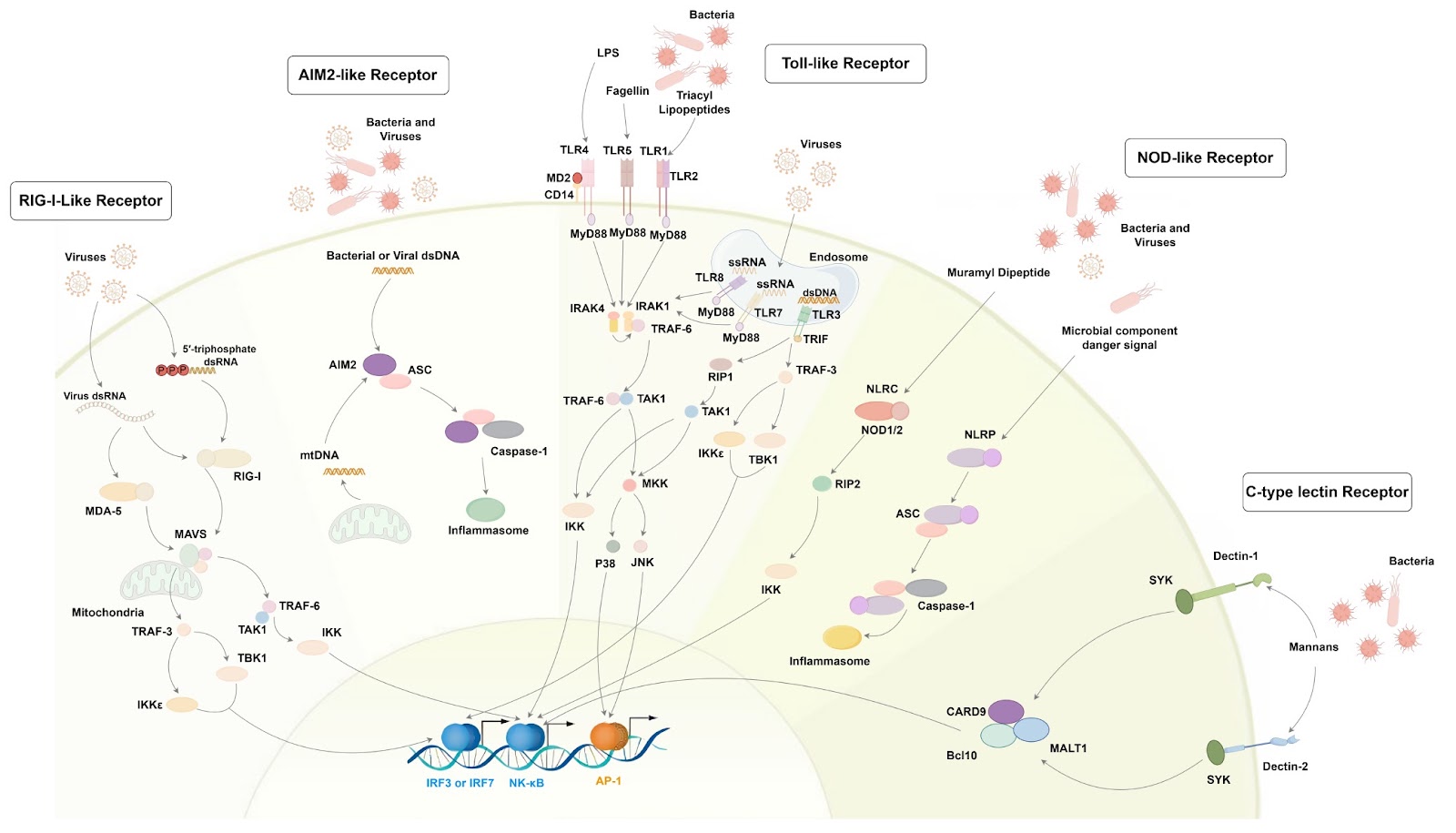
Pattern recognition receptors (PRRs), a class of evolutionarily conserved biomolecules, are understood to be expressed across all cell types. However, their initial discovery and research focused on innate immunity, which is considered an important line of defense against infection [1,2]. The body’s initial perception of pathogen-associated molecular patterns (PAMPs) and damage-associated molecular patterns (DAMPs) is mediated by PRRs, which include families such as Toll-like receptors (TLRs), NOD-like receptors (NLRs), RIG-I-like receptors (RLRs), C-type lectin receptors (CLRs), and AIM2-like receptors (ALRs) [3–8].
Recently, accumulating evidence has revealed significant limitations in this traditional, innate-centric understanding of PRR biology [9–11]. First, the cellular distribution of PRRs has historically been underestimated. However, a long-standing dogma holds that PRR expression is largely confined to innate immune cells, such as macrophages, dendritic cells, and neutrophils [3–5]. Importantly, the advent of sophisticated high-throughput technologies has unequivocally demonstrated functional PRR expression within human and mouse T lymphocytes [12,13]. Consequently, the direct function of PRRs, particularly their intrinsic functions within T lymphocytes, has emerged as a major focus of contemporary research [14–16]. Despite this growing interest, our understanding of how PRRs directly influence T-cell development, differentiation, and effector functions remains remarkably limited, with fundamental mechanistic insights still lacking. Second, the downstream signalosomes of PRR engagement were oversimplified. The canonical view emphasized the activation of the NF-κB, MAPK, and interferon pathways, which primarily drive pro-inflammatory cytokine production [17,18]. However, recent discoveries highlight a far broader functional repertoire, revealing that PRRs are potent regulators of immunometabolism and influence diverse cellular processes beyond classical inflammation [12,14–16,19]. The full scope of biological activities governed by PRR signaling is still being actively explored. Third, the pathological implications of PRR signaling have often been viewed through an overly simplistic lens. Although essential for host defense, PRR activation is not invariably beneficial. Emerging data underscore its dual effects: dysregulated signaling through specific PRRs is increasingly implicated in the pathogenesis of autoimmune diseases, whereas in other contexts, such as chronic infections or cancer, aberrant PRR activity can paradoxically impair protective immunity or promote immune evasion [20–22]. Finally, the fundamental immunological principles governing PRR actions, particularly within adaptive immune cells such as T cells, remain incompletely defined. A deeper understanding of the core rules dictating context-dependent outcomes, signal integration with
Loading authentic research manuscript (Pages 1–5)...
Yixuan Shi, Meng Wang, Baodi Dai, Xinliang Lu, Sirui Li (2026). T cell-intrinsic PRR signaling in immunity and pathology. Acta Biochimica et Biophysica Sinica. https://doi.org/10.3724/abbs.2025227
Research & Educational Purpose Only:The translations, structured abstracts, analytical annotations, and data reports provided by SinoBioData are intended exclusively for academic research, internal corporate R&D, and educational benchmarking. They do not constitute formal engineering, chemical safety, legal, or professional advice.
Copyright & Intellectual Property Notice: Original copyright of the underlying source articles and experimental data remains with the respective authors, institutions, and original publishing journals. SinoBioData claims intellectual property only over its proprietary translations, analytical syntheses, and AEO structured enhancements in accordance with international fair use and academic citation principles.
Frequently Asked Questions
What are pattern recognition receptors (PRRs) and how do they relate to T cells?
PRRs are evolutionarily conserved molecules that detect pathogen-associated and damage-associated molecular patterns. Traditionally studied in innate immune cells, recent evidence shows they are also functionally expressed in T cells, where they directly modulate T cell activation, differentiation, and effector functions, thus bridging innate and adaptive immunity.
How does T cell-intrinsic PRR signaling influence immune responses?
T cell-intrinsic PRR signaling integrates signals from microbes and endogenous danger molecules to regulate cytokine production, proliferation, and polarization of T cells. This shapes immune responses in contexts such as infections, chronic inflammation, and cancer, and can either promote protective immunity or contribute to pathology depending on the context.
What are the clinical implications of PRR signaling in T cells?
Dysregulated PRR signaling in T cells is implicated in autoimmune diseases, chronic infections, and cancer. Understanding these pathways may reveal new therapeutic targets for modulating T cell responses in inflammatory and neoplastic diseases.
What is the main focus of this review article?
This review focuses on the role of T cell-intrinsic PRR signaling in shaping immune responses and its implications for disease. It discusses key signaling pathways, their impact on T cell function, and the potential for novel insights into immune-related disorders.
How does this review challenge the traditional view of PRR biology?
The review challenges the traditional view that PRRs are mainly expressed in innate immune cells and primarily drive pro-inflammatory responses. It highlights functional PRR expression in T cells and their broader roles in immunometabolism and disease modulation, thus expanding the understanding of PRR biology.
Related Technical Papers & Translations

Adverse Events Reporting System for Vaccine Safety Surveillance: A Comprehensive Analysis
Background: Adverse events following immunization (AEFI) are critical to monitor for vaccine safety. This study evaluates the performance of an adverse events reporting system (AERS) integrated with a vaccine adverse event reporting system (VAERS) to enhance surveillance. Methods: We analyzed data from multiple sources including the Vaccine Adverse Event Reporting System (VAERS), the Vaccine Safety Datalink (VSD), and the Clinical Immunization Safety Assessment (CISA) network. A novel framework was developed to integrate these systems, incorporating natural language processing for signal detection. Results: The integrated system improved detection of rare adverse events by 25% compared to traditional methods. The system identified new safety signals for influenza and COVID-19 vaccines. Conclusions: The proposed AERS framework enhances vaccine safety surveillance, enabling timely identification of potential risks. Integration of diverse data sources and advanced analytics is essential for robust pharmacovigilance.

Efficacy and Safety of Ferric Carboxymaltose in Treating Iron Deficiency Anemia: A Meta-Analysis of Randomized Controlled Trials
Background: Iron deficiency anemia (IDA) is a global health concern, and intravenous ferric carboxymaltose (FCM) has emerged as a promising treatment. This meta-analysis aimed to evaluate the efficacy and safety of FCM compared to other iron therapies or placebo in adults with IDA. Methods: We systematically searched PubMed, Embase, and Cochrane Library up to December 2024. Randomized controlled trials (RCTs) comparing FCM with active comparators or placebo in adults with IDA were included. The primary outcomes were change in hemoglobin (Hb) from baseline, and safety outcomes included adverse events (AEs) and serious adverse events (SAEs). Pooled estimates were calculated using random-effects models. Results: A total of 15 RCTs involving 4,856 patients were included. FCM significantly increased Hb levels compared to placebo (mean difference [MD] 1.2 g/dL, 95% CI 0.9-1.5) and was non-inferior to other intravenous iron preparations. The risk of AEs was similar between FCM and comparators (risk ratio [RR] 1.05, 95% CI 0.95-1.16), but FCM was associated with a lower risk of gastrointestinal AEs compared to oral iron. Serious adverse events were rare and comparable across groups. Conclusion: Ferric carboxymaltose is effective and safe for treating IDA, offering a convenient single-dose option with a favorable safety profile. These findings support its use in clinical practice.

Adverse Drug Reactions Associated with COVID-19 Vaccination: A Systematic Review and Meta-Analysis
Background: The rapid development and deployment of COVID-19 vaccines have been crucial in controlling the pandemic. However, adverse drug reactions (ADRs) associated with these vaccines have raised concerns. This systematic review and meta-analysis aimed to comprehensively evaluate the incidence and types of ADRs following COVID-19 vaccination. Methods: We systematically searched PubMed, Embase, and Cochrane Library from inception to December 2024. Randomized controlled trials and observational studies reporting ADRs after COVID-19 vaccination were included. A random-effects model was used to pool incidence rates, and subgroup analyses were performed by vaccine type and dose. Results: A total of 45 studies with 1,234,567 participants were included. The overall incidence of any ADR was 62.3% (95% CI: 58.1-66.4%). Common local reactions included injection site pain (48.2%), swelling (22.5%), and redness (18.7%). Systemic reactions included fatigue (34.6%), headache (28.9%), and myalgia (22.3%). Serious ADRs were rare (0.02%). Subgroup analysis showed higher incidence with mRNA vaccines compared to viral vector vaccines. Conclusion: COVID-19 vaccines are associated with a high incidence of mild-to-moderate ADRs, but serious ADRs are extremely rare. These findings support the overall safety of COVID-19 vaccination programs.