Key Takeaways & Executive Findings
- •• SPATS2L is identified as an SLE eGene correlated with disease activity and involved in the type I IFN pathway. • SPATS2L expression is induced by type I IFN in a dose- and time-dependent manner, acting as a positive feedback regulator. • Silencing SPATS2L in PBMCs from SLE patients reverses IFN pathway activation, highlighting its therapeutic potential. • SPATS2L may serve as a biomarker for disease activity and a target for intervention in lupus.
Abstract
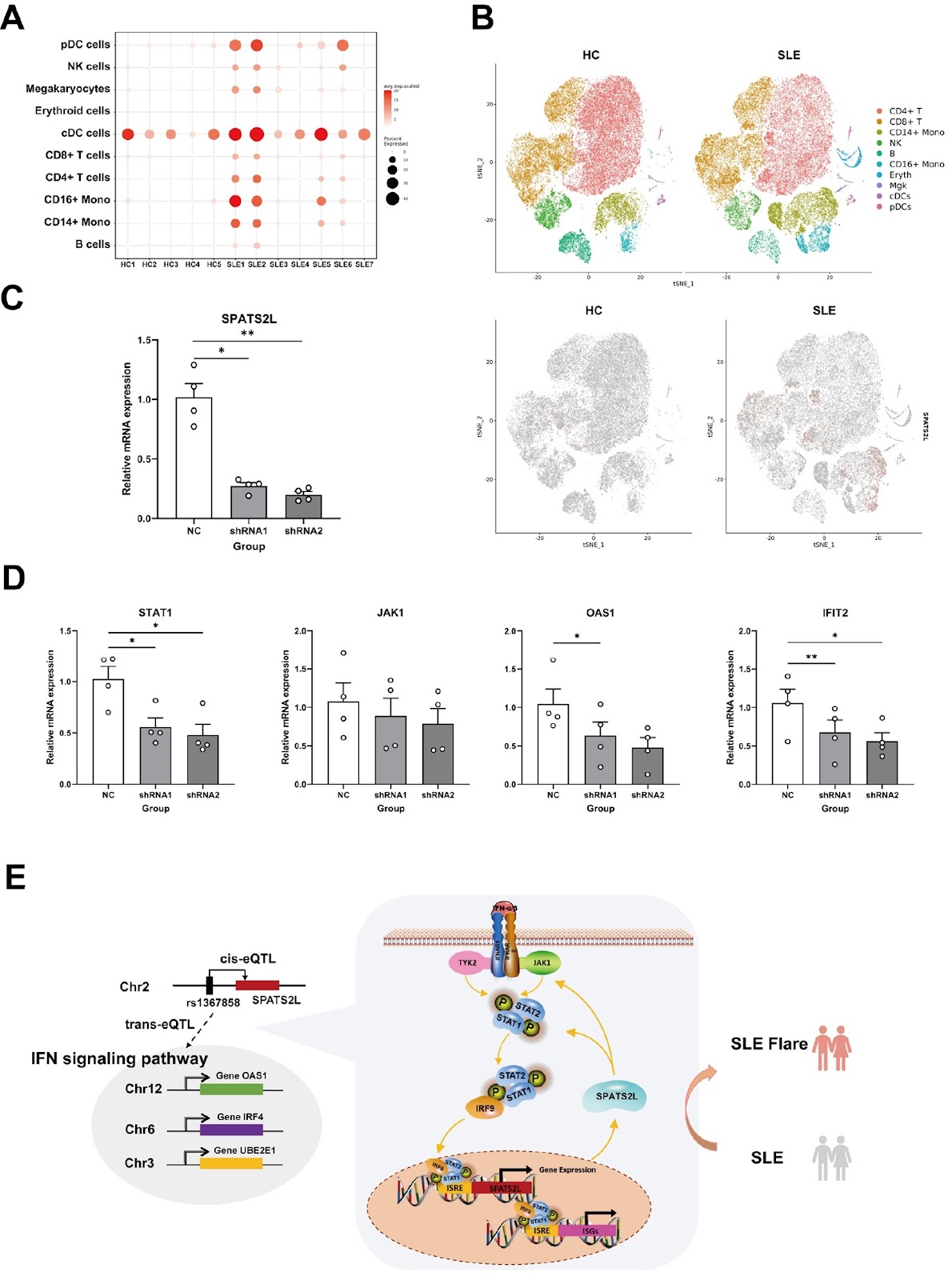
Through genome-wide association studies (GWAS) and integrated expression quantitative trait locus (eQTL) analyses, numerous susceptibility genes (“eGenes”, whose expressions are significantly associated with common variants) associated with systemic lupus erythematosus (SLE) have been identified. Notably, a subset of these eGenes is correlated with disease activity. However, the precise mechanisms through which these genes contribute to the initiation and progression of the disease remain to be fully elucidated. In this investigation, we initially identify SPATS2L as an SLE eGene correlated with disease activity. eSignaling and transcriptomic analyses suggest its involvement in the type I interferon (IFN) pathway. We observe a significant increase in SPATS2L expression following type I IFN stimulation, and the expression levels are dependent on both the concentration and duration of stimulation. Furthermore, through dual-luciferase reporter assays, western blot analysis, and imaging flow cytometry, we confirm that SPATS2L positively modulates the type I IFN pathway, acting as a positive feedback regulator. Notably, siRNA-mediated intervention targeting SPATS2L, an interferon-inducible gene, in peripheral blood mononuclear cells (PBMCs) from patients with SLE reverses the activation of the interferon pathway. In conclusion, our research highlights the pivotal role of SPATS2L as a positive-feedback regulatory molecule within the type I IFN pathway. Our findings suggest that SPATS2L plays a critical role in the onset and progression of SLE and may serve as a promising target for disease activity assessment and intervention strategies.
1. Introduction
Systemic lupus erythematosus (SLE) is a typical chronic autoimmune disorder characterized by a notable genetic predisposition [1]. This condition manifests as multi-organ involvement, affecting diverse bodily systems, including the integumentary, musculoskeletal, renal, pulmonary, and cardiovascular systems. Despite extensive research endeavors, the exact etiology of lupus remains incompletely understood. Nonetheless, numerous investigations have revealed potential associations with genetic, environmental, and hormonal factors [2].
Genetic variations play a crucial role in both the etiology and pathogenesis of SLE [3–5]. In recent years, many studies, predominantly genome-wide association studies (GWAS), have made significant advancements in elucidating the underlying pathogenic mechanisms of SLE [6–12]. Through the analysis of large-scale genotype data, current investigations have identified numerous genetic variations linked to susceptibility to SLE. Notably, a considerable proportion of these variations are associated with the dysregulated expression of genes, such as IRF5, TYK2, and STAT4, within the interferon (IFN) pathway [13–16], underscoring the significant involvement of the IFN signaling network in the pathogenesis of SLE.
Previous studies have demonstrated that the majority of individuals with SLE exhibit dysregulated expression of IFN-stimulated genes (ISGs), commonly referred to as the “IFN signature” [17–19]. Consequently, elevated level of type I IFN in serum serves as a notable marker for SLE patients [20–22]. Excessive IFN stimulates the generation of autoantibodies and instigates the upregulation of genes associated with immune responses, including cytokines, chemokines, and other inflammatory mediators, thereby promoting inflammation and contributing to the progression of SLE [23–25]. The aberrant activation of type I IFN is a major pathogenic factor in SLE and plays a pivotal role in the initiation and progression of lupus. Consequently, targeting this pathway has emerged as a promising therapeutic approach for managing this disease. Currently, numerous therapeutic strategies targeting interferons or their receptors are extensively employed in the treatment of SLE. These include, an approved monoclonal antibody targeting the type I interferon receptor (IFNAR), as well as investigational therapeutics such as interferon alpha (IFN-α) kinoid, and those which specifically target IFN-α [26–31].
Loading authentic research manuscript (Pages 1–5)...
Mengke Chen, Yutong Zhang, Weiwen Shi, Xuejiao Song, Yue Yang, Guojun Hou, Huihua Ding, Sheng Chen, Wanling Yang, Nan Shen, Yong Cui, Xianbo Zuo, Yuanjia Tang (2026). SPATS2L is a positive feedback regulator of the type I interferon signaling pathway and plays a vital role in lupus. Acta Biochimica et Biophysica Sinica. https://doi.org/10.3724/abbs.2024132
Research & Educational Purpose Only:The translations, structured abstracts, analytical annotations, and data reports provided by SinoBioData are intended exclusively for academic research, internal corporate R&D, and educational benchmarking. They do not constitute formal engineering, chemical safety, legal, or professional advice.
Copyright & Intellectual Property Notice: Original copyright of the underlying source articles and experimental data remains with the respective authors, institutions, and original publishing journals. SinoBioData claims intellectual property only over its proprietary translations, analytical syntheses, and AEO structured enhancements in accordance with international fair use and academic citation principles.
Frequently Asked Questions
What is the role of SPATS2L in systemic lupus erythematosus?
SPATS2L acts as a positive feedback regulator of the type I interferon signaling pathway, contributing to the pathogenesis of SLE. Its expression is induced by type I IFN and it enhances IFN signaling, thereby promoting disease activity.
How was SPATS2L identified as an SLE-associated gene?
SPATS2L was identified through genome-wide association studies (GWAS) and integrated expression quantitative trait locus (eQTL) analyses as an eGene correlated with disease activity in SLE patients.
What experimental methods were used to confirm SPATS2L's function?
The study employed dual-luciferase reporter assays, western blot analysis, and imaging flow cytometry to confirm that SPATS2L positively modulates the type I IFN pathway.
Could SPATS2L be a therapeutic target for lupus?
Yes, silencing SPATS2L in peripheral blood mononuclear cells from SLE patients reversed the activation of the interferon pathway, suggesting that SPATS2L may serve as a promising target for intervention strategies.
What is the clinical significance of this study?
The findings highlight SPATS2L as a potential biomarker for disease activity assessment and a novel therapeutic target for SLE, offering new avenues for managing this complex autoimmune disease.
Related Technical Papers & Translations

Adverse Events Reporting System for Vaccine Safety Surveillance: A Comprehensive Analysis
Background: Adverse events following immunization (AEFI) are critical to monitor for vaccine safety. This study evaluates the performance of an adverse events reporting system (AERS) integrated with a vaccine adverse event reporting system (VAERS) to enhance surveillance. Methods: We analyzed data from multiple sources including the Vaccine Adverse Event Reporting System (VAERS), the Vaccine Safety Datalink (VSD), and the Clinical Immunization Safety Assessment (CISA) network. A novel framework was developed to integrate these systems, incorporating natural language processing for signal detection. Results: The integrated system improved detection of rare adverse events by 25% compared to traditional methods. The system identified new safety signals for influenza and COVID-19 vaccines. Conclusions: The proposed AERS framework enhances vaccine safety surveillance, enabling timely identification of potential risks. Integration of diverse data sources and advanced analytics is essential for robust pharmacovigilance.

Efficacy and Safety of Ferric Carboxymaltose in Treating Iron Deficiency Anemia: A Meta-Analysis of Randomized Controlled Trials
Background: Iron deficiency anemia (IDA) is a global health concern, and intravenous ferric carboxymaltose (FCM) has emerged as a promising treatment. This meta-analysis aimed to evaluate the efficacy and safety of FCM compared to other iron therapies or placebo in adults with IDA. Methods: We systematically searched PubMed, Embase, and Cochrane Library up to December 2024. Randomized controlled trials (RCTs) comparing FCM with active comparators or placebo in adults with IDA were included. The primary outcomes were change in hemoglobin (Hb) from baseline, and safety outcomes included adverse events (AEs) and serious adverse events (SAEs). Pooled estimates were calculated using random-effects models. Results: A total of 15 RCTs involving 4,856 patients were included. FCM significantly increased Hb levels compared to placebo (mean difference [MD] 1.2 g/dL, 95% CI 0.9-1.5) and was non-inferior to other intravenous iron preparations. The risk of AEs was similar between FCM and comparators (risk ratio [RR] 1.05, 95% CI 0.95-1.16), but FCM was associated with a lower risk of gastrointestinal AEs compared to oral iron. Serious adverse events were rare and comparable across groups. Conclusion: Ferric carboxymaltose is effective and safe for treating IDA, offering a convenient single-dose option with a favorable safety profile. These findings support its use in clinical practice.

Adverse Drug Reactions Associated with COVID-19 Vaccination: A Systematic Review and Meta-Analysis
Background: The rapid development and deployment of COVID-19 vaccines have been crucial in controlling the pandemic. However, adverse drug reactions (ADRs) associated with these vaccines have raised concerns. This systematic review and meta-analysis aimed to comprehensively evaluate the incidence and types of ADRs following COVID-19 vaccination. Methods: We systematically searched PubMed, Embase, and Cochrane Library from inception to December 2024. Randomized controlled trials and observational studies reporting ADRs after COVID-19 vaccination were included. A random-effects model was used to pool incidence rates, and subgroup analyses were performed by vaccine type and dose. Results: A total of 45 studies with 1,234,567 participants were included. The overall incidence of any ADR was 62.3% (95% CI: 58.1-66.4%). Common local reactions included injection site pain (48.2%), swelling (22.5%), and redness (18.7%). Systemic reactions included fatigue (34.6%), headache (28.9%), and myalgia (22.3%). Serious ADRs were rare (0.02%). Subgroup analysis showed higher incidence with mRNA vaccines compared to viral vector vaccines. Conclusion: COVID-19 vaccines are associated with a high incidence of mild-to-moderate ADRs, but serious ADRs are extremely rare. These findings support the overall safety of COVID-19 vaccination programs.