Key Takeaways & Executive Findings
- •• Ultra-wide field microscopy with a stemness reporter enables long-term tracking of breast cancer cell phenotypes, revealing spatial zonation of CSCs and CDCs into niche-like clusters. • Spontaneous reprogramming from differentiated to cancer stem cells occurs even in unperturbed populations, often during the cell cycle, challenging the unidirectional differentiation model. • Phenotypic inheritance is partial, but cell-cell interactions critically influence transitions: neighboring CSCs promote reprogramming while CDCs inhibit it, driving spatial self-organization. • These findings provide a mechanistic framework for understanding tumor heterogeneity and resistance, with implications for developing therapies that target CSC plasticity and niche maintenance.
Abstract
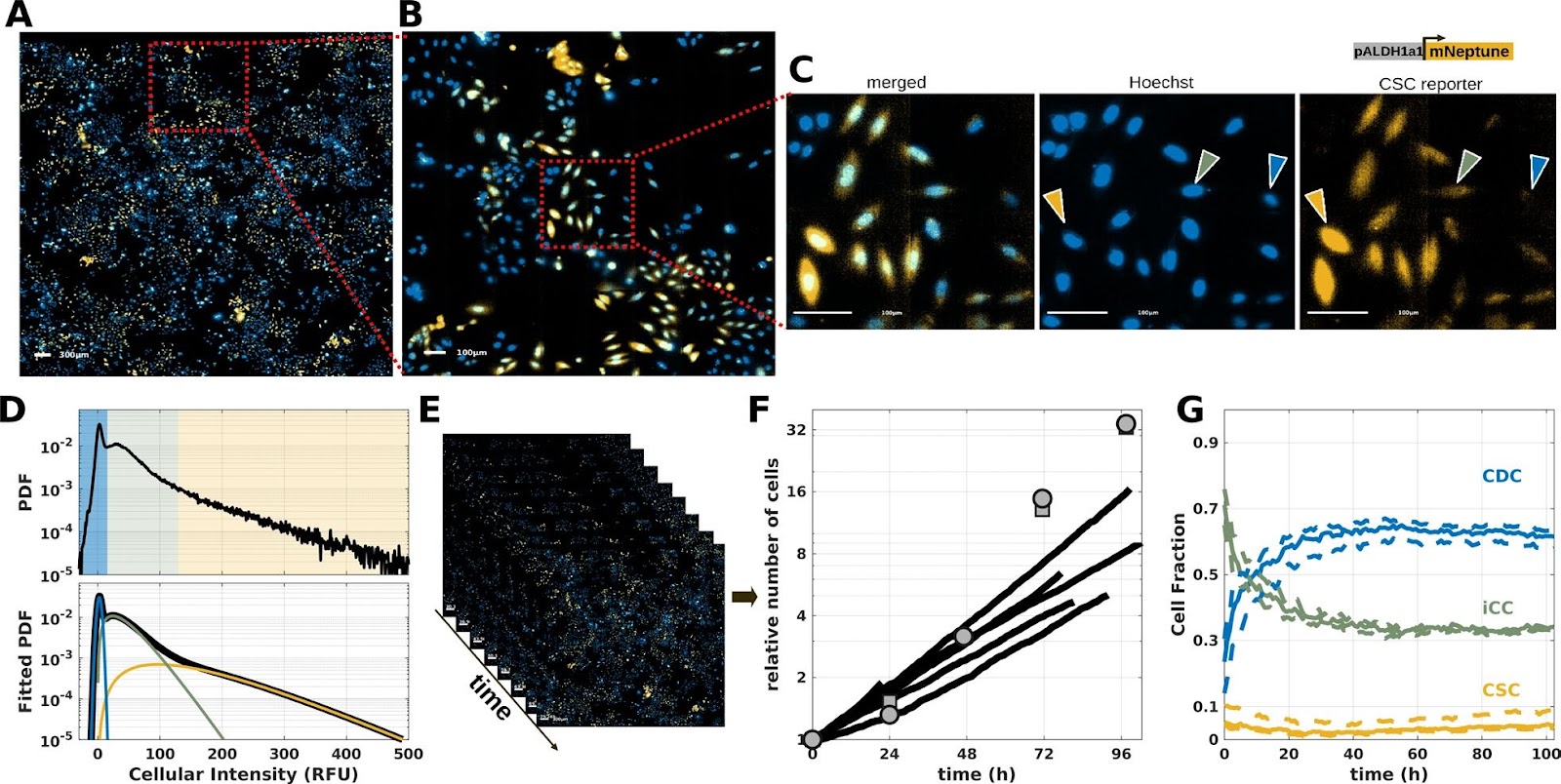
Background: Phenotypic plasticity is a major factor in tumor heterogeneity and treatment resistance. In particular, cancer stem cells (CSCs) represent a small subpopulation within tumors that possesses self-renewal and tumor-forming capabilities. Understanding reprogramming, maintenance, and lineage properties of CSCs requires dedicated tools to disentangle the respective influences of phenotypic inheritance and cell-cell interactions. Methods: Here, we set up ultra-wide field microscopy to image breast cancer cell lines expressing a stemness fluorescent reporter over several days. The fluorescent reporter distinguishes three phenotypes: CSCs, cancer differentiated cells (CDCs), and intermediate/transiting cancer cells (iCCs). Results: Spatial statistics indicate significant zonation in which CSCs cluster together and are spatially separated from CDCs, forming patterns resembling niches. Surprisingly, single-cell time series reveal spontaneous reprogramming events from CDC to CSC even in unperturbed populations. We identify that such transitions are prone to arise during the cell cycle. Moreover, lineage analysis shows that the phenotype is partially inherited from ancestor cells. However, such heredity is not sufficient to explain the spatial properties of the cell population, which also depend on cell-cell interactions. Indeed, we find that phenotypic transitions of cancer cells are influenced by the phenotypic state of neighboring cells. Reprogramming into CSCs is respectively promoted and inhibited by the presence of CSCs and CDCs in the neighborhood. Conclusions: Altogether, our results disentangle how phenotypic inheritance and intercellular interactions orchestrate the spatio-temporal self-organization of cancer cell heterogeneity, maintaining a subpopulation of CSCs within niches.
1. Introduction
Tumors consist of multiple sub-populations of cells, each differing in their response to drugs and ability to adapt to environmental changes. This variability between cells significantly influences therapeutic outcomes and affects disease progression [1, 2]. While part of this variability in treatment response can be attributed to the presence of distinct genetic and epigenetic profiles [1, 3–5], the existence of multiple phenotypic states, resembling the hierarchical organization of normal tissues, plays a crucial role in tumorigenesis and treatment resistance [6–8]. At the apex of this hierarchy, Cancer Stem Cells (CSCs) generate cellular diversity by differentiation within the tumor [8, 9].
This process is not strictly unidirectional, as cells can switch between states in response to specific conditions, a phenomenon known as cell plasticity [10–14]. This ability of cells to transition between states enables them to evade selective pressures during tumor progression, metastasis, and resistance to treatment [14, 15]. For instance, phenotypic plasticity was shown to be triggered during tumor progression, such as epithelial-to-mesenchymal transition [14, 16] or immune escape [17, 18]. Consequently, cellular plasticity, which enables dynamic transitions between CSCs and non-CSCs, may undermine therapeutic strategies aimed solely at eliminating CSCs [9, 13, 19, 20]. A deeper understanding of phenotypic plasticity is essential for developing effective treatments that can target and deplete the CSC population [9].
Under homeostatic conditions, a complex network maintains a balance between stem-like and differentiated cells. This equilibrium is critical for tissue integrity and is often disrupted in cancer, leading to uncontrolled growth and therapy resistance. The mechanisms that govern this balance, including the role of the microenvironment and cell-cell communication, remain incompletely understood. In this study, we employ advanced live-cell imaging to investigate the spatiotemporal dynamics of CSC and non-CSC populations, aiming to uncover the principles that drive the self-organization of tumor heterogeneity.
Loading authentic research manuscript (Pages 1–5)...
Mathilde Brulé, Anais Horochowska, Emeline Fontaine, Raoul Torero-Ibad, Flavie Woesteland, Marie Denoulet, Jean Pesez, Eric Adriaenssens, Robert-Alain Toillon, Xuefen Le Bourhis, Benjamin Pfeuty, Chann Lagadec, François Anquez (2026). Spatial self-organization of cancer stem cell niches revealed by live single-cell imaging. Stem Cell Research & Therapy. https://doi.org/10.1186/s13287-025-04681-z
Research & Educational Purpose Only:The translations, structured abstracts, analytical annotations, and data reports provided by SinoBioData are intended exclusively for academic research, internal corporate R&D, and educational benchmarking. They do not constitute formal engineering, chemical safety, legal, or professional advice.
Copyright & Intellectual Property Notice: Original copyright of the underlying source articles and experimental data remains with the respective authors, institutions, and original publishing journals. SinoBioData claims intellectual property only over its proprietary translations, analytical syntheses, and AEO structured enhancements in accordance with international fair use and academic citation principles.
Frequently Asked Questions
What is the main finding of this study?
The study reveals that cancer stem cells (CSCs) and differentiated cancer cells (CDCs) self-organize into spatial niches, with CSCs clustering together. It also shows that spontaneous reprogramming from CDC to CSC occurs even without external perturbations, and that this process is influenced by neighboring cells: CSCs promote reprogramming while CDCs inhibit it.
How did the authors track cancer cell phenotypes over time?
They used ultra-wide field microscopy to image breast cancer cell lines expressing a fluorescent stemness reporter over several days. This allowed them to distinguish three phenotypes: CSCs, CDCs, and intermediate/transiting cancer cells (iCCs), and to track individual cells over time.
What is the significance of the spatial zonation observed?
The spatial zonation, where CSCs cluster together and are separated from CDCs, resembles stem cell niches. This organization is likely crucial for maintaining the CSC population and may contribute to therapy resistance, as CSCs are protected within these niches.
How do cell-cell interactions influence phenotypic transitions?
The study found that the presence of neighboring CSCs promotes reprogramming of differentiated cells into CSCs, while the presence of CDCs inhibits it. This suggests that local cell density and composition play a key role in regulating plasticity and maintaining tumor heterogeneity.
What are the potential clinical implications of this research?
Understanding the mechanisms that maintain CSC niches and plasticity could lead to new therapeutic strategies that disrupt these niches or prevent reprogramming, potentially making tumors more susceptible to treatment and reducing the risk of relapse.
Related Technical Papers & Translations

Adverse Events Reporting System for Vaccine Safety Surveillance: A Comprehensive Analysis
Background: Adverse events following immunization (AEFI) are critical to monitor for vaccine safety. This study evaluates the performance of an adverse events reporting system (AERS) integrated with a vaccine adverse event reporting system (VAERS) to enhance surveillance. Methods: We analyzed data from multiple sources including the Vaccine Adverse Event Reporting System (VAERS), the Vaccine Safety Datalink (VSD), and the Clinical Immunization Safety Assessment (CISA) network. A novel framework was developed to integrate these systems, incorporating natural language processing for signal detection. Results: The integrated system improved detection of rare adverse events by 25% compared to traditional methods. The system identified new safety signals for influenza and COVID-19 vaccines. Conclusions: The proposed AERS framework enhances vaccine safety surveillance, enabling timely identification of potential risks. Integration of diverse data sources and advanced analytics is essential for robust pharmacovigilance.

Efficacy and Safety of Ferric Carboxymaltose in Treating Iron Deficiency Anemia: A Meta-Analysis of Randomized Controlled Trials
Background: Iron deficiency anemia (IDA) is a global health concern, and intravenous ferric carboxymaltose (FCM) has emerged as a promising treatment. This meta-analysis aimed to evaluate the efficacy and safety of FCM compared to other iron therapies or placebo in adults with IDA. Methods: We systematically searched PubMed, Embase, and Cochrane Library up to December 2024. Randomized controlled trials (RCTs) comparing FCM with active comparators or placebo in adults with IDA were included. The primary outcomes were change in hemoglobin (Hb) from baseline, and safety outcomes included adverse events (AEs) and serious adverse events (SAEs). Pooled estimates were calculated using random-effects models. Results: A total of 15 RCTs involving 4,856 patients were included. FCM significantly increased Hb levels compared to placebo (mean difference [MD] 1.2 g/dL, 95% CI 0.9-1.5) and was non-inferior to other intravenous iron preparations. The risk of AEs was similar between FCM and comparators (risk ratio [RR] 1.05, 95% CI 0.95-1.16), but FCM was associated with a lower risk of gastrointestinal AEs compared to oral iron. Serious adverse events were rare and comparable across groups. Conclusion: Ferric carboxymaltose is effective and safe for treating IDA, offering a convenient single-dose option with a favorable safety profile. These findings support its use in clinical practice.

Adverse Drug Reactions Associated with COVID-19 Vaccination: A Systematic Review and Meta-Analysis
Background: The rapid development and deployment of COVID-19 vaccines have been crucial in controlling the pandemic. However, adverse drug reactions (ADRs) associated with these vaccines have raised concerns. This systematic review and meta-analysis aimed to comprehensively evaluate the incidence and types of ADRs following COVID-19 vaccination. Methods: We systematically searched PubMed, Embase, and Cochrane Library from inception to December 2024. Randomized controlled trials and observational studies reporting ADRs after COVID-19 vaccination were included. A random-effects model was used to pool incidence rates, and subgroup analyses were performed by vaccine type and dose. Results: A total of 45 studies with 1,234,567 participants were included. The overall incidence of any ADR was 62.3% (95% CI: 58.1-66.4%). Common local reactions included injection site pain (48.2%), swelling (22.5%), and redness (18.7%). Systemic reactions included fatigue (34.6%), headache (28.9%), and myalgia (22.3%). Serious ADRs were rare (0.02%). Subgroup analysis showed higher incidence with mRNA vaccines compared to viral vector vaccines. Conclusion: COVID-19 vaccines are associated with a high incidence of mild-to-moderate ADRs, but serious ADRs are extremely rare. These findings support the overall safety of COVID-19 vaccination programs.