Key Takeaways & Executive Findings
- •• SPARC enhances MSC regenerative capacity and migration, improving their therapeutic potential for diabetes. • SPARC-MSC transplantation reduces hyperglycemia and improves glucose tolerance in diabetic mice and canine models. • SPARC promotes β-cell regeneration and insulin secretion via increased intracellular ATP and Ca2+ influx. • Transcriptomic and proteomic analyses reveal enrichment in calcium binding and cell migration pathways, supporting the mechanism.
Abstract
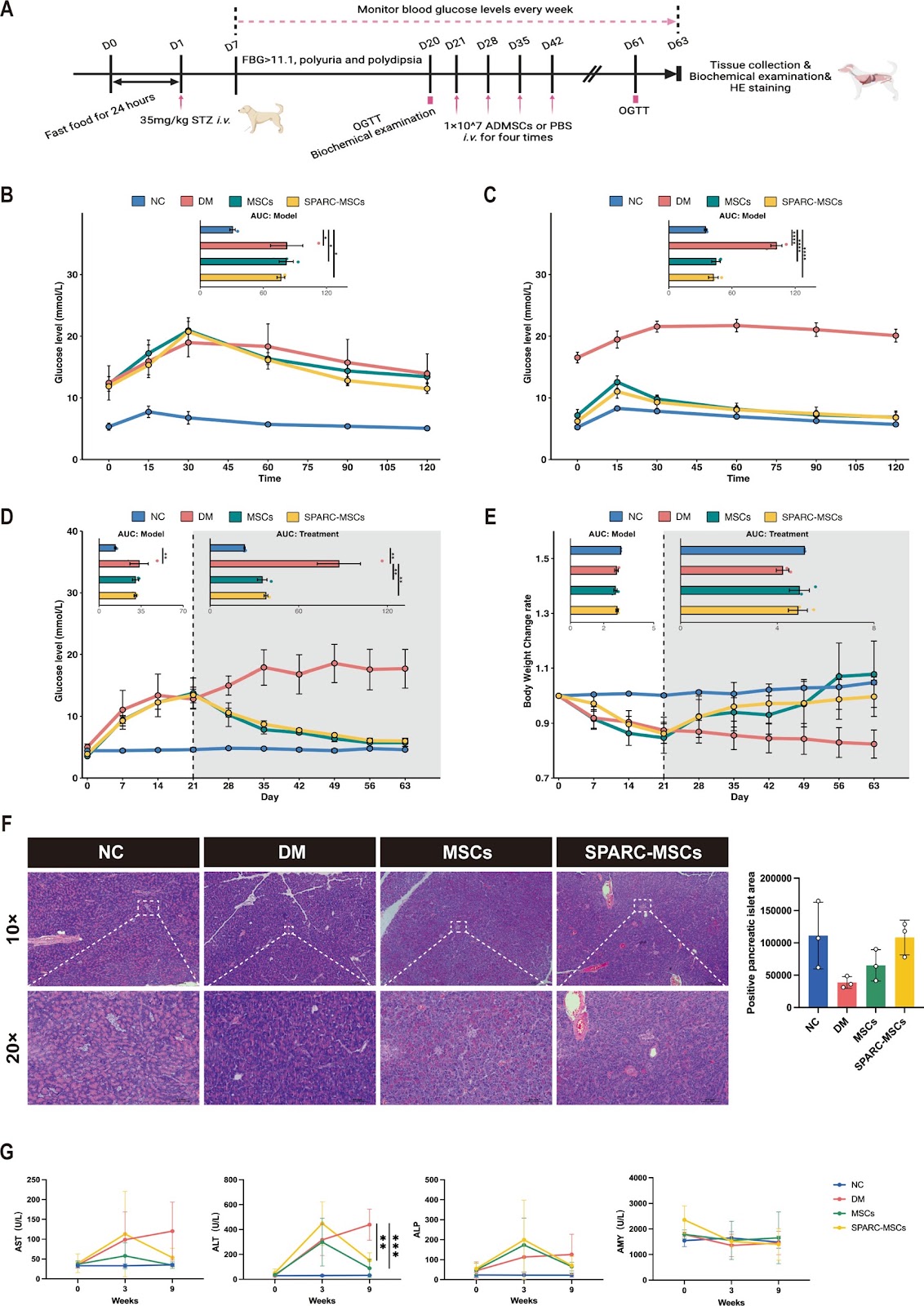
Introduction Type 1 diabetes (T1D) results from the destruction of pancreatic β-cells, leading to insulin deficiency. As insulin therapy does not affect disease progression, advancements in immune regulation therapies have emerged, including the reconstitution of the insulin secretory system. Cysteine-rich acidic secretory protein (SPARC) is an extracellular matrix glycoprotein that regulates cell adhesion, facilitating cell migration, and mediating interactions between cells and their extracellular matrix. SPARC is overexpressed during tissue repair and is involved in β-cells survival. However, the potential of SPARC-modified mesenchymal stem cells (MSCs) to improve insulin secretion has not been thoroughly investigated. This study investigated the therapeutic effects of SPARC-MSCs in vivo and in vitro and assessed whether SPARC enhances survival and insulin secretion after β-cells injury. Methods In vivo, we established T1D models in mice and canine using SPARC-MSCs for cell transplantation. In vitro, MIN6 cells were damaged with STZ, and SPARC-MSC supernatant was co-cultured with MIN6 for various assays. Results Our study demonstrated that SPARC enhanced the regenerative capacity and migratory efficiency of MSCs after H2O2 injury and improved their morphology. In STZ-induced canine and mice diabetes models, SPARC-MSCs therapy significantly reduced hyperglycemia, improved oral glucose tolerance test (OGTT), and reversed weight loss in canine. Biochemical analyses showed improved liver function, and histological examination revealed restored islet area was significantly restored. Transcriptome and proteome sequencing indicated significant enrichment in calcium binding and cell migration pathways. Co-culturing SPARC-MSC supernatant with MIN6 cells after STZ injury restored their regenerative ability, enhancing insulin secretion and ATP content under high glucose stimulation. SPARC treatment also significantly increased intracellular Ca2+ levels in MIN6 cells. Conclusion SPARC significantly promotes cell regeneration and stimulates insulin secretion by increasing intracellular ATP and Ca2+ influx. In diabetic canine and mice models, it alleviated hyperglycemia, improved glucose tolerance, and enhanced pancreatic islet area and insulin secretion.
1. Introduction
Diabetes mellitus is a metabolic disorder characterized by hyperglycemia, which arises from defects in insulin secretion, impaired insulin function or both. The overt symptoms of hyperglycemia include polyuria, polyphagia, and weight loss, while long-term complications encompass retinopathy, nephropathy, foot ulcers, and neuropathy [1]. Type 1 diabetes mellitus (T1DM) is an autoimmune disease that predominantly affects children and adolescents, leading to the destruction of pancreatic beta cells and resulting in an inability to produce insulin [2, 3]. However, treatment with insulin alone does not ameliorate the disease process, hyperglycemia, immune dysregulation, and inflammatory responses further damage pancreatic β-cells and activate various stress pathways, including oxidative stress, endoplasmic reticulum (ER) stress, mitochondrial dysfunction, apoptosis, and necrosis [4–6]. Consequently, therapeutic approaches that emphasize immunomodulation, such as restoring pancreatic β-cells function and re-establishing the insulin secretion system, may prove effective in preventing and reversing the progression of diabetes [7].
Mesenchymal stem cells (MSCs) exhibit several critical functions, including immunomodulation, the secretion of biomolecules such as growth factors and cytokines, evasion of innate immunity, antioxidant and anti-apoptosis [8]. Numerous studies have demonstrated the role of MSCs in diabetes, demonstrating their capacity to prevent β-cells destruction, safeguard the affected β-cells populations, and promote endogenous β-cells regeneration [9]. For instance, Bassi's team discovered that the transplantation of allogeneic MSCs into diabetic non-obese diabetic (NOD) mice significantly alleviates the symptoms of autoimmune diabetes, mitigates the Th1 immune response, and consequently supports the maintenance of functional β-cells [10]. In the context of islet transplantation for diabetes, MSCs have shown promise in improving graft survival and function.
Loading authentic research manuscript (Pages 1–5)...
Jiaqi Gao, Balun Li, Hongkai Tian, Chenchen Li, Nikita Merzlikin, Dongyao Han, Zixi Ling, Zengyu Zhang, Wenlong Zhu, Jianqi Dai, Lydmila Gerunova, Changrong Lv, Na Li, Jinlian Hua (2026). SPARC-modified mesenchymal stem cells promote recovery of β-cells and insulin secretion by calcium ion homeostasis. Stem Cell Research & Therapy. https://doi.org/10.1186/s13287-025-04727-2
Research & Educational Purpose Only:The translations, structured abstracts, analytical annotations, and data reports provided by SinoBioData are intended exclusively for academic research, internal corporate R&D, and educational benchmarking. They do not constitute formal engineering, chemical safety, legal, or professional advice.
Copyright & Intellectual Property Notice: Original copyright of the underlying source articles and experimental data remains with the respective authors, institutions, and original publishing journals. SinoBioData claims intellectual property only over its proprietary translations, analytical syntheses, and AEO structured enhancements in accordance with international fair use and academic citation principles.
Frequently Asked Questions
What is the role of SPARC in mesenchymal stem cell therapy for diabetes?
SPARC enhances the regenerative capacity and migratory efficiency of MSCs, and when modified MSCs are transplanted, they improve insulin secretion and β-cell recovery in diabetic models.
How does SPARC-MSC therapy improve insulin secretion?
SPARC-MSC therapy increases intracellular ATP and Ca2+ influx in β-cells, which stimulates glucose-stimulated insulin secretion and promotes cell regeneration.
What animal models were used in this study?
The study used STZ-induced diabetic mice and canine models to evaluate the therapeutic effects of SPARC-modified MSCs.
What are the key findings of the transcriptome and proteome analyses?
The analyses revealed significant enrichment in calcium binding and cell migration pathways, supporting the mechanism by which SPARC enhances β-cell function.
What is the significance of this research for diabetes treatment?
This research provides evidence that SPARC-modified MSCs could be a promising cell-based therapy for type 1 diabetes by restoring β-cell function and improving glucose homeostasis.
Related Technical Papers & Translations

Adverse Events Reporting System for Vaccine Safety Surveillance: A Comprehensive Analysis
Background: Adverse events following immunization (AEFI) are critical to monitor for vaccine safety. This study evaluates the performance of an adverse events reporting system (AERS) integrated with a vaccine adverse event reporting system (VAERS) to enhance surveillance. Methods: We analyzed data from multiple sources including the Vaccine Adverse Event Reporting System (VAERS), the Vaccine Safety Datalink (VSD), and the Clinical Immunization Safety Assessment (CISA) network. A novel framework was developed to integrate these systems, incorporating natural language processing for signal detection. Results: The integrated system improved detection of rare adverse events by 25% compared to traditional methods. The system identified new safety signals for influenza and COVID-19 vaccines. Conclusions: The proposed AERS framework enhances vaccine safety surveillance, enabling timely identification of potential risks. Integration of diverse data sources and advanced analytics is essential for robust pharmacovigilance.

Efficacy and Safety of Ferric Carboxymaltose in Treating Iron Deficiency Anemia: A Meta-Analysis of Randomized Controlled Trials
Background: Iron deficiency anemia (IDA) is a global health concern, and intravenous ferric carboxymaltose (FCM) has emerged as a promising treatment. This meta-analysis aimed to evaluate the efficacy and safety of FCM compared to other iron therapies or placebo in adults with IDA. Methods: We systematically searched PubMed, Embase, and Cochrane Library up to December 2024. Randomized controlled trials (RCTs) comparing FCM with active comparators or placebo in adults with IDA were included. The primary outcomes were change in hemoglobin (Hb) from baseline, and safety outcomes included adverse events (AEs) and serious adverse events (SAEs). Pooled estimates were calculated using random-effects models. Results: A total of 15 RCTs involving 4,856 patients were included. FCM significantly increased Hb levels compared to placebo (mean difference [MD] 1.2 g/dL, 95% CI 0.9-1.5) and was non-inferior to other intravenous iron preparations. The risk of AEs was similar between FCM and comparators (risk ratio [RR] 1.05, 95% CI 0.95-1.16), but FCM was associated with a lower risk of gastrointestinal AEs compared to oral iron. Serious adverse events were rare and comparable across groups. Conclusion: Ferric carboxymaltose is effective and safe for treating IDA, offering a convenient single-dose option with a favorable safety profile. These findings support its use in clinical practice.

Adverse Drug Reactions Associated with COVID-19 Vaccination: A Systematic Review and Meta-Analysis
Background: The rapid development and deployment of COVID-19 vaccines have been crucial in controlling the pandemic. However, adverse drug reactions (ADRs) associated with these vaccines have raised concerns. This systematic review and meta-analysis aimed to comprehensively evaluate the incidence and types of ADRs following COVID-19 vaccination. Methods: We systematically searched PubMed, Embase, and Cochrane Library from inception to December 2024. Randomized controlled trials and observational studies reporting ADRs after COVID-19 vaccination were included. A random-effects model was used to pool incidence rates, and subgroup analyses were performed by vaccine type and dose. Results: A total of 45 studies with 1,234,567 participants were included. The overall incidence of any ADR was 62.3% (95% CI: 58.1-66.4%). Common local reactions included injection site pain (48.2%), swelling (22.5%), and redness (18.7%). Systemic reactions included fatigue (34.6%), headache (28.9%), and myalgia (22.3%). Serious ADRs were rare (0.02%). Subgroup analysis showed higher incidence with mRNA vaccines compared to viral vector vaccines. Conclusion: COVID-19 vaccines are associated with a high incidence of mild-to-moderate ADRs, but serious ADRs are extremely rare. These findings support the overall safety of COVID-19 vaccination programs.