Key Takeaways & Executive Findings
- •• SOX2 is highly expressed in LUSC and correlates with poor prognosis, driving carboplatin resistance. • SOX2 directly transactivates NRF2, enhancing glutathione synthesis to counteract carboplatin-induced oxidative stress. • Inhibition of NRF2, either pharmacologically or genetically, reverses SOX2-mediated carboplatin resistance in vitro and in vivo. • The SOX2-NRF2 axis is a promising therapeutic target; NRF2 inhibition could overcome chemoresistance in LUSC.
Abstract
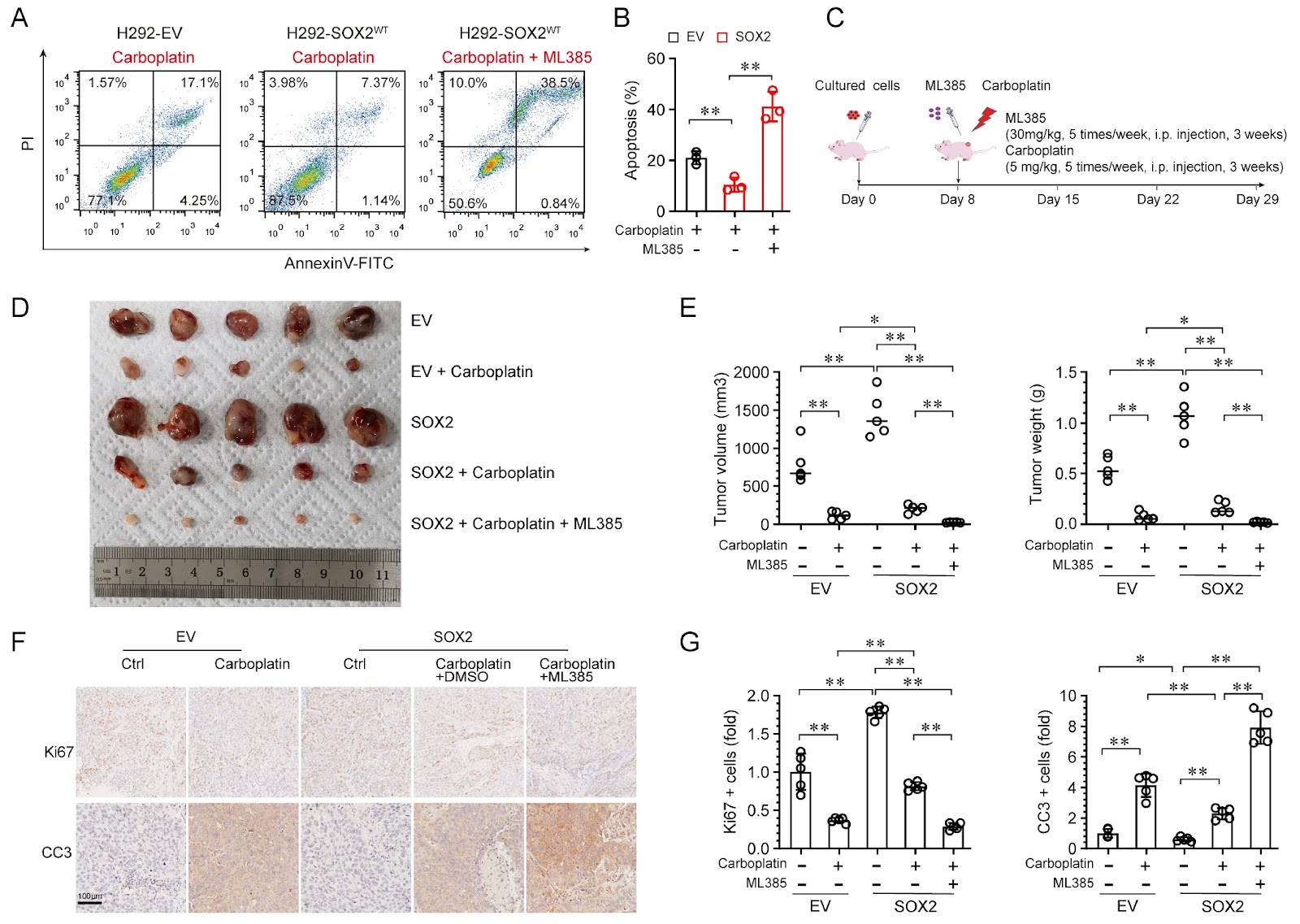
Lung squamous cell carcinoma (LUSC) remains a major therapeutic challenge because of its pronounced resistance to chemotherapy, particularly carboplatin. In this study, we investigate the role of SOX2, a lineage-survival oncogene, in mediating carboplatin resistance in LUSC. We demonstrate that SOX2 is highly expressed in LUSC and is significantly associated with poor prognosis. Our results show that SOX2 directly transactivates the expression of NRF2, a master regulator of cellular redox homeostasis, thereby increasing glutathione (GSH) synthesis and protecting cells from carboplatin-induced oxidative stress. Pharmacological or genetic inhibition of NRF2 effectively abrogates SOX2-mediated carboplatin resistance both in vitro and in vivo, resensitizing LUSC cells to chemotherapy. These findings highlight SOX2 as a critical redox regulator that modulates NRF2 signaling to promote carboplatin resistance in LUSC. The identification of the SOX2-NRF2 axis as a potential therapeutic target suggests that NRF2 inhibition may represent a promising strategy to overcome chemoresistance in LUSC.
1. Introduction
Lung squamous cell carcinoma (LUSC) accounts for approximately 20%–30% of non-small cell lung cancer (NSCLC) cases and collectively comprises approximately 80% of all lung cancers [1][2]. Since the 1990s, the incidence of LUSC has declined, largely due to the success of smoking cessation programs [3], in contrast to lung adenocarcinoma (LUAD), another predominant NSCLC subtype that has benefited from targeted therapies against specific genetic alterations [4]. Despite significant advances in cancer therapeutics, effective therapies specifically tailored to LUSC are lacking [5]. Most LUSC patients are diagnosed at an advanced stage, characterized by limited treatment options and high disease-related mortality [6]. Treatment typically involves platinum-based chemotherapy regimens, such as carboplatin-containing combinations. Recent therapeutic approaches include the use of EGFR monoclonal antibodies (e.g., necitumumab) [7] and immune checkpoint inhibitors (e.g., pembrolizumab, pislelizumab, sintilimab) [8–10]. Platinum-immunotherapy combinations have now become the standard first-line treatment for metastatic LUSC [6,11]. However, despite these advancements, durable responses and long-term survival benefits remain rare [12]. Therefore, understanding the mechanisms underlying chemoresistance in LUSC is critical for developing novel therapeutic strategies to overcome resistance and improve patient outcomes.
Lineage survival oncogenes are activated by somatic DNA alterations in cancers arising from the cell lineages where these genes contribute to normal development [13]. The transcription factor SOX2 is frequently subjected to genomic amplification on chromosome 3q26.33 in squamous cell carcinomas (SCCs) and is now recognized as a key driver oncogene that promotes tumorigenesis, proliferation, and invasion/metastasis [14,15]. Notably, SOX2 plays a crucial role in determining squamous cell fate across various cellular origins [16]. Additionally, SOX2, in cooperation with PKCι or ΔNp63α, drives tumorigenesis in LUSC [17,18]. Cancer stem cells (CSCs), a subset of tumor cells with self-renewal and differentiation capabilities, are widely acknowledged for their critical role in therapeutic resistance [19]. SOX2 is a key transcription factor that not only maintains stem cell properties but also confers drug resistance [19]. Elevated SOX2 expression has been shown to be correlated with both drug resistance and poor patient survival [20]. Consequently, targeting SOX2 represents an attractive therapeutic strategy for cancer treatment [21]. However, progress in the development of SOX2 inhibitors has been limited, largely because of the “undruggable” nature of SOX2 as a transcription factor. Despite its well-established role in cancer therapy resistance, the contribution of SOX2 to carboplatin resistance in lung squamous cell carcinoma (LUSC) remains poorly understood.
Loading authentic research manuscript (Pages 1–5)...
Hanfei Gao, Chaomei Li, Jie Sun, Liyuan Deng, Jia Li, Zhiqiang Wu, Hu Chen (2026). SOX2 transactivates NRF2 to promote carboplatin resistance in lung squamous cell carcinoma. Acta Biochimica et Biophysica Sinica. https://doi.org/10.3724/abbs.2025228
Research & Educational Purpose Only:The translations, structured abstracts, analytical annotations, and data reports provided by SinoBioData are intended exclusively for academic research, internal corporate R&D, and educational benchmarking. They do not constitute formal engineering, chemical safety, legal, or professional advice.
Copyright & Intellectual Property Notice: Original copyright of the underlying source articles and experimental data remains with the respective authors, institutions, and original publishing journals. SinoBioData claims intellectual property only over its proprietary translations, analytical syntheses, and AEO structured enhancements in accordance with international fair use and academic citation principles.
Frequently Asked Questions
What is the role of SOX2 in carboplatin resistance in LUSC?
SOX2 is highly expressed in LUSC and directly transactivates NRF2, which increases glutathione synthesis and protects cells from carboplatin-induced oxidative stress, thereby promoting carboplatin resistance.
How does NRF2 inhibition affect SOX2-mediated carboplatin resistance?
Pharmacological or genetic inhibition of NRF2 effectively abrogates SOX2-mediated carboplatin resistance both in vitro and in vivo, resensitizing LUSC cells to chemotherapy.
What is the clinical significance of the SOX2-NRF2 axis?
The SOX2-NRF2 axis is identified as a potential therapeutic target, and NRF2 inhibition may represent a promising strategy to overcome chemoresistance in LUSC.
What are the key findings of this study?
The study demonstrates that SOX2 promotes carboplatin resistance by transactivating NRF2, and that inhibiting NRF2 reverses this resistance, highlighting a novel therapeutic approach for LUSC.
Related Technical Papers & Translations

Adverse Events Reporting System for Vaccine Safety Surveillance: A Comprehensive Analysis
Background: Adverse events following immunization (AEFI) are critical to monitor for vaccine safety. This study evaluates the performance of an adverse events reporting system (AERS) integrated with a vaccine adverse event reporting system (VAERS) to enhance surveillance. Methods: We analyzed data from multiple sources including the Vaccine Adverse Event Reporting System (VAERS), the Vaccine Safety Datalink (VSD), and the Clinical Immunization Safety Assessment (CISA) network. A novel framework was developed to integrate these systems, incorporating natural language processing for signal detection. Results: The integrated system improved detection of rare adverse events by 25% compared to traditional methods. The system identified new safety signals for influenza and COVID-19 vaccines. Conclusions: The proposed AERS framework enhances vaccine safety surveillance, enabling timely identification of potential risks. Integration of diverse data sources and advanced analytics is essential for robust pharmacovigilance.

Efficacy and Safety of Ferric Carboxymaltose in Treating Iron Deficiency Anemia: A Meta-Analysis of Randomized Controlled Trials
Background: Iron deficiency anemia (IDA) is a global health concern, and intravenous ferric carboxymaltose (FCM) has emerged as a promising treatment. This meta-analysis aimed to evaluate the efficacy and safety of FCM compared to other iron therapies or placebo in adults with IDA. Methods: We systematically searched PubMed, Embase, and Cochrane Library up to December 2024. Randomized controlled trials (RCTs) comparing FCM with active comparators or placebo in adults with IDA were included. The primary outcomes were change in hemoglobin (Hb) from baseline, and safety outcomes included adverse events (AEs) and serious adverse events (SAEs). Pooled estimates were calculated using random-effects models. Results: A total of 15 RCTs involving 4,856 patients were included. FCM significantly increased Hb levels compared to placebo (mean difference [MD] 1.2 g/dL, 95% CI 0.9-1.5) and was non-inferior to other intravenous iron preparations. The risk of AEs was similar between FCM and comparators (risk ratio [RR] 1.05, 95% CI 0.95-1.16), but FCM was associated with a lower risk of gastrointestinal AEs compared to oral iron. Serious adverse events were rare and comparable across groups. Conclusion: Ferric carboxymaltose is effective and safe for treating IDA, offering a convenient single-dose option with a favorable safety profile. These findings support its use in clinical practice.

Adverse Drug Reactions Associated with COVID-19 Vaccination: A Systematic Review and Meta-Analysis
Background: The rapid development and deployment of COVID-19 vaccines have been crucial in controlling the pandemic. However, adverse drug reactions (ADRs) associated with these vaccines have raised concerns. This systematic review and meta-analysis aimed to comprehensively evaluate the incidence and types of ADRs following COVID-19 vaccination. Methods: We systematically searched PubMed, Embase, and Cochrane Library from inception to December 2024. Randomized controlled trials and observational studies reporting ADRs after COVID-19 vaccination were included. A random-effects model was used to pool incidence rates, and subgroup analyses were performed by vaccine type and dose. Results: A total of 45 studies with 1,234,567 participants were included. The overall incidence of any ADR was 62.3% (95% CI: 58.1-66.4%). Common local reactions included injection site pain (48.2%), swelling (22.5%), and redness (18.7%). Systemic reactions included fatigue (34.6%), headache (28.9%), and myalgia (22.3%). Serious ADRs were rare (0.02%). Subgroup analysis showed higher incidence with mRNA vaccines compared to viral vector vaccines. Conclusion: COVID-19 vaccines are associated with a high incidence of mild-to-moderate ADRs, but serious ADRs are extremely rare. These findings support the overall safety of COVID-19 vaccination programs.