Key Takeaways & Executive Findings
- •• Plasma sPRR levels are significantly elevated in patients with atherosclerosis compared to non-AS controls, suggesting its potential as a novel laboratory biomarker. • In a mouse model of atherosclerosis (ApoE–/– mice fed a high-fat diet), plasma sPRR levels were also significantly increased, corroborating the clinical findings. • The study provides evidence that sPRR may serve as a non-invasive indicator for atherosclerosis severity, potentially aiding in early diagnosis and risk stratification. • These findings highlight the role of the (pro)renin receptor in atherosclerosis pathophysiology and open avenues for targeted therapeutic strategies.
Abstract
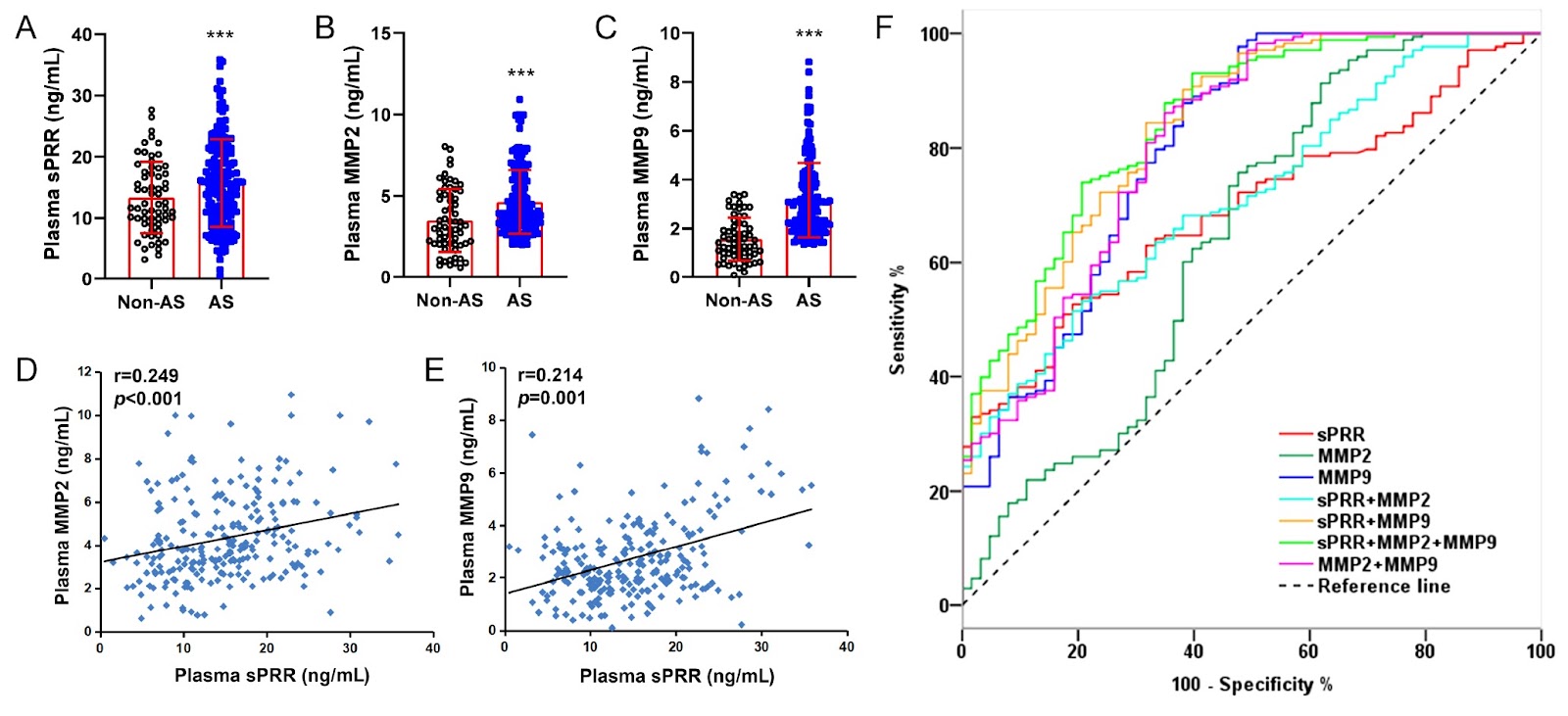
Atherosclerosis (AS), a chronic inflammatory disease involving the large and middle arteries, is characterized by inflammation, abnormal deposition of lipids, and other pathological events. Endothelial cell injury, the migration and proliferation of vascular smooth muscle cells, and the inflammatory polarization of macrophages play crucial roles in the formation and progression of atherosclerotic plaques. The renin–angiotensin system (RAS), an essential regulator of the inflammatory response, is closely correlated with atherosclerotic plaque formation. Targeting the components of the RAS could be a promising therapeutic strategy for AS. (Pro)renin receptor (PRR), a single transmembrane protein, works as a key regulator of the local RAS with nearly equal affinity to bind to renin and (pro)renin and plays essential roles in cardiovascular homeostasis by targeting multiple RAS-dependent and RAS-independent intracellular signals in cardiovascular cells. sPRR, a soluble form of PRR, is generated by proteases (Furin, a disintegrin and metalloproteinase 19, site-1-protease, or an unknown convertase)-mediated cleavage of the full-length PRR and is released into extracellular spaces, including the plasma and urine, where it participates in various physio-pathological processes. An increasing number of studies have demonstrated an increase in circulating sPRR levels in patients and animals with various cardiovascular diseases, including hypertension and heart failure, which may be promising indicators of these cardiovascular diseases. Amari et al. reported that serum sPRR levels were significantly greater in hemodialysis patients with an ankle–brachial index (ABI) < 0.9 (an indicator of severe AS or obstruction of lower limb arteries) than in patients with an ABI ≥0.9. They reported a negative correlation between serum sPRR levels and ABI independent of other atherogenic risk factors, including age and hemoglobin A1c, suggesting an association between serum sPRR levels and severe AS of the lower limbs. Thus, increased serum sPRR levels may be a marker for AS progression. However, the clinical significance of the sPRR in patients with AS remains unclear. To further determine the association between plasma sPRR levels and the severity of AS, we prospectively enrolled 236 participants in the present study, including 63 subjects with non-AS (n = 63, 58.8 ± 11.7 years) and 173 with AS (n = 173, 67.1 ± 11.0 years, P < 0.001 vs the non-AS group). The diagnosis of subclinical atherosclerosis was established after the carotid intima–media thickness and plaque area were evaluated via bilateral carotid ultrasonography. Patients with heart diseases (rheumatic heart disease, valvular heart disease, and cardiomyopathy), hepatic failure, chronic kidney disease, hyperthyroidism, chronic inflammatory disorders, malignancy, or pulmonary embolism were excluded. The baseline clinical characteristics are shown in Supplementary Table S1. Although plasma brain natriuretic peptide, urea nitrogen, and triglyceride levels were slightly higher in the AS group than in the non-AS group, there were no significant differences in sex, body mass index, comorbidities, blood pressure, parameters reflecting cardiac function, and plasma creatine, uric acid, low-density lipoprotein cholesterol (LDL-c), high density lipoprotein cholesterol (HDL-c), and total cholesterol between the two groups. The ApoE–/– mice were fed with a high-fat diet (HFD) for 16 weeks to establish an atherosclerotic mouse model successfully, which was determined by Oil-red-O staining of the full-length aorta and the aortic root as well as H&E staining of the aortic root (Supplementary Figure S1). The studies involving human participants were reviewed and approved by the Affiliated Hospital of Jiangxi University of Chinese Medicine (JZFYLL20230208002). The patients/participants provided written informed consent to participate in this study. The studies involving animals were reviewed and approved by the Animal Care and Use Committee, which approved the animal protocols at Jiangxi University of Chinese Medicine (No. JZLLSC20230254). The levels of plasma sPRR in AS patients were significantly higher than those in the non-AS groups (15.9 ± 6.9 vs 11.5 ± 4.0 ng/mL, P < 0.001, Figure 1A). After HFD feeding for 16 weeks, the levels of plasma sPRR in ApoE–/– mice were also significantly greater than those in ApoE–/– mice fed with a normal diet (24.1 ± 8.6 vs 10.3 ± 3.1 ng/mL, P < 0.001; Figure 2A). Thus, plasma sPRR levels are significantly elevated under atherosclerotic
1. Introduction
Atherosclerosis (AS), a chronic inflammatory disease involving the large and middle arteries, is characterized by inflammation, abnormal deposition of lipids, and other pathological events. Endothelial cell injury, the migration and proliferation of vascular smooth muscle cells, and the inflammatory polarization of macrophages play crucial roles in the formation and progression of atherosclerotic plaques. The renin–angiotensin system (RAS), an essential regulator of the inflammatory response, is closely correlated with atherosclerotic plaque formation. Targeting the components of the RAS could be a promising therapeutic strategy for AS.
(Pro)renin receptor (PRR), a single transmembrane protein, works as a key regulator of the local RAS with nearly equal affinity to bind to renin and (pro)renin and plays essential roles in cardiovascular homeostasis by targeting multiple RAS-dependent and RAS-independent intracellular signals in cardiovascular cells. sPRR, a soluble form of PRR, is generated by proteases (Furin, a disintegrin and metalloproteinase 19, site-1-protease, or an unknown convertase)-mediated cleavage of the full-length PRR and is released into extracellular spaces, including the plasma and urine, where it participates in various physio-pathological processes. An increasing number of studies have demonstrated an increase in circulating sPRR levels in patients and animals with various cardiovascular diseases, including hypertension and heart failure, which may be promising indicators of these cardiovascular diseases.
Loading authentic research manuscript (Pages 1–5)...
Chunju Liu, Shanshan Song, Xiaoli Yi, Huiru Yang, Jianhua Xiong, Mulan Wang, Wenting Tan, Mengzhi Zhu, Lixiang Zheng, Jun Yu, Chuanming Xu (2026). Soluble (pro)renin receptor as a novel laboratory biomarker of atherosclerosis. Acta Biochimica et Biophysica Sinica. https://doi.org/10.3724/abbs.2024150
Research & Educational Purpose Only:The translations, structured abstracts, analytical annotations, and data reports provided by SinoBioData are intended exclusively for academic research, internal corporate R&D, and educational benchmarking. They do not constitute formal engineering, chemical safety, legal, or professional advice.
Copyright & Intellectual Property Notice: Original copyright of the underlying source articles and experimental data remains with the respective authors, institutions, and original publishing journals. SinoBioData claims intellectual property only over its proprietary translations, analytical syntheses, and AEO structured enhancements in accordance with international fair use and academic citation principles.
Frequently Asked Questions
What is the soluble (pro)renin receptor (sPRR) and how is it related to atherosclerosis?
sPRR is a soluble form of the (pro)renin receptor, generated by protease-mediated cleavage of the full-length PRR. It is released into extracellular spaces and has been associated with cardiovascular diseases. This study found that plasma sPRR levels are significantly elevated in patients with atherosclerosis, suggesting it may serve as a novel biomarker for the condition.
How was the study conducted to assess sPRR levels in atherosclerosis?
The study prospectively enrolled 236 participants (63 non-AS and 173 AS) and measured plasma sPRR levels. Additionally, an atherosclerotic mouse model was established using ApoE–/– mice fed a high-fat diet for 16 weeks, and plasma sPRR levels were measured. Both human and mouse data showed significantly higher sPRR levels in the atherosclerotic groups.
What are the key findings of this research?
The key findings are that plasma sPRR levels are significantly elevated in both human patients with atherosclerosis and in a mouse model of the disease, indicating that sPRR could be a promising laboratory biomarker for atherosclerosis.
What are the potential clinical implications of this study?
The study suggests that measuring plasma sPRR levels could aid in the diagnosis and risk stratification of atherosclerosis, potentially serving as a non-invasive biomarker. It also highlights the role of the renin-angiotensin system in atherosclerosis and may inform future therapeutic strategies targeting PRR.
What is the significance of using ApoE–/– mice in this study?
ApoE–/– mice are a well-established model for atherosclerosis when fed a high-fat diet. They develop atherosclerotic lesions similar to human pathology, making them suitable for studying the disease and validating biomarkers like sPRR.
Related Technical Papers & Translations

Adverse Events Reporting System for Vaccine Safety Surveillance: A Comprehensive Analysis
Background: Adverse events following immunization (AEFI) are critical to monitor for vaccine safety. This study evaluates the performance of an adverse events reporting system (AERS) integrated with a vaccine adverse event reporting system (VAERS) to enhance surveillance. Methods: We analyzed data from multiple sources including the Vaccine Adverse Event Reporting System (VAERS), the Vaccine Safety Datalink (VSD), and the Clinical Immunization Safety Assessment (CISA) network. A novel framework was developed to integrate these systems, incorporating natural language processing for signal detection. Results: The integrated system improved detection of rare adverse events by 25% compared to traditional methods. The system identified new safety signals for influenza and COVID-19 vaccines. Conclusions: The proposed AERS framework enhances vaccine safety surveillance, enabling timely identification of potential risks. Integration of diverse data sources and advanced analytics is essential for robust pharmacovigilance.

Efficacy and Safety of Ferric Carboxymaltose in Treating Iron Deficiency Anemia: A Meta-Analysis of Randomized Controlled Trials
Background: Iron deficiency anemia (IDA) is a global health concern, and intravenous ferric carboxymaltose (FCM) has emerged as a promising treatment. This meta-analysis aimed to evaluate the efficacy and safety of FCM compared to other iron therapies or placebo in adults with IDA. Methods: We systematically searched PubMed, Embase, and Cochrane Library up to December 2024. Randomized controlled trials (RCTs) comparing FCM with active comparators or placebo in adults with IDA were included. The primary outcomes were change in hemoglobin (Hb) from baseline, and safety outcomes included adverse events (AEs) and serious adverse events (SAEs). Pooled estimates were calculated using random-effects models. Results: A total of 15 RCTs involving 4,856 patients were included. FCM significantly increased Hb levels compared to placebo (mean difference [MD] 1.2 g/dL, 95% CI 0.9-1.5) and was non-inferior to other intravenous iron preparations. The risk of AEs was similar between FCM and comparators (risk ratio [RR] 1.05, 95% CI 0.95-1.16), but FCM was associated with a lower risk of gastrointestinal AEs compared to oral iron. Serious adverse events were rare and comparable across groups. Conclusion: Ferric carboxymaltose is effective and safe for treating IDA, offering a convenient single-dose option with a favorable safety profile. These findings support its use in clinical practice.

Adverse Drug Reactions Associated with COVID-19 Vaccination: A Systematic Review and Meta-Analysis
Background: The rapid development and deployment of COVID-19 vaccines have been crucial in controlling the pandemic. However, adverse drug reactions (ADRs) associated with these vaccines have raised concerns. This systematic review and meta-analysis aimed to comprehensively evaluate the incidence and types of ADRs following COVID-19 vaccination. Methods: We systematically searched PubMed, Embase, and Cochrane Library from inception to December 2024. Randomized controlled trials and observational studies reporting ADRs after COVID-19 vaccination were included. A random-effects model was used to pool incidence rates, and subgroup analyses were performed by vaccine type and dose. Results: A total of 45 studies with 1,234,567 participants were included. The overall incidence of any ADR was 62.3% (95% CI: 58.1-66.4%). Common local reactions included injection site pain (48.2%), swelling (22.5%), and redness (18.7%). Systemic reactions included fatigue (34.6%), headache (28.9%), and myalgia (22.3%). Serious ADRs were rare (0.02%). Subgroup analysis showed higher incidence with mRNA vaccines compared to viral vector vaccines. Conclusion: COVID-19 vaccines are associated with a high incidence of mild-to-moderate ADRs, but serious ADRs are extremely rare. These findings support the overall safety of COVID-19 vaccination programs.