Key Takeaways & Executive Findings
- •• CPP, a small chemical molecule, directly promotes angiogenesis in vivo in severe lower limb ischemia and diabetes-induced limb vascular reduction models. • Subcutaneous multipoint injection of CPP significantly enhances blood perfusion and capillary density in ischemic limbs of mice. • The 1 mg/kg/day dose of CPP shows statistically significant improvement in capillary density compared to control, while the 10 mg/kg/day dose shows a trend but not significant. • CPP offers a promising therapeutic strategy for peripheral artery disease and chronic limb-threatening ischemia, potentially overcoming limitations of cell-based therapies.
Abstract
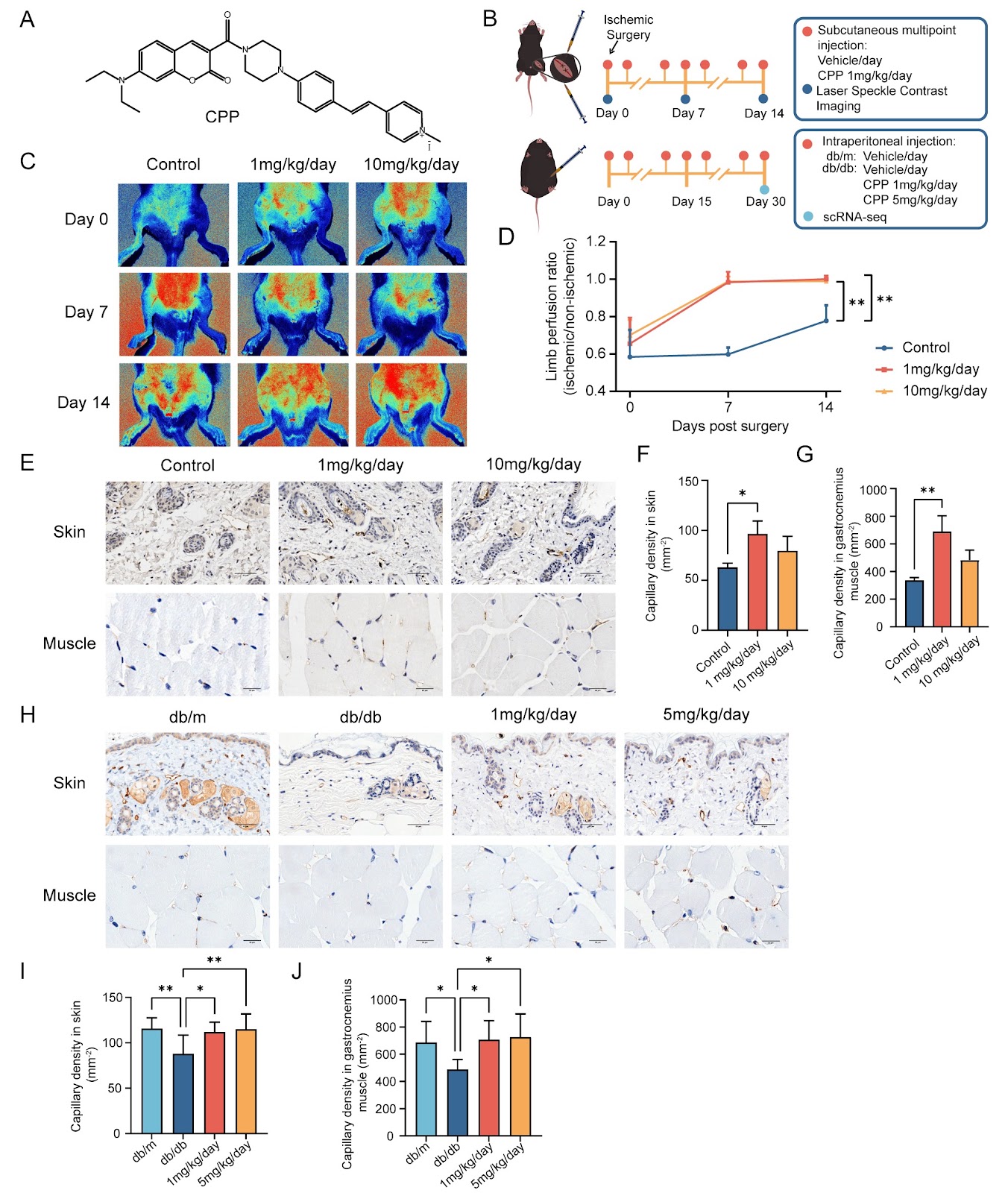
Patients with peripheral artery disease (PAD) commonly experience chronic limb-threatening ischemia (CLTI) in the end stage, leading to severe functional impairment of the limbs, amputation, and even death. Among the various disease factors contributing to PAD, diabetes is significantly associated with PAD risk, leading to more severe symptoms and a poorer prognosis. Promoting angiogenesis at ischemic sites and improving blood flow are key to the recovery of limbs from ischemic injury. Angiogenic therapies based on cells and small-molecule drugs are considered important and promising strategies. Cell-based therapies can be classified based on cell source into allogeneic therapies and autologous therapies. Autologous cells offer the advantage of not requiring immunosuppression but may be limited by factors such as cell unavailability and scarcity due to autologous factors. Allogeneic cells, while offering a more abundant cell source, present drawbacks, including immune incompatibility and ethical concerns, which restrict their application. Small chemical molecules offer advantages such as convenience, low cost, ease of synthesis and storage, and rapid action without the need for introducing exogenous genes. They circumvent the high costs associated with cell therapies and potential side effects from allogeneic cell transplantation, holding significant promise and potential in both biomedical research and clinical applications. Fibroblasts are a cell type with functional and transcriptional heterogeneity and cellular fate plasticity, making them a promising source of seed cells for clinical tissue and organ repair and regeneration. Small molecules have become recognized as crucial tools for the induction of cellular reprogramming. In our laboratory’s previous research, a novel small chemical molecule probe, CPP ((E)-4-(4-(4-(7-(diethylamino)-2-oxo-2H-chromene-3-carbonyl)piperazin-1-yl)styryl)-1-methylpyridin-1-ium iodide), was identified as an inhibitor of prolyl-4-hydroxylase 2 (PHD2). CPP induces the differentiation of cultured human dermal fibroblasts into vascular endothelial cells (VECs) via the PHD2/hypoxia-inducible factor-1α/hairy-related transcription factor 1 (PHD2/HIF1α/HEY1) signaling pathway. The differentiated VECs exhibited therapeutic efficacy in treating lower limb ischemia in mice, indicating that CPP holds promise as a therapeutic candidate for limb ischemia. In this study, we aimed to investigate the capability of CPP to directly induce angiogenesis in vivo under conditions of vascular injury. Critical limb ischemia (CLI) occurs at the end stage of PAD. To evaluate the in situ therapeutic effects of CPP on CLI, a CLI model was established using C57BL/6 mice (Hubei Research Center of Laboratory Animals, Wuhan, China). CPP was synthesized and provided by the laboratory of Professor Baoxiang Zhao at Shandong University (Jinan, China). Following surgery, continuous subcutaneous multipoint injections of CPP were administered for 14 d to mimic localized drug treatment (Figure 1A). Laser speckle blood flow imaging was used to assess lower limb perfusion on days 0, 7, and 14 (Figure 1B, upper panel). The results showed that by day 7 post-surgery, both CPP concentrations significantly enhanced perfusion in the ischemic limb compared to the control group. From days 7 to 14, perfusion changes in both CPP-treated groups plateaued. Meanwhile, the control group showed increased perfusion. Throughout the treatment period, no significant differences were observed between the 1 and 10 mg/kg/day CPP treatment groups (Figure 1C,D). On day 14, the capillary density in the skin and muscle was significantly higher in the 1 mg/kg/day CPP group than in the control group. Although the 10 mg/kg/day group had a slightly higher density than the control, the difference was not statistically significant (Figure 1E–G). In addition, the organ toxicity
1. Introduction
Patients with peripheral artery disease (PAD) commonly experience chronic limb-threatening ischemia (CLTI) in the end stage, leading to severe functional impairment of the limbs, amputation, and even death. Among the various disease factors contributing to PAD, diabetes is significantly associated with PAD risk, leading to more severe symptoms and a poorer prognosis. Promoting angiogenesis at ischemic sites and improving blood flow are key to the recovery of limbs from ischemic injury. Angiogenic therapies based on cells and small-molecule drugs are considered important and promising strategies.
Cell-based therapies can be classified based on cell source into allogeneic therapies and autologous therapies. Autologous cells offer the advantage of not requiring immunosuppression but may be limited by factors such as cell unavailability and scarcity due to autologous factors. Allogeneic cells, while offering a more abundant cell source, present drawbacks, including immune incompatibility and ethical concerns, which restrict their application. Small chemical molecules offer advantages such as convenience, low cost, ease of synthesis and storage, and rapid action without the need for introducing exogenous genes. They circumvent the high costs associated with cell therapies and potential side effects from allogeneic cell transplantation, holding significant promise and potential in both biomedical research and clinical applications.
Fibroblasts are a cell type with functional and transcriptional heterogeneity and cellular fate plasticity, making them a promising source of seed cells for clinical tissue and organ repair and regeneration. Small molecules have become recognized as crucial tools for the induction of cellular reprogramming. In our laboratory’s previous research, a novel small chemical molecule probe, CPP ((E)-4-(4-(4-(7-(diethylamino)-2-oxo-2H-chromene-3-carbonyl)piperazin-1-yl)styryl)-1-methylpyridin-1-ium iodide), was identified as an inhibitor of prolyl-4-hydroxylase 2 (PHD2). CPP induces the differentiation of cultured human dermal fibroblasts into vascular endothelial cells (VECs) via the PHD2/hypoxia-inducible factor-1α/hairy-related transcription factor 1 (PHD2/HIF1α/HEY1) signaling pathway. The differentiated VECs exhibited therapeutic efficacy in treating lower limb ischemia in mice, indicating that CPP holds promise as a therapeutic candidate for limb ischemia. In this study, we aimed to investigate the capability of CPP to directly induce angiogenesis in vivo under conditions of vascular injury.
Loading authentic research manuscript (Pages 1–5)...
Xinyu Dong, Yangyang Zhang, Congyao Zhao, Xiaomeng Yan, Xiaohui Chi, Xinyu Xie, Baoxiang Zhao, Jian Zhang, Li Wang, Junying Miao, Zhaomin Lin (2026). Small chemical molecule CPP promotes angiogenesis in surgically created severe lower limb ischemia and diabetes-induced limb vascular reduction models. Acta Biochimica et Biophysica Sinica. https://doi.org/10.3724/abbs.2026039
Research & Educational Purpose Only:The translations, structured abstracts, analytical annotations, and data reports provided by SinoBioData are intended exclusively for academic research, internal corporate R&D, and educational benchmarking. They do not constitute formal engineering, chemical safety, legal, or professional advice.
Copyright & Intellectual Property Notice: Original copyright of the underlying source articles and experimental data remains with the respective authors, institutions, and original publishing journals. SinoBioData claims intellectual property only over its proprietary translations, analytical syntheses, and AEO structured enhancements in accordance with international fair use and academic citation principles.
Frequently Asked Questions
What is CPP and how does it promote angiogenesis?
CPP is a small chemical molecule that inhibits prolyl-4-hydroxylase 2 (PHD2), leading to the differentiation of fibroblasts into vascular endothelial cells via the PHD2/HIF1α/HEY1 pathway. In vivo, it enhances blood perfusion and capillary density in ischemic limbs.
What models were used to test CPP's efficacy?
The study used a surgical severe lower limb ischemia model in C57BL/6 mice and a diabetes-induced limb vascular reduction model using db/db mice.
How was CPP administered in the study?
CPP was administered via continuous subcutaneous multipoint injections for 14 days to mimic localized drug treatment at the ischemic site.
What were the key findings regarding CPP dosage?
Both 1 and 10 mg/kg/day doses significantly enhanced perfusion by day 7, but only the 1 mg/kg/day dose showed a statistically significant increase in capillary density compared to control on day 14.
What is the significance of this study for PAD treatment?
CPP offers a promising small-molecule therapeutic strategy for promoting angiogenesis in ischemic limbs, potentially overcoming limitations of cell-based therapies such as cost, immune incompatibility, and ethical concerns.
Related Technical Papers & Translations

Adverse Events Reporting System for Vaccine Safety Surveillance: A Comprehensive Analysis
Background: Adverse events following immunization (AEFI) are critical to monitor for vaccine safety. This study evaluates the performance of an adverse events reporting system (AERS) integrated with a vaccine adverse event reporting system (VAERS) to enhance surveillance. Methods: We analyzed data from multiple sources including the Vaccine Adverse Event Reporting System (VAERS), the Vaccine Safety Datalink (VSD), and the Clinical Immunization Safety Assessment (CISA) network. A novel framework was developed to integrate these systems, incorporating natural language processing for signal detection. Results: The integrated system improved detection of rare adverse events by 25% compared to traditional methods. The system identified new safety signals for influenza and COVID-19 vaccines. Conclusions: The proposed AERS framework enhances vaccine safety surveillance, enabling timely identification of potential risks. Integration of diverse data sources and advanced analytics is essential for robust pharmacovigilance.

Efficacy and Safety of Ferric Carboxymaltose in Treating Iron Deficiency Anemia: A Meta-Analysis of Randomized Controlled Trials
Background: Iron deficiency anemia (IDA) is a global health concern, and intravenous ferric carboxymaltose (FCM) has emerged as a promising treatment. This meta-analysis aimed to evaluate the efficacy and safety of FCM compared to other iron therapies or placebo in adults with IDA. Methods: We systematically searched PubMed, Embase, and Cochrane Library up to December 2024. Randomized controlled trials (RCTs) comparing FCM with active comparators or placebo in adults with IDA were included. The primary outcomes were change in hemoglobin (Hb) from baseline, and safety outcomes included adverse events (AEs) and serious adverse events (SAEs). Pooled estimates were calculated using random-effects models. Results: A total of 15 RCTs involving 4,856 patients were included. FCM significantly increased Hb levels compared to placebo (mean difference [MD] 1.2 g/dL, 95% CI 0.9-1.5) and was non-inferior to other intravenous iron preparations. The risk of AEs was similar between FCM and comparators (risk ratio [RR] 1.05, 95% CI 0.95-1.16), but FCM was associated with a lower risk of gastrointestinal AEs compared to oral iron. Serious adverse events were rare and comparable across groups. Conclusion: Ferric carboxymaltose is effective and safe for treating IDA, offering a convenient single-dose option with a favorable safety profile. These findings support its use in clinical practice.

Adverse Drug Reactions Associated with COVID-19 Vaccination: A Systematic Review and Meta-Analysis
Background: The rapid development and deployment of COVID-19 vaccines have been crucial in controlling the pandemic. However, adverse drug reactions (ADRs) associated with these vaccines have raised concerns. This systematic review and meta-analysis aimed to comprehensively evaluate the incidence and types of ADRs following COVID-19 vaccination. Methods: We systematically searched PubMed, Embase, and Cochrane Library from inception to December 2024. Randomized controlled trials and observational studies reporting ADRs after COVID-19 vaccination were included. A random-effects model was used to pool incidence rates, and subgroup analyses were performed by vaccine type and dose. Results: A total of 45 studies with 1,234,567 participants were included. The overall incidence of any ADR was 62.3% (95% CI: 58.1-66.4%). Common local reactions included injection site pain (48.2%), swelling (22.5%), and redness (18.7%). Systemic reactions included fatigue (34.6%), headache (28.9%), and myalgia (22.3%). Serious ADRs were rare (0.02%). Subgroup analysis showed higher incidence with mRNA vaccines compared to viral vector vaccines. Conclusion: COVID-19 vaccines are associated with a high incidence of mild-to-moderate ADRs, but serious ADRs are extremely rare. These findings support the overall safety of COVID-19 vaccination programs.