Key Takeaways & Executive Findings
- •• β-sitosterol enhances BMSC viability and upregulates chondrogenic markers (Col2a1, aggrecan) while suppressing MMP13, indicating chondroprotective effects. • β-sitosterol alleviates oxidative stress and preserves mitochondrial function in BMSCs, addressing a key barrier to stem cell therapy efficacy in OA. • BMSCs preconditioned with β-sitosterol show improved cartilage regeneration in a rabbit OA model, as confirmed by histopathological analysis. • This study provides a novel strategy to enhance stem cell-based therapies for OA by leveraging the antioxidative properties of a natural compound.
Abstract
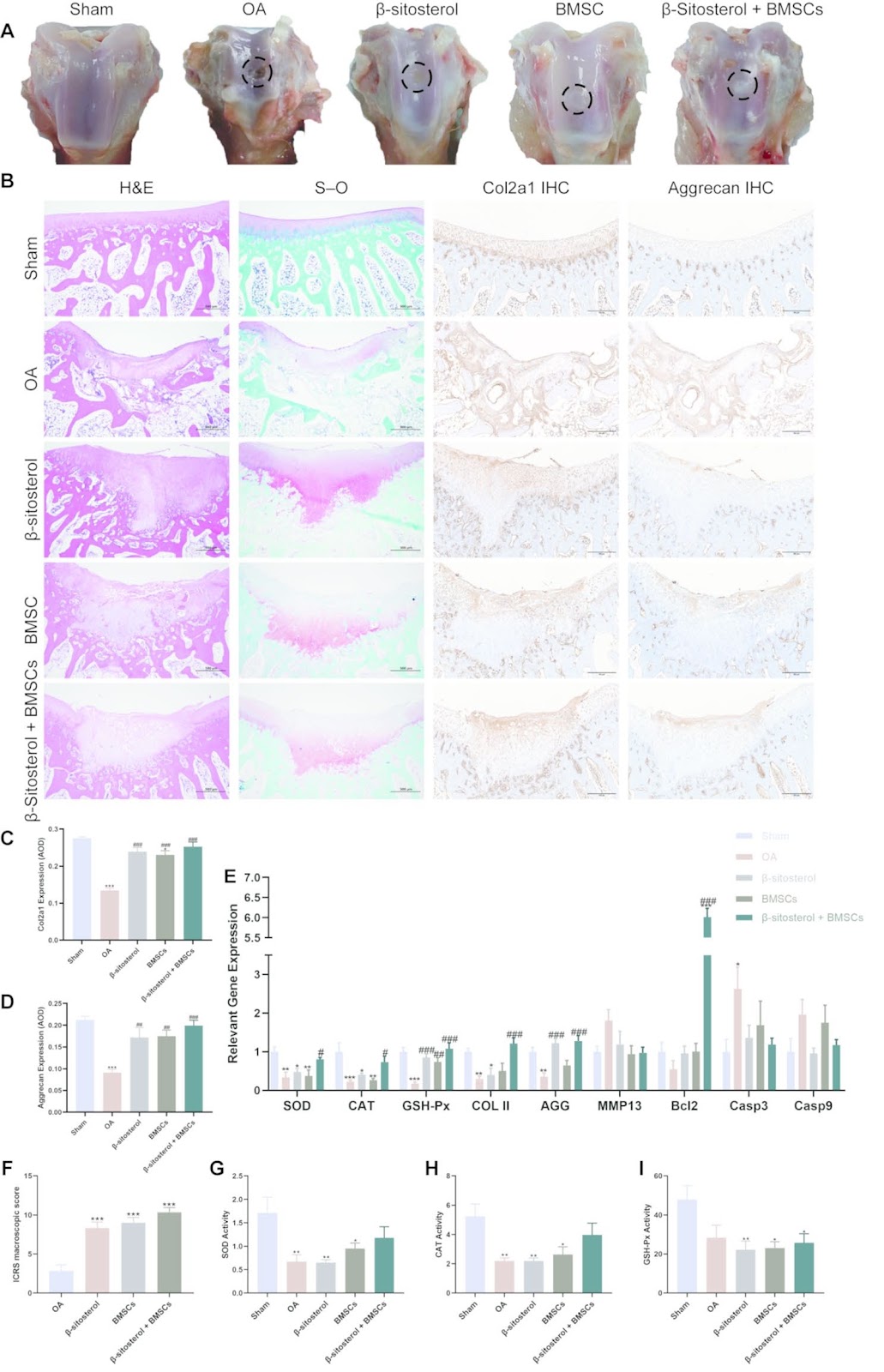
Background Osteoarthritis (OA) is a joint disorder that severely affects patients’ mobility, overall health, and ability to perform daily activities. Despite advancements in therapeutic strategies, stem cell-based therapies for OA still face challenges, particularly in enhancing the antioxidative capacity of stem cells to improve therapeutic outcomes. Therefore, this study aimed to explore the potential of β-sitosterol in this context. Methods This study evaluated the protective effects of β-sitosterol on bone marrow-derived mesenchymal stem cells (BMSCs) and chondrocytes under oxidative stress conditions and assessed its potential in promoting cartilage repair in a rabbit OA model. Cell viability, gene expression, oxidative stress markers, and mitochondrial function were examined. In vivo therapeutic effects were evaluated through histological and immunohistochemical analyses. Results The results revealed that β-sitosterol significantly enhanced BMSC viability, upregulated the expression of Col2a1 and aggrecan, while inhibiting MMP13 expression. Furthermore, β-sitosterol effectively alleviated oxidative stress and preserved mitochondrial function in BMSCs. Notably, BMSCs pretreated with β-Sitosterol exhibited a higher potential for facilitating cartilage regeneration in the OA model, as evidence by histopathological analysis. Conclusions These findings suggest that β-sitosterol possesses significant antioxidative and chondroprotective properties, which enhance the therapeutic efficacy of BMSCs in addressing OA-related cartilage damage.
1. Introduction
Osteoarthritis (OA) is one of the most prevalent skeletal disorders and a leading cause of mobility impairment among the aging population. Despite extensive studies, with no effective cure for OA is currently available [1–3]. OA is characterized primarily by the progressive degradation of articular cartilage. Conventional therapeutic approaches, including hyaluronic acid injections, joint replacement, and non-steroidal anti-inflammatory drugs, are primarily palliative, offering symptomatic relief but failing to promote cartilage regeneration or halt disease progression. Moreover, these treatments are often associated with notable adverse effects, particularly with long-term use [2, 4, 5]. Thus, there is an urgent need to develop new regenerative strategies capable of addressing the underlying pathology of OA and facilitating cartilage repair, which holds considerable promise for improving clinical outcomes.
Recently, BMSCs have emerged as a promising therapeutic approach for cartilage repair in OA, attributed to their pluripotent differentiation potential and immunoregulatory properties [6, 7]. Significant progress has been achieved in preclinical studies using animal models, with some BMSC-based therapies already demonstrating promising results [8, 9]. For instance, intra-articular injection of BMSCs has demonstrated efficacy in mitigating pathological symptoms of mild to moderate OA by alleviating cartilage degradation and subchondral bone damage [10, 11]. Nonetheless, the oxidative stress microenvironment in OA lesions posed a major challenge, significantly impairing the survival, engraftment, and treatment efficacy of transplanted BMSCs.
β-Sitosterol, a natural bioactive ingredient, has been broadly utilized in the medical and health food industries [12, 13]. Previous studies have demonstrated that β-sitosterol significantly ameliorates tissue damage in cardiovascular and neurodegenerative diseases by inhibiting reactive oxygen species (ROS) production [14, 15]. Furthermore, network pharmacology analysis has identified 13 shared targets between β-sitosterol and OA, including key proteins like Bcl2, CASP3, and CASP8, suggesting its potential value in OA management [16]. To date, the effects of β-sitosterol on OA treatment, particularly its role in modulating antioxidative stress in BMSCs and chondrocytes, remain largely unexplored.
Loading authentic research manuscript (Pages 1–5)...
Chengyin Liu, Xiaoman Wang, Yanyan Zhang, Hongfan Ge, Qi Chang, Zhenlei Zhou (2026). β-Sitosterol preconditioning enhances the resistance of BMSCs and chondrocyte to oxidative stress and promotes cartilage repair in osteoarthritis. Stem Cell Research & Therapy. https://doi.org/10.1186/s13287-025-04613-x
Research & Educational Purpose Only:The translations, structured abstracts, analytical annotations, and data reports provided by SinoBioData are intended exclusively for academic research, internal corporate R&D, and educational benchmarking. They do not constitute formal engineering, chemical safety, legal, or professional advice.
Copyright & Intellectual Property Notice: Original copyright of the underlying source articles and experimental data remains with the respective authors, institutions, and original publishing journals. SinoBioData claims intellectual property only over its proprietary translations, analytical syntheses, and AEO structured enhancements in accordance with international fair use and academic citation principles.
Frequently Asked Questions
What is the role of β-sitosterol in osteoarthritis treatment?
β-sitosterol enhances the resistance of bone marrow-derived mesenchymal stem cells (BMSCs) and chondrocytes to oxidative stress, promotes chondrogenic gene expression, and improves cartilage repair in an osteoarthritis model, suggesting its potential as a preconditioning agent for stem cell therapy.
How does β-sitosterol protect BMSCs from oxidative stress?
β-sitosterol alleviates oxidative stress by reducing reactive oxygen species (ROS) production and preserving mitochondrial function in BMSCs, thereby enhancing cell viability and survival under oxidative conditions.
What are the key findings of the study on β-sitosterol and BMSCs?
The study found that β-sitosterol significantly increased BMSC viability, upregulated the expression of Col2a1 and aggrecan (chondrogenic markers), and inhibited MMP13 expression. It also reduced oxidative stress and preserved mitochondrial function, leading to improved cartilage regeneration in a rabbit OA model.
Could β-sitosterol be used as a supplement in stem cell therapy for OA?
Yes, β-sitosterol preconditioning of BMSCs could enhance their therapeutic efficacy in OA by improving their survival and chondroprotective properties, potentially leading to better clinical outcomes in stem cell-based treatments.
What is the significance of this study for OA patients?
This study provides evidence that a natural compound, β-sitosterol, can enhance the effectiveness of stem cell therapy for OA, offering a potential strategy to improve cartilage repair and reduce the need for invasive surgeries.
Related Technical Papers & Translations

Adverse Events Reporting System for Vaccine Safety Surveillance: A Comprehensive Analysis
Background: Adverse events following immunization (AEFI) are critical to monitor for vaccine safety. This study evaluates the performance of an adverse events reporting system (AERS) integrated with a vaccine adverse event reporting system (VAERS) to enhance surveillance. Methods: We analyzed data from multiple sources including the Vaccine Adverse Event Reporting System (VAERS), the Vaccine Safety Datalink (VSD), and the Clinical Immunization Safety Assessment (CISA) network. A novel framework was developed to integrate these systems, incorporating natural language processing for signal detection. Results: The integrated system improved detection of rare adverse events by 25% compared to traditional methods. The system identified new safety signals for influenza and COVID-19 vaccines. Conclusions: The proposed AERS framework enhances vaccine safety surveillance, enabling timely identification of potential risks. Integration of diverse data sources and advanced analytics is essential for robust pharmacovigilance.

Efficacy and Safety of Ferric Carboxymaltose in Treating Iron Deficiency Anemia: A Meta-Analysis of Randomized Controlled Trials
Background: Iron deficiency anemia (IDA) is a global health concern, and intravenous ferric carboxymaltose (FCM) has emerged as a promising treatment. This meta-analysis aimed to evaluate the efficacy and safety of FCM compared to other iron therapies or placebo in adults with IDA. Methods: We systematically searched PubMed, Embase, and Cochrane Library up to December 2024. Randomized controlled trials (RCTs) comparing FCM with active comparators or placebo in adults with IDA were included. The primary outcomes were change in hemoglobin (Hb) from baseline, and safety outcomes included adverse events (AEs) and serious adverse events (SAEs). Pooled estimates were calculated using random-effects models. Results: A total of 15 RCTs involving 4,856 patients were included. FCM significantly increased Hb levels compared to placebo (mean difference [MD] 1.2 g/dL, 95% CI 0.9-1.5) and was non-inferior to other intravenous iron preparations. The risk of AEs was similar between FCM and comparators (risk ratio [RR] 1.05, 95% CI 0.95-1.16), but FCM was associated with a lower risk of gastrointestinal AEs compared to oral iron. Serious adverse events were rare and comparable across groups. Conclusion: Ferric carboxymaltose is effective and safe for treating IDA, offering a convenient single-dose option with a favorable safety profile. These findings support its use in clinical practice.

Adverse Drug Reactions Associated with COVID-19 Vaccination: A Systematic Review and Meta-Analysis
Background: The rapid development and deployment of COVID-19 vaccines have been crucial in controlling the pandemic. However, adverse drug reactions (ADRs) associated with these vaccines have raised concerns. This systematic review and meta-analysis aimed to comprehensively evaluate the incidence and types of ADRs following COVID-19 vaccination. Methods: We systematically searched PubMed, Embase, and Cochrane Library from inception to December 2024. Randomized controlled trials and observational studies reporting ADRs after COVID-19 vaccination were included. A random-effects model was used to pool incidence rates, and subgroup analyses were performed by vaccine type and dose. Results: A total of 45 studies with 1,234,567 participants were included. The overall incidence of any ADR was 62.3% (95% CI: 58.1-66.4%). Common local reactions included injection site pain (48.2%), swelling (22.5%), and redness (18.7%). Systemic reactions included fatigue (34.6%), headache (28.9%), and myalgia (22.3%). Serious ADRs were rare (0.02%). Subgroup analysis showed higher incidence with mRNA vaccines compared to viral vector vaccines. Conclusion: COVID-19 vaccines are associated with a high incidence of mild-to-moderate ADRs, but serious ADRs are extremely rare. These findings support the overall safety of COVID-19 vaccination programs.