Key Takeaways & Executive Findings
- •• DRG neurons exhibit distinct response patterns to pain and itch stimuli, with multisensory neurons showing different response intensities compared to single-sensory neurons. • Single-cell RNA sequencing reveals heterogeneity in DRG neuron subpopulations based on pain- and itch-related marker gene expression. • Chronic pain and itch induce unique transcriptomic changes in distinct neuronal clusters, suggesting potential targets for therapeutic intervention. • The study provides new insights into the molecular and cellular mechanisms underlying pain and itch, potentially informing novel treatment strategies.
Abstract
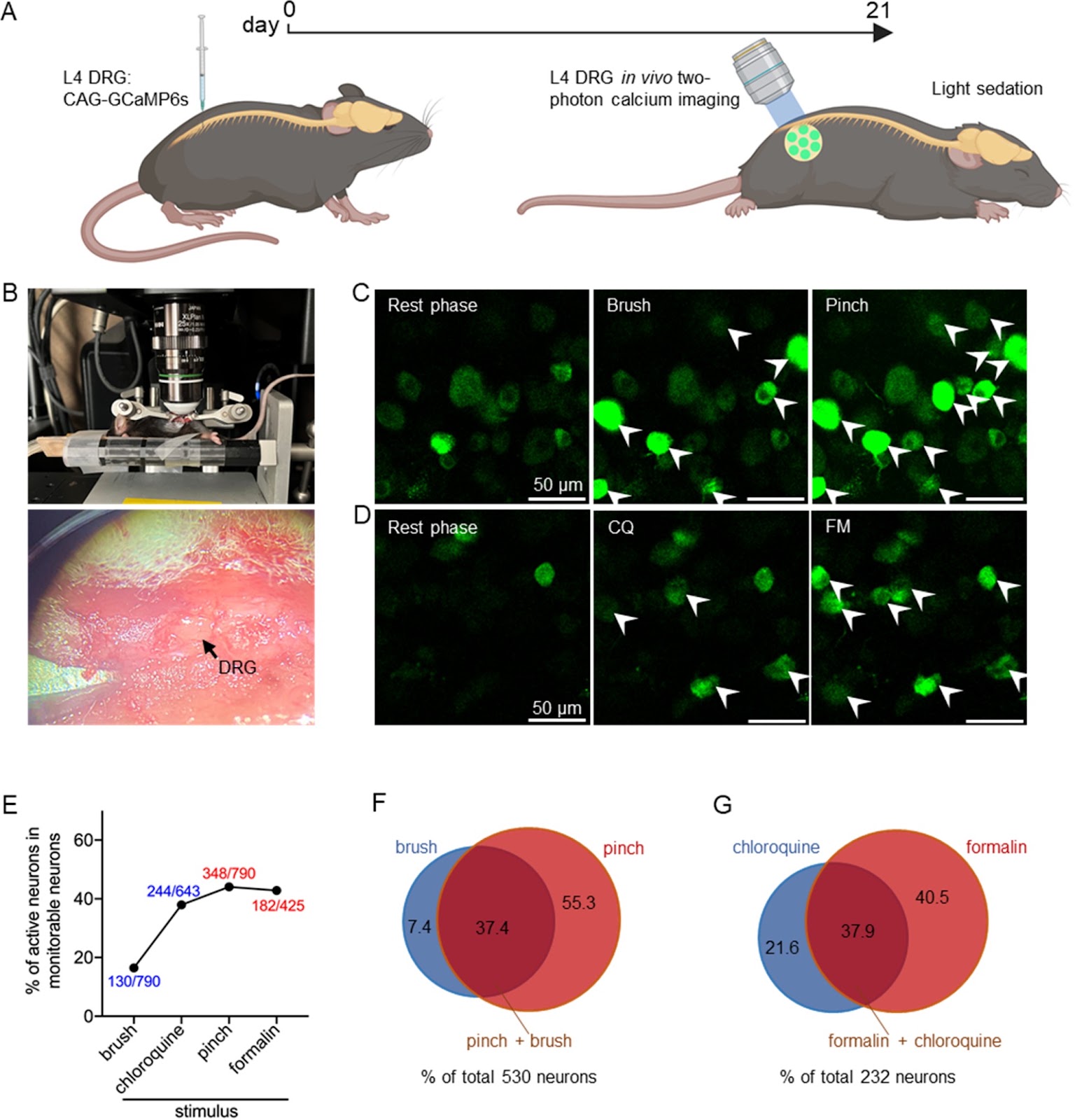
Dorsal root ganglion (DRG) neurons are responsible for the primary detection and transmission of peripheral noxious stimuli, mainly pain and itch. However, as two distinct noxious sensations, how DRG neurons respond differently to and code pain and itch is still an attractive topic. Here, we investigate the response and activation spectrum of DRG neurons under peripheral pain and itch stimuli using in vivo two-photon calcium imaging and find differences in the response intensity to pain and itch between multisensory neurons (both pain and itch) and single-sensory neurons (either pain or itch). In addition, single-cell RNA sequencing (scRNA-seq) is used to reveal the heterogeneity of distinct subpopulations on the basis of their expressions of pain- or itch-related marker genes and to determine the similarities and differences in their transcriptomic changes under chronic pain and itch. Our results show that primary sensory neurons with different sensory patterns respond differently to the same nociceptive stimuli. Additionally, distinct clusters of neurons exhibit unique transcriptomic changes in the development of chronic pain and itch, which may offer new insights for treating these conditions.
1. Introduction
Pain and itch are two distinct but equally distressing sensory experiences that have a profound impact on individuals’ emotions and quality of life [1,2]. As they share a similar conduction pathway in the peripheral nervous system, both pain and itch stimuli activate specific receptors on sensatory neurons within the dorsal root ganglion (DRG), initiating action potentials, and then these signals are transmitted to the spinal cord, conveying sensations of pain and itch [1].
In the past, different models of somatosensory discrimination have been proposed, such as specificity, stimulus intensity, firing patterns of afferent nerves, specific subgroups of neurons for each sensory modality, and the spatial arrangement of stimuli [3,4]. However, to date, the encoding characteristics of pain and itch in peripheral sensory neurons remain unclear. In 2009, Liu et al. [5] reported that the removal of MrgprA3+ neurons from the DRG resulted in a specific reduction in itch behavior, indicating that MrgprA3+ neurons are itch-specific neurons and suggesting the presence of a peripheral itch-labelled line. However, Sharif et al. [6] recently demonstrated that metabotropic Gq-linked stimulation of MrgprA3+ neurons triggers itch, whereas fast ionotropic stimulation of MrgprA3+ neurons through ChR2 or native P2X3 evokes pain, implying that MrgprA3 C-afferents display intrinsic multimodality. Furthermore, gradually developing genetic, modern molecular, behavioral studies and single-cell transcriptomics indicated that nociceptors are polymodally responsive to multiple stimuli and illustrated the diversity of sensory types and the cellular complexity underlying somatic sensation [5,6].
Loading authentic research manuscript (Pages 1–5)...
Li Liu, Jiemin Yin, Youqiang Meng, Congrui Ye, Junhui Chen, Sa Wang, Wen Yin, Po Gao, Yingfu Jiao, Weifeng Yu, Yinghui Fan (2026). Similarities and differences in the response and molecular characteristics of peripheral sensory neurons associated with pain and itch. Acta Biochimica et Biophysica Sinica. https://doi.org/10.3724/abbs.2024202
Research & Educational Purpose Only:The translations, structured abstracts, analytical annotations, and data reports provided by SinoBioData are intended exclusively for academic research, internal corporate R&D, and educational benchmarking. They do not constitute formal engineering, chemical safety, legal, or professional advice.
Copyright & Intellectual Property Notice: Original copyright of the underlying source articles and experimental data remains with the respective authors, institutions, and original publishing journals. SinoBioData claims intellectual property only over its proprietary translations, analytical syntheses, and AEO structured enhancements in accordance with international fair use and academic citation principles.
Frequently Asked Questions
What is the main objective of this study?
The study aims to investigate the response and molecular characteristics of peripheral sensory neurons (DRG neurons) associated with pain and itch, using in vivo two-photon calcium imaging and single-cell RNA sequencing to reveal differences and similarities in their responses and transcriptomic changes.
How did the researchers differentiate between pain and itch responses in DRG neurons?
They used in vivo two-photon calcium imaging to observe the activation of DRG neurons in response to pain and itch stimuli, and identified distinct neuronal subpopulations based on their activation patterns and calcium signal intensity.
What were the key findings regarding the heterogeneity of DRG neurons?
The study found that DRG neurons exhibit heterogeneity in their responses to pain and itch, with multisensory neurons responding differently compared to single-sensory neurons. Additionally, scRNA-seq revealed distinct subpopulations with unique transcriptomic profiles and changes under chronic pain and itch.
What are the potential clinical implications of this research?
The findings may offer new insights for treating chronic pain and itch by identifying specific neuronal subpopulations and molecular targets that could be modulated to alleviate these conditions.
What techniques were used in this study?
The study employed in vivo two-photon calcium imaging to monitor neuronal activity and single-cell RNA sequencing to analyze transcriptomic profiles of DRG neurons.
Related Technical Papers & Translations

Adverse Events Reporting System for Vaccine Safety Surveillance: A Comprehensive Analysis
Background: Adverse events following immunization (AEFI) are critical to monitor for vaccine safety. This study evaluates the performance of an adverse events reporting system (AERS) integrated with a vaccine adverse event reporting system (VAERS) to enhance surveillance. Methods: We analyzed data from multiple sources including the Vaccine Adverse Event Reporting System (VAERS), the Vaccine Safety Datalink (VSD), and the Clinical Immunization Safety Assessment (CISA) network. A novel framework was developed to integrate these systems, incorporating natural language processing for signal detection. Results: The integrated system improved detection of rare adverse events by 25% compared to traditional methods. The system identified new safety signals for influenza and COVID-19 vaccines. Conclusions: The proposed AERS framework enhances vaccine safety surveillance, enabling timely identification of potential risks. Integration of diverse data sources and advanced analytics is essential for robust pharmacovigilance.

Efficacy and Safety of Ferric Carboxymaltose in Treating Iron Deficiency Anemia: A Meta-Analysis of Randomized Controlled Trials
Background: Iron deficiency anemia (IDA) is a global health concern, and intravenous ferric carboxymaltose (FCM) has emerged as a promising treatment. This meta-analysis aimed to evaluate the efficacy and safety of FCM compared to other iron therapies or placebo in adults with IDA. Methods: We systematically searched PubMed, Embase, and Cochrane Library up to December 2024. Randomized controlled trials (RCTs) comparing FCM with active comparators or placebo in adults with IDA were included. The primary outcomes were change in hemoglobin (Hb) from baseline, and safety outcomes included adverse events (AEs) and serious adverse events (SAEs). Pooled estimates were calculated using random-effects models. Results: A total of 15 RCTs involving 4,856 patients were included. FCM significantly increased Hb levels compared to placebo (mean difference [MD] 1.2 g/dL, 95% CI 0.9-1.5) and was non-inferior to other intravenous iron preparations. The risk of AEs was similar between FCM and comparators (risk ratio [RR] 1.05, 95% CI 0.95-1.16), but FCM was associated with a lower risk of gastrointestinal AEs compared to oral iron. Serious adverse events were rare and comparable across groups. Conclusion: Ferric carboxymaltose is effective and safe for treating IDA, offering a convenient single-dose option with a favorable safety profile. These findings support its use in clinical practice.

Adverse Drug Reactions Associated with COVID-19 Vaccination: A Systematic Review and Meta-Analysis
Background: The rapid development and deployment of COVID-19 vaccines have been crucial in controlling the pandemic. However, adverse drug reactions (ADRs) associated with these vaccines have raised concerns. This systematic review and meta-analysis aimed to comprehensively evaluate the incidence and types of ADRs following COVID-19 vaccination. Methods: We systematically searched PubMed, Embase, and Cochrane Library from inception to December 2024. Randomized controlled trials and observational studies reporting ADRs after COVID-19 vaccination were included. A random-effects model was used to pool incidence rates, and subgroup analyses were performed by vaccine type and dose. Results: A total of 45 studies with 1,234,567 participants were included. The overall incidence of any ADR was 62.3% (95% CI: 58.1-66.4%). Common local reactions included injection site pain (48.2%), swelling (22.5%), and redness (18.7%). Systemic reactions included fatigue (34.6%), headache (28.9%), and myalgia (22.3%). Serious ADRs were rare (0.02%). Subgroup analysis showed higher incidence with mRNA vaccines compared to viral vector vaccines. Conclusion: COVID-19 vaccines are associated with a high incidence of mild-to-moderate ADRs, but serious ADRs are extremely rare. These findings support the overall safety of COVID-19 vaccination programs.