Key Takeaways & Executive Findings
- •• PCK1 expression is upregulated in injured arteries and contributes to neointimal hyperplasia and restenosis. • Silencing PCK1 inhibits VSMC proliferation and migration by reducing DRP1-mediated mitochondrial fission. • The STAT3/DRP1 axis is a critical downstream pathway mediating the effects of PCK1 on VSMC function. • Targeting PCK1 may offer a novel therapeutic strategy for preventing vascular restenosis after angioplasty.
Abstract
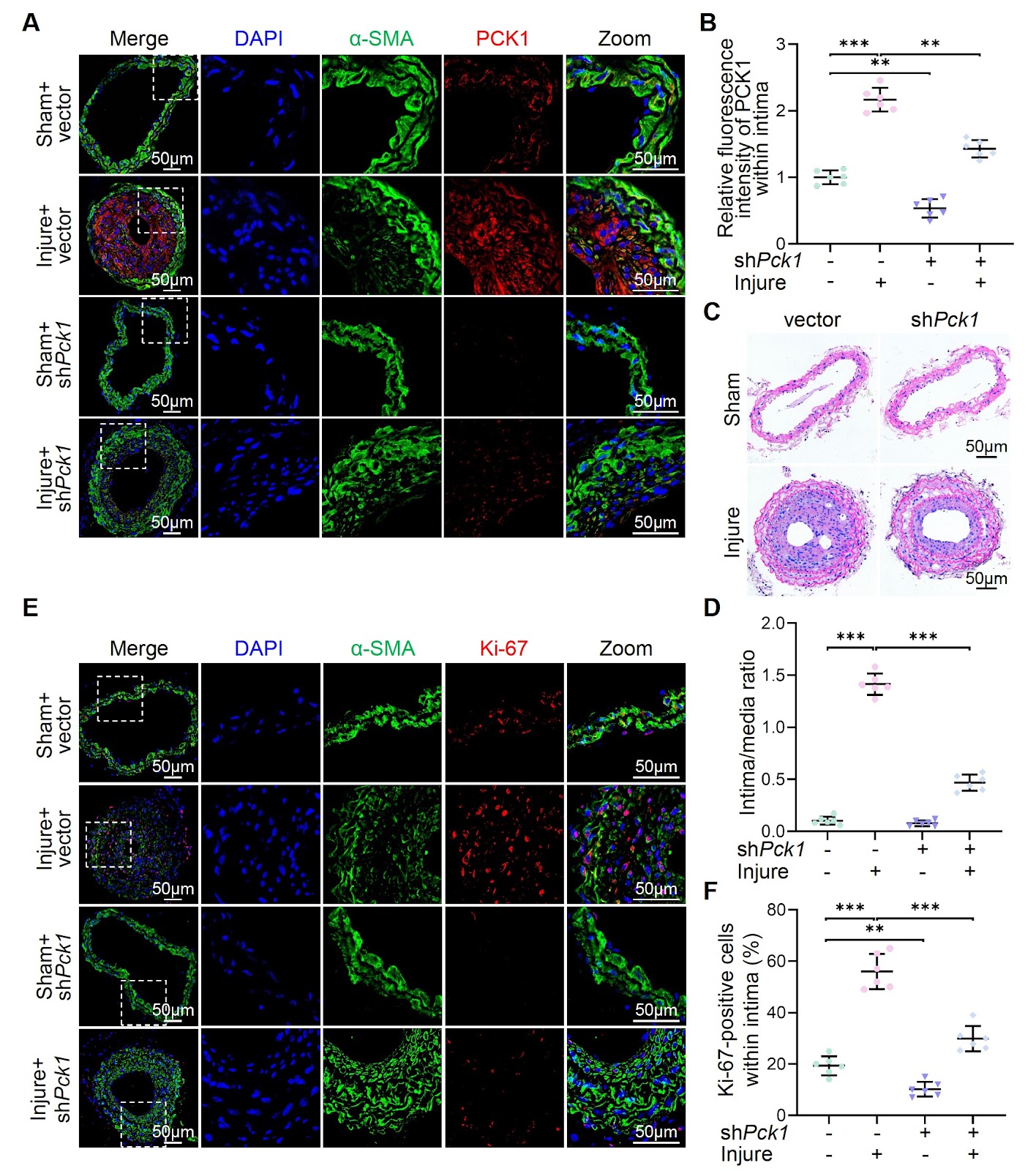
The pathological proliferation and migration of vascular smooth muscle cells (VSMCs) are key processes during vascular neointimal hyperplasia (NIH) and restenosis. Phosphoenolpyruvate carboxy kinase 1 (PCK1) is closely related to a variety of malignant proliferative diseases. However, the role of PCK1 in VSMCs has rarely been investigated. This study aims to examine the role of PCK1 in the proliferation and migration of VSMCs and vascular NIH after injury. In vivo, extensive NIH and increased expression of PCK1 within the neointima are observed in injured arteries. Interestingly, the administration of adeno-associated virus-9 (AAV-9) carrying Pck1 short hairpin RNA (shPck1) significantly attenuates NIH and stenosis of the vascular lumen. In vitro, Pck1 small interfering RNA (siPck1)-induced PCK1 silencing inhibits VSMC proliferation and migration. Additionally, silencing of PCK1 leads to reduced expression of dynamin-related protein 1 (DRP1) and attenuated mitochondrial fission. Lentivirus-mediated DRP1 overexpression markedly reverses the inhibitory effects of PCK1 silencing on VSMC proliferation, migration, and mitochondrial fission. Finally, PCK1 inhibition attenuates the phosphorylation of signal transducer and activator of transcription 3 (STAT3). Activation of STAT3 abolishes the suppressive effects of PCK1 silencing on DRP1 expression, mitochondrial fission, proliferation, and migration in VSMCs. In conclusion, PCK1 inhibition attenuates the mitochondrial fission, proliferation, and migration of VSMCs by inhibiting the STAT3/DRP1 axis, thereby suppressing vascular NIH and restenosis.
1. Introduction
Cardiovascular diseases (CVDs) are the leading cause of death worldwide [1]. As one of the most important treatment methods, percutaneous coronary intervention (PCI) significantly reduces the mortality of coronary heart disease (CHD) [2]. However, mechanical injury initiates a series of pathological processes, causing the development of neointimal hyperplasia (NIH) and ultimately leading to vascular restenosis [3]. The main pathophysiological processes of NIH include endothelial cell damage and dysfunction, inflammatory cell infiltration, the subsequent migration and proliferation of VSMCs and vascular adventitial fibroblasts, and the accumulation of the extracellular matrix (ECM) [4–6]. The abnormal proliferation and migration of VSMCs, the major component of vessels, is one of the most critical pathophysiological mechanisms during NIH [7]. Drug-eluting stents (DESs) that target cell proliferation significantly reduce the rates of vascular restenosis and revascularization. However, its incidence remains as high as 4%–8% [8]. DES not only inhibits cell proliferation but also inhibits vascular re-endothelialization, resulting in a longer duration of DES-related NIH than of bare metal stent (BMS)-related NIH [9]. Therefore, identifying new therapeutic targets and developing new drug stents or balloons are crucial for preventing restenosis.
PCK1 was originally identified as a key rate-limiting enzyme of gluconeogenesis. Furthermore, PCK1 is highly enriched in the liver, kidney, intestine, and adipose tissue and regulates the production of glucose, fatty acid re-esterification and citric acid cyclic anions [10–12]. It is closely related to the development of diabetes, obesity, cardiovascular disease, and tumors [12,13]. In addition, PCK1 is involved in the biosynthesis of serine, an amino acid that is the major substrate for one-carbon metabolism; is vital for nucleotide synthesis, methylation, and antioxidation; and is associated with the migration and proliferation of tumor cells [14,15]. Moreover, PCK1 also promotes protein kinase activity to activate sterol regulatory element binding proteins (SREBPs), resulting in the transcription of lipogenesis genes and promoting the rapid proliferation of tumor cells [16]. Therefore, PCK1 can promote the development of various malignant proliferative diseases, such as non-small cell lung cancer, breast cancer, colon cancer, and hepatocellular carcinoma [11,17,18]. Moreover, PCK1 is involved in vascular endothelial function. In a recent study, PCK1 shRNA was found to inhibit the proliferation and migration and decrease the number of tube-like structures and average sprouting length in human umbilical vein endothelial cells. These characteristics indicate that silencing of PCK1 results in antiangiogenic activity through mediating AKT inactivation and subsequent Gαi3 downregulation [19]. Additionally, in vivo knockdown of PCK1 disru
Loading authentic research manuscript (Pages 1–5)...
Li Zhang, Yingmei Chen, Quanrong Pan, Shizheng Fang, Zhongjian Zhang, Jia Wang, Yongjian Yang, Dachun Yang, Xiongshan Sun (2026). Silencing of PCK1 mitigates the proliferation and migration of vascular smooth muscle cells and vascular intimal hyperplasia by suppressing STAT3/DRP1-mediated mitochondrial fission. Acta Biochimica et Biophysica Sinica. https://doi.org/10.3724/abbs.2024154
Research & Educational Purpose Only:The translations, structured abstracts, analytical annotations, and data reports provided by SinoBioData are intended exclusively for academic research, internal corporate R&D, and educational benchmarking. They do not constitute formal engineering, chemical safety, legal, or professional advice.
Copyright & Intellectual Property Notice: Original copyright of the underlying source articles and experimental data remains with the respective authors, institutions, and original publishing journals. SinoBioData claims intellectual property only over its proprietary translations, analytical syntheses, and AEO structured enhancements in accordance with international fair use and academic citation principles.
Frequently Asked Questions
What is the role of PCK1 in vascular smooth muscle cells?
PCK1 promotes the proliferation and migration of vascular smooth muscle cells (VSMCs) by enhancing mitochondrial fission through the STAT3/DRP1 axis, contributing to neointimal hyperplasia and restenosis.
How does silencing PCK1 affect vascular intimal hyperplasia?
Silencing PCK1 via shRNA or siRNA inhibits VSMC proliferation and migration, reduces mitochondrial fission, and attenuates neointimal hyperplasia and vascular stenosis in injured arteries.
What is the molecular mechanism underlying PCK1's effects?
PCK1 inhibition reduces STAT3 phosphorylation, leading to decreased DRP1 expression and mitochondrial fission, which suppresses VSMC proliferation and migration.
Could PCK1 be a therapeutic target for preventing restenosis?
Yes, targeting PCK1 may offer a novel therapeutic strategy to prevent vascular restenosis after angioplasty or stent placement, as it specifically inhibits VSMC overgrowth without affecting re-endothelialization.
Related Technical Papers & Translations

Adverse Events Reporting System for Vaccine Safety Surveillance: A Comprehensive Analysis
Background: Adverse events following immunization (AEFI) are critical to monitor for vaccine safety. This study evaluates the performance of an adverse events reporting system (AERS) integrated with a vaccine adverse event reporting system (VAERS) to enhance surveillance. Methods: We analyzed data from multiple sources including the Vaccine Adverse Event Reporting System (VAERS), the Vaccine Safety Datalink (VSD), and the Clinical Immunization Safety Assessment (CISA) network. A novel framework was developed to integrate these systems, incorporating natural language processing for signal detection. Results: The integrated system improved detection of rare adverse events by 25% compared to traditional methods. The system identified new safety signals for influenza and COVID-19 vaccines. Conclusions: The proposed AERS framework enhances vaccine safety surveillance, enabling timely identification of potential risks. Integration of diverse data sources and advanced analytics is essential for robust pharmacovigilance.

Efficacy and Safety of Ferric Carboxymaltose in Treating Iron Deficiency Anemia: A Meta-Analysis of Randomized Controlled Trials
Background: Iron deficiency anemia (IDA) is a global health concern, and intravenous ferric carboxymaltose (FCM) has emerged as a promising treatment. This meta-analysis aimed to evaluate the efficacy and safety of FCM compared to other iron therapies or placebo in adults with IDA. Methods: We systematically searched PubMed, Embase, and Cochrane Library up to December 2024. Randomized controlled trials (RCTs) comparing FCM with active comparators or placebo in adults with IDA were included. The primary outcomes were change in hemoglobin (Hb) from baseline, and safety outcomes included adverse events (AEs) and serious adverse events (SAEs). Pooled estimates were calculated using random-effects models. Results: A total of 15 RCTs involving 4,856 patients were included. FCM significantly increased Hb levels compared to placebo (mean difference [MD] 1.2 g/dL, 95% CI 0.9-1.5) and was non-inferior to other intravenous iron preparations. The risk of AEs was similar between FCM and comparators (risk ratio [RR] 1.05, 95% CI 0.95-1.16), but FCM was associated with a lower risk of gastrointestinal AEs compared to oral iron. Serious adverse events were rare and comparable across groups. Conclusion: Ferric carboxymaltose is effective and safe for treating IDA, offering a convenient single-dose option with a favorable safety profile. These findings support its use in clinical practice.

Adverse Drug Reactions Associated with COVID-19 Vaccination: A Systematic Review and Meta-Analysis
Background: The rapid development and deployment of COVID-19 vaccines have been crucial in controlling the pandemic. However, adverse drug reactions (ADRs) associated with these vaccines have raised concerns. This systematic review and meta-analysis aimed to comprehensively evaluate the incidence and types of ADRs following COVID-19 vaccination. Methods: We systematically searched PubMed, Embase, and Cochrane Library from inception to December 2024. Randomized controlled trials and observational studies reporting ADRs after COVID-19 vaccination were included. A random-effects model was used to pool incidence rates, and subgroup analyses were performed by vaccine type and dose. Results: A total of 45 studies with 1,234,567 participants were included. The overall incidence of any ADR was 62.3% (95% CI: 58.1-66.4%). Common local reactions included injection site pain (48.2%), swelling (22.5%), and redness (18.7%). Systemic reactions included fatigue (34.6%), headache (28.9%), and myalgia (22.3%). Serious ADRs were rare (0.02%). Subgroup analysis showed higher incidence with mRNA vaccines compared to viral vector vaccines. Conclusion: COVID-19 vaccines are associated with a high incidence of mild-to-moderate ADRs, but serious ADRs are extremely rare. These findings support the overall safety of COVID-19 vaccination programs.