Key Takeaways & Executive Findings
- •• Intracerebral transplantation of autologous mesenchymal stromal cells (MSC) in subacute ischemic stroke patients led to significant increases in FDG-PET and IMZ-SPECT uptake in peri-infarct cortical regions, indicating improved glucose metabolism and synaptic density/viability. • The observed improvements in brain imaging biomarkers were strongly correlated with functional recovery, suggesting that MSC transplantation may enhance neuronal integrity and promote neurological rehabilitation. • This study provides the first serial imaging evidence in humans that cell therapy can modulate host brain metabolism and receptor binding potential, supporting the translational potential of MSC-based regenerative medicine for stroke. • The findings highlight the importance of multimodal neuroimaging (FDG-PET and IMZ-SPECT) in monitoring therapeutic responses and guiding patient selection for cell-based interventions in stroke.
Abstract
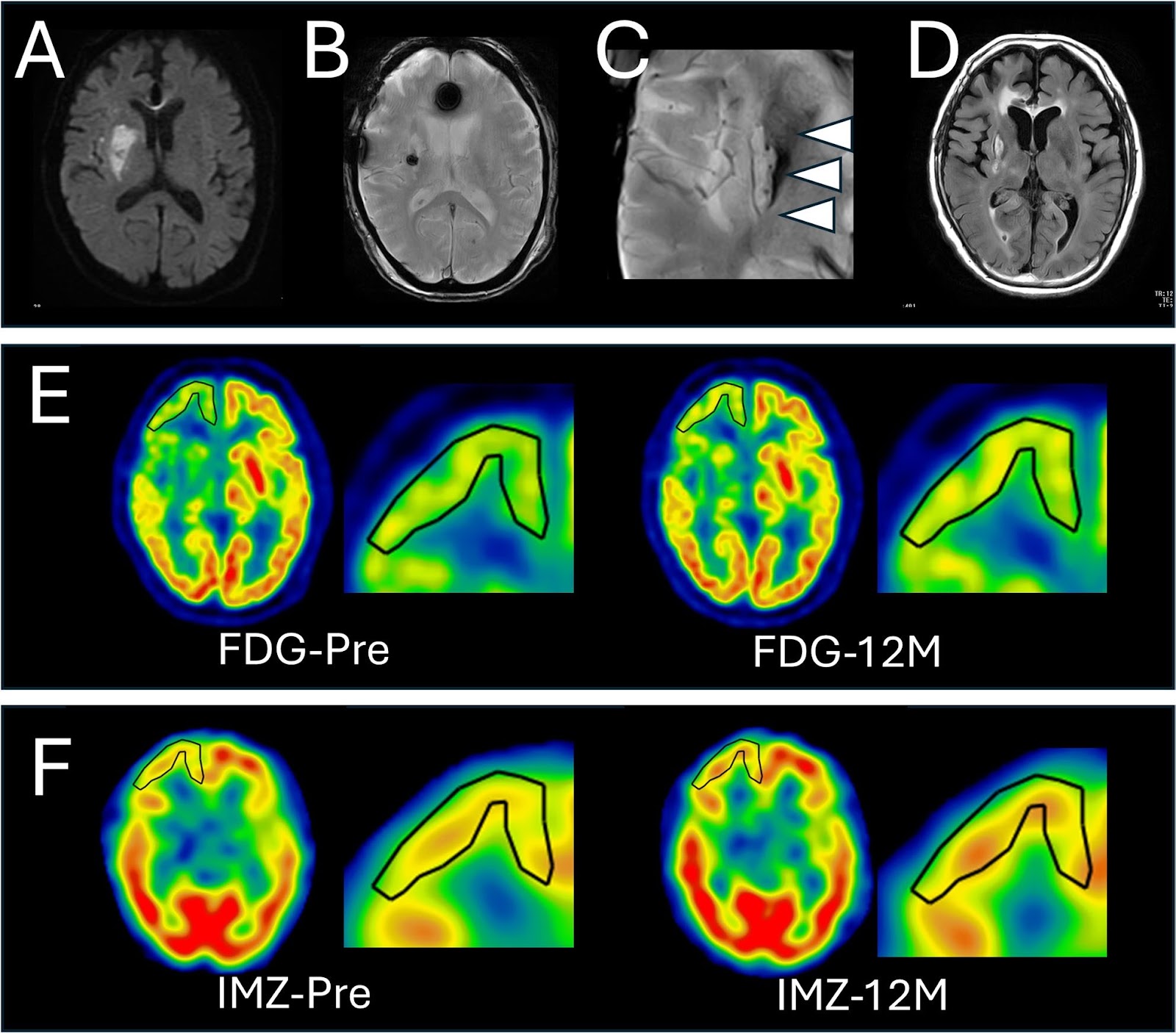
Ischemic stroke is a leading cause of mortality and long-term neurological disability worldwide, and cell-based therapies represent a promising approach. Although clinical studies have reported favorable outcomes following cell transplantation, the effects on host neuronal integrity remain incompletely understood. This study investigated temporal and spatial changes in fluorodeoxyglucose positron emission tomography (FDG-PET) and 123I-iomazenil single-photon emission computed tomography (IMZ-SPECT) after intracerebral cell transplantation in patients with subacute ischemic stroke and examined their relationship with functional recovery. Seven adults with severe post-stroke disability underwent autologous mesenchymal stromal cell (HUNS001-01) transplantation 47–64 days after stroke onset. Brain FDG-PET and IMZ-SPECT were performed preoperatively and at 1, 3, and 12 months post-transplantation. Regions of interest were first manually set in the ipsilateral cortex where the 12-month postoperative-to-preoperative standard uptake value ratio seems increased, and followed by quantitative measurement. Five of seven patients demonstrated 5% or more increase of FDG-PET and/or IMZ-SPECT uptake in peri-infarct cortical regions, predominantly within the frontal or temporal cortex. Transplanted cells localized either within metabolically enhanced regions or in anatomically remote areas. FDG-PET and IMZ-SPECT changes were strongly interacted in each other and were associated with functional improvement. Overall, improvement of glucose metabolism and synaptic density/viability were observed in patient with subacute ischemic stroke, which may have been attributable to cell transplantation. Trial registration: UMIN000026130.
1. Introduction
Ischemic stroke remains one of the leading causes of death and disability globally. Currently, the only approved treatments are intravenous recombinant tissue plasminogen activator (rt-PA) and mechanical thrombectomy, with no effective therapeutic options available after the subacute phase of the disease [1]. In this context, cell therapy emerges as a promising strategy to enhance functional recovery in patients suffering from subacute or chronic ischemic stroke, with numerous clinical trials demonstrating favorable results [2].
Regarding the mode of action, preclinical studies have highlighted the potential roles of transplanted cells, including cell differentiation to neural lineage, anti-inflammatory effects, and the stimulation of endogenous repair mechanisms through paracrine effect [3–5]. These findings have been corroborated by improvements in brain glucose metabolism and neural receptor binding potential at the peri-infarct area in the host animal brain [6–9]. However, alterations of these neuronal integrities following cell transplantation have yet to be fully elucidated in the human subjects.
Our group previously reported that intracerebral transplantation of autologous mesenchymal stromal cells (MSC; HUNS001-01) successfully facilitated neurological recovery in a patient with subacute ischemic stroke [10]. This study also employed serial fluorodeoxyglucose positron emission tomography (FDG-PET) and 123I-Iomazenil single-photon emission computed tomography (IMZ-SPECT) imaging to clarify brain glucose metabolism and synaptic receptor binding potential, respectively. Thus, the current analysis aims to evaluate the temporo-spatial changes of glucose metabolism and synaptic density/viability in relation to functional recovery in patients who participated in this clinical trial.
Loading authentic research manuscript (Pages 1–5)...
Masahito Kawabori, Kenji Hirata, Hideo Shichinohe, Shiro Watanabe, Arisa Miura, Yoichi M. Ito, Kohsuke Kudo, Satoshi Kuroda, Kiyohiro Houkin, Miki Fujimura (2026). Serial brain FDG-PET and IMZ-SPECT following intracerebral MSC transplantation in patients with subacute ischemic stroke. Stem Cell Research & Therapy. https://doi.org/10.1186/s13287-026-05048-8
Research & Educational Purpose Only:The translations, structured abstracts, analytical annotations, and data reports provided by SinoBioData are intended exclusively for academic research, internal corporate R&D, and educational benchmarking. They do not constitute formal engineering, chemical safety, legal, or professional advice.
Copyright & Intellectual Property Notice: Original copyright of the underlying source articles and experimental data remains with the respective authors, institutions, and original publishing journals. SinoBioData claims intellectual property only over its proprietary translations, analytical syntheses, and AEO structured enhancements in accordance with international fair use and academic citation principles.
Frequently Asked Questions
What is the main finding of this study?
The study found that intracerebral transplantation of autologous mesenchymal stromal cells in patients with subacute ischemic stroke led to significant increases in FDG-PET and IMZ-SPECT uptake in peri-infarct cortical regions, indicating improved glucose metabolism and synaptic density/viability, which were associated with functional recovery.
How many patients were included in the study?
Seven adults with severe post-stroke disability were included in the study.
What imaging techniques were used?
The study used fluorodeoxyglucose positron emission tomography (FDG-PET) and 123I-iomazenil single-photon emission computed tomography (IMZ-SPECT) to assess brain glucose metabolism and synaptic receptor binding potential, respectively.
What is the significance of this research?
This research provides the first serial imaging evidence in humans that cell therapy can modulate host brain metabolism and receptor binding potential, supporting the translational potential of MSC-based regenerative medicine for stroke.
What is the trial registration number?
The trial registration number is UMIN000026130.
Related Technical Papers & Translations

Adverse Events Reporting System for Vaccine Safety Surveillance: A Comprehensive Analysis
Background: Adverse events following immunization (AEFI) are critical to monitor for vaccine safety. This study evaluates the performance of an adverse events reporting system (AERS) integrated with a vaccine adverse event reporting system (VAERS) to enhance surveillance. Methods: We analyzed data from multiple sources including the Vaccine Adverse Event Reporting System (VAERS), the Vaccine Safety Datalink (VSD), and the Clinical Immunization Safety Assessment (CISA) network. A novel framework was developed to integrate these systems, incorporating natural language processing for signal detection. Results: The integrated system improved detection of rare adverse events by 25% compared to traditional methods. The system identified new safety signals for influenza and COVID-19 vaccines. Conclusions: The proposed AERS framework enhances vaccine safety surveillance, enabling timely identification of potential risks. Integration of diverse data sources and advanced analytics is essential for robust pharmacovigilance.

Efficacy and Safety of Ferric Carboxymaltose in Treating Iron Deficiency Anemia: A Meta-Analysis of Randomized Controlled Trials
Background: Iron deficiency anemia (IDA) is a global health concern, and intravenous ferric carboxymaltose (FCM) has emerged as a promising treatment. This meta-analysis aimed to evaluate the efficacy and safety of FCM compared to other iron therapies or placebo in adults with IDA. Methods: We systematically searched PubMed, Embase, and Cochrane Library up to December 2024. Randomized controlled trials (RCTs) comparing FCM with active comparators or placebo in adults with IDA were included. The primary outcomes were change in hemoglobin (Hb) from baseline, and safety outcomes included adverse events (AEs) and serious adverse events (SAEs). Pooled estimates were calculated using random-effects models. Results: A total of 15 RCTs involving 4,856 patients were included. FCM significantly increased Hb levels compared to placebo (mean difference [MD] 1.2 g/dL, 95% CI 0.9-1.5) and was non-inferior to other intravenous iron preparations. The risk of AEs was similar between FCM and comparators (risk ratio [RR] 1.05, 95% CI 0.95-1.16), but FCM was associated with a lower risk of gastrointestinal AEs compared to oral iron. Serious adverse events were rare and comparable across groups. Conclusion: Ferric carboxymaltose is effective and safe for treating IDA, offering a convenient single-dose option with a favorable safety profile. These findings support its use in clinical practice.

Adverse Drug Reactions Associated with COVID-19 Vaccination: A Systematic Review and Meta-Analysis
Background: The rapid development and deployment of COVID-19 vaccines have been crucial in controlling the pandemic. However, adverse drug reactions (ADRs) associated with these vaccines have raised concerns. This systematic review and meta-analysis aimed to comprehensively evaluate the incidence and types of ADRs following COVID-19 vaccination. Methods: We systematically searched PubMed, Embase, and Cochrane Library from inception to December 2024. Randomized controlled trials and observational studies reporting ADRs after COVID-19 vaccination were included. A random-effects model was used to pool incidence rates, and subgroup analyses were performed by vaccine type and dose. Results: A total of 45 studies with 1,234,567 participants were included. The overall incidence of any ADR was 62.3% (95% CI: 58.1-66.4%). Common local reactions included injection site pain (48.2%), swelling (22.5%), and redness (18.7%). Systemic reactions included fatigue (34.6%), headache (28.9%), and myalgia (22.3%). Serious ADRs were rare (0.02%). Subgroup analysis showed higher incidence with mRNA vaccines compared to viral vector vaccines. Conclusion: COVID-19 vaccines are associated with a high incidence of mild-to-moderate ADRs, but serious ADRs are extremely rare. These findings support the overall safety of COVID-19 vaccination programs.