Key Takeaways & Executive Findings
- •• T4015 is a novel dual inhibitor of JAK/STAT and NF-κB signaling pathways, effectively suppressing key phosphorylation events in vitro. • Transcriptomic analysis reveals broad downregulation of inflammation-related pathways, including TNF, IL-17, and Toll-like receptor signaling. • In a bleomycin-induced PF mouse model, T4015 improves survival, reduces collagen deposition, and lowers pro-inflammatory and profibrotic markers. • Molecular docking predicts strong binding of T4015 to multiple kinases in the JAK/STAT and NF-κB networks, supporting its dual-target mechanism.
Abstract
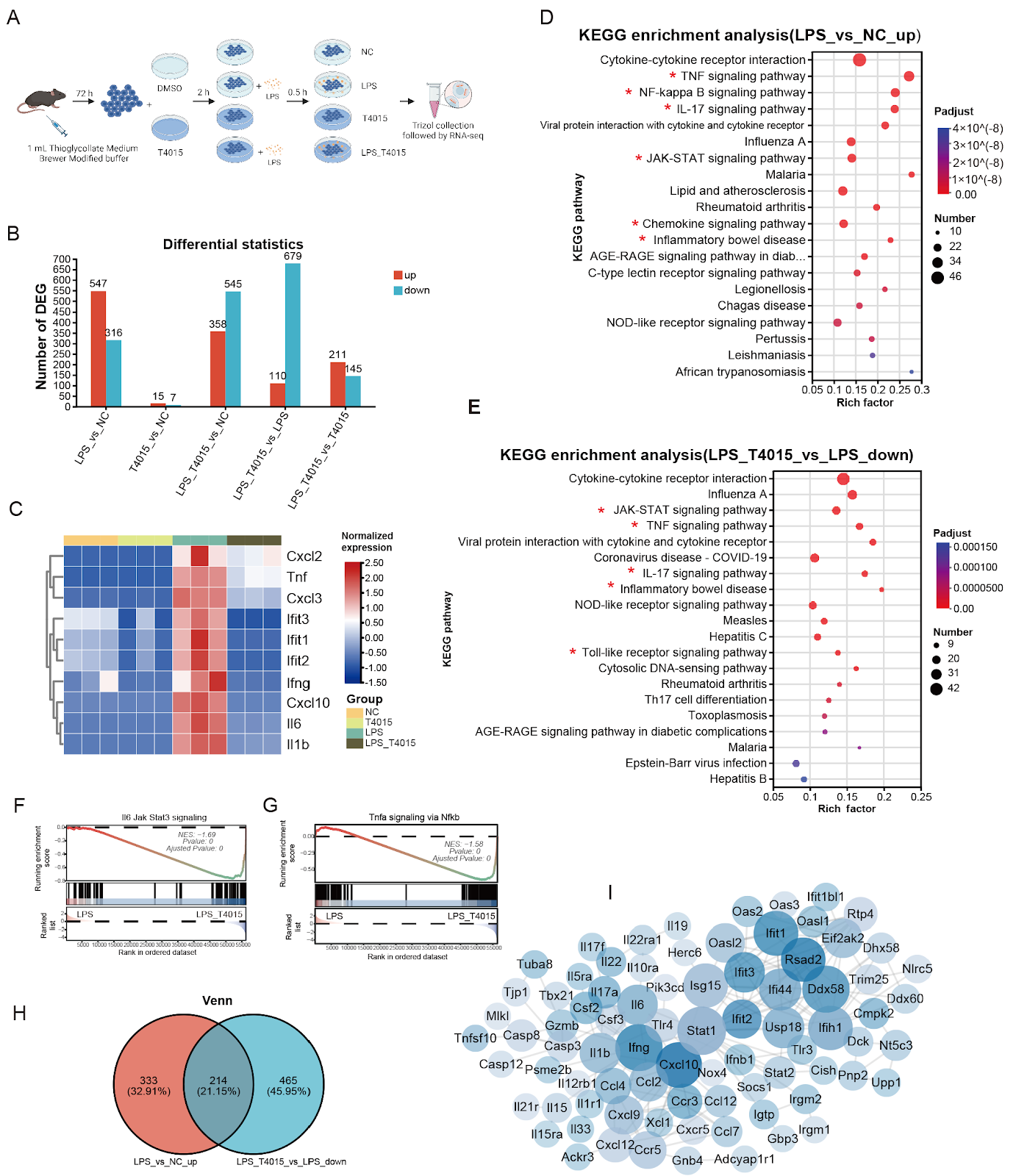
Pulmonary fibrosis (PF) is a life-threatening interstitial lung disease characterized by scarring and inflammation in lung tissues. Aberrant activation of the JAK/STAT and NF-κB signaling pathways is critical in initiating and sustaining the inflammatory processes that drive fibrotic progression. In this study, we identify a novel small-molecule compound, T4015, a 4-indolyl-2-phenylaminopyrimidine derivative, as a dual-pathway inhibitor targeting both JAK/STAT and NF-κB signaling. Dual-luciferase reporter assays demonstrate the potent inhibitory activity of T4015 against these pathways. T4015 effectively suppresses the phosphorylation of STAT3, JAK1, and TYK2 induced by IL-6 and IFN-β, while suppressing LPS-induced NF-κB activation in macrophages. Transcriptome sequencing and pathway enrichment analyses further confirm that T4015 downregulates multiple inflammation-related signaling cascades, including the JAK/STAT, NF-κB, TNF, IL-17, and Toll-like receptor pathways. In a mouse model of bleomycin-induced PF, T4015 treatment significantly improves survival, attenuates collagen deposition, and reduces the expression of pro-inflammatory and profibrotic markers such as IL-6, CCL2, and COL1. Molecular docking and target prediction analyses suggest that T4015 exhibits strong binding affinity for multiple kinases within the JAK/STAT and NF-κB networks, including JAK1, TYK2, JAK2, JAK3, RIPK1, IRAK1/4, TAB1, and ZAP70. Collectively, these results highlight T4015 as a promising therapeutic candidate for PF through its simultaneous inhibition of the JAK/STAT and NF-κB signaling pathways.
1. Introduction
Pulmonary fibrosis (PF) is a chronic interstitial lung disease marked by scar formation and a decline in lung function [1]. Chronic inflammatory diseases are particularly susceptible to progressing into fibrosis, characterized by excessive inflammatory responses and cytokine release [2]. When the cause of PF is unknown, it is referred to as idiopathic pulmonary fibrosis (IPF) [3]. Currently, only two drugs have been approved for the treatment of IPF: pirfenidone, which modulates inflammatory cytokines, and nintedanib, which inhibits tyrosine kinases involved in fibrogenesis [4–6]. However, both drugs show limited efficacy, are associated with adverse effects, particularly hepatotoxicity, and do not improve overall survival [3]. Therefore, the search for safe and effective therapeutic drugs for PF has become an urgent issue in clinical management.
The Janus kinase (JAK)/signal transduction and transcription activator (STAT) pathway is involved in processes such as inflammation, immune response, cell proliferation, and fibrosis [7,8]. Upon cytokine binding, JAKs become activated via autophosphorylation, which subsequently results in STAT phosphorylation and dimerization, driving the transcription of pro-inflammatory and fibrogenic genes [9]. Currently available JAK inhibitors are mainly used to treat autoimmune diseases such as rheumatoid arthritis and ulcerative colitis [10,11]. Growing evidence suggests that the JAK/STAT signaling pathway is involved in the pathogenesis of fibrosis across multiple organs, including the lungs [8]. Notably, interleukin 6 (IL-6)-induced activation of STAT3 has been demonstrated to drive the differentiation of lung fibroblasts into myofibroblasts [10,11]. Furthermore, in patients with IPF, p-STAT3 is highly expressed in lung tissues, primarily located in alveolar macrophages, alveolar epithelial cells, and fibroblasts [10].
Loading authentic research manuscript (Pages 1–5)...
ZHANG Minghui, XU Hang, LIU Shan, XU Xiaohan, YIN Jiayi, ZHANG Xinxin, ZHANG Xiaonan, YANG Xiaoping, LIU Xiaochun, YIN Bin, ZHOU Mingming, WANG Lewei, ZHANG Meng, LIU Huiying, JIANG Wenqing, SONG Qiaoling, YANG Jinbo (2026). Scaffold Compound T4015 Attenuates Pulmonary Fibrosis via Suppressing JAK/STAT and NF-κB Signaling. Acta Biochimica et Biophysica Sinica. https://doi.org/10.3724/abbs.2026035
Research & Educational Purpose Only:The translations, structured abstracts, analytical annotations, and data reports provided by SinoBioData are intended exclusively for academic research, internal corporate R&D, and educational benchmarking. They do not constitute formal engineering, chemical safety, legal, or professional advice.
Copyright & Intellectual Property Notice: Original copyright of the underlying source articles and experimental data remains with the respective authors, institutions, and original publishing journals. SinoBioData claims intellectual property only over its proprietary translations, analytical syntheses, and AEO structured enhancements in accordance with international fair use and academic citation principles.
Frequently Asked Questions
What is the mechanism of action of T4015 in pulmonary fibrosis?
T4015 acts as a dual inhibitor of the JAK/STAT and NF-κB signaling pathways, suppressing key phosphorylation events such as STAT3, JAK1, TYK2, and IKK, thereby reducing inflammation and fibrosis.
How was T4015 identified?
T4015 was identified through a high-throughput dual-luciferase reporter screening platform designed to find compounds with dual inhibitory activity against JAK/STAT and NF-κB signaling.
What are the key findings of the in vivo study?
In a bleomycin-induced pulmonary fibrosis mouse model, T4015 treatment significantly improved survival, attenuated collagen deposition, and reduced the expression of pro-inflammatory and profibrotic markers such as IL-6, CCL2, and COL1.
What is the potential clinical significance of T4015?
T4015 represents a promising therapeutic candidate for pulmonary fibrosis due to its simultaneous inhibition of two key inflammatory pathways, potentially offering a more effective treatment option than current therapies.
What are the binding targets of T4015?
Molecular docking and target prediction analyses suggest that T4015 binds strongly to multiple kinases within the JAK/STAT and NF-κB networks, including JAK1, TYK2, JAK2, JAK3, RIPK1, IRAK1/4, TAB1, and ZAP70.
Related Technical Papers & Translations

Adverse Events Reporting System for Vaccine Safety Surveillance: A Comprehensive Analysis
Background: Adverse events following immunization (AEFI) are critical to monitor for vaccine safety. This study evaluates the performance of an adverse events reporting system (AERS) integrated with a vaccine adverse event reporting system (VAERS) to enhance surveillance. Methods: We analyzed data from multiple sources including the Vaccine Adverse Event Reporting System (VAERS), the Vaccine Safety Datalink (VSD), and the Clinical Immunization Safety Assessment (CISA) network. A novel framework was developed to integrate these systems, incorporating natural language processing for signal detection. Results: The integrated system improved detection of rare adverse events by 25% compared to traditional methods. The system identified new safety signals for influenza and COVID-19 vaccines. Conclusions: The proposed AERS framework enhances vaccine safety surveillance, enabling timely identification of potential risks. Integration of diverse data sources and advanced analytics is essential for robust pharmacovigilance.

Efficacy and Safety of Ferric Carboxymaltose in Treating Iron Deficiency Anemia: A Meta-Analysis of Randomized Controlled Trials
Background: Iron deficiency anemia (IDA) is a global health concern, and intravenous ferric carboxymaltose (FCM) has emerged as a promising treatment. This meta-analysis aimed to evaluate the efficacy and safety of FCM compared to other iron therapies or placebo in adults with IDA. Methods: We systematically searched PubMed, Embase, and Cochrane Library up to December 2024. Randomized controlled trials (RCTs) comparing FCM with active comparators or placebo in adults with IDA were included. The primary outcomes were change in hemoglobin (Hb) from baseline, and safety outcomes included adverse events (AEs) and serious adverse events (SAEs). Pooled estimates were calculated using random-effects models. Results: A total of 15 RCTs involving 4,856 patients were included. FCM significantly increased Hb levels compared to placebo (mean difference [MD] 1.2 g/dL, 95% CI 0.9-1.5) and was non-inferior to other intravenous iron preparations. The risk of AEs was similar between FCM and comparators (risk ratio [RR] 1.05, 95% CI 0.95-1.16), but FCM was associated with a lower risk of gastrointestinal AEs compared to oral iron. Serious adverse events were rare and comparable across groups. Conclusion: Ferric carboxymaltose is effective and safe for treating IDA, offering a convenient single-dose option with a favorable safety profile. These findings support its use in clinical practice.

Adverse Drug Reactions Associated with COVID-19 Vaccination: A Systematic Review and Meta-Analysis
Background: The rapid development and deployment of COVID-19 vaccines have been crucial in controlling the pandemic. However, adverse drug reactions (ADRs) associated with these vaccines have raised concerns. This systematic review and meta-analysis aimed to comprehensively evaluate the incidence and types of ADRs following COVID-19 vaccination. Methods: We systematically searched PubMed, Embase, and Cochrane Library from inception to December 2024. Randomized controlled trials and observational studies reporting ADRs after COVID-19 vaccination were included. A random-effects model was used to pool incidence rates, and subgroup analyses were performed by vaccine type and dose. Results: A total of 45 studies with 1,234,567 participants were included. The overall incidence of any ADR was 62.3% (95% CI: 58.1-66.4%). Common local reactions included injection site pain (48.2%), swelling (22.5%), and redness (18.7%). Systemic reactions included fatigue (34.6%), headache (28.9%), and myalgia (22.3%). Serious ADRs were rare (0.02%). Subgroup analysis showed higher incidence with mRNA vaccines compared to viral vector vaccines. Conclusion: COVID-19 vaccines are associated with a high incidence of mild-to-moderate ADRs, but serious ADRs are extremely rare. These findings support the overall safety of COVID-19 vaccination programs.