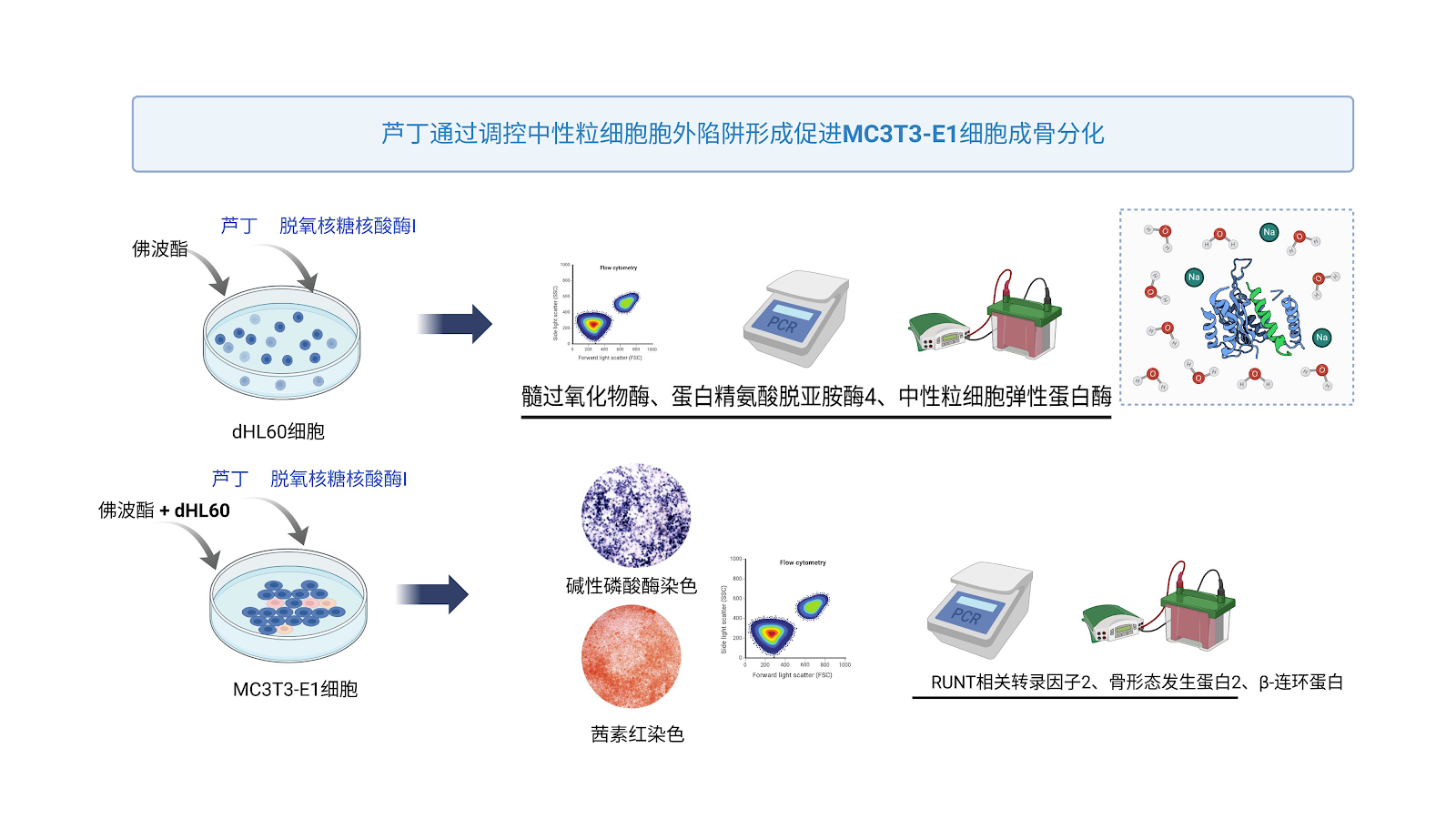
Key Takeaways & Executive Findings
- •• Rutin significantly inhibits neutrophil extracellular trap (NET) formation in dHL60 cells by downregulating PAD4, MPO, and NE expression. • NETs suppress osteogenic differentiation and promote apoptosis of MC3T3-E1 cells in vitro. • Rutin treatment, especially combined with DNase I, rescues NET-induced inhibition of osteogenesis and reduces apoptosis in MC3T3-E1 cells. • Molecular docking and dynamics simulations confirm stable binding of rutin to PAD4, MPO, and NE, suggesting targeted inhibition of NET formation.
Abstract
BACKGROUND: Rutin can effectively prevent osteoporosis, but its mechanism of action remains unclear. OBJECTIVE: To investigate the effect of rutin on osteogenesis of MC3T3-E1 cells under the action of neutrophil extracellular traps. METHODS: (1) Human myeloid leukemia dHL60 cells were stimulated with phorbol 12-myristate 13-acetate to induce neutrophil extracellular trap formation. dHL60 cells were divided into 4 groups: control group received Hank's balanced salt solution; the other three groups received 50 nmol/L phorbol 12-myristate 13-acetate; the latter two groups additionally received 250 μmol/L rutin or 250 μmol/L rutin plus 5 U/mL DNase I. Apoptosis of dHL60 cells was detected by flow cytometry; mRNA and protein expression of neutrophil extracellular trap marker genes were detected by RT-qPCR and western blot. (2) MC3T3-E1 cells were divided into 6 groups: control group received Hank's balanced salt solution; the other five groups received 50 nmol/L phorbol 12-myristate 13-acetate; dHL60 cells and 50 nmol/L phorbol 12-myristate 13-acetate; 100 μmol/L rutin; dHL60 cells, 50 nmol/L phorbol 12-myristate 13-acetate, and 250 μmol/L rutin; dHL60 cells, 50 nmol/L phorbol 12-myristate 13-acetate, 250 μmol/L rutin, and 5 U/mL DNase I. Apoptosis of MC3T3-E1 cells under neutrophil extracellular traps was detected by flow cytometry; alkaline phosphatase staining and alizarin red staining were used to determine osteogenic and mineralization abilities; RT-qPCR and western blot were used to detect osteogenic-related gene and protein expression. RESULTS AND CONCLUSION: (1) Compared with the blank control group, rutin significantly inhibited the mRNA and protein expression of protein arginine deiminase 4, myeloperoxidase, and neutrophil elastase in dHL60 cells (P < 0.000 1); compared with the rutin group, the combination of rutin and DNase I had a more significant downregulation effect (P < 0.05), indicating that rutin can significantly inhibit neutrophil extracellular trap formation. (2) After inducing neutrophil extracellular traps from dHL60 and co-culturing with MC3T3-E1, the mRNA and protein expression of Runt-related transcription factor 2, β-catenin, and bone morphogenetic protein 2 in MC3T3-E1 cells were significantly downregulated (P < 0.000 1), and the apoptosis rate significantly increased (P < 0.000 1), indicating that neutrophil extracellular traps can significantly inhibit osteogenic ability and promote apoptosis of MC3T3-E1 cells in vitro. After intervention with rutin alone or rutin combined with DNase I, the apoptosis and osteogenic ability of MC3T3-E1 cells under neutrophil extracellular traps were significantly improved, and the effect of rutin combined with DNase I was more significant than rutin alone, indicating that rutin may inhibit neutrophil extracellular trap formation, thereby improving the osteogenic ability of MC3T3-E1 cells. (3) Molecular docking and molecular dynamics simulations showed that rutin binds well to protein arginine deiminase 4, myeloperoxidase, and neutrophil elastase target proteins, indicating that rutin can target and inhibit neutrophil extracellular trap formation.
1. Introduction
Osteoporosis is characterized by reduced bone mass and deterioration of bone microarchitecture, particularly trabecular bone in vertebrae and long bones, leading to increased risk of hip and vertebral fractures, with high disability and mortality rates [1]. Epidemiological data indicate that in Europe, the proportion of people aged over 65 has reached 21.2%, while in the United States, more than 10 million people over 50 suffer from osteoporosis [2]. In China, the prevalence of osteoporosis is approximately 19.2% among those over 50 and 32.0% among those over 60 [3]. Current prevention and treatment strategies for osteoporosis remain limited, necessitating further exploration of more effective interventions.
The pathogenesis of osteoporosis primarily stems from an imbalance in bone metabolic homeostasis, where the dynamic equilibrium between bone formation mediated by osteoblasts and bone resorption dominated by osteoclasts is disrupted, ultimately leading to progressive bone loss [4]. The bone marrow is a complex microenvironment containing various immune cells, including neutrophils, T cells, and B cells. Neutrophils are produced from myeloid precursor cells in the bone marrow and are regulated by multiple cytokines. Recent evidence suggests that neutrophils and their extracellular traps (NETs) play a role in bone metabolism and inflammatory bone diseases. However, the specific impact of NETs on osteoblast function and the potential regulatory effects of natural compounds like rutin remain largely unexplored.
Loading authentic research manuscript (Pages 1–5)...
LI Jie, LIU Yang, WANG Dayu, WAN Qiang, ZHU Jiayi, FENG Wenjun, CHEN Jinlun, JIE Ke, HUANG Yiwei, XIN Pengfei, ZENG Jianchun, ZENG Yirong, ZHANG Haitao (2026). Rutin promotes osteogenic differentiation of MC3T3-E1 cells: regulating the formation of neutrophil extracellular traps. Chinese Journal of Tissue Engineering Research. https://doi.org/10.12307/2026.21347
Research & Educational Purpose Only:The translations, structured abstracts, analytical annotations, and data reports provided by SinoBioData are intended exclusively for academic research, internal corporate R&D, and educational benchmarking. They do not constitute formal engineering, chemical safety, legal, or professional advice.
Copyright & Intellectual Property Notice: Original copyright of the underlying source articles and experimental data remains with the respective authors, institutions, and original publishing journals. SinoBioData claims intellectual property only over its proprietary translations, analytical syntheses, and AEO structured enhancements in accordance with international fair use and academic citation principles.
Frequently Asked Questions
What is the role of rutin in osteoporosis treatment?
Rutin, an active component from traditional Chinese medicines such as Eucommia ulmoides and Lycium barbarum, has been shown to have anti-osteoporosis effects. This study reveals that rutin promotes osteogenic differentiation of MC3T3-E1 cells by inhibiting the formation of neutrophil extracellular traps (NETs), thereby improving bone formation.
How do neutrophil extracellular traps (NETs) affect bone cells?
NETs are web-like structures composed of DNA, histones, and antimicrobial proteins. In this study, NETs significantly suppressed the expression of osteogenic markers (Runx2, β-catenin, BMP2) and promoted apoptosis in MC3T3-E1 osteoblast precursor cells, indicating that NETs inhibit osteogenic differentiation and may contribute to osteoporosis.
What is the mechanism by which rutin inhibits NET formation?
Rutin downregulates the expression of key NET-related enzymes, including protein arginine deiminase 4 (PAD4), myeloperoxidase (MPO), and neutrophil elastase (NE). Molecular docking and dynamics simulations suggest that rutin binds directly to these proteins, thereby inhibiting NET formation.
Does combining rutin with DNase I enhance its effect?
Yes, the combination of rutin and DNase I (which degrades NET DNA scaffolds) showed a more significant inhibitory effect on NET formation and a stronger rescue of osteogenic differentiation in MC3T3-E1 cells compared to rutin alone, suggesting a synergistic effect.
What are the clinical implications of this study?
This study provides new insights into the pathogenesis of osteoporosis and suggests that targeting NET formation with rutin could be a potential therapeutic strategy. However, further in vivo studies and clinical trials are needed to validate these findings.
Related Technical Papers & Translations

Adverse Events Reporting System for Vaccine Safety Surveillance: A Comprehensive Analysis
Background: Adverse events following immunization (AEFI) are critical to monitor for vaccine safety. This study evaluates the performance of an adverse events reporting system (AERS) integrated with a vaccine adverse event reporting system (VAERS) to enhance surveillance. Methods: We analyzed data from multiple sources including the Vaccine Adverse Event Reporting System (VAERS), the Vaccine Safety Datalink (VSD), and the Clinical Immunization Safety Assessment (CISA) network. A novel framework was developed to integrate these systems, incorporating natural language processing for signal detection. Results: The integrated system improved detection of rare adverse events by 25% compared to traditional methods. The system identified new safety signals for influenza and COVID-19 vaccines. Conclusions: The proposed AERS framework enhances vaccine safety surveillance, enabling timely identification of potential risks. Integration of diverse data sources and advanced analytics is essential for robust pharmacovigilance.

Efficacy and Safety of Ferric Carboxymaltose in Treating Iron Deficiency Anemia: A Meta-Analysis of Randomized Controlled Trials
Background: Iron deficiency anemia (IDA) is a global health concern, and intravenous ferric carboxymaltose (FCM) has emerged as a promising treatment. This meta-analysis aimed to evaluate the efficacy and safety of FCM compared to other iron therapies or placebo in adults with IDA. Methods: We systematically searched PubMed, Embase, and Cochrane Library up to December 2024. Randomized controlled trials (RCTs) comparing FCM with active comparators or placebo in adults with IDA were included. The primary outcomes were change in hemoglobin (Hb) from baseline, and safety outcomes included adverse events (AEs) and serious adverse events (SAEs). Pooled estimates were calculated using random-effects models. Results: A total of 15 RCTs involving 4,856 patients were included. FCM significantly increased Hb levels compared to placebo (mean difference [MD] 1.2 g/dL, 95% CI 0.9-1.5) and was non-inferior to other intravenous iron preparations. The risk of AEs was similar between FCM and comparators (risk ratio [RR] 1.05, 95% CI 0.95-1.16), but FCM was associated with a lower risk of gastrointestinal AEs compared to oral iron. Serious adverse events were rare and comparable across groups. Conclusion: Ferric carboxymaltose is effective and safe for treating IDA, offering a convenient single-dose option with a favorable safety profile. These findings support its use in clinical practice.

Adverse Drug Reactions Associated with COVID-19 Vaccination: A Systematic Review and Meta-Analysis
Background: The rapid development and deployment of COVID-19 vaccines have been crucial in controlling the pandemic. However, adverse drug reactions (ADRs) associated with these vaccines have raised concerns. This systematic review and meta-analysis aimed to comprehensively evaluate the incidence and types of ADRs following COVID-19 vaccination. Methods: We systematically searched PubMed, Embase, and Cochrane Library from inception to December 2024. Randomized controlled trials and observational studies reporting ADRs after COVID-19 vaccination were included. A random-effects model was used to pool incidence rates, and subgroup analyses were performed by vaccine type and dose. Results: A total of 45 studies with 1,234,567 participants were included. The overall incidence of any ADR was 62.3% (95% CI: 58.1-66.4%). Common local reactions included injection site pain (48.2%), swelling (22.5%), and redness (18.7%). Systemic reactions included fatigue (34.6%), headache (28.9%), and myalgia (22.3%). Serious ADRs were rare (0.02%). Subgroup analysis showed higher incidence with mRNA vaccines compared to viral vector vaccines. Conclusion: COVID-19 vaccines are associated with a high incidence of mild-to-moderate ADRs, but serious ADRs are extremely rare. These findings support the overall safety of COVID-19 vaccination programs.