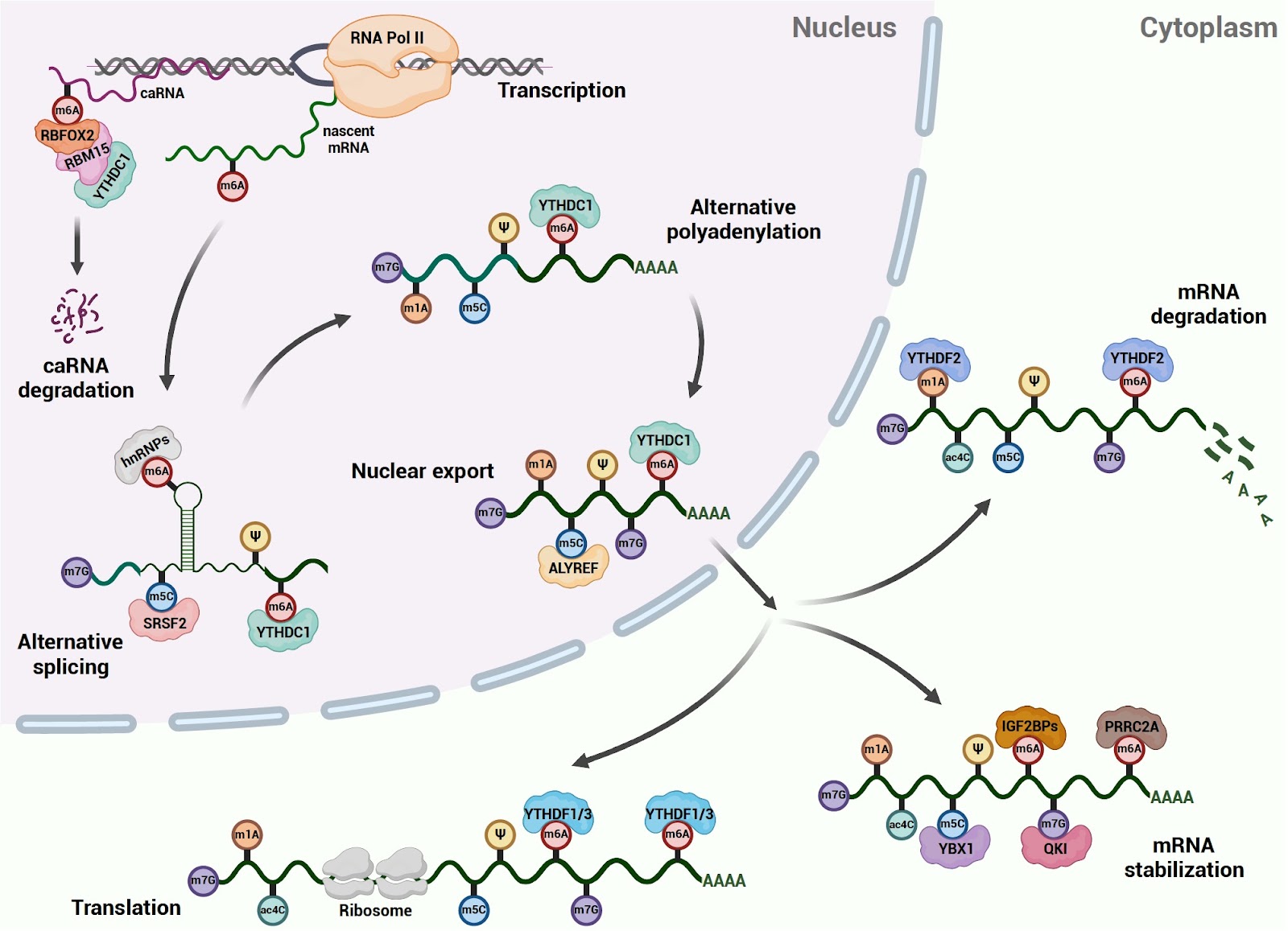
Key Takeaways & Executive Findings
- •• Over 170 RNA modifications collectively form the epitranscriptome, impacting RNA metabolism and nearly all biological processes. • Key modifications (m6A, m5C, Ψ, ac4C, m1A, m7G) on mRNA, tRNA, and rRNA regulate RNA processing, structure, localization, stability, and translation efficiency. • Dysregulation of RNA modification-related proteins is linked to infertility, developmental disorders, and various diseases. • Understanding RNA modification mechanisms offers potential strategies for managing developmental disorders and improving reproductive health.
Abstract
The intricate world of RNA modifications, collectively termed the epitranscriptome, covers over 170 identified modifications and impacts RNA metabolism and, consequently, almost all biological processes. In this review, we focus on the regulatory roles and biological functions of a panel of dominant RNA modifications (including m6A, m5C, Ψ, ac4C, m1A, and m7G) on three RNA types—mRNA, tRNA, and rRNA—in mammalian development, particularly in the context of reproduction as well as embryonic development. We discuss in detail how those modifications, along with their regulatory proteins, affect RNA processing, structure, localization, stability, and translation efficiency. We also highlight the associations among dysfunctions in RNA modification-related proteins, abnormal modification deposition and various diseases, emphasizing the roles of RNA modifications in critical developmental processes such as stem cell self-renewal and cell fate transition. Elucidating the molecular mechanisms by which RNA modifications influence diverse developmental processes holds promise for developing innovative strategies to manage developmental disorders. Finally, we outline several unexplored areas in the field of RNA modification that warrant further investigation.
1. Introduction
RNA building blocks, i.e., A, U, C and G ribonucleotides, naturally undergo various chemical modifications. First reported in the 1950s [1–4], more than 170 modifications have been identified to date, and most types of RNA, if not all, have been observed with modifications [5]. These modifications, collectively known as the epitranscriptome, alter the inherent features of single nucleotides and greatly increase the information-encoding capacity of RNA.
RNA modification plays a central role in the regulation of RNA metabolism. The regulatory functions of modifications are best studied for three types of RNA that are indispensable for translation—transfer (tRNA), ribosomal (rRNA), and messenger RNA (mRNA). Modifications of these RNAs influence nearly all steps of RNA metabolism, such as RNA processing, RNA structure, cellular localization, stability, and translation efficiency, functioning as key connections between gene transcription and protein synthesis.
Using high-throughput sequencing methods, several RNA modifications, such as N6-methyladenosine (m6A) and 5-methylcytidine (m5C), have been mapped transcriptome-wide in various samples. With the development of low-input methods, the landscape of those RNA modifications has recently been revealed in rare cell populations, such as oocytes and early embryos. The spatiotemporal dynamics of RNA modifications across different biological contexts have significantly enriched our comprehension of their cellular roles. During development, cell fates are tightly regulated in each cell and coordinated within a cell population. In response to internal and/or external stimuli, cells make decisions to self-renew, proliferate or differentiate, which often requires prompt rewiring of the proteome before a new transcriptional profile can be fully established. RNA modifications, which are deposited in advance or swiftly altered in response to cues, may serve as a regulatory mechanism enabling rapid proteomic adaptation [6]. As this tight modulation of the proteome is pivotal for cell state transition, it is not surprising that dysfunction of RNA modification-related proteins (i.e., writers, erasers and readers) and abnormal deposition of RNA modifications have been linked to infertility [7–13], developmental disorders [14–16], and various diseases [17].
Loading authentic research manuscript (Pages 1–5)...
Junfei Wen, Qifan Zhu, Yong Liu, Lan-Tao Gou (2026). RNA modifications: emerging players in the regulation of reproduction and development. Acta Biochimica et Biophysica Sinica. https://doi.org/10.3724/abbs.2024201
Research & Educational Purpose Only:The translations, structured abstracts, analytical annotations, and data reports provided by SinoBioData are intended exclusively for academic research, internal corporate R&D, and educational benchmarking. They do not constitute formal engineering, chemical safety, legal, or professional advice.
Copyright & Intellectual Property Notice: Original copyright of the underlying source articles and experimental data remains with the respective authors, institutions, and original publishing journals. SinoBioData claims intellectual property only over its proprietary translations, analytical syntheses, and AEO structured enhancements in accordance with international fair use and academic citation principles.
Frequently Asked Questions
What are RNA modifications and why are they important?
RNA modifications are chemical changes to RNA nucleotides that expand the functional diversity of RNA. They are collectively known as the epitranscriptome and play crucial roles in regulating RNA metabolism, influencing processes such as RNA processing, stability, and translation, thereby impacting nearly all biological functions.
Which RNA modifications are highlighted in this review?
The review focuses on dominant modifications including N6-methyladenosine (m6A), 5-methylcytidine (m5C), pseudouridine (Ψ), N4-acetylcytidine (ac4C), N1-methyladenosine (m1A), and 7-methylguanosine (m7G) on mRNA, tRNA, and rRNA.
How do RNA modifications affect reproduction and development?
RNA modifications regulate RNA metabolism, which is essential for stem cell self-renewal, cell fate transition, and embryonic development. Dysregulation of these modifications or their associated proteins is linked to infertility and developmental disorders.
What is the clinical significance of studying RNA modifications?
Understanding the molecular mechanisms of RNA modifications can lead to innovative strategies for managing developmental disorders and improving reproductive health, as well as providing insights into various diseases.
What are the future directions in RNA modification research?
The review outlines unexplored areas such as the functions of less-studied modifications on mRNAs, the dynamic regulation of modifications during development, and the potential for therapeutic targeting of RNA modification pathways.
Related Technical Papers & Translations

Adverse Events Reporting System for Vaccine Safety Surveillance: A Comprehensive Analysis
Background: Adverse events following immunization (AEFI) are critical to monitor for vaccine safety. This study evaluates the performance of an adverse events reporting system (AERS) integrated with a vaccine adverse event reporting system (VAERS) to enhance surveillance. Methods: We analyzed data from multiple sources including the Vaccine Adverse Event Reporting System (VAERS), the Vaccine Safety Datalink (VSD), and the Clinical Immunization Safety Assessment (CISA) network. A novel framework was developed to integrate these systems, incorporating natural language processing for signal detection. Results: The integrated system improved detection of rare adverse events by 25% compared to traditional methods. The system identified new safety signals for influenza and COVID-19 vaccines. Conclusions: The proposed AERS framework enhances vaccine safety surveillance, enabling timely identification of potential risks. Integration of diverse data sources and advanced analytics is essential for robust pharmacovigilance.

Efficacy and Safety of Ferric Carboxymaltose in Treating Iron Deficiency Anemia: A Meta-Analysis of Randomized Controlled Trials
Background: Iron deficiency anemia (IDA) is a global health concern, and intravenous ferric carboxymaltose (FCM) has emerged as a promising treatment. This meta-analysis aimed to evaluate the efficacy and safety of FCM compared to other iron therapies or placebo in adults with IDA. Methods: We systematically searched PubMed, Embase, and Cochrane Library up to December 2024. Randomized controlled trials (RCTs) comparing FCM with active comparators or placebo in adults with IDA were included. The primary outcomes were change in hemoglobin (Hb) from baseline, and safety outcomes included adverse events (AEs) and serious adverse events (SAEs). Pooled estimates were calculated using random-effects models. Results: A total of 15 RCTs involving 4,856 patients were included. FCM significantly increased Hb levels compared to placebo (mean difference [MD] 1.2 g/dL, 95% CI 0.9-1.5) and was non-inferior to other intravenous iron preparations. The risk of AEs was similar between FCM and comparators (risk ratio [RR] 1.05, 95% CI 0.95-1.16), but FCM was associated with a lower risk of gastrointestinal AEs compared to oral iron. Serious adverse events were rare and comparable across groups. Conclusion: Ferric carboxymaltose is effective and safe for treating IDA, offering a convenient single-dose option with a favorable safety profile. These findings support its use in clinical practice.

Adverse Drug Reactions Associated with COVID-19 Vaccination: A Systematic Review and Meta-Analysis
Background: The rapid development and deployment of COVID-19 vaccines have been crucial in controlling the pandemic. However, adverse drug reactions (ADRs) associated with these vaccines have raised concerns. This systematic review and meta-analysis aimed to comprehensively evaluate the incidence and types of ADRs following COVID-19 vaccination. Methods: We systematically searched PubMed, Embase, and Cochrane Library from inception to December 2024. Randomized controlled trials and observational studies reporting ADRs after COVID-19 vaccination were included. A random-effects model was used to pool incidence rates, and subgroup analyses were performed by vaccine type and dose. Results: A total of 45 studies with 1,234,567 participants were included. The overall incidence of any ADR was 62.3% (95% CI: 58.1-66.4%). Common local reactions included injection site pain (48.2%), swelling (22.5%), and redness (18.7%). Systemic reactions included fatigue (34.6%), headache (28.9%), and myalgia (22.3%). Serious ADRs were rare (0.02%). Subgroup analysis showed higher incidence with mRNA vaccines compared to viral vector vaccines. Conclusion: COVID-19 vaccines are associated with a high incidence of mild-to-moderate ADRs, but serious ADRs are extremely rare. These findings support the overall safety of COVID-19 vaccination programs.