Key Takeaways & Executive Findings
- •• Specific RA concentration (0.1 μM) during days 3-6 of hiPSC differentiation yields left ventricle-like cardiomyocytes with enhanced contractile protein expression and functional properties. • Engineered heart tissues from HRA-treated cells exhibit higher contraction force, lower beating frequency, and increased sensitivity to hypoxia and isoprenaline, closely mimicking left ventricular physiology. • RNA sequencing reveals that RA promotes augmented extracellular matrix strength, which underlies the heightened contractility of EHTs. • This study provides a novel method to generate ventricle-specific cardiomyocytes and EHTs, advancing personalized drug screening and regenerative medicine.
Abstract
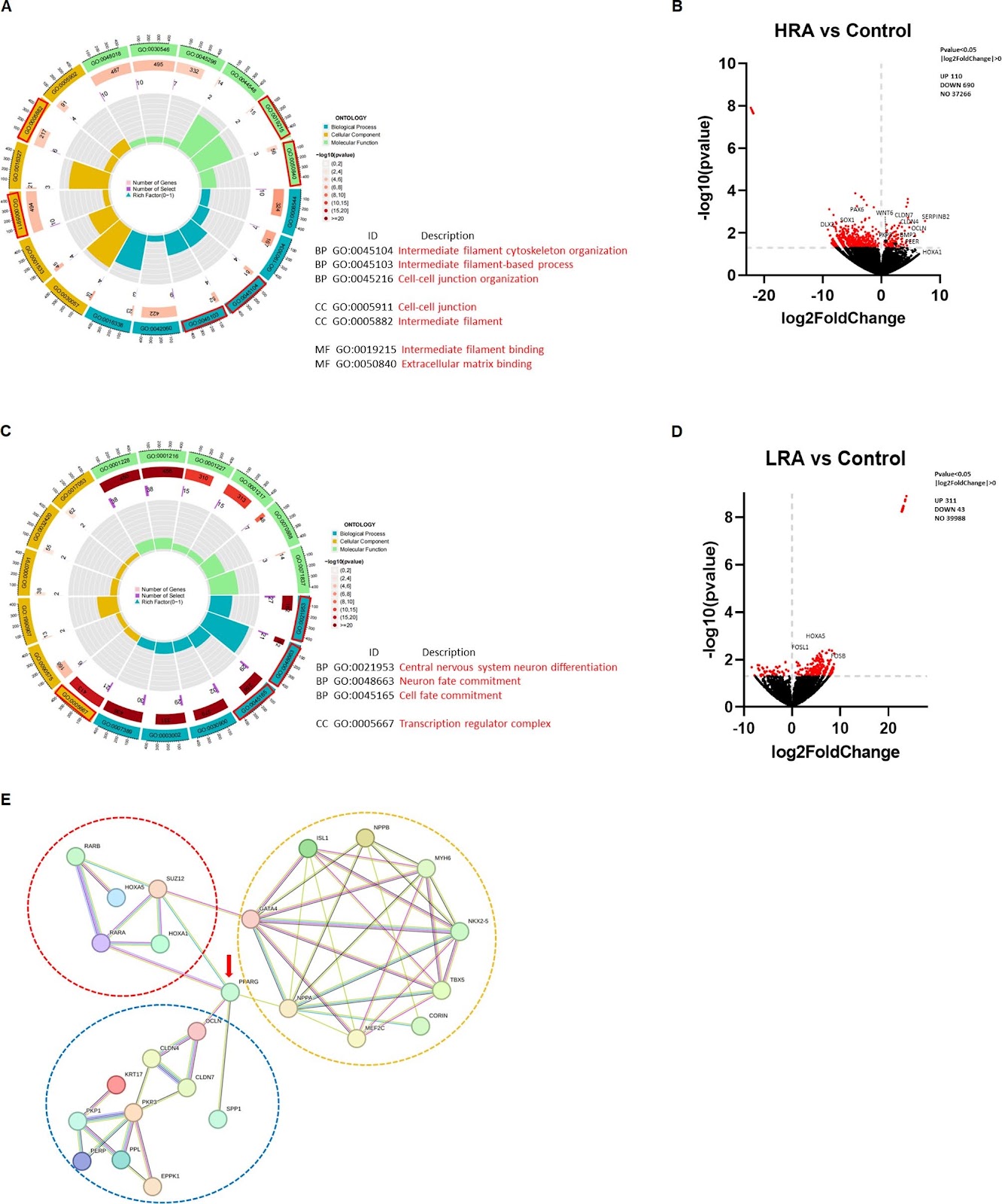
Background Cardiomyocytes (CMs) derived from human induced pluripotent stem cells (hiPSCs) by traditional methods are a mix of atrial and ventricular CMs and many other non-cardiomyocyte cells. Retinoic acid (RA) plays an important role in regulation of the spatiotemporal development of the embryonic heart. Methods CMs were derived from hiPSC (hi-PCS-CM) using different concentrations of RA (Control without RA, LRA with 0.05μM and HRA with 0.1 μM) between day 3-6 of the differentiation process. Engineered heart tissues (EHTs) were generated by assembling hiPSC-CM at high cell density in a low collagen hydrogel. Results In the HRA group, hiPSC-CMs exhibited highest expression of contractile proteins MYH6, MYH7 and cTnT. The expression of TBX5, NKX2.5 and CORIN, which are marker genes for left ventricular CMs, was also the highest in the HRA group. In terms of EHT, the HRA group displayed the highest contraction force, the lowest beating frequency, and the highest sensitivity to hypoxia and isoprenaline, which means it was functionally more similar to the left ventricle. RNAsequencing revealed that the heightened contractility of EHT within the HRA group can be attributed to the promotion of augmented extracellular matrix strength by RA. Conclusion By interfering with the differentiation process of hiPSC with a specific concentration of RA at a specific time, we were able to successfully induce CMs and EHTs with a phenotype similar to that of the left ventricle or right ventricle.
1. Introduction
Cardiomyocytes (CMs), derived from human induced pluripotent stem cells (hiPSC-CMs), and the engineered heart tissue (EHT) derived from these hiPSC-CMs, constitute a highly advantageous in vitro experimental model for conducting personalized drug screening and advancing regenerative strategies within the realm of precision medicine [27, 37]. However, CMs induced from hiPSCs using traditional methods represent a heterogeneous population comprising both atrial and ventricular cells [29, 64]. Although earlier studies have effectively accomplished the differentiation of hiPSC-CM into distinct atrial or ventricular phenotypes [14, 30], no prior research has achieved the successful differentiation of hiPSC-CM into EHTs with specific phenotypes corresponding to either the left ventricle (LV) or the right ventricle (RV).
Retinoic acid (RA) signaling plays a pivotal role in embryonic development, as it is essential for organizing the trunk and facilitating organogenesis in diverse tissues derived from all three germ layers [16, 22]. In addition to being one of ingredients regulating embryonic development, RA also regulates cardiac development and affects the differentiation of hiPSC-CM into different subtypes, with the direction of differentiation being time- and concentration-dependent [59] (Fig. 1A). Previous research has demonstrated that RA concentrations ranging from 1 µM to 5 µM appear to promote hiPSC-CM or heart embryonic differentiation toward atrial CMs [14, 30, 59], whereas a concentration of 0.05 µM appears to promote differentiation towards left ventricular CMs [25]. Other studies found that RA mainly induces epicardial cells at
Loading authentic research manuscript (Pages 1–5)...
Hengliang Zhang, Payel Sen, Jules Hamers, Theresa Sittig, Brent Woestenburg, Allessandra Moretti, Andreas Dendorfer, Daphne Merkus (2026). Retinoic acid modulation guides human-induced pluripotent stem cell differentiation towards left or right ventricle-like cardiomyocytes. Stem Cell Research & Therapy. https://doi.org/10.1186/s13287-024-03741-0
Research & Educational Purpose Only:The translations, structured abstracts, analytical annotations, and data reports provided by SinoBioData are intended exclusively for academic research, internal corporate R&D, and educational benchmarking. They do not constitute formal engineering, chemical safety, legal, or professional advice.
Copyright & Intellectual Property Notice: Original copyright of the underlying source articles and experimental data remains with the respective authors, institutions, and original publishing journals. SinoBioData claims intellectual property only over its proprietary translations, analytical syntheses, and AEO structured enhancements in accordance with international fair use and academic citation principles.
Frequently Asked Questions
What is the role of retinoic acid in cardiac differentiation?
Retinoic acid (RA) plays a crucial role in embryonic cardiac development and can direct the differentiation of human induced pluripotent stem cells (hiPSCs) into specific cardiomyocyte subtypes in a time- and concentration-dependent manner. This study shows that specific RA concentrations can generate left or right ventricle-like cardiomyocytes.
How were left ventricle-like cardiomyocytes generated?
By treating hiPSC-derived cardiomyocytes with 0.1 μM retinoic acid (HRA) between days 3-6 of differentiation, the cells exhibited higher expression of left ventricular markers (TBX5, NKX2.5, CORIN) and contractile proteins, and engineered heart tissues showed functional properties similar to the left ventricle.
What are the functional characteristics of the engineered heart tissues in the HRA group?
The HRA group displayed the highest contraction force, the lowest beating frequency, and the highest sensitivity to hypoxia and isoprenaline, indicating a more left ventricular-like phenotype.
What is the significance of this research?
This research provides a method to generate ventricle-specific cardiomyocytes and engineered heart tissues, which can improve drug screening accuracy and advance regenerative medicine for cardiac diseases.
What is the mechanism behind the enhanced contractility in HRA-treated EHTs?
RNA sequencing revealed that retinoic acid promotes augmented extracellular matrix strength, which contributes to the heightened contractility of the engineered heart tissues.
Related Technical Papers & Translations

Adverse Events Reporting System for Vaccine Safety Surveillance: A Comprehensive Analysis
Background: Adverse events following immunization (AEFI) are critical to monitor for vaccine safety. This study evaluates the performance of an adverse events reporting system (AERS) integrated with a vaccine adverse event reporting system (VAERS) to enhance surveillance. Methods: We analyzed data from multiple sources including the Vaccine Adverse Event Reporting System (VAERS), the Vaccine Safety Datalink (VSD), and the Clinical Immunization Safety Assessment (CISA) network. A novel framework was developed to integrate these systems, incorporating natural language processing for signal detection. Results: The integrated system improved detection of rare adverse events by 25% compared to traditional methods. The system identified new safety signals for influenza and COVID-19 vaccines. Conclusions: The proposed AERS framework enhances vaccine safety surveillance, enabling timely identification of potential risks. Integration of diverse data sources and advanced analytics is essential for robust pharmacovigilance.

Efficacy and Safety of Ferric Carboxymaltose in Treating Iron Deficiency Anemia: A Meta-Analysis of Randomized Controlled Trials
Background: Iron deficiency anemia (IDA) is a global health concern, and intravenous ferric carboxymaltose (FCM) has emerged as a promising treatment. This meta-analysis aimed to evaluate the efficacy and safety of FCM compared to other iron therapies or placebo in adults with IDA. Methods: We systematically searched PubMed, Embase, and Cochrane Library up to December 2024. Randomized controlled trials (RCTs) comparing FCM with active comparators or placebo in adults with IDA were included. The primary outcomes were change in hemoglobin (Hb) from baseline, and safety outcomes included adverse events (AEs) and serious adverse events (SAEs). Pooled estimates were calculated using random-effects models. Results: A total of 15 RCTs involving 4,856 patients were included. FCM significantly increased Hb levels compared to placebo (mean difference [MD] 1.2 g/dL, 95% CI 0.9-1.5) and was non-inferior to other intravenous iron preparations. The risk of AEs was similar between FCM and comparators (risk ratio [RR] 1.05, 95% CI 0.95-1.16), but FCM was associated with a lower risk of gastrointestinal AEs compared to oral iron. Serious adverse events were rare and comparable across groups. Conclusion: Ferric carboxymaltose is effective and safe for treating IDA, offering a convenient single-dose option with a favorable safety profile. These findings support its use in clinical practice.

Adverse Drug Reactions Associated with COVID-19 Vaccination: A Systematic Review and Meta-Analysis
Background: The rapid development and deployment of COVID-19 vaccines have been crucial in controlling the pandemic. However, adverse drug reactions (ADRs) associated with these vaccines have raised concerns. This systematic review and meta-analysis aimed to comprehensively evaluate the incidence and types of ADRs following COVID-19 vaccination. Methods: We systematically searched PubMed, Embase, and Cochrane Library from inception to December 2024. Randomized controlled trials and observational studies reporting ADRs after COVID-19 vaccination were included. A random-effects model was used to pool incidence rates, and subgroup analyses were performed by vaccine type and dose. Results: A total of 45 studies with 1,234,567 participants were included. The overall incidence of any ADR was 62.3% (95% CI: 58.1-66.4%). Common local reactions included injection site pain (48.2%), swelling (22.5%), and redness (18.7%). Systemic reactions included fatigue (34.6%), headache (28.9%), and myalgia (22.3%). Serious ADRs were rare (0.02%). Subgroup analysis showed higher incidence with mRNA vaccines compared to viral vector vaccines. Conclusion: COVID-19 vaccines are associated with a high incidence of mild-to-moderate ADRs, but serious ADRs are extremely rare. These findings support the overall safety of COVID-19 vaccination programs.