Key Takeaways & Executive Findings
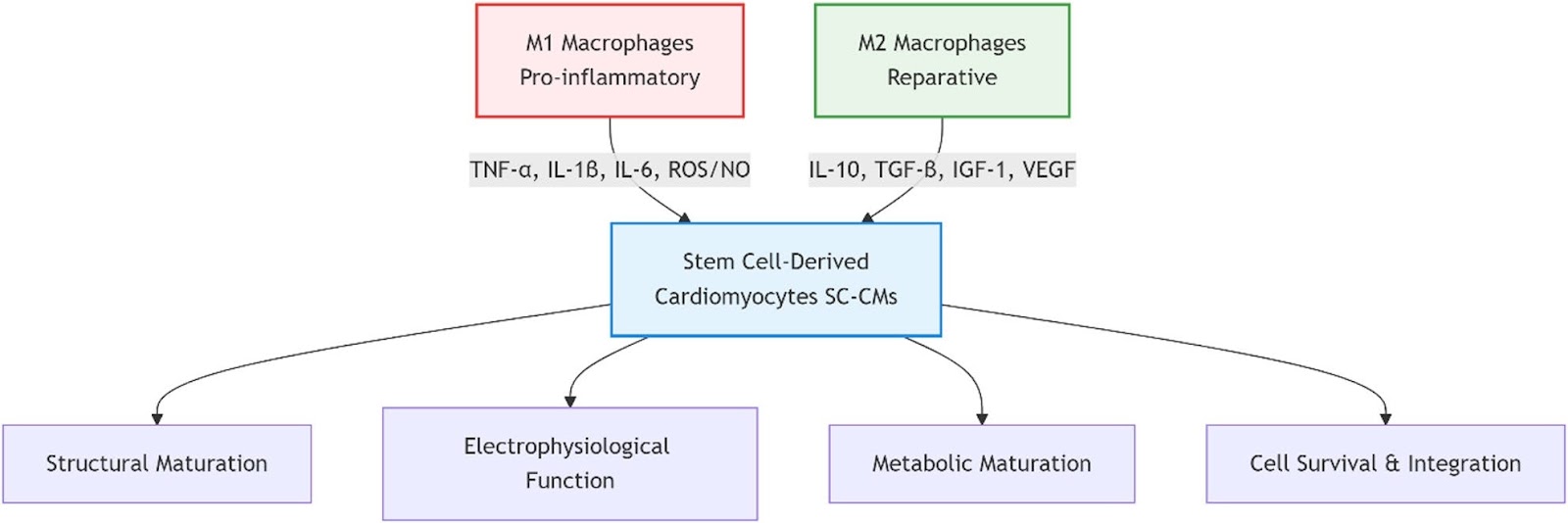
- •• M1 macrophages inhibit SC-CM differentiation and maturation via pro-inflammatory cytokines (TNF-α, IL-1β) that suppress Wnt/β-catenin signaling and maintain glycolytic metabolism. • M2 macrophages promote SC-CM maturation through trophic factors (IGF-1, HGF) that enhance electrophysiological properties, metabolic reprogramming to oxidative phosphorylation, and angiogenesis via VEGF. • The immune microenvironment, particularly macrophage polarization, is a critical determinant of SC-CM transplantation success, influencing survival, integration, and functional recovery. • Emerging therapeutic strategies, including optimized transplantation timing, co-transplantation with immunomodulatory cells, engineered exosomes, and smart biomaterials, aim to harness macrophage polarization to improve cardiac regeneration outcomes.
Abstract
Stem cell-derived cardiomyocytes (SC-CMs) represent a promising cell source for cardiac regenerative medicine, disease modeling, and drug screening. However, their clinical translation faces significant challenges, including functional immaturity, poor long-term survival, and inadequate integration with host tissue following transplantation. The immune microenvironment, particularly the dynamic polarization of macrophages into pro-inflammatory (M1) or reparative (M2) phenotypes, is increasingly recognized as a critical regulator of cardiac repair, yet a systematic understanding of its specific effects on SC-CM fate remains incomplete. This review aims to comprehensively evaluate the dual regulatory roles of M1 and M2 macrophages on the differentiation efficiency, structural and functional maturation, and in vivo transplantation efficacy of SC-CMs. A systematic literature search was conducted in PubMed, Web of Science, Nature, and CNKI for relevant studies published from database inception to July 2025. After screening, 92 articles were included for analysis. The synthesized evidence demonstrates that M1 macrophages and their secreted factors (e.g., TNF-α, IL-1β) impede cardiac differentiation by inhibiting the Wnt/β-catenin pathway, disrupt sarcomeric organization and calcium handling, and maintain SC-CMs in a glycolytic, immature state. In contrast, M2 macrophages enhance SC-CM maturation by providing trophic support (e.g., IGF-1, HGF), promoting electrophysiological maturation and metabolic reprogramming towards oxidative phosphorylation, and facilitating angiogenesis via VEGF. The novelty of this review lies in its integrated perspective on macrophage-driven immunomodulation as a central axis for SC-CM maturation. Furthermore, it discusses emerging therapeutic strategies—such as optimized transplantation timing, co-transplantation with immunomodulatory cells, engineered exosomes, and smart biomaterials—that leverage macrophage polarization to create a favorable microenvironment for SC-CMs. Ultimately, harnessing macrophage-SC-CM crosstalk is a crucial step toward advancing clinically effective and immunologically informed cardiac regeneration therapies.
1. Introduction
Cardiovascular disease is the leading cause of death worldwide. Myocardial infarction (MI), which leads to massive loss of cardiomyocytes and subsequent fibrotic scar formation, is a major pathological basis for heart failure [1]. The self-regenerative capacity of the adult heart is extremely limited. Therefore, treatment for end-stage heart failure often ultimately relies on heart transplantation, but the severe shortage of donors limits this approach [2]. The rise of regenerative medicine, particularly the development of human pluripotent stem cell (hPSC) technologies, including embryonic stem cells and induced pluripotent stem cells, provides an unlimited cell source for generating functional cardiomyocytes (i.e., stem cell-derived cardiomyocytes [SC-CMs]), offering revolutionary hope for cardiac repair [3].
However, despite technological advancements, the clinical application of SC-CMs still faces two core challenges. First, SC-CMs obtained from in vitro differentiation resemble fetal rather than adult cardiomyocytes in terms of structure, gene expression, metabolism, and electrophysiological properties. This functional immaturity of SC-CMs causes difficulty for them to achieve effective electro-mechanical integration with host mature myocardium and may even trigger fatal arrhythmias [4]. Second, when SC-CMs are transplanted into the injured heart, they encounter an extremely hostile microenvironment, such as ischemia, hypoxia, and a strong host immune inflammatory response, leading to massive death of the transplanted cells. Additionally, tumorigenicity is a major concern in the application of pluripotent stem cells (PSCs) for myocardial regeneration because cardiac regeneration requires large quantities of cardiomyocytes differentiated from PSCs [5].
Previously, the heart was often considered a terminally differentiated organ with few immune cells. Traditional research primarily focused on optimizing biochemical signaling pathways (e.g., BMP, Wnt, and FGF) for inducing cardiac differentiation [6]. However, increasing evidence in recent years has indicated that the heart...
Loading authentic research manuscript (Pages 1–5)...
Xi Wu, Fan Zhou, Junsheng Mu (2026). Research progress on the effects of M1/M2 macrophages on the differentiation and maturation of stem cell-derived cardiomyocytes: a review. Stem Cell Research & Therapy. https://doi.org/10.1186/s13287-026-04938-1
Research & Educational Purpose Only:The translations, structured abstracts, analytical annotations, and data reports provided by SinoBioData are intended exclusively for academic research, internal corporate R&D, and educational benchmarking. They do not constitute formal engineering, chemical safety, legal, or professional advice.
Copyright & Intellectual Property Notice: Original copyright of the underlying source articles and experimental data remains with the respective authors, institutions, and original publishing journals. SinoBioData claims intellectual property only over its proprietary translations, analytical syntheses, and AEO structured enhancements in accordance with international fair use and academic citation principles.
Frequently Asked Questions
What are the main challenges in using stem cell-derived cardiomyocytes for cardiac repair?
The main challenges include functional immaturity of SC-CMs, poor long-term survival after transplantation, inadequate integration with host tissue, and potential tumorigenicity.
How do M1 macrophages affect stem cell-derived cardiomyocytes?
M1 macrophages secrete pro-inflammatory cytokines like TNF-α and IL-1β, which inhibit cardiac differentiation by suppressing the Wnt/β-catenin pathway, disrupt sarcomeric organization and calcium handling, and maintain SC-CMs in a glycolytic, immature state.
How do M2 macrophages promote maturation of stem cell-derived cardiomyocytes?
M2 macrophages provide trophic support through factors like IGF-1 and HGF, which enhance electrophysiological maturation, promote metabolic reprogramming towards oxidative phosphorylation, and facilitate angiogenesis via VEGF.
What therapeutic strategies are emerging to leverage macrophage polarization for cardiac regeneration?
Emerging strategies include optimizing transplantation timing, co-transplantation with immunomodulatory cells, using engineered exosomes, and developing smart biomaterials that modulate macrophage polarization to create a favorable microenvironment for SC-CMs.
Why is the immune microenvironment important for stem cell-derived cardiomyocyte transplantation?
The immune microenvironment, particularly macrophage polarization, critically regulates the survival, integration, and maturation of transplanted SC-CMs, influencing the overall success of cardiac regeneration therapies.
Related Technical Papers & Translations

Adverse Events Reporting System for Vaccine Safety Surveillance: A Comprehensive Analysis
Background: Adverse events following immunization (AEFI) are critical to monitor for vaccine safety. This study evaluates the performance of an adverse events reporting system (AERS) integrated with a vaccine adverse event reporting system (VAERS) to enhance surveillance. Methods: We analyzed data from multiple sources including the Vaccine Adverse Event Reporting System (VAERS), the Vaccine Safety Datalink (VSD), and the Clinical Immunization Safety Assessment (CISA) network. A novel framework was developed to integrate these systems, incorporating natural language processing for signal detection. Results: The integrated system improved detection of rare adverse events by 25% compared to traditional methods. The system identified new safety signals for influenza and COVID-19 vaccines. Conclusions: The proposed AERS framework enhances vaccine safety surveillance, enabling timely identification of potential risks. Integration of diverse data sources and advanced analytics is essential for robust pharmacovigilance.

Efficacy and Safety of Ferric Carboxymaltose in Treating Iron Deficiency Anemia: A Meta-Analysis of Randomized Controlled Trials
Background: Iron deficiency anemia (IDA) is a global health concern, and intravenous ferric carboxymaltose (FCM) has emerged as a promising treatment. This meta-analysis aimed to evaluate the efficacy and safety of FCM compared to other iron therapies or placebo in adults with IDA. Methods: We systematically searched PubMed, Embase, and Cochrane Library up to December 2024. Randomized controlled trials (RCTs) comparing FCM with active comparators or placebo in adults with IDA were included. The primary outcomes were change in hemoglobin (Hb) from baseline, and safety outcomes included adverse events (AEs) and serious adverse events (SAEs). Pooled estimates were calculated using random-effects models. Results: A total of 15 RCTs involving 4,856 patients were included. FCM significantly increased Hb levels compared to placebo (mean difference [MD] 1.2 g/dL, 95% CI 0.9-1.5) and was non-inferior to other intravenous iron preparations. The risk of AEs was similar between FCM and comparators (risk ratio [RR] 1.05, 95% CI 0.95-1.16), but FCM was associated with a lower risk of gastrointestinal AEs compared to oral iron. Serious adverse events were rare and comparable across groups. Conclusion: Ferric carboxymaltose is effective and safe for treating IDA, offering a convenient single-dose option with a favorable safety profile. These findings support its use in clinical practice.

Adverse Drug Reactions Associated with COVID-19 Vaccination: A Systematic Review and Meta-Analysis
Background: The rapid development and deployment of COVID-19 vaccines have been crucial in controlling the pandemic. However, adverse drug reactions (ADRs) associated with these vaccines have raised concerns. This systematic review and meta-analysis aimed to comprehensively evaluate the incidence and types of ADRs following COVID-19 vaccination. Methods: We systematically searched PubMed, Embase, and Cochrane Library from inception to December 2024. Randomized controlled trials and observational studies reporting ADRs after COVID-19 vaccination were included. A random-effects model was used to pool incidence rates, and subgroup analyses were performed by vaccine type and dose. Results: A total of 45 studies with 1,234,567 participants were included. The overall incidence of any ADR was 62.3% (95% CI: 58.1-66.4%). Common local reactions included injection site pain (48.2%), swelling (22.5%), and redness (18.7%). Systemic reactions included fatigue (34.6%), headache (28.9%), and myalgia (22.3%). Serious ADRs were rare (0.02%). Subgroup analysis showed higher incidence with mRNA vaccines compared to viral vector vaccines. Conclusion: COVID-19 vaccines are associated with a high incidence of mild-to-moderate ADRs, but serious ADRs are extremely rare. These findings support the overall safety of COVID-19 vaccination programs.