Key Takeaways & Executive Findings
- •• hUC-MSCs and their EVs show therapeutic potential for reproductive disorders by reducing oxidative stress, autophagy, and ferroptosis while promoting anti-inflammatory factors and vascular remodeling. • EVs offer advantages over hUC-MSCs, including lower tumorigenicity and higher infusion efficiency, making them a promising alternative for cell-free therapy. • The review highlights the mechanisms of hUC-MSC/EV action in treating female and male infertility, emphasizing their role in endometrial repair and fertility restoration. • Future research should focus on optimizing EV production and standardization to translate these findings into clinical applications for reproductive medicine.
Abstract
Reproductive system disorders significantly contribute to infertility, and traditional or conventional treatments often have limited efficacy in addressing this issue. In recent years, stem cell therapy has emerged as an alternative therapeutic strategy owing to its various advantages. Human umbilical cord mesenchymal stem cells (hUC-MSCs) are pivotal in tissue repair owing to their robust proliferative capacity, potent immunomodulatory effects, low immunogenicity, and paracrine actions. Extracellular vesicles (EVs), the primary mediators of paracrine functions, exhibit therapeutic effects similar to those of hUC-MSCs. Consequently, numerous researchers have investigated the application of hUC-MSCs and their EVs in treating reproductive disorders. These cells have the potential to restore fertility by mitigating oxidative stress, excessive autophagy, and ferroptosis in tissues, while promoting the expression of anti-inflammatory factors and vascular remodeling. However, hUC-MSCs present significant limitations compared to EVs, including higher tumorigenicity and low infusion efficiency. Consequently, EVs may emerge as the primary alternative therapy, while hUC-MSCs hold promise as a therapeutic option with potential applications in regenerative medicine.
1. Introduction
In recent years, reproductive system disorders have affected the health and well-being of millions of couples worldwide [1]. In the female reproductive system, the ovaries and uterus play a crucial role in both natural conception and in vitro fertilization [2]. Healthy ovaries are essential for ensuring oocyte quality and maturation in females. Once the oocytes merge with sperm to form zygotes, they develop in the fallopian tubes before being implanted into the uterus; consequently, any phenotypic abnormalities or functional disorders in these structures can lead to infertility [3, 4].
Stem cells and extracellular vesicles (EVs) are currently utilized in various areas of disease treatment. For instance, stem cells can address acute myocardial infarction by releasing biological factors, whereas mesenchymal stem cell (MSCs)-derived EVs can significantly inhibit tumor cell growth [5–7]. Moreover, enhancing the effectiveness of stem cells in disease treatment has become an important area of interest. For example, the use of hematopoietic stem cells that express tumor-associated antigen-specific T-cell receptors or chimeric antigen receptors is being explored for treating acute myeloid leukemia [8].
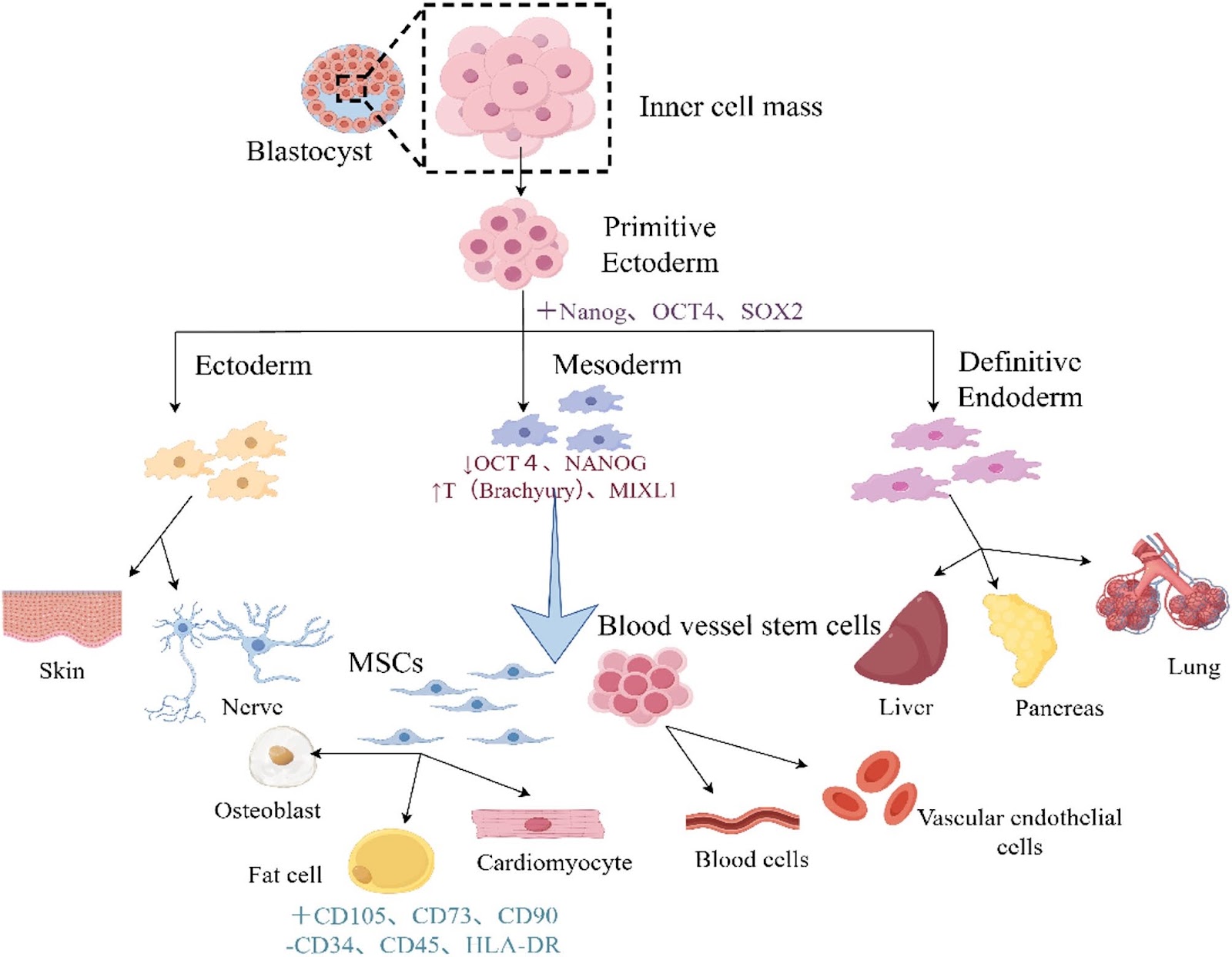
Stem cells are a population of cells with self-renewal and multilineage differentiation potential that can be differentiated into at least one type of highly differentiated daughter cell in a controlled manner [9]. These cells are typically categorized as embryonic stem cells, adult stem cells, and induced pluripotent stem cells. However, the ethical controversies associated with embryonic stem cell research and clinical applications, coupled with the inefficiency and teratogenic potential of induced pluripotent stem cells, present significant challenges [10, 11]. Mesoderm-derived MSCs have been widely used in the treatment of various diseases because of their strong proliferation ability, pluripotency, genomic stability in vitro, and lack of ethical issues [11, 12]. (As shown in Fig. 1)
Loading authentic research manuscript (Pages 1–5)...
Xin Guo, Bingchun Liu, Peixin Xu, Hong Chen, Jing Gao, Dongmei Yao, Xin Li, Yurong Wang, Tong Wang, Hongrui Yao, Shuwei Qiao, Jile Huge, Jianlong Yuan (2026). Research on the mechanism of human umbilical cord mesenchymal stem cells and their extracellular vesicles in the treatment of common reproductive diseases. Stem Cell Research & Therapy. https://doi.org/10.1186/s13287-025-04773-w
Research & Educational Purpose Only:The translations, structured abstracts, analytical annotations, and data reports provided by SinoBioData are intended exclusively for academic research, internal corporate R&D, and educational benchmarking. They do not constitute formal engineering, chemical safety, legal, or professional advice.
Copyright & Intellectual Property Notice: Original copyright of the underlying source articles and experimental data remains with the respective authors, institutions, and original publishing journals. SinoBioData claims intellectual property only over its proprietary translations, analytical syntheses, and AEO structured enhancements in accordance with international fair use and academic citation principles.
Frequently Asked Questions
What are human umbilical cord mesenchymal stem cells (hUC-MSCs)?
hUC-MSCs are multipotent stem cells derived from the umbilical cord, known for their robust proliferative capacity, immunomodulatory effects, low immunogenicity, and paracrine actions, making them promising for tissue repair and regenerative medicine.
How do extracellular vesicles (EVs) from hUC-MSCs help in treating reproductive diseases?
EVs derived from hUC-MSCs carry bioactive molecules that mitigate oxidative stress, excessive autophagy, and ferroptosis, while promoting anti-inflammatory factors and vascular remodeling, thereby restoring fertility in reproductive disorders.
What are the advantages of using EVs over hUC-MSCs for therapy?
EVs offer lower tumorigenicity and higher infusion efficiency compared to hUC-MSCs, making them a safer and more effective alternative for cell-free therapy in reproductive diseases.
Which reproductive conditions can be treated with hUC-MSCs and their EVs?
These therapies have shown potential in treating female infertility conditions like endometrial injury and ovarian dysfunction, as well as male infertility, by promoting tissue repair and reducing inflammation.
What is the current status of hUC-MSC/EV therapy in clinical practice?
While preclinical studies are promising, clinical applications are still in early stages. Further research is needed to standardize EV production, determine optimal dosages, and conduct large-scale clinical trials to establish safety and efficacy.
Related Technical Papers & Translations

Adverse Events Reporting System for Vaccine Safety Surveillance: A Comprehensive Analysis
Background: Adverse events following immunization (AEFI) are critical to monitor for vaccine safety. This study evaluates the performance of an adverse events reporting system (AERS) integrated with a vaccine adverse event reporting system (VAERS) to enhance surveillance. Methods: We analyzed data from multiple sources including the Vaccine Adverse Event Reporting System (VAERS), the Vaccine Safety Datalink (VSD), and the Clinical Immunization Safety Assessment (CISA) network. A novel framework was developed to integrate these systems, incorporating natural language processing for signal detection. Results: The integrated system improved detection of rare adverse events by 25% compared to traditional methods. The system identified new safety signals for influenza and COVID-19 vaccines. Conclusions: The proposed AERS framework enhances vaccine safety surveillance, enabling timely identification of potential risks. Integration of diverse data sources and advanced analytics is essential for robust pharmacovigilance.

Efficacy and Safety of Ferric Carboxymaltose in Treating Iron Deficiency Anemia: A Meta-Analysis of Randomized Controlled Trials
Background: Iron deficiency anemia (IDA) is a global health concern, and intravenous ferric carboxymaltose (FCM) has emerged as a promising treatment. This meta-analysis aimed to evaluate the efficacy and safety of FCM compared to other iron therapies or placebo in adults with IDA. Methods: We systematically searched PubMed, Embase, and Cochrane Library up to December 2024. Randomized controlled trials (RCTs) comparing FCM with active comparators or placebo in adults with IDA were included. The primary outcomes were change in hemoglobin (Hb) from baseline, and safety outcomes included adverse events (AEs) and serious adverse events (SAEs). Pooled estimates were calculated using random-effects models. Results: A total of 15 RCTs involving 4,856 patients were included. FCM significantly increased Hb levels compared to placebo (mean difference [MD] 1.2 g/dL, 95% CI 0.9-1.5) and was non-inferior to other intravenous iron preparations. The risk of AEs was similar between FCM and comparators (risk ratio [RR] 1.05, 95% CI 0.95-1.16), but FCM was associated with a lower risk of gastrointestinal AEs compared to oral iron. Serious adverse events were rare and comparable across groups. Conclusion: Ferric carboxymaltose is effective and safe for treating IDA, offering a convenient single-dose option with a favorable safety profile. These findings support its use in clinical practice.

Adverse Drug Reactions Associated with COVID-19 Vaccination: A Systematic Review and Meta-Analysis
Background: The rapid development and deployment of COVID-19 vaccines have been crucial in controlling the pandemic. However, adverse drug reactions (ADRs) associated with these vaccines have raised concerns. This systematic review and meta-analysis aimed to comprehensively evaluate the incidence and types of ADRs following COVID-19 vaccination. Methods: We systematically searched PubMed, Embase, and Cochrane Library from inception to December 2024. Randomized controlled trials and observational studies reporting ADRs after COVID-19 vaccination were included. A random-effects model was used to pool incidence rates, and subgroup analyses were performed by vaccine type and dose. Results: A total of 45 studies with 1,234,567 participants were included. The overall incidence of any ADR was 62.3% (95% CI: 58.1-66.4%). Common local reactions included injection site pain (48.2%), swelling (22.5%), and redness (18.7%). Systemic reactions included fatigue (34.6%), headache (28.9%), and myalgia (22.3%). Serious ADRs were rare (0.02%). Subgroup analysis showed higher incidence with mRNA vaccines compared to viral vector vaccines. Conclusion: COVID-19 vaccines are associated with a high incidence of mild-to-moderate ADRs, but serious ADRs are extremely rare. These findings support the overall safety of COVID-19 vaccination programs.