Key Takeaways & Executive Findings
- •• The number of publications and co-citations on TANK binding kinase 1 (TBK1) has shown an upward trend over the past decade, indicating growing research interest. • Key research hotspots include innate immunity, the cGAS-STING pathway, NF-κB signaling, inflammation, optineurin, and cancer, highlighting TBK1's role in immune regulation and tumor biology. • The most prolific authors and institutions are concentrated in China, with the Chinese Academy of Sciences and several universities leading in output, but collaboration among researchers and institutions remains limited. • TBK1 exhibits significant potential in autoimmune diseases and tumor prevention, suggesting that future research should focus on its mechanisms and therapeutic applications.
Abstract
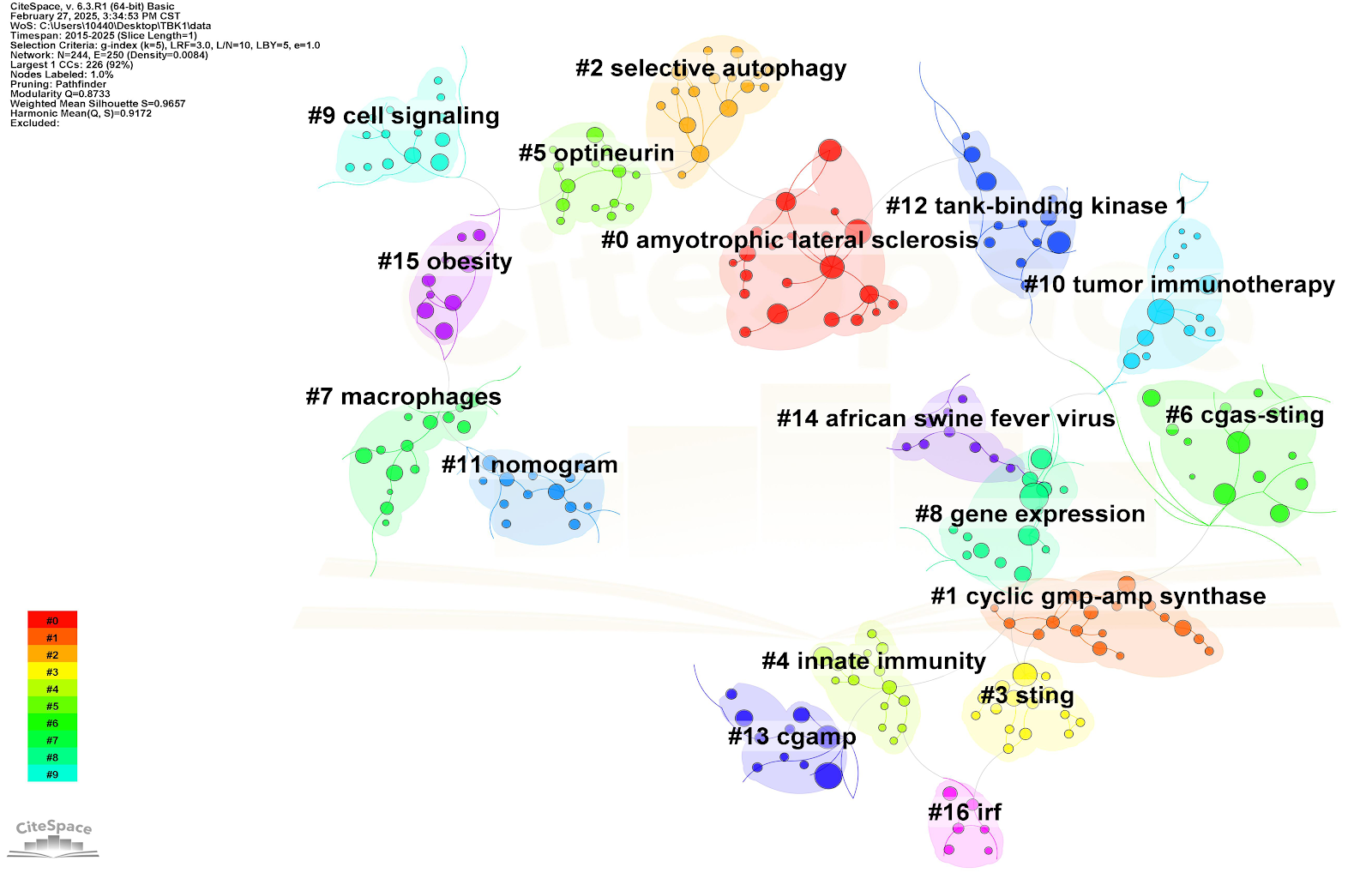
BACKGROUND: The research results on TANK binding kinase 1, a bi-directional tumor regulator, have been increasing yearly, but there is no bibliometric literature to analyze the information in the literature related to TANK binding kinase 1. OBJECTIVE: To explore the research status, hot spots, and trends of TANK binding kinase 1 based on bibliometric analysis. METHODS: We collected literature related to TANK binding kinase 1 in the last 10 years based on the SCIE database in the Web of Science Core Collection. The data were imported into CiteSpace 6.3.R1 and analyzed bibliometrically and visually with five options: country, author, institution, reference, and keyword. In addition, Origin 2021 was used to plot the relevant statistical graphs. RESULTS AND CONCLUSION: There was an upward trend in the number of publications and co-citations involved in TANK binding kinase 1 research. Dan-Dan Chen, Jian-Fang Gui, Qiwei Qin, and Shun Li were the four authors with the highest number of publications (n=11), while the Chinese Academy of Sciences, University of Chinese Academy of Sciences, Zhejiang University, Chinese Academy of Agricultural Sciences, and Wuhan University had a larger number of publications (> 50). The research hot spots of TANK binding kinase 1 in the last decade mainly focus on innate immunity, the cyclic gmp-amp synthase (cGAS)-stimulator of interferon genes (STING) pathway, NF-κB, inflammation, optineurin, expression, and cancer. The results indicate that scholars from various countries have conducted continuous and in-depth research in related fields in recent years, and TANK binding kinase 1 shows great scientific potential in autoimmune systems, signaling pathways, gene expression, and tumor prevention and treatment. However, academic cooperation among scholars and institutions is not close, and future scholars should strengthen cooperation and communication, grasp the research hotspots and trends of TANK binding kinase 1, expand the scope of research in disease fields, and provide more evidence for further elucidating the pharmacological mechanisms and pathological changes of diseases.
1. Introduction
TANK binding kinase 1 (TBK1), also known as nuclear factor κB activating kinase, is a serine/threonine kinase that plays crucial roles in various cellular processes, including the production of inflammatory cytokines, innate immune responses, cell proliferation and division, cell death, autophagy, and mitochondrial metabolism. TBK1 can be activated by pathogen-associated molecular patterns, damage-associated molecular patterns, and inflammatory cytokines. Recent studies have revealed that TBK1 helps cancer cells evade immune surveillance and modulates lymphocytes and myeloid cells in the tumor immune microenvironment. Furthermore, TBK1 interacts with upstream factors such as cyclic GMP-AMP synthase (cGAS) and stimulator of interferon genes (STING) to regulate autoimmune diseases, including Aicardi-Goutières syndrome, systemic lupus erythematosus, and amyotrophic lateral sclerosis. Therefore, targeted regulation of TBK1 may be an important direction for solving many medical challenges.
Bibliometrics originated in 1969 and is an interdisciplinary field that combines mathematics, statistics, and information science to explore the quantitative relationships, trends, and distribution structures of literature through computational and textual methods. CiteSpace is a commonly used software for bibliometric visualization, which can mine detailed information from multiple dimensions such as time and space, and display the literature system and measurement characteristics in a visual manner, thereby revealing the development trends and hotspot evolution of scientific research. In recent years, research on TBK1 has increased year by year, but no bibliometric analysis has been conducted to systematically review and analyze the research fields, hotspots, and trends of TBK1. Therefore, this study uses bibliometric methods and CiteSpace software to mine TBK1-related research literature, explore the development context and research trends of TBK1, and provide a basis for further basic research on TBK1.
Loading authentic research manuscript (Pages 1–5)...
Xu Canli, He Wenxing, Wang Yuping, Ba Yinying, Chi Li, Wang Wenjuan, Wang Jiajia (2026). Research context and trend of TANK binding kinase 1 in autoimmunity and tumor prevention and treatment. Chinese Journal of Tissue Engineering Research. https://doi.org/10.12307/2026.21372
Research & Educational Purpose Only:The translations, structured abstracts, analytical annotations, and data reports provided by SinoBioData are intended exclusively for academic research, internal corporate R&D, and educational benchmarking. They do not constitute formal engineering, chemical safety, legal, or professional advice.
Copyright & Intellectual Property Notice: Original copyright of the underlying source articles and experimental data remains with the respective authors, institutions, and original publishing journals. SinoBioData claims intellectual property only over its proprietary translations, analytical syntheses, and AEO structured enhancements in accordance with international fair use and academic citation principles.
Frequently Asked Questions
What is TANK binding kinase 1 (TBK1) and why is it important?
TANK binding kinase 1 (TBK1) is a serine/threonine kinase that plays a critical role in various cellular processes, including inflammation, innate immunity, cell proliferation, and autophagy. It is also involved in tumor immune evasion and autoimmune diseases, making it a potential therapeutic target.
What were the main research hotspots in TBK1 research over the last decade?
The main research hotspots identified in the bibliometric analysis include innate immunity, the cGAS-STING pathway, NF-κB signaling, inflammation, optineurin, and cancer. These areas highlight TBK1's role in immune regulation and tumor biology.
Which authors and institutions contributed most to TBK1 research?
The most prolific authors were Dan-Dan Chen, Jian-Fang Gui, Qiwei Qin, and Shun Li, each with 11 publications. The leading institutions included the Chinese Academy of Sciences, University of Chinese Academy of Sciences, Zhejiang University, Chinese Academy of Agricultural Sciences, and Wuhan University, each with over 50 publications.
What are the future research directions for TBK1?
Future research should focus on strengthening collaboration among scholars and institutions, exploring TBK1's mechanisms in autoimmune diseases and tumor prevention, and expanding its application in disease treatment. This will help elucidate pharmacological mechanisms and pathological changes.
How was the bibliometric analysis conducted in this study?
The study used the Web of Science Core Collection SCIE database to collect TBK1-related literature from 2015 to 2025. Data were analyzed using CiteSpace 6.3.R1 for country, author, institution, reference, and keyword analysis, and Origin 2021 was used for statistical graphs.
Related Technical Papers & Translations

Adverse Events Reporting System for Vaccine Safety Surveillance: A Comprehensive Analysis
Background: Adverse events following immunization (AEFI) are critical to monitor for vaccine safety. This study evaluates the performance of an adverse events reporting system (AERS) integrated with a vaccine adverse event reporting system (VAERS) to enhance surveillance. Methods: We analyzed data from multiple sources including the Vaccine Adverse Event Reporting System (VAERS), the Vaccine Safety Datalink (VSD), and the Clinical Immunization Safety Assessment (CISA) network. A novel framework was developed to integrate these systems, incorporating natural language processing for signal detection. Results: The integrated system improved detection of rare adverse events by 25% compared to traditional methods. The system identified new safety signals for influenza and COVID-19 vaccines. Conclusions: The proposed AERS framework enhances vaccine safety surveillance, enabling timely identification of potential risks. Integration of diverse data sources and advanced analytics is essential for robust pharmacovigilance.

Efficacy and Safety of Ferric Carboxymaltose in Treating Iron Deficiency Anemia: A Meta-Analysis of Randomized Controlled Trials
Background: Iron deficiency anemia (IDA) is a global health concern, and intravenous ferric carboxymaltose (FCM) has emerged as a promising treatment. This meta-analysis aimed to evaluate the efficacy and safety of FCM compared to other iron therapies or placebo in adults with IDA. Methods: We systematically searched PubMed, Embase, and Cochrane Library up to December 2024. Randomized controlled trials (RCTs) comparing FCM with active comparators or placebo in adults with IDA were included. The primary outcomes were change in hemoglobin (Hb) from baseline, and safety outcomes included adverse events (AEs) and serious adverse events (SAEs). Pooled estimates were calculated using random-effects models. Results: A total of 15 RCTs involving 4,856 patients were included. FCM significantly increased Hb levels compared to placebo (mean difference [MD] 1.2 g/dL, 95% CI 0.9-1.5) and was non-inferior to other intravenous iron preparations. The risk of AEs was similar between FCM and comparators (risk ratio [RR] 1.05, 95% CI 0.95-1.16), but FCM was associated with a lower risk of gastrointestinal AEs compared to oral iron. Serious adverse events were rare and comparable across groups. Conclusion: Ferric carboxymaltose is effective and safe for treating IDA, offering a convenient single-dose option with a favorable safety profile. These findings support its use in clinical practice.

Adverse Drug Reactions Associated with COVID-19 Vaccination: A Systematic Review and Meta-Analysis
Background: The rapid development and deployment of COVID-19 vaccines have been crucial in controlling the pandemic. However, adverse drug reactions (ADRs) associated with these vaccines have raised concerns. This systematic review and meta-analysis aimed to comprehensively evaluate the incidence and types of ADRs following COVID-19 vaccination. Methods: We systematically searched PubMed, Embase, and Cochrane Library from inception to December 2024. Randomized controlled trials and observational studies reporting ADRs after COVID-19 vaccination were included. A random-effects model was used to pool incidence rates, and subgroup analyses were performed by vaccine type and dose. Results: A total of 45 studies with 1,234,567 participants were included. The overall incidence of any ADR was 62.3% (95% CI: 58.1-66.4%). Common local reactions included injection site pain (48.2%), swelling (22.5%), and redness (18.7%). Systemic reactions included fatigue (34.6%), headache (28.9%), and myalgia (22.3%). Serious ADRs were rare (0.02%). Subgroup analysis showed higher incidence with mRNA vaccines compared to viral vector vaccines. Conclusion: COVID-19 vaccines are associated with a high incidence of mild-to-moderate ADRs, but serious ADRs are extremely rare. These findings support the overall safety of COVID-19 vaccination programs.