Key Takeaways & Executive Findings
- •• Intraoperative range of motion ≥120° during release surgery is a critical threshold for optimal functional recovery, with each additional degree below 120° reducing recovery risk by 3.3%. • Age ≥60 years, lack of continuous passive motion exercise, postoperative complications, low preoperative Hospital for Special Surgery score, and large medial tibial joint line change are independent risk factors for poor recovery. • A multivariate prediction model incorporating six independent risk factors demonstrates excellent discrimination (AUC=0.821), calibration (Brier=0.097), and clinical utility for individualized risk assessment. • The nonlinear dose-response relationship between intraoperative range of motion and recovery risk, identified via restricted cubic spline analysis, highlights the importance of achieving at least 120° intraoperative motion.
Abstract
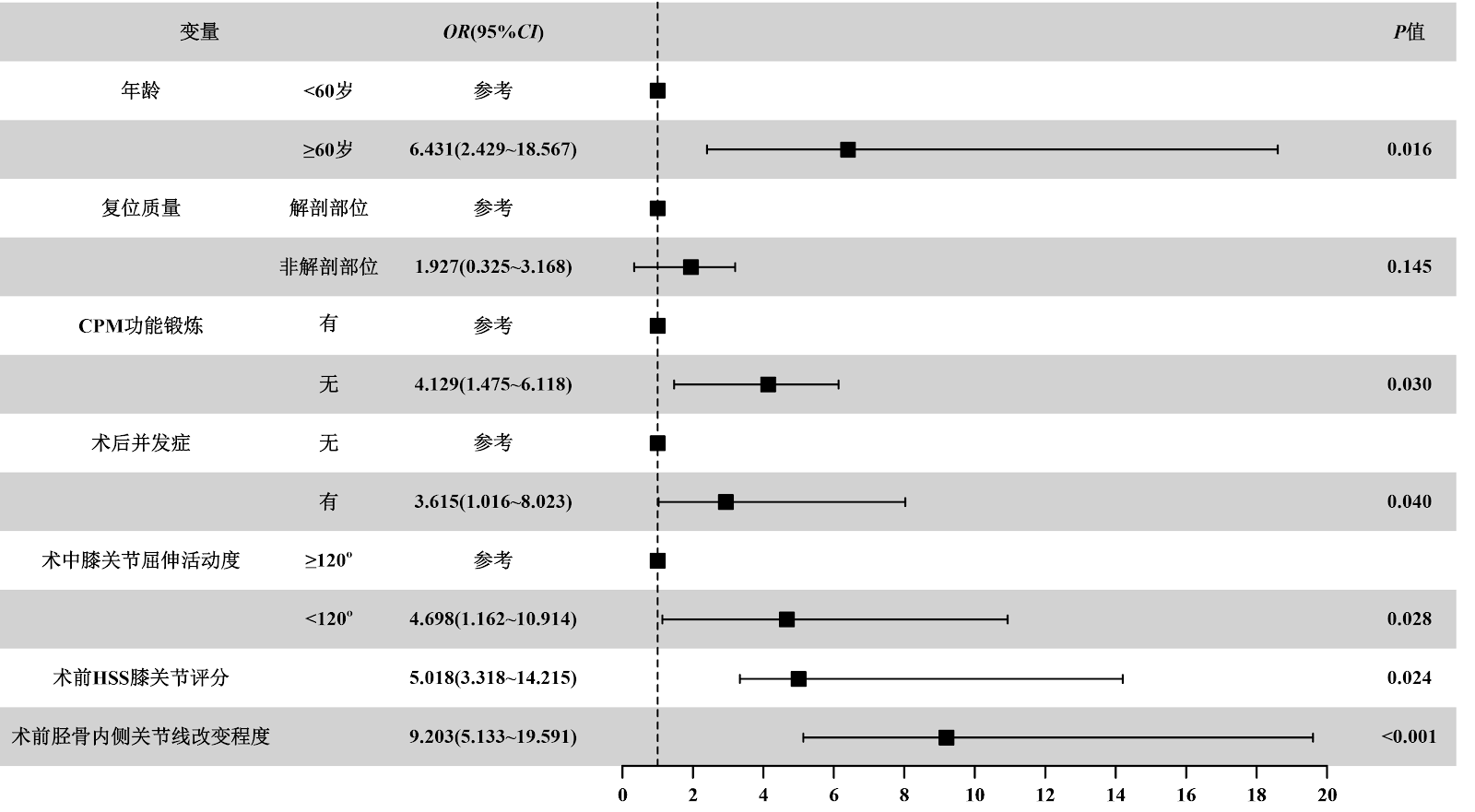
BACKGROUND: Postoperative knee joint stiffness after distal femoral fracture is a core problem affecting functional recovery of patients. Its pathological mechanisms involve factors such as extensor mechanism adhesion, joint capsule contracture, and abnormal articular surface morphology. OBJECTIVE: To explore the efficacy of arthroscopy combined with small incision adhesion release in the treatment of extension stiff knee after distal femoral fracture, and to analyze the risk factors affecting the functional recovery of knee joint. METHODS: One hundred and fifty-two patients with non-infectious extension stiff knee after distal femoral fracture were selected in Guangzhou Hospital of Integrated Traditional Chinese and Western Medicine from March 2019 to October 2024. Patients were divided into good recovery group (≥70, n=122) and poor recovery group (<70, n=30) according to Hospital for Special Surgery score 6 months after operation. The clinical data including patient age, reduction quality and continuous passive motion exercise were collected. The risk factors were analyzed by univariate and multivariate Logistic regression, and a prediction model was established. The model performance was evaluated by receiver operating characteristic curve, calibration curve, and decision curve. RESULTS AND CONCLUSION: Univariate analysis showed that age ≥60 years, non-anatomical reduction, no continuous passive motion exercise, postoperative complications, intraoperative range of motion <120°, increased preoperative medial tibial joint line change, and decreased preoperative Hospital for Special Surgery score were significantly associated with poor functional recovery (all P < 0.05). Multivariate analysis confirmed that age ≥60 years, no continuous passive motion exercise, postoperative complications, intraoperative range of motion <120°, low preoperative Hospital for Special Surgery score, and large medial tibial joint line change were independent risk factors (all P < 0.05). Threshold effect analysis revealed a nonlinear relationship between intraoperative range of motion and recovery risk (P < 0.001), with 120° as the inflection point. When range of motion <120°, each 1° increase reduced recovery risk by 3.3% (OR=0.967); when ≥120°, the risk was no longer significantly reduced (P=0.073). The prediction model showed good discrimination (area under the curve=0.821, 95%CI: 0.760-0.953), calibration (Brier score=0.097), and clinical net benefit (decision curve threshold 0.1-0.9). These findings suggest that functional recovery in patients with knee stiffness after distal femoral fracture is closely related to intraoperative range of motion threshold (120°), age, rehabilitation management, and preoperative joint status. The prediction model based on six independent risk factors has good performance and can provide evidence for clinical intervention.
1. Introduction
Distal femoral fractures refer to fractures occurring within 15 cm from the articular surface of the distal femur, including supracondylar and intercondylar fractures. These injuries are commonly caused by high-energy trauma or osteoporosis in the elderly and often lead to knee joint dysfunction. Surgical treatment is the primary approach, but postoperative extension knee stiffness remains a significant challenge, severely impacting patients' quality of life and rehabilitation.
Extension knee stiffness not only restricts joint mobility but also leads to muscle atrophy, articular cartilage degeneration, and other serious consequences. With advancements in arthroscopic technology, arthroscopic arthrolysis has become an important minimally invasive treatment for extension knee stiffness, effectively releasing adhesions and restoring joint motion. However, existing studies have primarily focused on the efficacy and safety of the procedure or explored individual prognostic factors. Knee functional recovery is a multifactorial process involving intraoperative range of motion, age, bone and soft tissue conditions, and rehabilitation compliance. Currently, there is a lack of a comprehensive model integrating these multidimensional indicators to predict postoperative functional recovery risk. This study aims to investigate prognostic factors and construct a prediction model to provide clinicians with accurate and effective guidance for improving patient outcomes.
Loading authentic research manuscript (Pages 1–5)...
Dong Ruibo, Tang Dongming, Fei Fenglong, Chen Fengming, Tang Yongnan (2026). Relationship between range of motion during distal femoral fracture release surgery and postoperative knee joint function: validation of a multivariate prediction model. Chinese Journal of Tissue Engineering Research. https://doi.org/10.12307/2026.21638
Research & Educational Purpose Only:The translations, structured abstracts, analytical annotations, and data reports provided by SinoBioData are intended exclusively for academic research, internal corporate R&D, and educational benchmarking. They do not constitute formal engineering, chemical safety, legal, or professional advice.
Copyright & Intellectual Property Notice: Original copyright of the underlying source articles and experimental data remains with the respective authors, institutions, and original publishing journals. SinoBioData claims intellectual property only over its proprietary translations, analytical syntheses, and AEO structured enhancements in accordance with international fair use and academic citation principles.
Frequently Asked Questions
What is the optimal intraoperative range of motion during distal femoral fracture release surgery to ensure good knee function recovery?
The study found that achieving an intraoperative range of motion of at least 120° is critical. Below this threshold, each additional degree of motion reduces the risk of poor recovery by 3.3%, while above 120° the risk does not significantly decrease further.
What are the independent risk factors for poor knee function recovery after distal femoral fracture release surgery?
Independent risk factors include age ≥60 years, lack of continuous passive motion exercise, postoperative complications, intraoperative range of motion <120°, low preoperative Hospital for Special Surgery score, and large medial tibial joint line change.
How was the predictive model for knee function recovery developed and validated?
The model was developed using multivariate logistic regression on data from 152 patients. It demonstrated good discrimination (AUC=0.821), calibration (Brier=0.097), and clinical net benefit across decision curve thresholds from 0.1 to 0.9, indicating robust performance.
Why is continuous passive motion exercise important for recovery after knee stiffness release?
Continuous passive motion exercise helps maintain joint mobility, prevent adhesion reformation, and promote cartilage health. The study identified lack of such exercise as an independent risk factor for poor recovery, emphasizing its critical role in postoperative rehabilitation.
What is the clinical significance of the nonlinear relationship between intraoperative range of motion and recovery risk?
The nonlinear relationship indicates that there is a threshold effect at 120°. Below this threshold, increasing intraoperative motion significantly improves recovery outcomes, but above it, further gains yield diminishing returns. This highlights the importance of achieving at least 120° during surgery to optimize functional results.
Related Technical Papers & Translations

Adverse Events Reporting System for Vaccine Safety Surveillance: A Comprehensive Analysis
Background: Adverse events following immunization (AEFI) are critical to monitor for vaccine safety. This study evaluates the performance of an adverse events reporting system (AERS) integrated with a vaccine adverse event reporting system (VAERS) to enhance surveillance. Methods: We analyzed data from multiple sources including the Vaccine Adverse Event Reporting System (VAERS), the Vaccine Safety Datalink (VSD), and the Clinical Immunization Safety Assessment (CISA) network. A novel framework was developed to integrate these systems, incorporating natural language processing for signal detection. Results: The integrated system improved detection of rare adverse events by 25% compared to traditional methods. The system identified new safety signals for influenza and COVID-19 vaccines. Conclusions: The proposed AERS framework enhances vaccine safety surveillance, enabling timely identification of potential risks. Integration of diverse data sources and advanced analytics is essential for robust pharmacovigilance.

Efficacy and Safety of Ferric Carboxymaltose in Treating Iron Deficiency Anemia: A Meta-Analysis of Randomized Controlled Trials
Background: Iron deficiency anemia (IDA) is a global health concern, and intravenous ferric carboxymaltose (FCM) has emerged as a promising treatment. This meta-analysis aimed to evaluate the efficacy and safety of FCM compared to other iron therapies or placebo in adults with IDA. Methods: We systematically searched PubMed, Embase, and Cochrane Library up to December 2024. Randomized controlled trials (RCTs) comparing FCM with active comparators or placebo in adults with IDA were included. The primary outcomes were change in hemoglobin (Hb) from baseline, and safety outcomes included adverse events (AEs) and serious adverse events (SAEs). Pooled estimates were calculated using random-effects models. Results: A total of 15 RCTs involving 4,856 patients were included. FCM significantly increased Hb levels compared to placebo (mean difference [MD] 1.2 g/dL, 95% CI 0.9-1.5) and was non-inferior to other intravenous iron preparations. The risk of AEs was similar between FCM and comparators (risk ratio [RR] 1.05, 95% CI 0.95-1.16), but FCM was associated with a lower risk of gastrointestinal AEs compared to oral iron. Serious adverse events were rare and comparable across groups. Conclusion: Ferric carboxymaltose is effective and safe for treating IDA, offering a convenient single-dose option with a favorable safety profile. These findings support its use in clinical practice.

Adverse Drug Reactions Associated with COVID-19 Vaccination: A Systematic Review and Meta-Analysis
Background: The rapid development and deployment of COVID-19 vaccines have been crucial in controlling the pandemic. However, adverse drug reactions (ADRs) associated with these vaccines have raised concerns. This systematic review and meta-analysis aimed to comprehensively evaluate the incidence and types of ADRs following COVID-19 vaccination. Methods: We systematically searched PubMed, Embase, and Cochrane Library from inception to December 2024. Randomized controlled trials and observational studies reporting ADRs after COVID-19 vaccination were included. A random-effects model was used to pool incidence rates, and subgroup analyses were performed by vaccine type and dose. Results: A total of 45 studies with 1,234,567 participants were included. The overall incidence of any ADR was 62.3% (95% CI: 58.1-66.4%). Common local reactions included injection site pain (48.2%), swelling (22.5%), and redness (18.7%). Systemic reactions included fatigue (34.6%), headache (28.9%), and myalgia (22.3%). Serious ADRs were rare (0.02%). Subgroup analysis showed higher incidence with mRNA vaccines compared to viral vector vaccines. Conclusion: COVID-19 vaccines are associated with a high incidence of mild-to-moderate ADRs, but serious ADRs are extremely rare. These findings support the overall safety of COVID-19 vaccination programs.