Key Takeaways & Executive Findings
- •• Microgravity promotes HSC expansion in bone marrow by inhibiting cell cycle progression and reducing apoptosis. • Microgravity suppresses differentiation and function of hematopoietic stem/progenitor cells (HSPCs). • Microgravity alters purine metabolism in the bone marrow microenvironment, affecting MAPK signaling and hematopoietic cell lineage. • Hypoxanthine acts as a signaling mediator under microgravity, modulating HSC fate and offering potential therapeutic targets for spaceflight-induced hematopoietic disorders.
Abstract
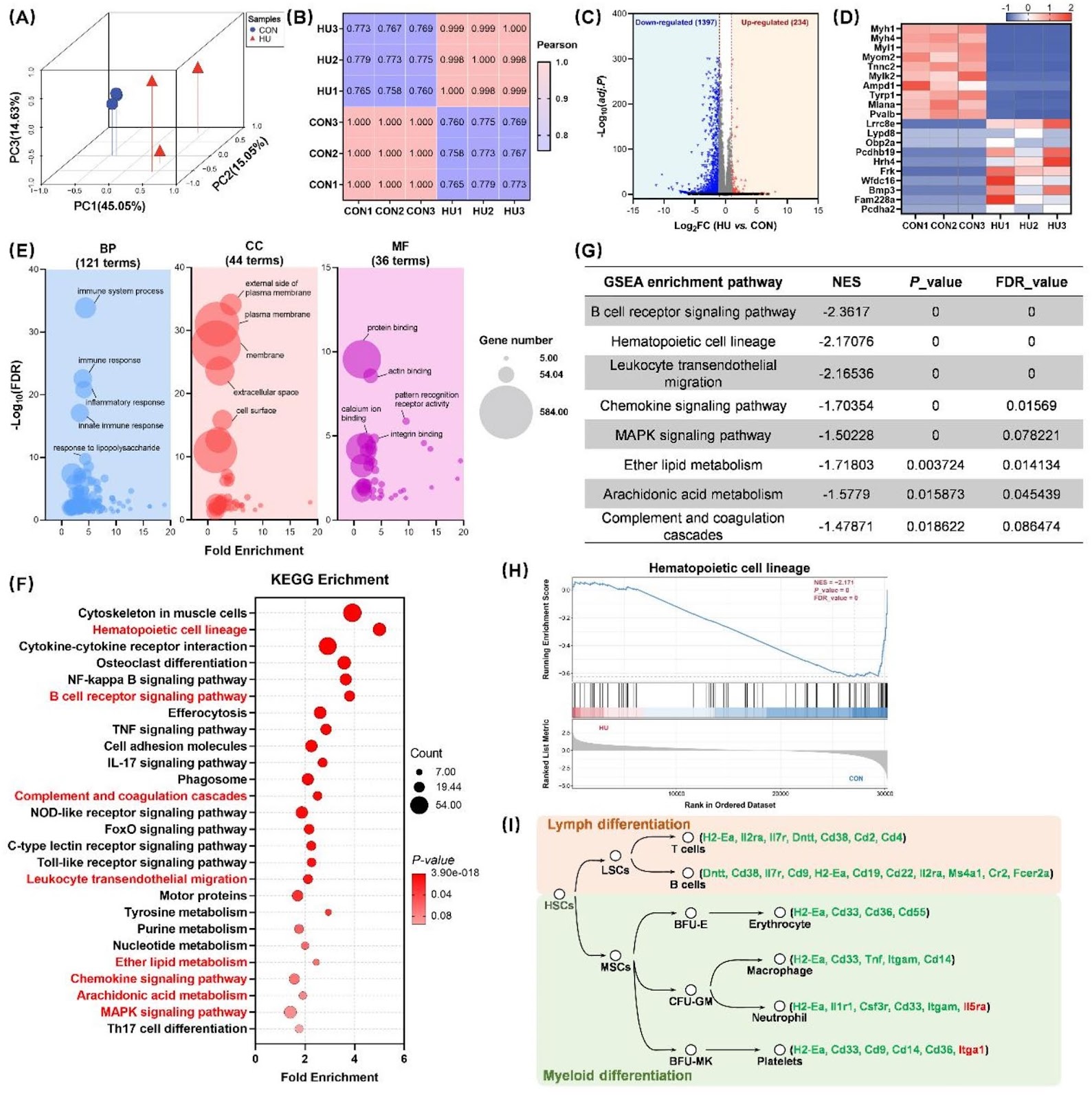
Background Spaceflight and microgravity environments have been shown to cause significant health impairments, including bone loss, immune dysfunction, and hematopoietic disorders. Hematopoietic stem cells (HSCs), as progenitors of the hematopoietic system, are critical for the continuous renewal and regulation of immune cells. Therefore, elucidating the regulatory mechanisms governing HSC fate and differentiation in microgravity environments is of paramount importance. Methods In this study, hindlimb unloading (HU) was employed in mice to simulate microgravity conditions. After 28 days of HU, cells were isolated for analysis. Flow cytometry and colony-forming assays were utilized to assess changes in HSC proliferation and differentiation. Additionally, transcriptomic and untargeted metabolomic sequencing were performed to elucidate alterations in the metabolic pathways of the bone marrow microenvironment and their molecular regulatory effects on HSCs fate. Results Our findings revealed that 28 days of HU impaired hematopoietic function, leading to multi-organ damage and hematological disorders. The simulated microgravity environment significantly increased the HSCs population in the bone marrow, particularly within the long-term and short-term subtypes, while severely compromising the differentiation capacity of hematopoietic stem/progenitor cells. Transcriptomic analysis of HSCs, combined with metabolomic profiling of bone marrow supernatants, identified 1,631 differentially expressed genes and 58 metabolites with altered abundance. Gene set enrichment analysis indicated that HU suppressed key pathways, including hematopoietic cell lineage and MAPK signaling. Furthermore, integrated analyses revealed that metabolites affected by HU, particularly hypoxanthine enriched in the purine metabolism pathway, were closely associated with hematopoietic cell lineage and MAPK signaling pathways. Molecular docking simulations and in vitro experiments confirmed that hypoxanthine interacts directly with core molecules within these pathways, influencing their expression. Conclusions These findings demonstrate that hypoxanthine in the bone marrow supernatant acts as a signaling mediator under microgravity, influencing HSCs fate by modulating hematopoietic cell lineage and MAPK signaling pathways. This study offers novel insights into the impact of microgravity on HSC fate and gene expression, underscoring the pivotal role of bone marrow microenvironmental metabolic changes in regulating key signaling pathways that determine hematopoietic destiny.
1. Introduction
With the advent of long-duration space missions, the complexity of the space environment and its impact on human physiology have garnered increasing attention [1]. The space environment is characterized by extreme conditions, including high radiation, microgravity, and high vacuum [2]. Among these, microgravity exerts particularly profound effects on biological systems [3]. Research has demonstrated that microgravity can lead to immune dysfunction [4], disrupted hematopoiesis [5], and bone marrow (BM) impairment [6], thereby increasing the risk of hematological disorders. These adverse effects are especially pronounced during extended space missions.
Under microgravity, the human hematopoietic system undergoes a series of physiological changes, including impaired platelet (PLT) function, reduced lymphocyte (LYM) counts, and suppressed LYM activity. For instance, a study reported a marked decrease in the absolute number of T and B LYMs in astronauts during spaceflight [7]. However, due to limited sample sizes and significant inter-individual variability, these findings remain inconclusive.
Loading authentic research manuscript (Pages 1–5)...
Xiru Liu, Hao Zhang, Jinxiao Yan, Penghui Ye, Yanran Wang, Nu Zhang, Zhenhao Tian, Bin Liu, Hui Yang (2026). Purine metabolism in bone marrow microenvironment inhibits hematopoietic stem cell differentiation under microgravity. Stem Cell Research & Therapy. https://doi.org/10.1186/s13287-025-04213-9
Research & Educational Purpose Only:The translations, structured abstracts, analytical annotations, and data reports provided by SinoBioData are intended exclusively for academic research, internal corporate R&D, and educational benchmarking. They do not constitute formal engineering, chemical safety, legal, or professional advice.
Copyright & Intellectual Property Notice: Original copyright of the underlying source articles and experimental data remains with the respective authors, institutions, and original publishing journals. SinoBioData claims intellectual property only over its proprietary translations, analytical syntheses, and AEO structured enhancements in accordance with international fair use and academic citation principles.
Frequently Asked Questions
What is the main finding of this study?
The study reveals that simulated microgravity via hindlimb unloading in mice leads to impaired hematopoietic function and altered HSC fate, with hypoxanthine in the bone marrow supernatant acting as a signaling mediator that inhibits HSC differentiation by modulating hematopoietic cell lineage and MAPK signaling pathways.
How was microgravity simulated in this research?
Microgravity was simulated using the hindlimb unloading (HU) mouse model, which is a well-established ground-based model for microgravity effects.
What are the implications for spaceflight health?
The findings provide insights into the molecular mechanisms underlying spaceflight-induced hematopoietic disorders, potentially guiding the development of countermeasures to protect astronaut health during long-duration missions.
What role does hypoxanthine play in HSC regulation?
Hypoxanthine, a metabolite enriched in the purine metabolism pathway under microgravity, directly interacts with core molecules in the hematopoietic cell lineage and MAPK signaling pathways, influencing their expression and thereby regulating HSC fate.
What methods were used in this study?
The study employed flow cytometry, colony-forming assays, transcriptomic and untargeted metabolomic sequencing, gene set enrichment analysis, molecular docking simulations, and in vitro experiments to assess HSC proliferation, differentiation, and molecular changes.
Related Technical Papers & Translations

Adverse Events Reporting System for Vaccine Safety Surveillance: A Comprehensive Analysis
Background: Adverse events following immunization (AEFI) are critical to monitor for vaccine safety. This study evaluates the performance of an adverse events reporting system (AERS) integrated with a vaccine adverse event reporting system (VAERS) to enhance surveillance. Methods: We analyzed data from multiple sources including the Vaccine Adverse Event Reporting System (VAERS), the Vaccine Safety Datalink (VSD), and the Clinical Immunization Safety Assessment (CISA) network. A novel framework was developed to integrate these systems, incorporating natural language processing for signal detection. Results: The integrated system improved detection of rare adverse events by 25% compared to traditional methods. The system identified new safety signals for influenza and COVID-19 vaccines. Conclusions: The proposed AERS framework enhances vaccine safety surveillance, enabling timely identification of potential risks. Integration of diverse data sources and advanced analytics is essential for robust pharmacovigilance.

Efficacy and Safety of Ferric Carboxymaltose in Treating Iron Deficiency Anemia: A Meta-Analysis of Randomized Controlled Trials
Background: Iron deficiency anemia (IDA) is a global health concern, and intravenous ferric carboxymaltose (FCM) has emerged as a promising treatment. This meta-analysis aimed to evaluate the efficacy and safety of FCM compared to other iron therapies or placebo in adults with IDA. Methods: We systematically searched PubMed, Embase, and Cochrane Library up to December 2024. Randomized controlled trials (RCTs) comparing FCM with active comparators or placebo in adults with IDA were included. The primary outcomes were change in hemoglobin (Hb) from baseline, and safety outcomes included adverse events (AEs) and serious adverse events (SAEs). Pooled estimates were calculated using random-effects models. Results: A total of 15 RCTs involving 4,856 patients were included. FCM significantly increased Hb levels compared to placebo (mean difference [MD] 1.2 g/dL, 95% CI 0.9-1.5) and was non-inferior to other intravenous iron preparations. The risk of AEs was similar between FCM and comparators (risk ratio [RR] 1.05, 95% CI 0.95-1.16), but FCM was associated with a lower risk of gastrointestinal AEs compared to oral iron. Serious adverse events were rare and comparable across groups. Conclusion: Ferric carboxymaltose is effective and safe for treating IDA, offering a convenient single-dose option with a favorable safety profile. These findings support its use in clinical practice.

Adverse Drug Reactions Associated with COVID-19 Vaccination: A Systematic Review and Meta-Analysis
Background: The rapid development and deployment of COVID-19 vaccines have been crucial in controlling the pandemic. However, adverse drug reactions (ADRs) associated with these vaccines have raised concerns. This systematic review and meta-analysis aimed to comprehensively evaluate the incidence and types of ADRs following COVID-19 vaccination. Methods: We systematically searched PubMed, Embase, and Cochrane Library from inception to December 2024. Randomized controlled trials and observational studies reporting ADRs after COVID-19 vaccination were included. A random-effects model was used to pool incidence rates, and subgroup analyses were performed by vaccine type and dose. Results: A total of 45 studies with 1,234,567 participants were included. The overall incidence of any ADR was 62.3% (95% CI: 58.1-66.4%). Common local reactions included injection site pain (48.2%), swelling (22.5%), and redness (18.7%). Systemic reactions included fatigue (34.6%), headache (28.9%), and myalgia (22.3%). Serious ADRs were rare (0.02%). Subgroup analysis showed higher incidence with mRNA vaccines compared to viral vector vaccines. Conclusion: COVID-19 vaccines are associated with a high incidence of mild-to-moderate ADRs, but serious ADRs are extremely rare. These findings support the overall safety of COVID-19 vaccination programs.