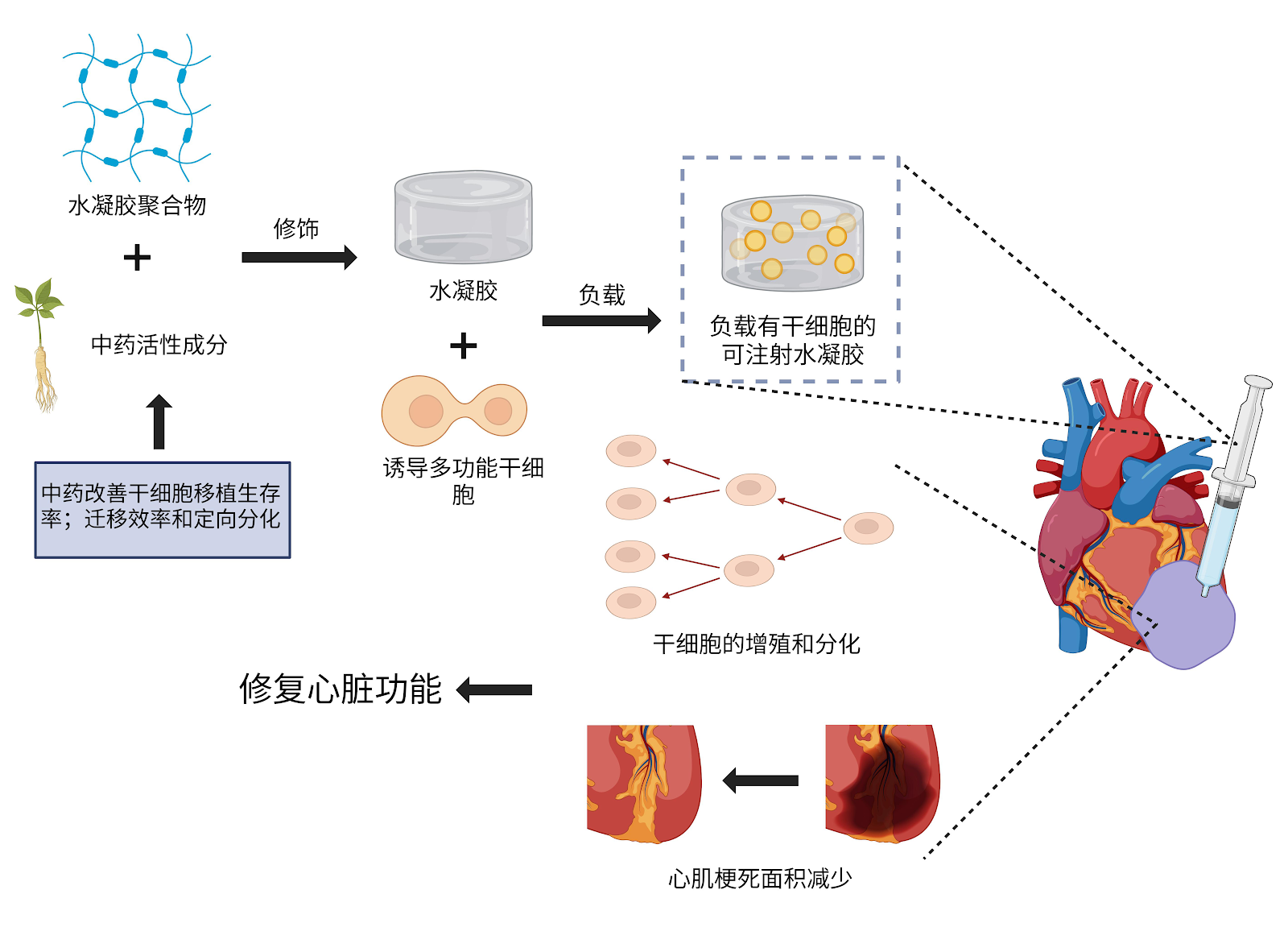
Key Takeaways & Executive Findings
- •• Hydrogel cardiac patches provide ideal mechanical support and a biomimetic microenvironment for myocardial repair, enhancing stem cell therapy efficacy. • TCM-modified hydrogels can promote stem cell proliferation, differentiation, migration, and homing, offering synergistic benefits for cardiac regeneration. • Current applications include precise drug delivery of TCM active ingredients, stem cell delivery via TCM-modified patches, and conductive hydrogels for electrophysiological repair. • Future research should explore diverse hydrogel materials and TCM formulations to optimize combined therapeutic strategies for myocardial infarction.
Abstract
BACKGROUND: Hydrogel cardiac patches, with their excellent biocompatibility and tunable mechanical properties, demonstrate significant potential in treating acute myocardial infarction, especially when combined with stem cell technology. Hydrogels modified with active components of traditional Chinese medicine (TCM) can promote the proliferation, differentiation, migration, and homing of stem cells. This synergistic effect provides a new approach for stem cell transplantation therapy based on hydrogel cardiac patches. OBJECTIVE: To focus on the application scenarios of novel biomaterial hydrogel cardiac patches combined with TCM in the treatment of myocardial infarction, and to discuss their development prospects. METHODS: PubMed and CNKI databases were searched for literature on TCM combined with hydrogel cardiac patches for the treatment of acute myocardial infarction from January 2010 to January 2025. English search terms included "hydrogel, cardiac patch, myocardial infarction, Chinese medicine, stem cell, drug delivery system"; Chinese search terms included "水凝胶, 心脏贴片, 心肌梗死, 中药, 干细胞, 递药系统". According to inclusion and exclusion criteria, 99 articles were finally included for review. RESULTS AND CONCLUSION: Hydrogel cardiac patches, with their excellent biocompatibility, tunable mechanical properties, and drug-loading capacity, provide ideal mechanical support and microenvironment for myocardial repair. As a hydrophilic polymer biomaterial, the three-dimensional network structure of hydrogel cardiac patches can highly mimic the physical properties of the natural cardiac extracellular matrix, providing a microenvironment for loaded biological cells to proliferate or maintain activity, and helping cell migration, adhesion, spreading, differentiation, and intercellular connection formation. Hydrogels modified with TCM can load stem cells, fully induce and regulate them, and more effectively perform cell regeneration therapy in the myocardial infarction area to achieve better repair. Therefore, the combined application of TCM and hydrogel cardiac patches has great development potential and prospects. Currently, the combined application mainly focuses on the following aspects: precise sustained-release therapy of TCM active ingredients via hydrogel cardiac patch loading; cell regeneration therapy via induced pluripotent stem cells delivered by TCM-modified hydrogel patches; and repair of cardiac electrophysiological function via TCM combined with conductive hydrogels. In future research, it is necessary to deeply understand the characteristics of hydrogels made from different materials and methods, and the therapeutic effects and mechanisms of TCM monomers and compound extracts, to achieve more combined applications of TCM and hydrogel cardiac patches.
1. Introduction
Acute myocardial infarction (AMI) is mostly caused by thrombus formation on the basis of coronary atherosclerosis, leading to narrowing of the coronary lumen, sharp reduction or interruption of coronary blood supply, and severe and persistent ischemia of the corresponding myocardium, resulting in necrosis [1], with a high mortality rate. Clinically, emergency revascularization treatments such as percutaneous coronary intervention, coronary artery bypass grafting, and drug thrombolysis are often used to reduce the acute mortality of patients with myocardial infarction. However, these revascularization procedures can cause ischemia-reperfusion injury, which catalyzes the production of large amounts of reactive oxygen species from xanthine in cells, exacerbating oxidative stress; activates endothelial cells to release inflammatory factors, triggering a cascade of inflammatory responses, further aggravating myocardial damage [2-4] and reducing cardiac function. Abnormal increase in matrix metalloproteinases in cells leads to excessive degradation of the extracellular matrix, causing pathological collagen deposition and tissue fibrosis, severely weakening the elasticity and contractile function of myocardial tissue [5-6]; it also causes dysfunction of myocardial ion channels, leading to abnormal electrophysiological coupling, increasing the risk of arrhythmias, and resulting in ventricular structural remodeling and electrical remodeling [7-8].
In recent years, tissue engineering and regenerative medicine have provided new strategies for the treatment of myocardial infarction. Hydrogel cardiac patches, as a type of bioactive material, have attracted much attention due to their excellent biocompatibility and tunable mechanical properties. They can mimic the natural extracellular matrix and provide a supportive microenvironment for cell growth and tissue regeneration. Furthermore, the combination of traditional Chinese medicine (TCM) with hydrogel cardiac patches has shown great potential in enhancing the therapeutic efficacy for myocardial infarction. TCM active ingredients can be loaded into hydrogels for sustained release, and TCM-modified hydrogels can regulate stem cell behavior, promoting cardiac repair. This review aims to explore the application scenarios and future prospects of hydrogel cardiac patches combined with TCM in the treatment of acute myocardial infarction.
Loading authentic research manuscript (Pages 1–5)...
Ding Hao, Gao Yuan, Li Bin, Yu Rui, Wang Jianru, Sun Yudie, Wang Xuanyang, Zhang Wenping, Zhu Mingjun (2026). Potential and application prospects of combined treatment of acute myocardial infarction with hydrogel cardiac patches and traditional Chinese medicine. Chinese Journal of Tissue Engineering Research. https://doi.org/10.12307/2026.21583
Research & Educational Purpose Only:The translations, structured abstracts, analytical annotations, and data reports provided by SinoBioData are intended exclusively for academic research, internal corporate R&D, and educational benchmarking. They do not constitute formal engineering, chemical safety, legal, or professional advice.
Copyright & Intellectual Property Notice: Original copyright of the underlying source articles and experimental data remains with the respective authors, institutions, and original publishing journals. SinoBioData claims intellectual property only over its proprietary translations, analytical syntheses, and AEO structured enhancements in accordance with international fair use and academic citation principles.
Frequently Asked Questions
What is a hydrogel cardiac patch?
A hydrogel cardiac patch is a bioactive, tissue-engineered patch made from hydrophilic polymer hydrogels. It is designed to be implanted onto damaged myocardium to support repair and regeneration. Its three-dimensional network mimics the natural extracellular matrix, providing a supportive microenvironment for cell growth and drug delivery.
How does traditional Chinese medicine enhance the effect of hydrogel cardiac patches?
Traditional Chinese medicine (TCM) active ingredients can be incorporated into hydrogels to achieve sustained release, and TCM-modified hydrogels can promote stem cell proliferation, differentiation, migration, and homing. This synergistic effect improves the regenerative capacity of stem cells and enhances the therapeutic outcome for myocardial infarction.
What are the current applications of TCM combined with hydrogel cardiac patches?
Current applications include: (1) precise sustained-release therapy of TCM active ingredients via hydrogel patches; (2) cell regeneration therapy using induced pluripotent stem cells delivered by TCM-modified hydrogels; and (3) repair of cardiac electrophysiological function using TCM combined with conductive hydrogels.
What are the future research directions for TCM and hydrogel cardiac patches?
Future research should focus on understanding the characteristics of hydrogels made from different materials and methods, and the therapeutic effects and mechanisms of TCM monomers and compound extracts. This will enable more effective combined applications for myocardial infarction treatment.
Why is the combination of TCM and hydrogel cardiac patches promising for myocardial infarction treatment?
The combination leverages the biocompatibility and mechanical support of hydrogels with the bioactive properties of TCM, which can enhance stem cell therapy and drug delivery. This synergistic approach addresses multiple aspects of myocardial repair, including cell regeneration, anti-inflammatory effects, and electrophysiological recovery, offering a comprehensive strategy for treating acute myocardial infarction.
Related Technical Papers & Translations

Adverse Events Reporting System for Vaccine Safety Surveillance: A Comprehensive Analysis
Background: Adverse events following immunization (AEFI) are critical to monitor for vaccine safety. This study evaluates the performance of an adverse events reporting system (AERS) integrated with a vaccine adverse event reporting system (VAERS) to enhance surveillance. Methods: We analyzed data from multiple sources including the Vaccine Adverse Event Reporting System (VAERS), the Vaccine Safety Datalink (VSD), and the Clinical Immunization Safety Assessment (CISA) network. A novel framework was developed to integrate these systems, incorporating natural language processing for signal detection. Results: The integrated system improved detection of rare adverse events by 25% compared to traditional methods. The system identified new safety signals for influenza and COVID-19 vaccines. Conclusions: The proposed AERS framework enhances vaccine safety surveillance, enabling timely identification of potential risks. Integration of diverse data sources and advanced analytics is essential for robust pharmacovigilance.

Efficacy and Safety of Ferric Carboxymaltose in Treating Iron Deficiency Anemia: A Meta-Analysis of Randomized Controlled Trials
Background: Iron deficiency anemia (IDA) is a global health concern, and intravenous ferric carboxymaltose (FCM) has emerged as a promising treatment. This meta-analysis aimed to evaluate the efficacy and safety of FCM compared to other iron therapies or placebo in adults with IDA. Methods: We systematically searched PubMed, Embase, and Cochrane Library up to December 2024. Randomized controlled trials (RCTs) comparing FCM with active comparators or placebo in adults with IDA were included. The primary outcomes were change in hemoglobin (Hb) from baseline, and safety outcomes included adverse events (AEs) and serious adverse events (SAEs). Pooled estimates were calculated using random-effects models. Results: A total of 15 RCTs involving 4,856 patients were included. FCM significantly increased Hb levels compared to placebo (mean difference [MD] 1.2 g/dL, 95% CI 0.9-1.5) and was non-inferior to other intravenous iron preparations. The risk of AEs was similar between FCM and comparators (risk ratio [RR] 1.05, 95% CI 0.95-1.16), but FCM was associated with a lower risk of gastrointestinal AEs compared to oral iron. Serious adverse events were rare and comparable across groups. Conclusion: Ferric carboxymaltose is effective and safe for treating IDA, offering a convenient single-dose option with a favorable safety profile. These findings support its use in clinical practice.

Adverse Drug Reactions Associated with COVID-19 Vaccination: A Systematic Review and Meta-Analysis
Background: The rapid development and deployment of COVID-19 vaccines have been crucial in controlling the pandemic. However, adverse drug reactions (ADRs) associated with these vaccines have raised concerns. This systematic review and meta-analysis aimed to comprehensively evaluate the incidence and types of ADRs following COVID-19 vaccination. Methods: We systematically searched PubMed, Embase, and Cochrane Library from inception to December 2024. Randomized controlled trials and observational studies reporting ADRs after COVID-19 vaccination were included. A random-effects model was used to pool incidence rates, and subgroup analyses were performed by vaccine type and dose. Results: A total of 45 studies with 1,234,567 participants were included. The overall incidence of any ADR was 62.3% (95% CI: 58.1-66.4%). Common local reactions included injection site pain (48.2%), swelling (22.5%), and redness (18.7%). Systemic reactions included fatigue (34.6%), headache (28.9%), and myalgia (22.3%). Serious ADRs were rare (0.02%). Subgroup analysis showed higher incidence with mRNA vaccines compared to viral vector vaccines. Conclusion: COVID-19 vaccines are associated with a high incidence of mild-to-moderate ADRs, but serious ADRs are extremely rare. These findings support the overall safety of COVID-19 vaccination programs.