Key Takeaways & Executive Findings
- •• Developed a two-step monolayer feeder-free protocol for generating iPSC-derived NK cells, offering a more efficient and uniform alternative to embryoid body-based methods. • iNK cells exhibit key NK cell markers (CD45, CD56, CD16) and functional receptors, with transcriptomic profiles closely resembling peripheral blood NK cells. • iNK cells demonstrate superior cytotoxicity against cholangiocarcinoma and breast cancer cell lines compared to NK-92 cells in both 2D and 3D tumor spheroid models. • This approach supports the development of off-the-shelf NK cell products for adoptive immunotherapy, potentially improving clinical scalability and consistency.
Abstract
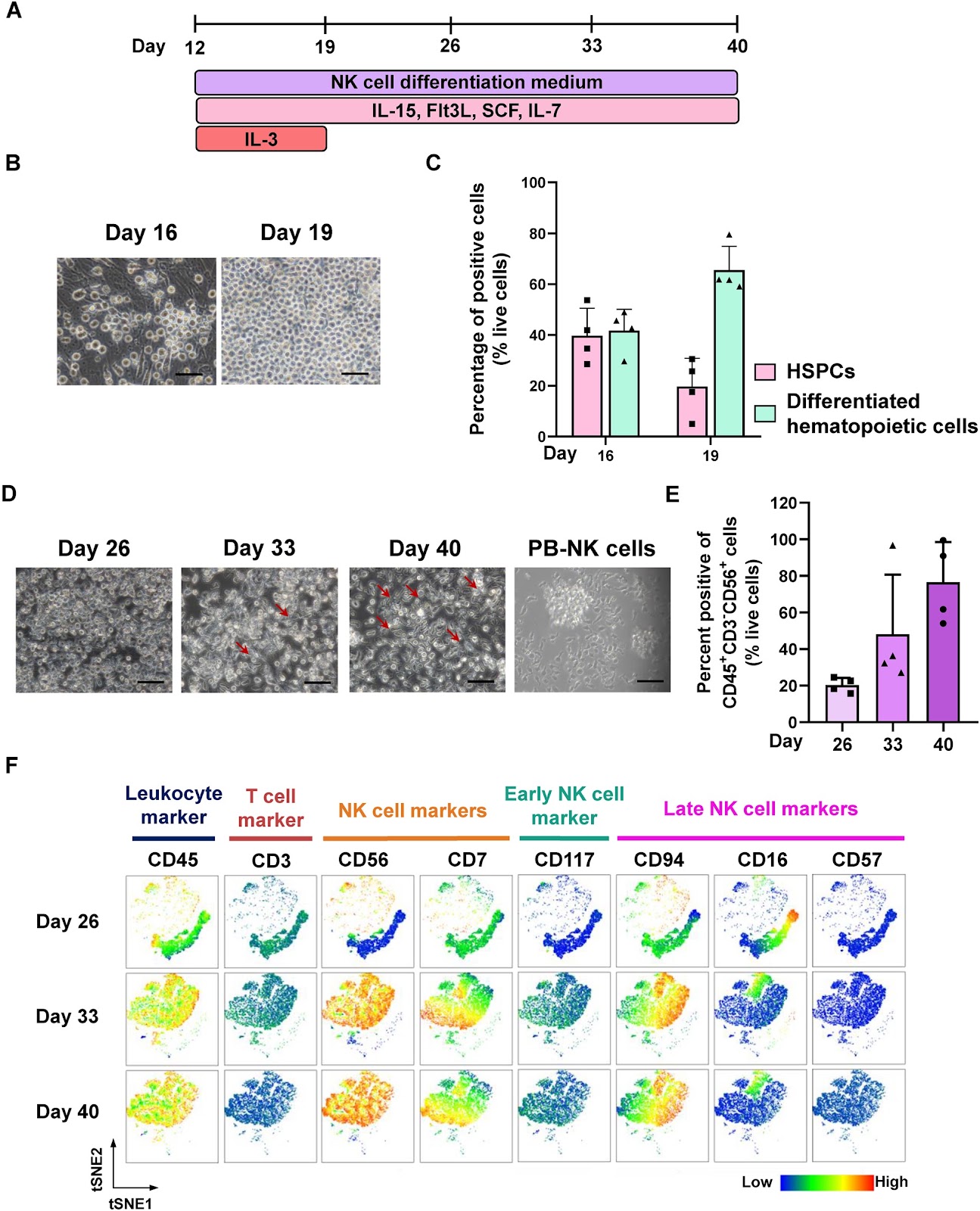
Background: Adoptive immunotherapy using natural killer (NK) cells has attracted considerable interest in numerous clinical trials targeting both hematological and solid tumors. Traditionally, NK cells are primarily derived from either peripheral blood (PB) or umbilical cord blood (UCB). However, these methods can lead to variability and heterogeneity within the NK cell population. In contrast, induced pluripotent stem cell (iPSC)-derived NK (iNK) cells provide a more controlled and uniform cellular population, suitable for large-scale clinical applications. This makes iNK cells a promising option for developing “off-the-shelf” immunotherapeutic products. Nevertheless, current NK cell differentiation protocols, which rely on embryoid body (EB) cultures, are labor-intensive and susceptible to unwanted heterogeneity during differentiation. Here, we developed a more efficient approach for generating iNK cells by employing a monolayer and feeder-free differentiation protocol, alongside optimized culture media. Methods: The iNK cells were generated using a two-step in vitro monolayer feeder-free system following NK cell development. To evaluate their maturity, phenotypic analysis was performed using flow cytometry, comparing with PB-NK cells and the NK-92 cell line. Additionally, single-cell RNA sequencing was performed to examine their transcriptomic profiles. The cytotoxic activity of the iNK cells was evaluated by co-culturing with cholangiocarcinoma (CCA) and breast cancer (BCA) cell lines in both monolayer (2D) and tumor spheroid (3D) co-culture systems. Results: We successfully differentiated iPSCs into mesoderm (ME), hematopoietic stem/progenitor cells (HSPCs), and NK cells. The resulting iNK cells exhibited typical NK cell markers such as CD45, CD56, and CD16, and expressed key functional proteins, including both activating and inhibitory receptors. Single-cell RNA sequencing confirmed that the transcriptomic profile of our iNK cells closely resembles that of PB-NK cells. Importantly, our iNK cells demonstrated strong cytotoxic abilities against various CCA and BCA cell lines, surpassing the NK-92 cell line in both monolayer cultures and tumor spheroid cultures. Conclusion: This study highlights the potential of iPSCs as an effective alternative cell source for generating NK cells. Using a two-step in vitro monolayer feeder-free system, we successfully generated iNK cells that not only expressed key NK cell markers and their receptors but also displayed a transcriptomic profile closely resembling PB-NK cells. Furthermore, iNK cells exhibited cytotoxicity against CCA and BCA cell lines comparable to that of PB-NK cells. This approach could pave the way for off-the-shelf NK cell products, potentially enhancing the effectiveness of adoptive NK cell therapy.
1. Introduction
Natural killer (NK) cells are innate lymphoid cells that can mediate cytotoxic activity against infected cells and several types of tumor cells without HLA restriction and prior sensitization. Human NK cells can be distinguished from other lymphocytes by the expression of neural cell adhesion molecule (NCAM or CD56) and the absence of CD3 molecule (CD56+ CD3−) [1, 2]. The distinct subset of functional NK cells can be classified into two main subpopulations, CD56bright and CD56dim. The majority of the NK cell population in peripheral blood is CD56dim, which mediates cytotoxic activity by secreting perforin and granzyme B, as well as other inflammatory cytokines upon activation. Meanwhile, the CD56bright population is more specialized in producing cytokines [3]. Even though NK cells lack genetically rearranged receptors, the cells can recognize abnormal cells through repertoires of the germline-encoded unique set of activating and inhibitory receptors, including killer immunoglobulin receptor (KIRs), natural cytotoxicity receptors (NCRs), and the Fc gamma receptor (FcγRIIIa) CD16a. The signals received through these receptors can regulate the NK cell function [4].
Numerous clinical studies demonstrated that adoptive cell therapy using allogeneic NK cells can effectively treat acute myeloid leukemia (AML) and other malignancies without causing graft-versus-host disease (GvHD) [5, 6]. Currently, the common sources of NK cells are primary NK cells isolated from peripheral blood (PB-NK cells), umbilical cord blood (UCB), and the NK-92 cell line. However, these sources have limitations such as variability, heterogeneity, and limited scalability. Induced pluripotent stem cell (iPSC)-derived NK cells offer a promising alternative, providing a uniform and scalable source for off-the-shelf immunotherapies. This study presents a novel two-step monolayer feeder-free differentiation protocol to generate iNK cells and evaluates their phenotype, transcriptome, and cytotoxic activity against cancer cell lines.
Loading authentic research manuscript (Pages 1–5)...
Nontaphat Thongsin, Siriwal Suwanpitak, Punn Augsornworawat, Jakkrapatra Srisantitham, Kritayaporn Saiprayong, Piroon Jenjaroenpun, Methichit Wattanapanitch (2026). Phenotypic and transcriptomic profiling of induced pluripotent stem cell (iPSC)-derived NK cells and their cytotoxicity against cancers. Stem Cell Research & Therapy. https://doi.org/10.1186/s13287-024-04029-z
Research & Educational Purpose Only:The translations, structured abstracts, analytical annotations, and data reports provided by SinoBioData are intended exclusively for academic research, internal corporate R&D, and educational benchmarking. They do not constitute formal engineering, chemical safety, legal, or professional advice.
Copyright & Intellectual Property Notice: Original copyright of the underlying source articles and experimental data remains with the respective authors, institutions, and original publishing journals. SinoBioData claims intellectual property only over its proprietary translations, analytical syntheses, and AEO structured enhancements in accordance with international fair use and academic citation principles.
Frequently Asked Questions
What are iPSC-derived NK cells?
iPSC-derived NK cells are natural killer cells generated from induced pluripotent stem cells through a controlled differentiation process. They offer a uniform and scalable source for adoptive immunotherapy, potentially enabling off-the-shelf cancer treatments.
How were the iNK cells generated in this study?
The iNK cells were generated using a two-step in vitro monolayer feeder-free differentiation protocol, which involves differentiating iPSCs into mesoderm, hematopoietic stem/progenitor cells, and finally into NK cells, using optimized culture media.
What are the key advantages of iNK cells over traditional NK cell sources?
iNK cells provide a more controlled and uniform cell population, reducing variability and heterogeneity seen with peripheral blood or umbilical cord blood-derived NK cells. They also allow for large-scale production, making them suitable for off-the-shelf immunotherapeutic products.
How did the iNK cells perform in cytotoxicity assays?
The iNK cells demonstrated strong cytotoxic activity against cholangiocarcinoma and breast cancer cell lines, surpassing the NK-92 cell line in both monolayer and tumor spheroid co-culture systems, indicating their potential for cancer immunotherapy.
What is the significance of the transcriptomic profiling in this study?
Single-cell RNA sequencing revealed that the transcriptomic profile of the iNK cells closely resembles that of peripheral blood NK cells, confirming their maturity and functional similarity, which is crucial for their therapeutic application.
Related Technical Papers & Translations

Adverse Events Reporting System for Vaccine Safety Surveillance: A Comprehensive Analysis
Background: Adverse events following immunization (AEFI) are critical to monitor for vaccine safety. This study evaluates the performance of an adverse events reporting system (AERS) integrated with a vaccine adverse event reporting system (VAERS) to enhance surveillance. Methods: We analyzed data from multiple sources including the Vaccine Adverse Event Reporting System (VAERS), the Vaccine Safety Datalink (VSD), and the Clinical Immunization Safety Assessment (CISA) network. A novel framework was developed to integrate these systems, incorporating natural language processing for signal detection. Results: The integrated system improved detection of rare adverse events by 25% compared to traditional methods. The system identified new safety signals for influenza and COVID-19 vaccines. Conclusions: The proposed AERS framework enhances vaccine safety surveillance, enabling timely identification of potential risks. Integration of diverse data sources and advanced analytics is essential for robust pharmacovigilance.

Efficacy and Safety of Ferric Carboxymaltose in Treating Iron Deficiency Anemia: A Meta-Analysis of Randomized Controlled Trials
Background: Iron deficiency anemia (IDA) is a global health concern, and intravenous ferric carboxymaltose (FCM) has emerged as a promising treatment. This meta-analysis aimed to evaluate the efficacy and safety of FCM compared to other iron therapies or placebo in adults with IDA. Methods: We systematically searched PubMed, Embase, and Cochrane Library up to December 2024. Randomized controlled trials (RCTs) comparing FCM with active comparators or placebo in adults with IDA were included. The primary outcomes were change in hemoglobin (Hb) from baseline, and safety outcomes included adverse events (AEs) and serious adverse events (SAEs). Pooled estimates were calculated using random-effects models. Results: A total of 15 RCTs involving 4,856 patients were included. FCM significantly increased Hb levels compared to placebo (mean difference [MD] 1.2 g/dL, 95% CI 0.9-1.5) and was non-inferior to other intravenous iron preparations. The risk of AEs was similar between FCM and comparators (risk ratio [RR] 1.05, 95% CI 0.95-1.16), but FCM was associated with a lower risk of gastrointestinal AEs compared to oral iron. Serious adverse events were rare and comparable across groups. Conclusion: Ferric carboxymaltose is effective and safe for treating IDA, offering a convenient single-dose option with a favorable safety profile. These findings support its use in clinical practice.

Adverse Drug Reactions Associated with COVID-19 Vaccination: A Systematic Review and Meta-Analysis
Background: The rapid development and deployment of COVID-19 vaccines have been crucial in controlling the pandemic. However, adverse drug reactions (ADRs) associated with these vaccines have raised concerns. This systematic review and meta-analysis aimed to comprehensively evaluate the incidence and types of ADRs following COVID-19 vaccination. Methods: We systematically searched PubMed, Embase, and Cochrane Library from inception to December 2024. Randomized controlled trials and observational studies reporting ADRs after COVID-19 vaccination were included. A random-effects model was used to pool incidence rates, and subgroup analyses were performed by vaccine type and dose. Results: A total of 45 studies with 1,234,567 participants were included. The overall incidence of any ADR was 62.3% (95% CI: 58.1-66.4%). Common local reactions included injection site pain (48.2%), swelling (22.5%), and redness (18.7%). Systemic reactions included fatigue (34.6%), headache (28.9%), and myalgia (22.3%). Serious ADRs were rare (0.02%). Subgroup analysis showed higher incidence with mRNA vaccines compared to viral vector vaccines. Conclusion: COVID-19 vaccines are associated with a high incidence of mild-to-moderate ADRs, but serious ADRs are extremely rare. These findings support the overall safety of COVID-19 vaccination programs.