Key Takeaways & Executive Findings
- •• Long-term culture of tonsil mesenchymal stem cells (TMSCs) leads to replicative senescence characterized by reduced proliferation and increased SA-β-gal activity. • Senescent TMSCs exhibit upregulation of senescence markers p16, p53, and p21. • RNA-seq and KEGG analysis reveal activation of the PI3K-Akt signaling pathway in senescent TMSCs. • Increased p-Akt/Akt ratio in senescent TMSCs suggests PI3K-Akt pathway as a potential therapeutic target to delay senescence.
Abstract
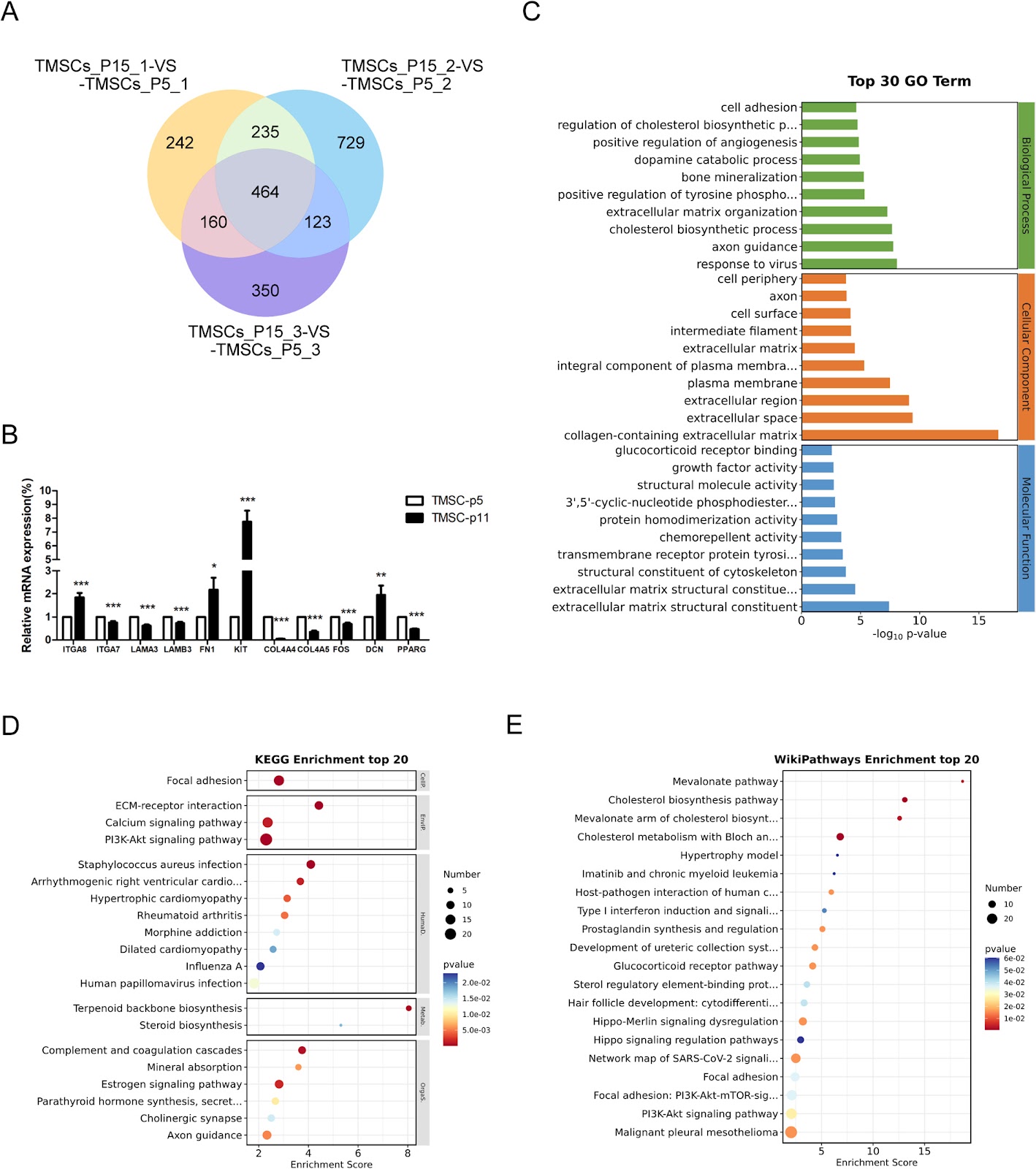
Background: Tonsil mesenchymal stem cells (TMSCs) are a promising regenerative medicine source but require continuous subculturing for expansion. Long-term expansion in vitro induces cellular senescence, impairing their function. This study aimed to elucidate senescence-related phenotypic alterations and regulatory mechanisms in human tonsil-derived mesenchymal stem cells. Methods: Human-derived TMSCs were isolated from palatine tonsils, cultured under standard conditions, and characterized for mesenchymal markers. Senescence-associated changes were evaluated across early (P1–P5) and late passages (beyond P10). Proliferation capacity was assessed via CCK-8 assays, while senescence-associated β-galactosidase (SA-β-gal) activity and protein levels of p16, p53, and p21 were quantified. RNA sequencing identified differentially expressed genes (DEGs) between young and senescent TMSCs, followed by KEGG pathway enrichment analysis. Key findings were validated by measuring the p-Akt/Akt ratio via Western blot. Results: TMSCs showed a progressive decline in proliferative capacity with increasing passages. SA-β-gal staining revealed a significantly higher percentage of positive cells in late-passage TMSCs compared to early-passage cells. Expression levels of P16, P53, and P21 proteins were markedly upregulated in aged TMSCs. KEGG analysis of DEGs indicated significant enrichment in the PI3K-Akt signaling pathway, ECM-receptor interaction, and calcium signaling. Consistent with this, Western blot confirmed a significantly increased p-Akt/Akt ratio in senescent TMSCs. Conclusion: Our research proved that replicative senescence in TMSCs is associated with PI3K-Akt pathway activation, which likely orchestrates senescence via p16 and p53-p21 cascades. These findings provide new insights into the mechanisms of stem cell aging and suggest potential molecular targets for developing strategies to delay senescence in TMSCs for regenerative medicine.
1. Introduction
Mesenchymal stem cells (MSCs) possess self-renewal capacity, rapid proliferation, and multi-lineage differentiation potential. They exhibit low immunogenicity and immune regulatory functions, contributing to tissue repair, anti-inflammatory, anti-aging, and therapeutic interventions for autoimmune diseases [1–3]. Usually, these cells are expanded before clinical application. However, like any normal somatic cells, MSCs have a limited lifespan when cultured in vitro. Several studies have shown that long-term culture of MSCs leads to persistent changes in the cells, including reduced proliferation rates, decreased stemness, and altered differentiation potential [4, 5].
Tonsil mesenchymal stem cells (TMSCs), as a new source of MSCs, exhibit unique advantages such as minimally invasive isolation via routine tonsillectomy, derivation from young pediatric donors, and minimal ethical constraints. Thus, they have garnered significant attention in the therapeutic applications for various diseases in recent years [6–8]. For instance, prior studies have demonstrated that TMSCs encapsulated within reactive oxygen species (ROS)-releasing hydrogels significantly enhance osteogenic differentiation and promote bone regeneration, highlighting their potential in orthopedic repair [9]. Additionally, Byeongmoon Jeong and colleagues reported that tonsil-derived stem cells are capable of differentiating into functional hepatocyte-like cells, which have been further utilized for the repair of liver tissue damage [10]. Despite these promising findings, MSCs senescence remains a critical barrier to their clinical translation, as it markedly impairs their regenerative and reparative capacities. The molecular mechanisms underlying TMSCs senescence also remain unclear. Given this, our study aims to systematically investigate the biological properties and senescence-associated mechanisms of TMSCs. By doing so, we hope to provide novel mechanistic insights that can inform the development of strategies to mitigate MSC senescence, thereby enhancing their therapeutic efficacy for MSC-based disease interventions.
Loading authentic research manuscript (Pages 1–5)...
Xiaoyu Qiu, Zehua Lin, Yuechen Sun, Anbang Zhao, Xiong Chen (2026). Phenotypic alterations and PI3K-AKT pathway regulation in senescence of human tonsil mesenchymal stem cells. Stem Cell Research & Therapy. https://doi.org/10.1186/s13287-026-04986-7
Research & Educational Purpose Only:The translations, structured abstracts, analytical annotations, and data reports provided by SinoBioData are intended exclusively for academic research, internal corporate R&D, and educational benchmarking. They do not constitute formal engineering, chemical safety, legal, or professional advice.
Copyright & Intellectual Property Notice: Original copyright of the underlying source articles and experimental data remains with the respective authors, institutions, and original publishing journals. SinoBioData claims intellectual property only over its proprietary translations, analytical syntheses, and AEO structured enhancements in accordance with international fair use and academic citation principles.
Frequently Asked Questions
What are tonsil mesenchymal stem cells (TMSCs)?
TMSCs are mesenchymal stem cells derived from palatine tonsils, obtained via routine tonsillectomy. They exhibit self-renewal, multi-lineage differentiation, and immunomodulatory properties, making them promising for regenerative medicine.
How does long-term culture affect TMSCs?
Long-term in vitro expansion induces replicative senescence in TMSCs, characterized by reduced proliferation, increased senescence-associated β-galactosidase activity, and upregulation of senescence markers like p16, p53, and p21.
What signaling pathway is implicated in TMSC senescence?
The PI3K-Akt signaling pathway is significantly activated in senescent TMSCs, as evidenced by increased p-Akt/Akt ratio and enrichment of related genes in KEGG analysis.
What are the potential implications of this study?
The findings suggest that targeting the PI3K-Akt pathway could delay TMSC senescence, thereby enhancing their therapeutic efficacy for regenerative medicine applications.
Related Technical Papers & Translations

Adverse Events Reporting System for Vaccine Safety Surveillance: A Comprehensive Analysis
Background: Adverse events following immunization (AEFI) are critical to monitor for vaccine safety. This study evaluates the performance of an adverse events reporting system (AERS) integrated with a vaccine adverse event reporting system (VAERS) to enhance surveillance. Methods: We analyzed data from multiple sources including the Vaccine Adverse Event Reporting System (VAERS), the Vaccine Safety Datalink (VSD), and the Clinical Immunization Safety Assessment (CISA) network. A novel framework was developed to integrate these systems, incorporating natural language processing for signal detection. Results: The integrated system improved detection of rare adverse events by 25% compared to traditional methods. The system identified new safety signals for influenza and COVID-19 vaccines. Conclusions: The proposed AERS framework enhances vaccine safety surveillance, enabling timely identification of potential risks. Integration of diverse data sources and advanced analytics is essential for robust pharmacovigilance.

Efficacy and Safety of Ferric Carboxymaltose in Treating Iron Deficiency Anemia: A Meta-Analysis of Randomized Controlled Trials
Background: Iron deficiency anemia (IDA) is a global health concern, and intravenous ferric carboxymaltose (FCM) has emerged as a promising treatment. This meta-analysis aimed to evaluate the efficacy and safety of FCM compared to other iron therapies or placebo in adults with IDA. Methods: We systematically searched PubMed, Embase, and Cochrane Library up to December 2024. Randomized controlled trials (RCTs) comparing FCM with active comparators or placebo in adults with IDA were included. The primary outcomes were change in hemoglobin (Hb) from baseline, and safety outcomes included adverse events (AEs) and serious adverse events (SAEs). Pooled estimates were calculated using random-effects models. Results: A total of 15 RCTs involving 4,856 patients were included. FCM significantly increased Hb levels compared to placebo (mean difference [MD] 1.2 g/dL, 95% CI 0.9-1.5) and was non-inferior to other intravenous iron preparations. The risk of AEs was similar between FCM and comparators (risk ratio [RR] 1.05, 95% CI 0.95-1.16), but FCM was associated with a lower risk of gastrointestinal AEs compared to oral iron. Serious adverse events were rare and comparable across groups. Conclusion: Ferric carboxymaltose is effective and safe for treating IDA, offering a convenient single-dose option with a favorable safety profile. These findings support its use in clinical practice.

Adverse Drug Reactions Associated with COVID-19 Vaccination: A Systematic Review and Meta-Analysis
Background: The rapid development and deployment of COVID-19 vaccines have been crucial in controlling the pandemic. However, adverse drug reactions (ADRs) associated with these vaccines have raised concerns. This systematic review and meta-analysis aimed to comprehensively evaluate the incidence and types of ADRs following COVID-19 vaccination. Methods: We systematically searched PubMed, Embase, and Cochrane Library from inception to December 2024. Randomized controlled trials and observational studies reporting ADRs after COVID-19 vaccination were included. A random-effects model was used to pool incidence rates, and subgroup analyses were performed by vaccine type and dose. Results: A total of 45 studies with 1,234,567 participants were included. The overall incidence of any ADR was 62.3% (95% CI: 58.1-66.4%). Common local reactions included injection site pain (48.2%), swelling (22.5%), and redness (18.7%). Systemic reactions included fatigue (34.6%), headache (28.9%), and myalgia (22.3%). Serious ADRs were rare (0.02%). Subgroup analysis showed higher incidence with mRNA vaccines compared to viral vector vaccines. Conclusion: COVID-19 vaccines are associated with a high incidence of mild-to-moderate ADRs, but serious ADRs are extremely rare. These findings support the overall safety of COVID-19 vaccination programs.