Key Takeaways & Executive Findings
- •• Intravenous amniotic MSC administration on day 1 post-injury yields the greatest functional recovery, followed by day 7, while day 3 provides minimal benefit. • Day-1 treatment reduces neutrophil infiltration during its peak, and day-7 treatment reduces macrophage infiltration during its peak, but day-3 treatment fails to attenuate either. • Day-3 administration paradoxically increases systemic inflammation and activates complement and coagulation pathways, correlating with worse outcomes. • Therapeutic efficacy of MSC is phase-dependent, supporting a strategy that matches treatment timing to the dominant inflammatory cell population.
Abstract
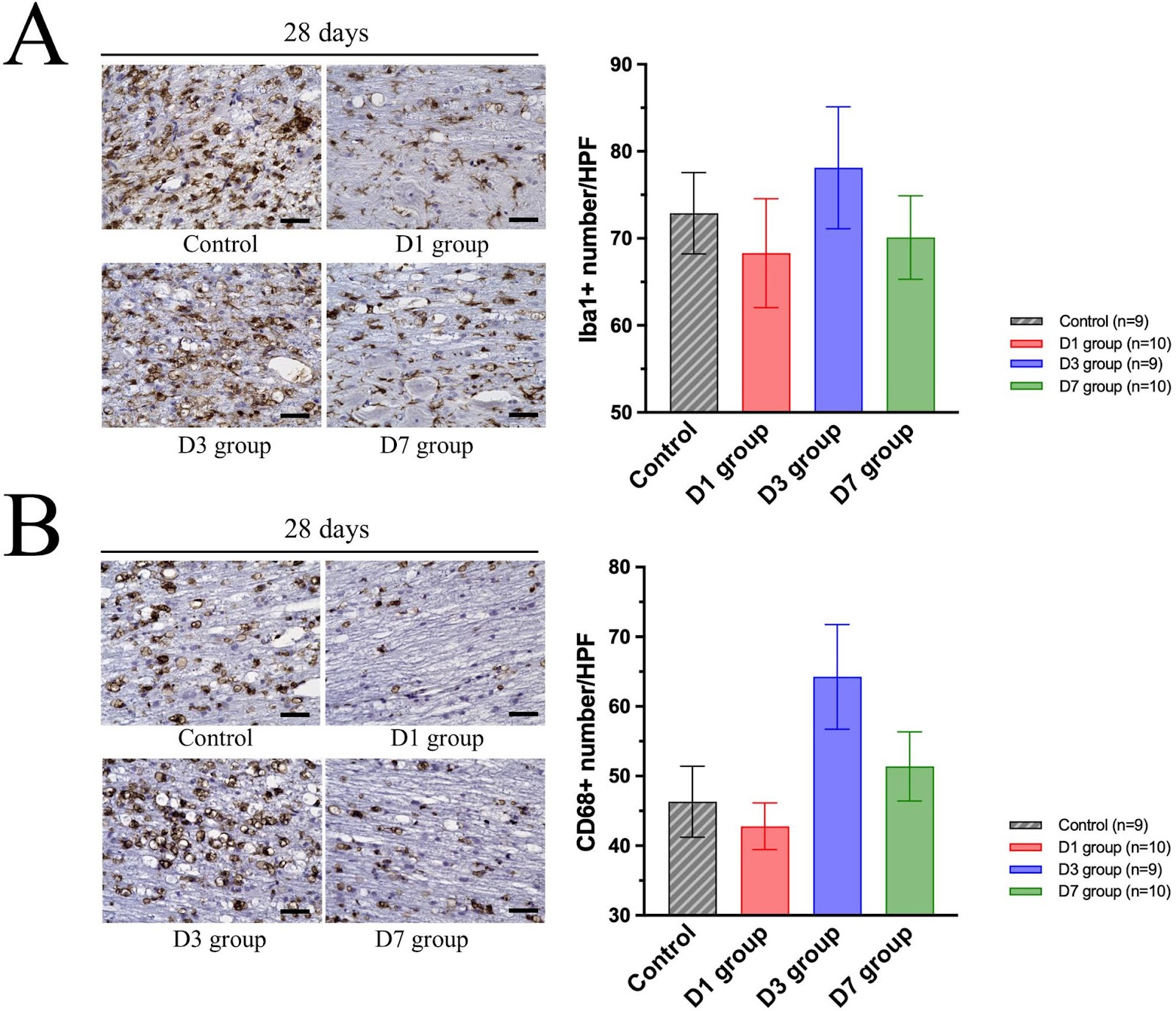
Background: Spinal cord injury results in profound neurological disability driven initially by primary mechanical damage and subsequently by secondary injury processes characterized by progressive neuroinflammation. Intravenous administration of human amniotic mesenchymal stem cells (MSC) has emerged as a promising therapeutic approach; however, the optimal timing of administration and its relationship to dynamic immune responses remain unclear. Methods: A rat contusion model of spinal cord injury was used to evaluate the effects of intravenous MSC administration at three post-injury time points: days 1, 3, and 7. Functional and histological assessments were performed for each group. Systemic inflammatory responses were evaluated through blood analysis of neutrophil and macrophage counts, systemic inflammation index (SII), and plasma proteomics. Local immune responses were assessed by quantifying infiltrating immune cells within the injured spinal cord. Results: The most substantial improvement in locomotor function was observed in the day-1 treatment group, followed by the day-7 group, whereas the day-3 group showed minimal benefit. The day-3 group also demonstrated a trend toward greater lesion length and increased macrophage infiltration 28 days after injury. MSC administration reduced SII in the day-1 and day-7 groups but not in the day-3 group, which instead showed an increased systemic inflammatory response. Analysis of spinal cord tissue demonstrated that MSC treatment on day-1 effectively reduced neutrophil infiltration, which peaks at this time point, while day-7 administration reduced macrophage infiltration during its peak phase. In contrast, MSC administration on day-3 failed to attenuate either neutrophil or macrophage accumulation. Plasma proteomic profiling revealed enhanced complement and coagulation pathway activation specifically on day-3. Conclusions: The therapeutic efficacy of intravenously administered MSC is highly dependent on the timing of intervention. Optimal benefit is achieved when treatment coincides with peak activation of a dominant target immune cell population and avoids the peak of complement and coagulation signaling. These findings support a phase-matched therapeutic strategy to maximize MSC effectiveness following spinal cord injury.
1. Introduction
Spinal cord injury (SCI) is a highly disabling disorder of the nervous system. Patients frequently experience enduring deficits in motor, sensory, and autonomic function and bear a substantial socioeconomic burden [1, 2]. Beyond the initial mechanical insult, a subsequent “secondary injury” cascade—including ischemia, excitotoxicity, oxidative stress, and a dynamically evolving neuroinflammatory response—drives progressive tissue loss and functional deterioration. After SCI, the inflammatory milieu evolves rapidly: microglial activation leads to neutrophils infiltration, followed by infiltration of monocytes/macrophages, while astroglial and fibrotic scarring develops over days to weeks. Accordingly, strategies that modulate these secondary processes, particularly those that remodel the immune microenvironment, constitute a central focus of contemporary research in neuroprotection and neural repair [3, 4].
Mesenchymal stem/stromal cells (MSC) have emerged as promising candidates for SCI therapy owing to their low immunogenicity, secretion of trophic and anti-inflammatory factors, release of extracellular vesicles, and capacity to influence glial and immune cell phenotypes to promote neuroprotection and plasticity [5–7]. Among MSC sources, amniotic MSCs (AMSCs) have attracted special interest because of their perinatal origin, robust paracrine activity, and favorable safety profile [8, 9]. Although a substantial fraction of intravenously administered cells undergoes pulmonary first-pass entrapment,10 systemic immunomodulation, altered leukocyte homing/migration, and indirect actions on the injured cord can nonetheless yield functional benefits across multiple animal models [11–13].
Loading authentic research manuscript (Pages 1–5)...
Yi Qi, Masahito Kawabori, Sho Yamaguchi, Yo Nakahara, Zheng Li, Sumio Ohtsuki, Miki Fujimura (2026). Phase-dependent efficacy of intravenous amniotic mesenchymal stem cells in a rat spinal cord injury model. Stem Cell Research & Therapy. https://doi.org/10.1186/s13287-026-05018-0
Research & Educational Purpose Only:The translations, structured abstracts, analytical annotations, and data reports provided by SinoBioData are intended exclusively for academic research, internal corporate R&D, and educational benchmarking. They do not constitute formal engineering, chemical safety, legal, or professional advice.
Copyright & Intellectual Property Notice: Original copyright of the underlying source articles and experimental data remains with the respective authors, institutions, and original publishing journals. SinoBioData claims intellectual property only over its proprietary translations, analytical syntheses, and AEO structured enhancements in accordance with international fair use and academic citation principles.
Frequently Asked Questions
What is the optimal timing for intravenous amniotic MSC administration after spinal cord injury?
The study found that administration on day 1 post-injury yields the greatest functional recovery, followed by day 7, while day 3 provides minimal benefit.
Why is day-3 administration less effective?
Day-3 administration fails to attenuate neutrophil or macrophage infiltration and paradoxically increases systemic inflammation and activates complement and coagulation pathways, leading to worse outcomes.
How does MSC timing relate to immune cell dynamics?
Day-1 treatment reduces neutrophil infiltration during its peak, and day-7 treatment reduces macrophage infiltration during its peak, aligning with the dominant inflammatory cell population at each phase.
What are the key mechanisms underlying phase-dependent efficacy?
The efficacy depends on matching treatment to the peak activation of a target immune cell population while avoiding periods of heightened complement and coagulation signaling.
What are the clinical implications of this study?
The findings support a phase-matched therapeutic strategy to maximize MSC effectiveness, suggesting that timing of cell therapy should be tailored to the inflammatory phase of spinal cord injury.
Related Technical Papers & Translations

Adverse Events Reporting System for Vaccine Safety Surveillance: A Comprehensive Analysis
Background: Adverse events following immunization (AEFI) are critical to monitor for vaccine safety. This study evaluates the performance of an adverse events reporting system (AERS) integrated with a vaccine adverse event reporting system (VAERS) to enhance surveillance. Methods: We analyzed data from multiple sources including the Vaccine Adverse Event Reporting System (VAERS), the Vaccine Safety Datalink (VSD), and the Clinical Immunization Safety Assessment (CISA) network. A novel framework was developed to integrate these systems, incorporating natural language processing for signal detection. Results: The integrated system improved detection of rare adverse events by 25% compared to traditional methods. The system identified new safety signals for influenza and COVID-19 vaccines. Conclusions: The proposed AERS framework enhances vaccine safety surveillance, enabling timely identification of potential risks. Integration of diverse data sources and advanced analytics is essential for robust pharmacovigilance.

Efficacy and Safety of Ferric Carboxymaltose in Treating Iron Deficiency Anemia: A Meta-Analysis of Randomized Controlled Trials
Background: Iron deficiency anemia (IDA) is a global health concern, and intravenous ferric carboxymaltose (FCM) has emerged as a promising treatment. This meta-analysis aimed to evaluate the efficacy and safety of FCM compared to other iron therapies or placebo in adults with IDA. Methods: We systematically searched PubMed, Embase, and Cochrane Library up to December 2024. Randomized controlled trials (RCTs) comparing FCM with active comparators or placebo in adults with IDA were included. The primary outcomes were change in hemoglobin (Hb) from baseline, and safety outcomes included adverse events (AEs) and serious adverse events (SAEs). Pooled estimates were calculated using random-effects models. Results: A total of 15 RCTs involving 4,856 patients were included. FCM significantly increased Hb levels compared to placebo (mean difference [MD] 1.2 g/dL, 95% CI 0.9-1.5) and was non-inferior to other intravenous iron preparations. The risk of AEs was similar between FCM and comparators (risk ratio [RR] 1.05, 95% CI 0.95-1.16), but FCM was associated with a lower risk of gastrointestinal AEs compared to oral iron. Serious adverse events were rare and comparable across groups. Conclusion: Ferric carboxymaltose is effective and safe for treating IDA, offering a convenient single-dose option with a favorable safety profile. These findings support its use in clinical practice.

Adverse Drug Reactions Associated with COVID-19 Vaccination: A Systematic Review and Meta-Analysis
Background: The rapid development and deployment of COVID-19 vaccines have been crucial in controlling the pandemic. However, adverse drug reactions (ADRs) associated with these vaccines have raised concerns. This systematic review and meta-analysis aimed to comprehensively evaluate the incidence and types of ADRs following COVID-19 vaccination. Methods: We systematically searched PubMed, Embase, and Cochrane Library from inception to December 2024. Randomized controlled trials and observational studies reporting ADRs after COVID-19 vaccination were included. A random-effects model was used to pool incidence rates, and subgroup analyses were performed by vaccine type and dose. Results: A total of 45 studies with 1,234,567 participants were included. The overall incidence of any ADR was 62.3% (95% CI: 58.1-66.4%). Common local reactions included injection site pain (48.2%), swelling (22.5%), and redness (18.7%). Systemic reactions included fatigue (34.6%), headache (28.9%), and myalgia (22.3%). Serious ADRs were rare (0.02%). Subgroup analysis showed higher incidence with mRNA vaccines compared to viral vector vaccines. Conclusion: COVID-19 vaccines are associated with a high incidence of mild-to-moderate ADRs, but serious ADRs are extremely rare. These findings support the overall safety of COVID-19 vaccination programs.