Key Takeaways & Executive Findings
- •• A GMP-compliant protocol using Type-I collagen achieves an 82% establishment rate for patient-derived colonic organoids from 60 patients. • Incorporation of the Wnt-activating peptide PG-008 enhances organoid growth and reduces patient-to-patient variability by enriching intestinal stem cells. • Single-cell RNA sequencing reveals that PG-008 yields a remarkably pure culture of LGR5+ and LGR5− regenerative intestinal stem cells. • This scalable, clinical-grade organoid platform supports applications in autologous transplantation and bioengineering for gastrointestinal regenerative therapy.
Abstract
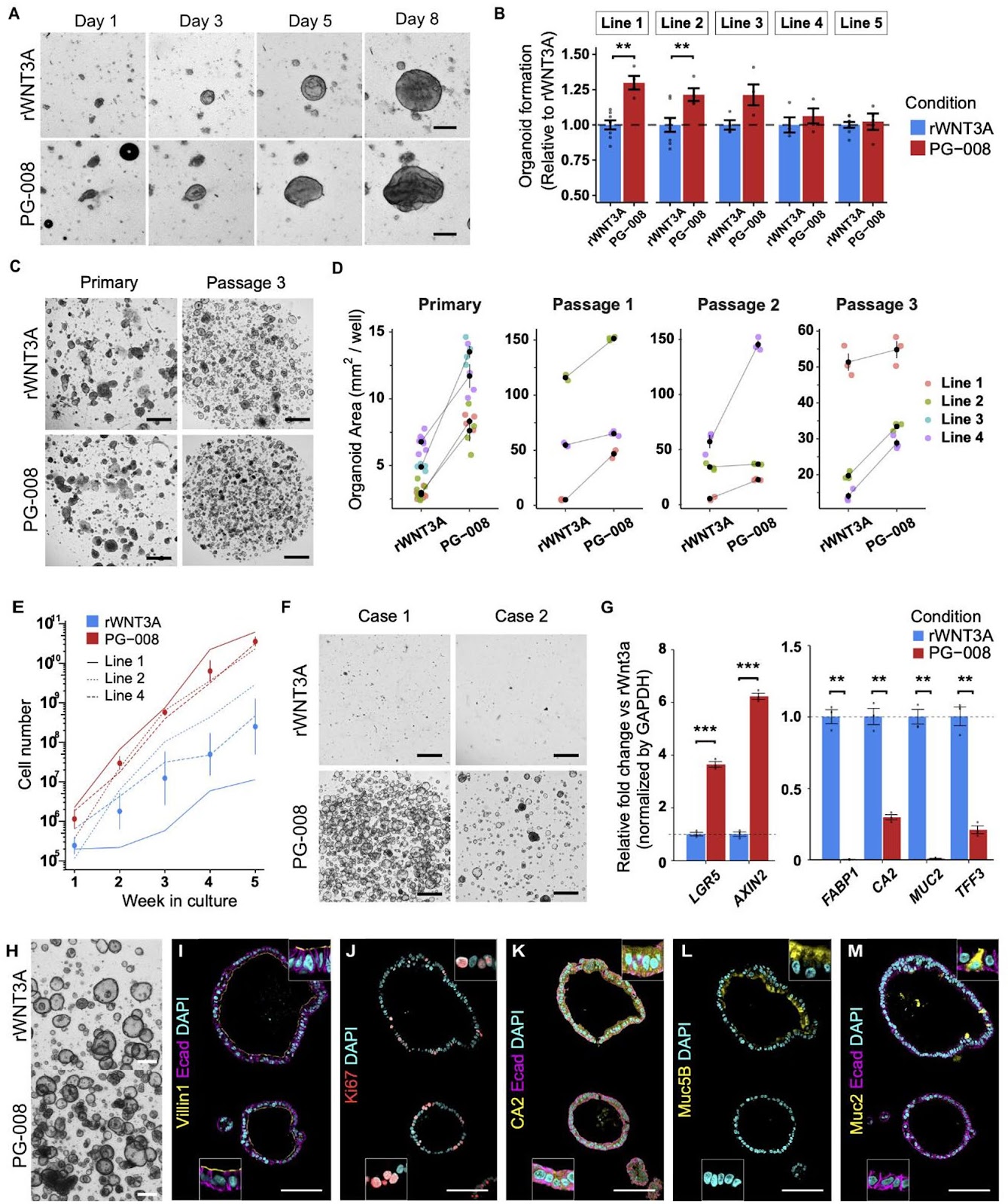
Background Gastrointestinal diseases often involve cellular damage, degeneration or dysfunction in the tract, frequently requiring surgical interventions risking complications and lowered quality of life. Regenerative medicine holds great promise in improving patient care and providing novel treatment options for previously irreparable and untreatable tissues. Despite the clinical potential of intestinal organoids as a resource for regenerative cell therapy and bioengineering, the lack of clinical-grade cultures has hampered further development. Moreover, strategies to efficiently and reliably expand clinical-grade cultures at the scale required for application is limited. Methods A GMP-compliant protocol was developed to generate patient-derived colonic organoids from endoscopic biopsies. Clinical-grade colonic organoids cultured and expanded in Type-I collagen were compared to conventional Matrigel cultured organoids. To improve the culture-, cost-, and time-efficiency of culture expansion, several strategies were developed including organoid area-based passaging, one well plate culture, and the incorporation of Wnt activating peptide, PG-008. Conventional recombinant WNT3A culture was compared to the peptide PG-008 culture using single cell RNA sequencing. Results Clinical-grade collagen cultured organoids exhibited similar culture efficiency to Matrigel. Organoid establishment rate from 60 patients using the GMP-compliant protocol was 82%. The incorporation of PG-008 significantly enhanced organoid growth and stabilized patient-patient variability through intestinal stem cell (ISC) enrichment. Single cell RNA sequencing revealed that PG-008 resulted in remarkably pure culture consisting of ISCs. Peptide-based Wnt signal activation enables scalable production of clinical-grade patient-derived intestinal organoids for regenerative cell therapy. Intriguingly, our GMP-grade colonic organoids contained LGR5+ ISCs, and injury-induced LGR5− regenerative ISCs, both enriched in peptide culture. Conclusions Our study establishes clinical-grade colonic organoids for further application, including autologous transplantations and bioengineering. Further, collagen cultured organoids can be a valuable model facilitating in vitro investigation.
1. Introduction
Intestinal organoids are self-renewing, self-organizing, three-dimensional cell cultures first reported in 2009 that proved to be a revolutionary in vitro platform to study gastrointestinal health and disease [1–3]. Since its inception, the therapeutic potential of organoids was evident particularly as a disease model for drug development and screening, but also as a means to reliably expand stem cell populations for cell therapy applications [4].
Several preclinical studies have demonstrated the potential of organoid-based regenerative therapies, both for tissue repair and function restoration. Organoid transplantation into various mouse colonic injury models have led to visible engraftment at the injury site and recovery, demonstrating that intestinal organoids can be applied directly to support wound healing [5–8]. This capacity to engraft and aid the regenerative process of intestinal injury was shown to be dependent on the intestinal stem cell (ISC) population within the organoids [7]. These results provide a proof-of-concept of organoid transplantation as a therapeutic option for intestinal injuries including inflammatory bowel disease (IBD) [9, 10].
Loading authentic research manuscript (Pages 1–5)...
Hady Yuki Sugihara, Sayaka Nagata, Sho Kawasaki, Junichi Takahashi, Yui Hiraguri, Masayoshi Fukuda, Kohei Suzuki, Tatsuro Murano, Satoru Fujii, Toshimitsu Fujii, Hiromichi Shimizu, Kazuo Ohtsuka, Mamoru Watanabe, Ryuichi Okamoto, Tomohiro Mizutani (2026). Peptide-based Wnt signal activation enables scalable production of clinical-grade patient-derived intestinal organoids for regenerative cell therapy. Stem Cell Research & Therapy. https://doi.org/10.1186/s13287-026-04995-6
Research & Educational Purpose Only:The translations, structured abstracts, analytical annotations, and data reports provided by SinoBioData are intended exclusively for academic research, internal corporate R&D, and educational benchmarking. They do not constitute formal engineering, chemical safety, legal, or professional advice.
Copyright & Intellectual Property Notice: Original copyright of the underlying source articles and experimental data remains with the respective authors, institutions, and original publishing journals. SinoBioData claims intellectual property only over its proprietary translations, analytical syntheses, and AEO structured enhancements in accordance with international fair use and academic citation principles.
Frequently Asked Questions
What is the main achievement of this study?
The study presents a GMP-compliant protocol for generating clinical-grade patient-derived colonic organoids using Type-I collagen, achieving an 82% establishment rate from 60 patients. It also demonstrates that incorporating the Wnt-activating peptide PG-008 enhances organoid growth and enriches intestinal stem cells, enabling scalable production for regenerative cell therapy.
How does the peptide PG-008 improve organoid culture?
PG-008, a Wnt-activating peptide, significantly enhances organoid growth and stabilizes patient-to-patient variability by enriching intestinal stem cells (ISCs). Single-cell RNA sequencing revealed that PG-008 yields a remarkably pure culture of LGR5+ and LGR5− regenerative ISCs, which are crucial for effective transplantation.
Why is Type-I collagen used instead of Matrigel?
Matrigel, derived from murine tumors, poses challenges for clinical application due to batch variability and safety concerns. Type-I collagen offers a more defined and GMP-compliant alternative, and this study shows that collagen-cultured organoids exhibit similar culture efficiency to Matrigel, making it suitable for clinical-grade production.
What are the potential applications of these clinical-grade organoids?
The clinical-grade colonic organoids can be used for autologous transplantation to treat gastrointestinal injuries, such as those from inflammatory bowel disease, and for bioengineering functional intestinal grafts. They also serve as a valuable model for in vitro investigations of intestinal biology and disease.
What is the significance of the 82% establishment rate?
The 82% establishment rate from 60 patients demonstrates the reliability and robustness of the GMP-compliant protocol, which is essential for large-scale biobanking and clinical translation. This high success rate indicates that the protocol can be consistently applied to diverse patient populations.
Related Technical Papers & Translations

Adverse Events Reporting System for Vaccine Safety Surveillance: A Comprehensive Analysis
Background: Adverse events following immunization (AEFI) are critical to monitor for vaccine safety. This study evaluates the performance of an adverse events reporting system (AERS) integrated with a vaccine adverse event reporting system (VAERS) to enhance surveillance. Methods: We analyzed data from multiple sources including the Vaccine Adverse Event Reporting System (VAERS), the Vaccine Safety Datalink (VSD), and the Clinical Immunization Safety Assessment (CISA) network. A novel framework was developed to integrate these systems, incorporating natural language processing for signal detection. Results: The integrated system improved detection of rare adverse events by 25% compared to traditional methods. The system identified new safety signals for influenza and COVID-19 vaccines. Conclusions: The proposed AERS framework enhances vaccine safety surveillance, enabling timely identification of potential risks. Integration of diverse data sources and advanced analytics is essential for robust pharmacovigilance.

Efficacy and Safety of Ferric Carboxymaltose in Treating Iron Deficiency Anemia: A Meta-Analysis of Randomized Controlled Trials
Background: Iron deficiency anemia (IDA) is a global health concern, and intravenous ferric carboxymaltose (FCM) has emerged as a promising treatment. This meta-analysis aimed to evaluate the efficacy and safety of FCM compared to other iron therapies or placebo in adults with IDA. Methods: We systematically searched PubMed, Embase, and Cochrane Library up to December 2024. Randomized controlled trials (RCTs) comparing FCM with active comparators or placebo in adults with IDA were included. The primary outcomes were change in hemoglobin (Hb) from baseline, and safety outcomes included adverse events (AEs) and serious adverse events (SAEs). Pooled estimates were calculated using random-effects models. Results: A total of 15 RCTs involving 4,856 patients were included. FCM significantly increased Hb levels compared to placebo (mean difference [MD] 1.2 g/dL, 95% CI 0.9-1.5) and was non-inferior to other intravenous iron preparations. The risk of AEs was similar between FCM and comparators (risk ratio [RR] 1.05, 95% CI 0.95-1.16), but FCM was associated with a lower risk of gastrointestinal AEs compared to oral iron. Serious adverse events were rare and comparable across groups. Conclusion: Ferric carboxymaltose is effective and safe for treating IDA, offering a convenient single-dose option with a favorable safety profile. These findings support its use in clinical practice.

Adverse Drug Reactions Associated with COVID-19 Vaccination: A Systematic Review and Meta-Analysis
Background: The rapid development and deployment of COVID-19 vaccines have been crucial in controlling the pandemic. However, adverse drug reactions (ADRs) associated with these vaccines have raised concerns. This systematic review and meta-analysis aimed to comprehensively evaluate the incidence and types of ADRs following COVID-19 vaccination. Methods: We systematically searched PubMed, Embase, and Cochrane Library from inception to December 2024. Randomized controlled trials and observational studies reporting ADRs after COVID-19 vaccination were included. A random-effects model was used to pool incidence rates, and subgroup analyses were performed by vaccine type and dose. Results: A total of 45 studies with 1,234,567 participants were included. The overall incidence of any ADR was 62.3% (95% CI: 58.1-66.4%). Common local reactions included injection site pain (48.2%), swelling (22.5%), and redness (18.7%). Systemic reactions included fatigue (34.6%), headache (28.9%), and myalgia (22.3%). Serious ADRs were rare (0.02%). Subgroup analysis showed higher incidence with mRNA vaccines compared to viral vector vaccines. Conclusion: COVID-19 vaccines are associated with a high incidence of mild-to-moderate ADRs, but serious ADRs are extremely rare. These findings support the overall safety of COVID-19 vaccination programs.