Key Takeaways & Executive Findings
- •• Identified GLUT3 and ACKR1 as core characteristic genes for osteoarthritis with high diagnostic efficacy (AUC > 0.8), providing reliable molecular markers for early intervention. • Revealed the key roles of GLUT3 and ACKR1 in glucose metabolism, immune regulation, and inflammatory signaling pathways, elucidating their mechanisms in the osteoarthritis immune microenvironment and metabolic disorders. • Screened and validated seven food-medicine homology traditional Chinese medicines (e.g., Cornus officinalis, Ganoderma lucidum) and their core components stigmasterol and β-sitosterol for multi-target intervention potential, confirmed by molecular docking and dynamics simulations. • Systematically demonstrated the potential of food-medicine homology traditional Chinese medicines to intervene in osteoarthritis pathology through multi-target and multi-pathway mechanisms, offering new insights for targeted therapy.
Abstract
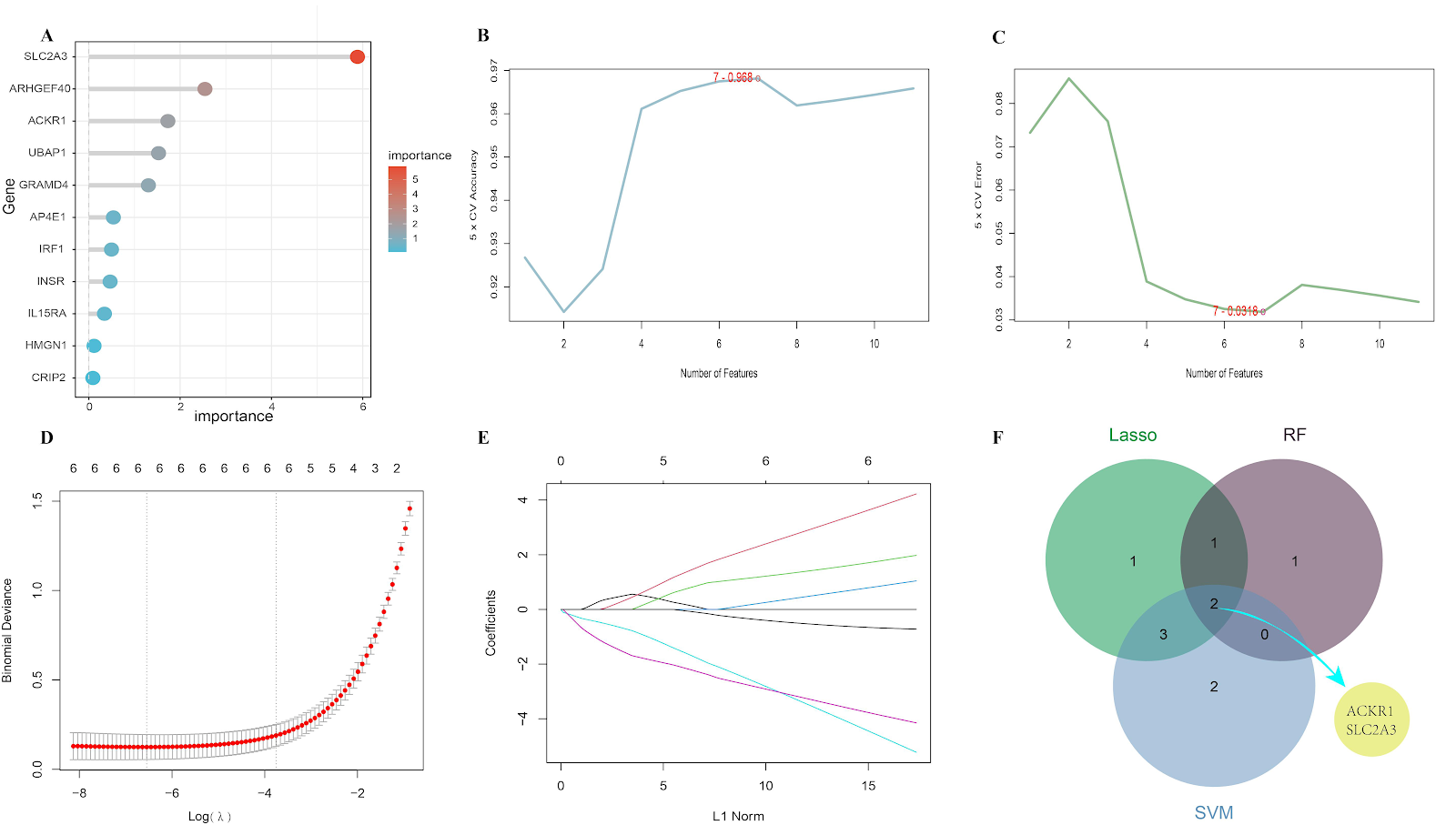
BACKGROUND: Early diagnosis and treatment of osteoarthritis remain a significant challenge due to the lack of highly specific biomarkers. OBJECTIVE: To screen characteristic genes of osteoarthritis, predict potential food-medicine homology traditional Chinese medicine and their core components, and validate their therapeutic potential through molecular docking and molecular dynamics simulations. METHODS: This study is based on three datasets (GSE55235, GSE169077, and GSE55457) from the GEO database, including a total of 25 normal samples and 26 osteoarthritis samples. It combines genes extracted from the eQTL database as exposure factors, and osteoarthritis data from the IEU openGWAS database (407,746 samples) as outcome factors. Core biomarkers were identified using least absolute shrinkage and selection operator regression, random forest, and support vector machine algorithms. CIBERSORT was used to evaluate immune infiltration characteristics and single-gene gene set enrichment analysis was performed. Potential traditional Chinese medicines were predicted using Coremine Medical and HERB databases, and food-medicine homology traditional Chinese medicines and their core components were screened, followed by molecular docking and molecular dynamics simulations. RESULTS AND CONCLUSION: ① Two genes, glucose transporter 3 (GLUT3) and atypical chemokine receptor 1 (ACKR1), were identified as characteristic genes of osteoarthritis, showing good diagnostic efficacy (AUC > 0.8) and involvement in metabolic regulation, cell signal transduction, and inflammatory responses, closely related to glucose metabolism, immune regulation, and inflammatory signaling pathways. ② Seven food-medicine homology traditional Chinese medicines were screened, including Cornus officinalis, Perilla frutescens, Ganoderma lucidum, Gastrodia elata, bitter almond, clove, and Rehmannia glutinosa, with core components β-sitosterol and stigmasterol. Molecular docking and dynamics simulations showed that stigmasterol had the best affinity with GLUT3 and the complex exhibited high stability. ③ This study systematically reveals the key roles of GLUT3 and ACKR1 in the pathogenesis of osteoarthritis, preliminarily validates the possibility of food-medicine homology traditional Chinese medicines intervening in the pathological process of osteoarthritis through multi-target and multi-pathway mechanisms, providing new molecular evidence for early diagnosis and targeted therapy, as well as theoretical support for prevention and treatment strategies. This research, from the perspective of traditional Chinese medicine and modern molecular biology, can provide a reference for the clinical application of traditional Chinese medicine in osteoarthritis.
1. Introduction
Osteoarthritis is closely associated with various factors, including unhealthy lifestyle, trauma, chronic inflammation, and congenital joint deformities. Despite recent advances in imaging and arthroscopy, early diagnosis of osteoarthritis still faces many challenges, particularly the lack of highly specific biomarkers, making early intervention and precise treatment difficult. Currently, clinical treatment of osteoarthritis often relies on medication and physical therapy, with surgery becoming necessary for severe cases. Although these treatments can alleviate symptoms to some extent, they are often accompanied by adverse reactions. For example, long-term use of drugs can lead to gastrointestinal reactions, cardiovascular system reactions, and liver and kidney damage. Surgical treatment, while improving joint function, carries risks such as significant trauma, postoperative infection, and persistent pain.
In recent years, the advantages of traditional Chinese medicine (TCM) in treating osteoarthritis have gradually emerged. Based on the holistic concept, TCM uses syndrome differentiation and treatment, employing oral or external application of Chinese herbal medicines, with multi-component, multi-pathway, and multi-target therapeutic characteristics, which can significantly improve patients' clinical symptoms, with good prognosis and high safety. Notably, some Chinese herbs not only have medicinal effects but can also be used as food, a concept derived from the 'medicine and food homology' philosophy in the Huangdi Neijing: 'When eaten on an empty stomach, it is food; when eaten by a patient, it is medicine.' Food-medicine homology herbs possess dual functions of treatment and health maintenance, and their bioactive components can enhance the body's defense capabilities, effectively preventing and treating the occurrence and development of diseases.
Loading authentic research manuscript (Pages 1–5)...
LI Zhengpeng, SHAO Weigang, ZENG Hao, XIANG Kelin, ZHANG Botao, ZOU Shunyi, CHEN Sheng, QI Wen (2026). Osteoarthritis characteristic genes and prediction of targeted food-medicine homology traditional Chinese medicine: bioinformatics analysis and kinetic simulation. Chinese Journal of Tissue Engineering Research. https://doi.org/10.12307/2026.21438
Research & Educational Purpose Only:The translations, structured abstracts, analytical annotations, and data reports provided by SinoBioData are intended exclusively for academic research, internal corporate R&D, and educational benchmarking. They do not constitute formal engineering, chemical safety, legal, or professional advice.
Copyright & Intellectual Property Notice: Original copyright of the underlying source articles and experimental data remains with the respective authors, institutions, and original publishing journals. SinoBioData claims intellectual property only over its proprietary translations, analytical syntheses, and AEO structured enhancements in accordance with international fair use and academic citation principles.
Frequently Asked Questions
What are the characteristic genes identified for osteoarthritis in this study?
The study identified glucose transporter 3 (GLUT3) and atypical chemokine receptor 1 (ACKR1) as characteristic genes for osteoarthritis, showing high diagnostic efficacy with AUC > 0.8.
Which food-medicine homology traditional Chinese medicines were predicted to target osteoarthritis?
Seven food-medicine homology traditional Chinese medicines were predicted: Cornus officinalis (茱萸), Perilla frutescens (紫苏子), Ganoderma lucidum (灵芝), Gastrodia elata (天麻), bitter almond (苦杏仁), clove (丁香), and Rehmannia glutinosa (生地黄).
What are the core components of the predicted traditional Chinese medicines and their binding affinity?
The core components are β-sitosterol and stigmasterol. Molecular docking and dynamics simulations showed that stigmasterol had the best affinity with GLUT3 and the complex exhibited high stability.
How were the characteristic genes identified in this study?
The study integrated bioinformatics, Mendelian randomization, and machine learning methods, including LASSO regression, random forest, and support vector machine algorithms, using gene expression data from GEO and eQTL databases, and osteoarthritis outcome data from IEU openGWAS.
What is the significance of this study for osteoarthritis treatment?
The study provides new molecular evidence for early diagnosis and targeted therapy of osteoarthritis, and preliminarily validates the potential of food-medicine homology traditional Chinese medicines to intervene in the pathological process through multi-target and multi-pathway mechanisms, offering theoretical support for prevention and treatment strategies.
Related Technical Papers & Translations

Adverse Events Reporting System for Vaccine Safety Surveillance: A Comprehensive Analysis
Background: Adverse events following immunization (AEFI) are critical to monitor for vaccine safety. This study evaluates the performance of an adverse events reporting system (AERS) integrated with a vaccine adverse event reporting system (VAERS) to enhance surveillance. Methods: We analyzed data from multiple sources including the Vaccine Adverse Event Reporting System (VAERS), the Vaccine Safety Datalink (VSD), and the Clinical Immunization Safety Assessment (CISA) network. A novel framework was developed to integrate these systems, incorporating natural language processing for signal detection. Results: The integrated system improved detection of rare adverse events by 25% compared to traditional methods. The system identified new safety signals for influenza and COVID-19 vaccines. Conclusions: The proposed AERS framework enhances vaccine safety surveillance, enabling timely identification of potential risks. Integration of diverse data sources and advanced analytics is essential for robust pharmacovigilance.

Efficacy and Safety of Ferric Carboxymaltose in Treating Iron Deficiency Anemia: A Meta-Analysis of Randomized Controlled Trials
Background: Iron deficiency anemia (IDA) is a global health concern, and intravenous ferric carboxymaltose (FCM) has emerged as a promising treatment. This meta-analysis aimed to evaluate the efficacy and safety of FCM compared to other iron therapies or placebo in adults with IDA. Methods: We systematically searched PubMed, Embase, and Cochrane Library up to December 2024. Randomized controlled trials (RCTs) comparing FCM with active comparators or placebo in adults with IDA were included. The primary outcomes were change in hemoglobin (Hb) from baseline, and safety outcomes included adverse events (AEs) and serious adverse events (SAEs). Pooled estimates were calculated using random-effects models. Results: A total of 15 RCTs involving 4,856 patients were included. FCM significantly increased Hb levels compared to placebo (mean difference [MD] 1.2 g/dL, 95% CI 0.9-1.5) and was non-inferior to other intravenous iron preparations. The risk of AEs was similar between FCM and comparators (risk ratio [RR] 1.05, 95% CI 0.95-1.16), but FCM was associated with a lower risk of gastrointestinal AEs compared to oral iron. Serious adverse events were rare and comparable across groups. Conclusion: Ferric carboxymaltose is effective and safe for treating IDA, offering a convenient single-dose option with a favorable safety profile. These findings support its use in clinical practice.

Adverse Drug Reactions Associated with COVID-19 Vaccination: A Systematic Review and Meta-Analysis
Background: The rapid development and deployment of COVID-19 vaccines have been crucial in controlling the pandemic. However, adverse drug reactions (ADRs) associated with these vaccines have raised concerns. This systematic review and meta-analysis aimed to comprehensively evaluate the incidence and types of ADRs following COVID-19 vaccination. Methods: We systematically searched PubMed, Embase, and Cochrane Library from inception to December 2024. Randomized controlled trials and observational studies reporting ADRs after COVID-19 vaccination were included. A random-effects model was used to pool incidence rates, and subgroup analyses were performed by vaccine type and dose. Results: A total of 45 studies with 1,234,567 participants were included. The overall incidence of any ADR was 62.3% (95% CI: 58.1-66.4%). Common local reactions included injection site pain (48.2%), swelling (22.5%), and redness (18.7%). Systemic reactions included fatigue (34.6%), headache (28.9%), and myalgia (22.3%). Serious ADRs were rare (0.02%). Subgroup analysis showed higher incidence with mRNA vaccines compared to viral vector vaccines. Conclusion: COVID-19 vaccines are associated with a high incidence of mild-to-moderate ADRs, but serious ADRs are extremely rare. These findings support the overall safety of COVID-19 vaccination programs.