Key Takeaways & Executive Findings
- •• Intravenous (IV) administration of IMRCs outperforms intratracheal (IT) delivery in improving survival, body weight recovery, and reducing fibrosis scores in a bleomycin-induced mouse model of pulmonary fibrosis. • Early and repeated (double) IV infusions of IMRCs significantly enhance therapeutic efficacy, improving lung function and promoting alveolar epithelial regeneration. • IMRCs mitigate lung injury by suppressing macrophage infiltration via CD24, highlighting a novel immunomodulatory mechanism. • These findings provide critical preclinical evidence for optimizing the route, timing, and frequency of IMRC administration, informing future clinical protocols for treating lung injury and fibrosis.
Abstract
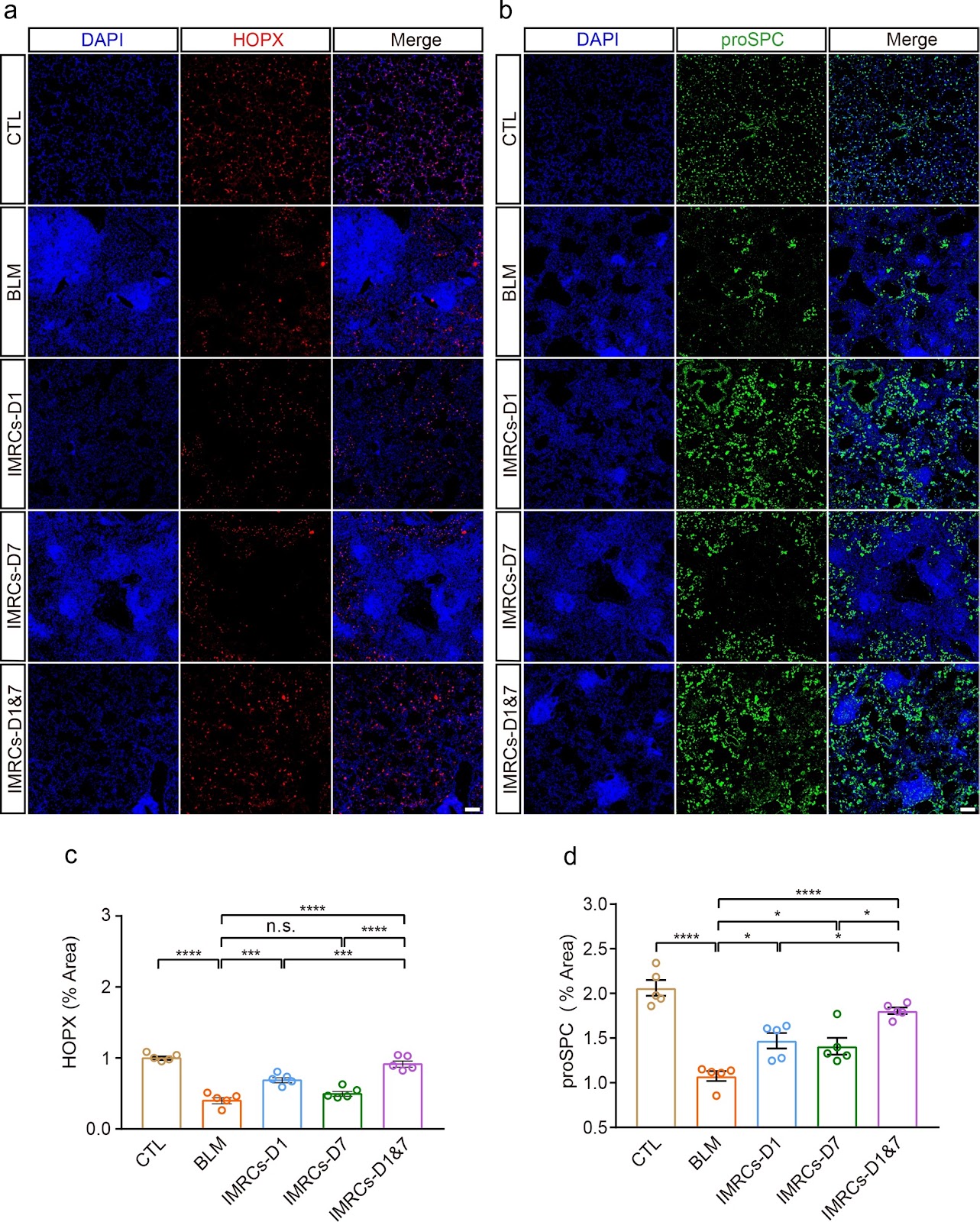
Background Lung injury and pulmonary fibrosis (PF), frequently arising as sequelae of severe and acute lung disease, currently face a dearth of effective therapeutic potions. Mesenchymal stem cells (MSCs) with immunomodulatory and tissue repair functions have immense potential to treat lung injury and PF. However, the optimal route of administration, timing, and frequency of dosing remain elusive. Human embryonic stem cell-derived immunity-and-matrix-regulatory cells (IMRCs) have shown therapeutic potential for lung injury and PF. Methods To ascertain the optimal therapeutic regimen for IMRCs in PF, we conducted an experimental study. Utilizing a mouse model of PF induced by bleomycin (BLM), IMRCs were administered via either a single or double intravenous (IV) or intratracheal (IT) injection on the first and seventh days post-BLM induction. Results Our findings revealed that IV infusion of IMRCs surpassed IT infusion in enhancing survival rates, facilitating body weight recovery, and optimizing Ashcroft and Szapiel scores among the model mice. Notably, IV administration exhibited a more profound ability to mitigate lung inflammation and fibrosis. Moreover, earlier and more frequent administrations of IMRCs were found to be advantageous in enhancing their therapeutic effects. Specifically, early administration with two IV infusions significantly improved body weight, lung organ coefficient, pulmonary ventilation and diffusion functions, and PF. This was accompanied by an increase in alveolar type I and II epithelial cells and a suppression of macrophage infiltration via CD24. Conclusion Collectively, these results suggested that IMRCs infusion ameliorated lung injury by promoting lung regeneration and inhibiting macrophage infiltration in a route, time, and frequency-dependent manner.
1. Introduction
Idiopathic pulmonary fibrosis (IPF) is a chronic and progressive interstitial lung disease with an elusive etiology. IPF predominantly affects middle-aged and elderly individuals, and is characterized by a gradual exacerbation of dyspnea and irreversible deterioration of pulmonary function [1]. Although the discovery and application of antifibrotic drugs pirfenidone and nintedanib have brought hope to IPF patients in the past decade, the disease progression of most patients is still irreversible and disease mortality remains high. The median survival duration for patients who do not undergo lung transplantation is approximately 3 to 5 years following diagnosis [2, 3].
Stem cell therapy represents a promising and burgeoning therapeutic approach for managing a spectrum of degenerative disorders, including IPF. Among these, immunity-and-matrix-regulatory cells (IMRCs), mesenchymal-like stem cells derived from human embryonic stem cells (hESCs), possess several notable advantages such as abundant availability, an absence of teratoma formation, exceptional homogeneity, and the circumvention of tumorigenicity and immune rejection risks [4]. Moreover, IMRCs showed a good therapeutic effect in a mouse model of bleomycin (BLM)-induced lung injury [4], and have been used to treat COVID-19 critical illness (NCT04331613) [5] and PF (ChiCTR2000031139) [6] in patients caused by severe acute respiratory syndrome coronavirus 2 (SARS-CoV-2) infection. However, owing to the limited number of cases, more data are needed to optimize treatment of lung injury and PF with IMRCs. Crucially, the limited preclinical evidence supporting the application of IMRCs in IPF underscores the necessity for prudence in future research endeavors, particularly pertaining to the optimal route of administration, timing, and dosing intervals. Nonetheless, the establishment of standardized protocols could motivate scientists to delve deeper.
Loading authentic research manuscript (Pages 1–5)...
Dingyun Song, Zhongwen Li, Faguo Sun, Kaiwei Wu, Kan Zhang, Wenjing Liu, Kaidi Liu, Bin An, Zai Wang, Tiemei Zhao, Huaiyong Chen, Li Xiao, Liu Wang, Lixin Xie, Wei Li, Liang Peng, Jie Hao, Jun Wu, Huaping Dai (2026). Optimized administration of human embryonic stem cell-derived immunity-and-matrix regulatory cells for mouse lung injury and fibrosis. Stem Cell Research & Therapy. https://doi.org/10.1186/s13287-024-03945-4
Research & Educational Purpose Only:The translations, structured abstracts, analytical annotations, and data reports provided by SinoBioData are intended exclusively for academic research, internal corporate R&D, and educational benchmarking. They do not constitute formal engineering, chemical safety, legal, or professional advice.
Copyright & Intellectual Property Notice: Original copyright of the underlying source articles and experimental data remains with the respective authors, institutions, and original publishing journals. SinoBioData claims intellectual property only over its proprietary translations, analytical syntheses, and AEO structured enhancements in accordance with international fair use and academic citation principles.
Frequently Asked Questions
What are IMRCs and how are they derived?
IMRCs (immunity-and-matrix-regulatory cells) are mesenchymal-like stem cells derived from human embryonic stem cells (hESCs). They offer advantages such as abundant availability, no teratoma formation, and reduced risks of tumorigenicity and immune rejection.
Which route of administration is more effective for IMRCs in treating lung injury?
The study found that intravenous (IV) infusion of IMRCs is more effective than intratracheal (IT) infusion, leading to improved survival rates, better body weight recovery, and reduced lung inflammation and fibrosis in a mouse model.
How does the timing and frequency of IMRC administration affect therapeutic outcomes?
Earlier and more frequent administrations (specifically two IV infusions) were found to be advantageous, significantly improving body weight, lung function, and reducing pulmonary fibrosis compared to single or delayed administration.
What is the proposed mechanism by which IMRCs ameliorate lung injury?
IMRCs promote lung regeneration by increasing alveolar type I and II epithelial cells and suppress macrophage infiltration via CD24, thereby reducing inflammation and fibrosis in a route-, time-, and frequency-dependent manner.
Related Technical Papers & Translations

Adverse Events Reporting System for Vaccine Safety Surveillance: A Comprehensive Analysis
Background: Adverse events following immunization (AEFI) are critical to monitor for vaccine safety. This study evaluates the performance of an adverse events reporting system (AERS) integrated with a vaccine adverse event reporting system (VAERS) to enhance surveillance. Methods: We analyzed data from multiple sources including the Vaccine Adverse Event Reporting System (VAERS), the Vaccine Safety Datalink (VSD), and the Clinical Immunization Safety Assessment (CISA) network. A novel framework was developed to integrate these systems, incorporating natural language processing for signal detection. Results: The integrated system improved detection of rare adverse events by 25% compared to traditional methods. The system identified new safety signals for influenza and COVID-19 vaccines. Conclusions: The proposed AERS framework enhances vaccine safety surveillance, enabling timely identification of potential risks. Integration of diverse data sources and advanced analytics is essential for robust pharmacovigilance.

Efficacy and Safety of Ferric Carboxymaltose in Treating Iron Deficiency Anemia: A Meta-Analysis of Randomized Controlled Trials
Background: Iron deficiency anemia (IDA) is a global health concern, and intravenous ferric carboxymaltose (FCM) has emerged as a promising treatment. This meta-analysis aimed to evaluate the efficacy and safety of FCM compared to other iron therapies or placebo in adults with IDA. Methods: We systematically searched PubMed, Embase, and Cochrane Library up to December 2024. Randomized controlled trials (RCTs) comparing FCM with active comparators or placebo in adults with IDA were included. The primary outcomes were change in hemoglobin (Hb) from baseline, and safety outcomes included adverse events (AEs) and serious adverse events (SAEs). Pooled estimates were calculated using random-effects models. Results: A total of 15 RCTs involving 4,856 patients were included. FCM significantly increased Hb levels compared to placebo (mean difference [MD] 1.2 g/dL, 95% CI 0.9-1.5) and was non-inferior to other intravenous iron preparations. The risk of AEs was similar between FCM and comparators (risk ratio [RR] 1.05, 95% CI 0.95-1.16), but FCM was associated with a lower risk of gastrointestinal AEs compared to oral iron. Serious adverse events were rare and comparable across groups. Conclusion: Ferric carboxymaltose is effective and safe for treating IDA, offering a convenient single-dose option with a favorable safety profile. These findings support its use in clinical practice.

Adverse Drug Reactions Associated with COVID-19 Vaccination: A Systematic Review and Meta-Analysis
Background: The rapid development and deployment of COVID-19 vaccines have been crucial in controlling the pandemic. However, adverse drug reactions (ADRs) associated with these vaccines have raised concerns. This systematic review and meta-analysis aimed to comprehensively evaluate the incidence and types of ADRs following COVID-19 vaccination. Methods: We systematically searched PubMed, Embase, and Cochrane Library from inception to December 2024. Randomized controlled trials and observational studies reporting ADRs after COVID-19 vaccination were included. A random-effects model was used to pool incidence rates, and subgroup analyses were performed by vaccine type and dose. Results: A total of 45 studies with 1,234,567 participants were included. The overall incidence of any ADR was 62.3% (95% CI: 58.1-66.4%). Common local reactions included injection site pain (48.2%), swelling (22.5%), and redness (18.7%). Systemic reactions included fatigue (34.6%), headache (28.9%), and myalgia (22.3%). Serious ADRs were rare (0.02%). Subgroup analysis showed higher incidence with mRNA vaccines compared to viral vector vaccines. Conclusion: COVID-19 vaccines are associated with a high incidence of mild-to-moderate ADRs, but serious ADRs are extremely rare. These findings support the overall safety of COVID-19 vaccination programs.