Key Takeaways & Executive Findings
- •• mRNA export is a critical regulatory step in gene expression, tightly coupled with pre-mRNA processing to ensure only mature mRNAs reach the cytoplasm. • Export factors not only facilitate transport but also influence upstream processing steps, adding complexity to gene regulation. • The export process competes with RNA processing and degradation pathways, maintaining a delicate balance essential for accurate gene expression. • While mechanisms are conserved, higher eukaryotes exhibit significant differences due to increased genome complexity, necessitating multiple adaptor proteins and sophisticated surveillance systems.
Abstract
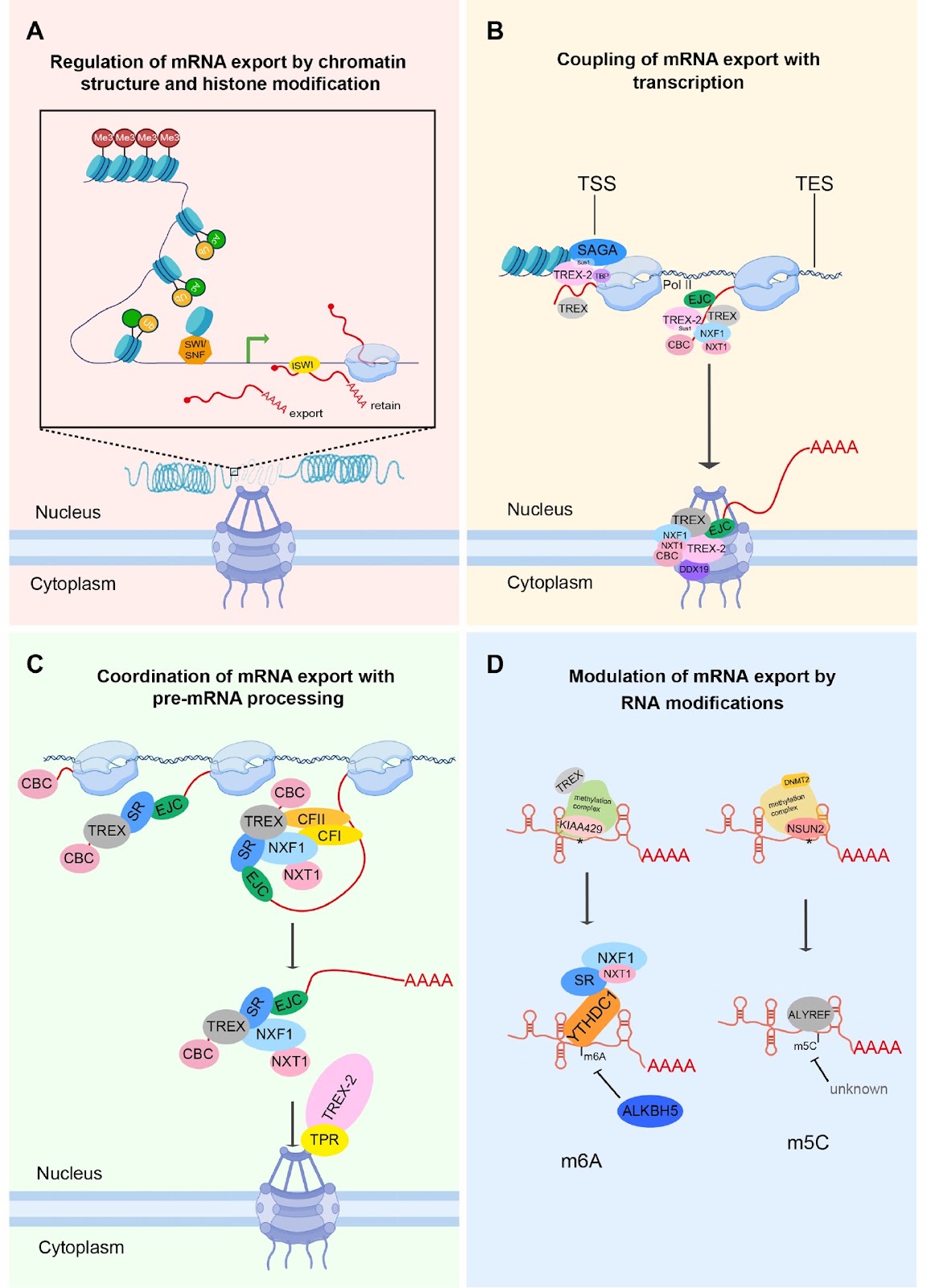
In eukaryotic cells, gene expression begins with transcription in the nucleus, followed by the maturation of messenger RNAs (mRNAs). These mRNA molecules are then exported to the cytoplasm through the nuclear pore complex (NPC), a process that serves as a critical regulatory phase of gene expression. The export of mRNA is intricately linked to precursor mRNA (pre-mRNA) processing, ensuring that only properly processed mRNA reaches the cytoplasm. This coordination is essential, as recent studies have revealed that mRNA export factors not only assist in transport but also influence upstream processing steps, adding a layer of complexity to gene regulation. Furthermore, the export process competes with RNA processing and degradation pathways, maintaining a delicate balance vital for accurate gene expression. While these mechanisms are generally conserved across eukaryotes, significant differences exist between yeast and higher eukaryotic cells, particularly due to the more genome complexity of the latter. This review delves into the current research on mRNA export in higher eukaryotic cells, focusing on its role in the broader context of gene expression regulation and highlighting how it interacts with other gene expression processes to ensure precise and efficient gene functionality in complex organisms.
1. Introduction
Eukaryotic cells contain all kinds of organelles that serve as sites of different cellular activities to maintain a variety of functions. The largest among them is the cell nucleus, which stores genetic information in the form of chromosomal DNA. A series of biological events, such as DNA replication, gene transcription and RNA processing, occur in the nucleus. However, protein translation and synthesis take place exclusively in the cytoplasm. The nuclear envelope that surrounds the nucleus separates these different activities. Owing to this physical separation, messenger RNAs (mRNAs) harboring genetic information must be exported to the cytoplasm for protein translation. Thus, the process of mRNA export is a key step for accurate expression of genetic information.
To be efficiently exported, nascent pre-mRNA needs to undergo a series of co- and post-transcriptional processing steps, including capping at the 5′ end, splicing to remove introns, 3′ end formation and RNA modifications. Then, the mature mRNA must cross the nuclear envelope through the NPC. This involves docking onto the nuclear basket, passing through the central channel of the nuclear envelope and being released from the cytoplasmic fibrils. All of these steps are highly regulated and coordinate with each other [1]. Correctly processed mRNAs are targeted for export by the formation of messenger ribonucleoprotein (mRNP) particles, with mRNA export factors recruited to the nascent mRNA co-transcriptionally. The mRNP with defects is eventually eliminated by mRNA surveillance systems.
Loading authentic research manuscript (Pages 1–5)...
Suli Chen, Qingyi Jiang, Jing Fan, Hong Cheng (2026). Nuclear mRNA export. Acta Biochimica et Biophysica Sinica. https://doi.org/10.3724/abbs.2024145
Research & Educational Purpose Only:The translations, structured abstracts, analytical annotations, and data reports provided by SinoBioData are intended exclusively for academic research, internal corporate R&D, and educational benchmarking. They do not constitute formal engineering, chemical safety, legal, or professional advice.
Copyright & Intellectual Property Notice: Original copyright of the underlying source articles and experimental data remains with the respective authors, institutions, and original publishing journals. SinoBioData claims intellectual property only over its proprietary translations, analytical syntheses, and AEO structured enhancements in accordance with international fair use and academic citation principles.
Frequently Asked Questions
What is the role of mRNA export in gene expression?
mRNA export is a critical regulatory step that ensures only properly processed mRNAs are transported from the nucleus to the cytoplasm for translation, thereby controlling gene expression.
How does mRNA export coordinate with pre-mRNA processing?
mRNA export factors are recruited co-transcriptionally and influence upstream processing steps such as capping, splicing, and 3' end formation, ensuring that only mature mRNAs are exported.
What are the main export receptors for mRNA?
The two main receptors are NXF1-NXT1 (Mex67-Mtr2 in yeast) and CRM1, which transport different subsets of mRNAs.
What differences exist between yeast and higher eukaryotes in mRNA export?
Higher eukaryotes have more complex genomes and extensive alternative splicing, requiring multiple adaptor proteins and sophisticated surveillance systems like the exon junction complex (EJC) to regulate export.
What is the significance of the competition between mRNA export and degradation?
The competition ensures that defective mRNPs are eliminated by surveillance systems, maintaining the fidelity of gene expression.
Related Technical Papers & Translations

Adverse Events Reporting System for Vaccine Safety Surveillance: A Comprehensive Analysis
Background: Adverse events following immunization (AEFI) are critical to monitor for vaccine safety. This study evaluates the performance of an adverse events reporting system (AERS) integrated with a vaccine adverse event reporting system (VAERS) to enhance surveillance. Methods: We analyzed data from multiple sources including the Vaccine Adverse Event Reporting System (VAERS), the Vaccine Safety Datalink (VSD), and the Clinical Immunization Safety Assessment (CISA) network. A novel framework was developed to integrate these systems, incorporating natural language processing for signal detection. Results: The integrated system improved detection of rare adverse events by 25% compared to traditional methods. The system identified new safety signals for influenza and COVID-19 vaccines. Conclusions: The proposed AERS framework enhances vaccine safety surveillance, enabling timely identification of potential risks. Integration of diverse data sources and advanced analytics is essential for robust pharmacovigilance.

Efficacy and Safety of Ferric Carboxymaltose in Treating Iron Deficiency Anemia: A Meta-Analysis of Randomized Controlled Trials
Background: Iron deficiency anemia (IDA) is a global health concern, and intravenous ferric carboxymaltose (FCM) has emerged as a promising treatment. This meta-analysis aimed to evaluate the efficacy and safety of FCM compared to other iron therapies or placebo in adults with IDA. Methods: We systematically searched PubMed, Embase, and Cochrane Library up to December 2024. Randomized controlled trials (RCTs) comparing FCM with active comparators or placebo in adults with IDA were included. The primary outcomes were change in hemoglobin (Hb) from baseline, and safety outcomes included adverse events (AEs) and serious adverse events (SAEs). Pooled estimates were calculated using random-effects models. Results: A total of 15 RCTs involving 4,856 patients were included. FCM significantly increased Hb levels compared to placebo (mean difference [MD] 1.2 g/dL, 95% CI 0.9-1.5) and was non-inferior to other intravenous iron preparations. The risk of AEs was similar between FCM and comparators (risk ratio [RR] 1.05, 95% CI 0.95-1.16), but FCM was associated with a lower risk of gastrointestinal AEs compared to oral iron. Serious adverse events were rare and comparable across groups. Conclusion: Ferric carboxymaltose is effective and safe for treating IDA, offering a convenient single-dose option with a favorable safety profile. These findings support its use in clinical practice.

Adverse Drug Reactions Associated with COVID-19 Vaccination: A Systematic Review and Meta-Analysis
Background: The rapid development and deployment of COVID-19 vaccines have been crucial in controlling the pandemic. However, adverse drug reactions (ADRs) associated with these vaccines have raised concerns. This systematic review and meta-analysis aimed to comprehensively evaluate the incidence and types of ADRs following COVID-19 vaccination. Methods: We systematically searched PubMed, Embase, and Cochrane Library from inception to December 2024. Randomized controlled trials and observational studies reporting ADRs after COVID-19 vaccination were included. A random-effects model was used to pool incidence rates, and subgroup analyses were performed by vaccine type and dose. Results: A total of 45 studies with 1,234,567 participants were included. The overall incidence of any ADR was 62.3% (95% CI: 58.1-66.4%). Common local reactions included injection site pain (48.2%), swelling (22.5%), and redness (18.7%). Systemic reactions included fatigue (34.6%), headache (28.9%), and myalgia (22.3%). Serious ADRs were rare (0.02%). Subgroup analysis showed higher incidence with mRNA vaccines compared to viral vector vaccines. Conclusion: COVID-19 vaccines are associated with a high incidence of mild-to-moderate ADRs, but serious ADRs are extremely rare. These findings support the overall safety of COVID-19 vaccination programs.