Key Takeaways & Executive Findings
- •• NOD1 deficiency in diabetic mice ameliorates diabetic retinopathy by restoring bone marrow hematopoietic balance and reducing retinal inflammation. • Hematopoietic-specific NOD1 ablation reduces macrophage infiltration and CXCL1/CXCL2 secretion in the retina, limiting neutrophil chemoattraction and NETosis. • Targeting NOD1 in bone marrow represents a novel therapeutic strategy for preventing and treating diabetic retinopathy. • The study reveals a critical role for NOD1 in mediating bone marrow–retina crosstalk, linking systemic innate immunity to local retinal pathology.
Abstract
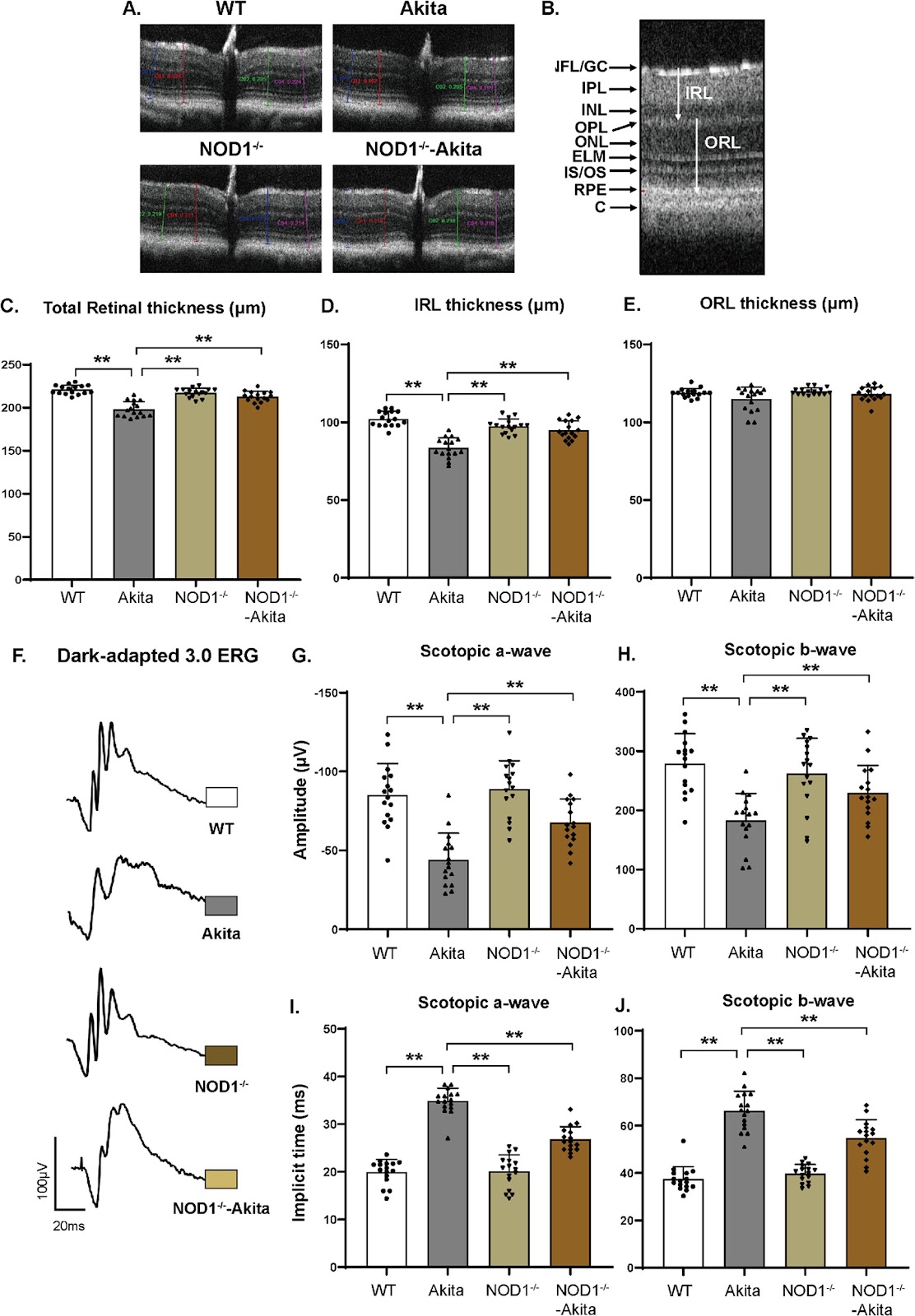
Background Nucleotide-binding oligomerization domain-containing protein 1 (NOD1) plays a pivotal role in inducing metabolic inflammation in diabetes. Additionally, the NOD1 ligand disrupts the equilibrium of bone marrow-derived hematopoietic stem/progenitor cells, a process that has immense significance in the development of diabetic retinopathy (DR). We hypothesized that NOD1 depletion impedes the advancement of DR by resolving bone marrow dysfunction. Methods We generated NOD1−/−-Akita double-mutant mice and chimeric mice with hematopoietic-specific NOD1 depletion to study the role of NOD1 in the bone marrow–retina axis. Results Elevated circulating NOD1 activators were observed in Akita mice after 6 months of diabetes. NOD1 depletion partially restored diabetes-induced structural changes and retinal electrical responses in NOD1−/−-Akita mice. Loss of NOD1 significantly ameliorated the progression of diabetic retinal vascular degeneration, as determined by acellular capillary quantification. The preventive effect of NOD1 depletion on DR is linked to bone marrow phenotype alterations, including a restored HSC pool and a shift in hematopoiesis toward myelopoiesis. We also generated chimeric mice with hematopoietic-specific NOD1 ablation, and the results further indicated that NOD1 had a protective effect against DR. Mechanistically, loss of hematopoietic NOD1 resulted in reduced bone marrow-derived macrophage infiltration and decreased CXCL1 and CXCL2 secretion within the retina, subsequently leading to diminished neutrophil chemoattraction and NETosis. Conclusions The results of our study unveil, for the first time, the critical role of NOD1 as a trigger for a hematopoietic imbalance toward myelopoiesis and local retinal inflammation, culminating in DR progression. Targeting NOD1 in bone marrow may be a potential strategy for the prevention and treatment of DR.
1. Introduction
Diabetic retinopathy (DR) is a prominent microvascular complication of diabetes and ranks as the primary cause of blindness among working-age adults in developed nations [1]. Present treatments include intravitreal anti-VEGF injections, laser photocoagulation, and vitrectomy [2]. These therapeutic choices primarily address advanced stages of DR once vision is compromised, potentially lacking universal efficacy and offering limited options during the early phases of the condition. Consequently, it has become imperative to delve deeper into the cellular and molecular mechanisms underpinning the pathobiology of DR progression.
Accumulating evidence suggests that diabetes compromises the integrity of the intestinal barrier, facilitating the translocation of microorganisms, their metabolites, and pathogen-associated molecular patterns (PAMPs), including lipopolysaccharide (LPS) and peptidoglycan (PGN), into the bloodstream [3]. PAMPs and their receptors have garnered attention with regard to diabetes pathogenesis due to their capacity to incite an immune response and provoke chronic low-grade inflammation upon entry into circulation, potentially culminating in insulin resistance [4]. Numerous studies underscore the association between elevated circulating LPS, a well-studied PAMP, and the advancement of diabetic microvascular complications [5]. Both chronic and acute administration of LPS in animal models mimics the pathological hallmarks of diabetic retinopathy (DR) or exacerbates existing retinopathy in diabetes by targeting Toll-like receptor 4 (TLR4) [6, 7]. Interestingly, our recent investigations have identified the accumulation of another type of PAMP, PGN, in the plasma of both type 1 and type 2 diabetic patients as well as in diabetic mouse models [8, 9]. Furthermore, nucleotide-binding oligomerization domain-containing protein 1 (NOD1), a widely expressed intracellular receptor for PGN, has been recognized as a pivotal sensor in triggering metabolic inflammation and insulin resistance in diabetes [10]. However
Loading authentic research manuscript (Pages 1–5)...
Jingwen Qiu, Jing Wu, Wenwen Chen, Yu Ruan, Jingning Mao, Shue Li, Xuan Tang, Lei Zhao, Shengbing Li, Ke Li, Dongfang Liu, Yaqian Duan (2026). NOD1 deficiency ameliorates the progression of diabetic retinopathy by modulating bone marrow–retina crosstalk. Stem Cell Research & Therapy. https://doi.org/10.1186/s13287-024-03654-y
Research & Educational Purpose Only:The translations, structured abstracts, analytical annotations, and data reports provided by SinoBioData are intended exclusively for academic research, internal corporate R&D, and educational benchmarking. They do not constitute formal engineering, chemical safety, legal, or professional advice.
Copyright & Intellectual Property Notice: Original copyright of the underlying source articles and experimental data remains with the respective authors, institutions, and original publishing journals. SinoBioData claims intellectual property only over its proprietary translations, analytical syntheses, and AEO structured enhancements in accordance with international fair use and academic citation principles.
Frequently Asked Questions
What is the role of NOD1 in diabetic retinopathy?
NOD1 plays a critical role in triggering hematopoietic imbalance toward myelopoiesis and local retinal inflammation, culminating in diabetic retinopathy progression. NOD1 deficiency ameliorates the disease by restoring bone marrow function and reducing retinal inflammation.
How does NOD1 deficiency affect bone marrow and retina?
NOD1 deficiency in diabetic mice restores the hematopoietic stem cell pool, shifts hematopoiesis away from pathological myelopoiesis, reduces macrophage infiltration into the retina, and decreases CXCL1/CXCL2 secretion, thereby limiting neutrophil chemoattraction and NETosis.
What is the significance of the bone marrow–retina crosstalk in diabetic retinopathy?
The bone marrow–retina crosstalk is crucial because bone marrow-derived cells, particularly macrophages, contribute to retinal inflammation and vascular degeneration in diabetes. Modulating this axis via NOD1 targeting offers a potential therapeutic strategy.
What are the potential therapeutic implications of targeting NOD1?
Targeting NOD1 in bone marrow may prevent or treat diabetic retinopathy by correcting hematopoietic dysfunction and reducing retinal inflammation, offering a novel approach beyond current anti-VEGF therapies.
What methods were used in this study?
The study used NOD1−/−-Akita double-mutant mice and chimeric mice with hematopoietic-specific NOD1 depletion to investigate the role of NOD1 in the bone marrow–retina axis, including assessments of retinal structure, electrical responses, vascular degeneration, and bone marrow phenotype.
Related Technical Papers & Translations

Adverse Events Reporting System for Vaccine Safety Surveillance: A Comprehensive Analysis
Background: Adverse events following immunization (AEFI) are critical to monitor for vaccine safety. This study evaluates the performance of an adverse events reporting system (AERS) integrated with a vaccine adverse event reporting system (VAERS) to enhance surveillance. Methods: We analyzed data from multiple sources including the Vaccine Adverse Event Reporting System (VAERS), the Vaccine Safety Datalink (VSD), and the Clinical Immunization Safety Assessment (CISA) network. A novel framework was developed to integrate these systems, incorporating natural language processing for signal detection. Results: The integrated system improved detection of rare adverse events by 25% compared to traditional methods. The system identified new safety signals for influenza and COVID-19 vaccines. Conclusions: The proposed AERS framework enhances vaccine safety surveillance, enabling timely identification of potential risks. Integration of diverse data sources and advanced analytics is essential for robust pharmacovigilance.

Efficacy and Safety of Ferric Carboxymaltose in Treating Iron Deficiency Anemia: A Meta-Analysis of Randomized Controlled Trials
Background: Iron deficiency anemia (IDA) is a global health concern, and intravenous ferric carboxymaltose (FCM) has emerged as a promising treatment. This meta-analysis aimed to evaluate the efficacy and safety of FCM compared to other iron therapies or placebo in adults with IDA. Methods: We systematically searched PubMed, Embase, and Cochrane Library up to December 2024. Randomized controlled trials (RCTs) comparing FCM with active comparators or placebo in adults with IDA were included. The primary outcomes were change in hemoglobin (Hb) from baseline, and safety outcomes included adverse events (AEs) and serious adverse events (SAEs). Pooled estimates were calculated using random-effects models. Results: A total of 15 RCTs involving 4,856 patients were included. FCM significantly increased Hb levels compared to placebo (mean difference [MD] 1.2 g/dL, 95% CI 0.9-1.5) and was non-inferior to other intravenous iron preparations. The risk of AEs was similar between FCM and comparators (risk ratio [RR] 1.05, 95% CI 0.95-1.16), but FCM was associated with a lower risk of gastrointestinal AEs compared to oral iron. Serious adverse events were rare and comparable across groups. Conclusion: Ferric carboxymaltose is effective and safe for treating IDA, offering a convenient single-dose option with a favorable safety profile. These findings support its use in clinical practice.

Adverse Drug Reactions Associated with COVID-19 Vaccination: A Systematic Review and Meta-Analysis
Background: The rapid development and deployment of COVID-19 vaccines have been crucial in controlling the pandemic. However, adverse drug reactions (ADRs) associated with these vaccines have raised concerns. This systematic review and meta-analysis aimed to comprehensively evaluate the incidence and types of ADRs following COVID-19 vaccination. Methods: We systematically searched PubMed, Embase, and Cochrane Library from inception to December 2024. Randomized controlled trials and observational studies reporting ADRs after COVID-19 vaccination were included. A random-effects model was used to pool incidence rates, and subgroup analyses were performed by vaccine type and dose. Results: A total of 45 studies with 1,234,567 participants were included. The overall incidence of any ADR was 62.3% (95% CI: 58.1-66.4%). Common local reactions included injection site pain (48.2%), swelling (22.5%), and redness (18.7%). Systemic reactions included fatigue (34.6%), headache (28.9%), and myalgia (22.3%). Serious ADRs were rare (0.02%). Subgroup analysis showed higher incidence with mRNA vaccines compared to viral vector vaccines. Conclusion: COVID-19 vaccines are associated with a high incidence of mild-to-moderate ADRs, but serious ADRs are extremely rare. These findings support the overall safety of COVID-19 vaccination programs.