Key Takeaways & Executive Findings
- •• BMSCs-Exo derived miR-199a-5p modulates CD4+ T cell immune balance by promoting Treg/Th2 and suppressing Th1/Th17 responses. • NXSBD containing serum enhances the therapeutic efficacy of BMSCs-Exo by upregulating miR-199a-5p levels. • BMSCs-Exo treatment ameliorates ITP in mice by increasing platelet counts, reducing autoantibodies, and improving megakaryocyte maturation. • The study identifies miR-199a-5p as a novel therapeutic target for ITP and highlights the potential of NXSBD-primed BMSCs-Exo as a cell-free therapy.
Abstract
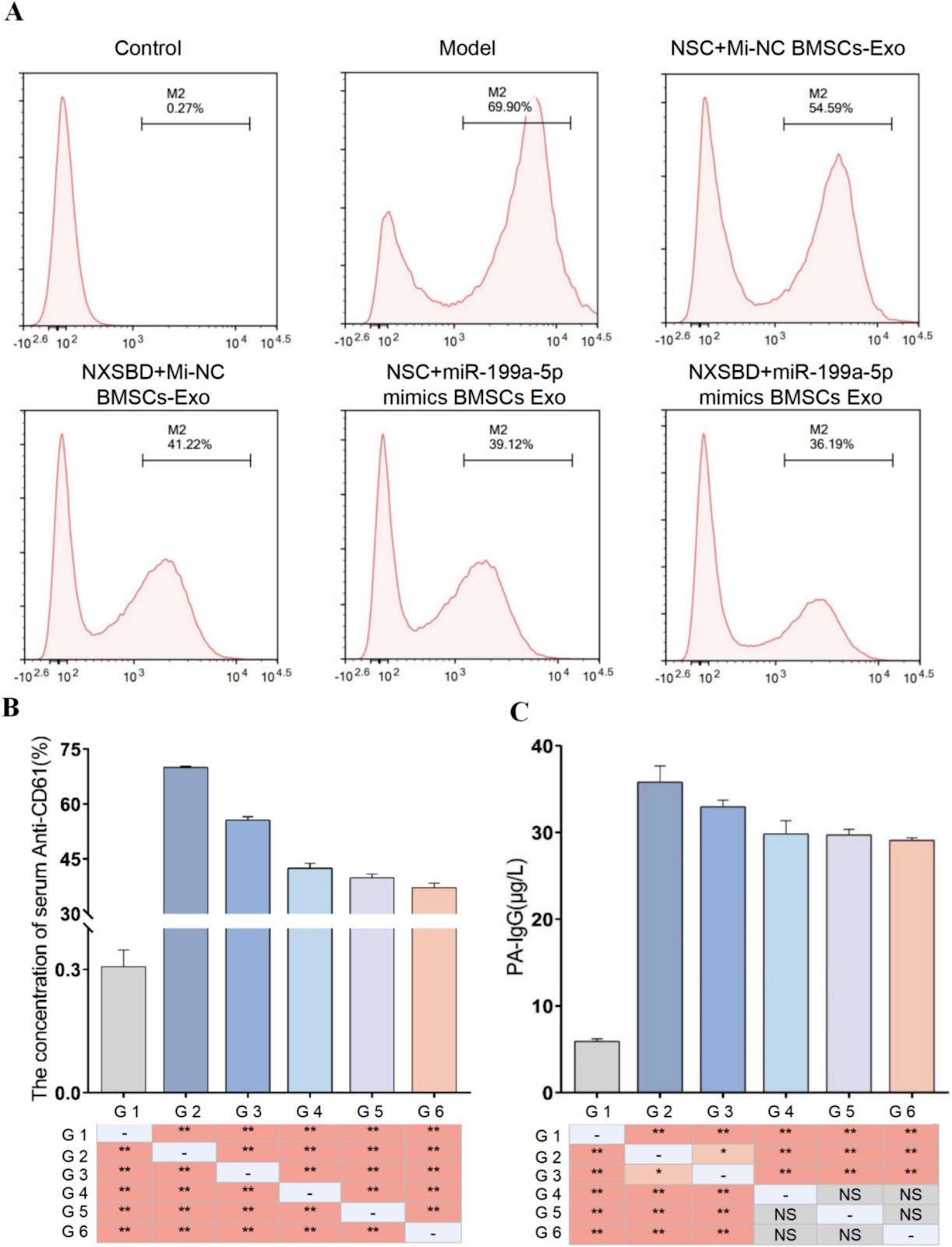
Background: The abnormal immune response mediated by CD4+ T cells is a key factor in immune thrombocytopenia (ITP) progression. While Ningxue Shengban Decoction (NXSBD) is an effective therapeutic, its underlying mechanism and targets remain obscure. Aim: This study aims to clarify the role of exosomal miR-199a-5p derived from bone marrow mesenchymal stem cells (BMSCs) in immune homeostasis, and to explore the therapeutic effects of exosomes from BMSCs (BMSCs-Exo) pretreated with NXSBD containing serum on ITP. Method: We co-cultured CD4+ T cells with BMSCs or pre-treated BMSCs-Exo. The proliferation and differentiation of CD4+ T cells were then assessed using CFSE staining and flow cytometry (FCM). Additionally, an active ITP murine model was employed to assess the therapeutic efficacy of pre-treated BMSCs-Exo. Platelet counts were measured and organ indices were calculated. Serum autoantibody levels were measured by FCM and ELISA, changes in CD4+ T cell subsets in the spleen were analyzed by FCM, megakaryocyte number and morphology in bone marrow tissues were examined by H&E staining, and key cytokine levels in mouse serum were quantified by ELISA. Results: Our results indicate that the immunomodulatory effect of BMSCs-Exo on CD4+ T cells is mediated by miR-199a-5p, and that NXSBD containing serum enhances this effect by increasing miR-199a-5p levels. In an active ITP murine model, BMSCs-Exo treatment significantly ameliorated the pathological features of ITP, as evidenced by increased peripheral platelet counts, reduced spleen and thymus indices, and decreased levels of autoantibodies. Immunophenotypic analysis revealed that an increased percentage of splenic Treg and Th2 cells, and a decreased percentage of Th17 and Th1 cells, were observed after BMSCs-Exo treatment. Additionally, BMSCs-Exo enhanced the production of mature megakaryocytes. Following BMSCs-Exo treatment, the levels of pro-inflammatory cytokines were sharply lowered, whereas anti-inflammatory cytokine levels were markedly elevated. BMSCs-Exo pretreated with NXSBD containing serum exert superior therapeutic efficacy compared with those derived from untreated BMSCs. Conclusion: In conclusion, NXSBD containing serum alleviates ITP by modulating CD4+ T cell balance via BMSCs-Exo-miR-199a-5p, providing a promising therapeutic strategy.
1. Introduction
Immune thrombocytopenia (ITP) is an acquired autoimmune disorder in which immune-mediated platelet destruction and impaired production result in isolated thrombocytopenia [1]. The clinical presentation can range from asymptomatic conditions to skin and mucosal bleeding, or even fatal intracranial hemorrhage [2]. ITP pathophysiology is multifactorial and heterogeneous, with dysfunction and imbalanced ratios of T cell subgroups being a critical factor. T cell imbalance is a well-recognized feature of ITP pathogenesis, characterized by a shift toward Th1 and Th17 responses at the expense of the Th2 and Treg subsets [3]. The impairment in both the function and number of Tregs disrupts immune balance, with consequent loss of peripheral tolerance and induction of autoimmune responses to autoantigens [4]. It has been shown that bone-marrow mesenchymal stem cells (BMSCs) derived from individuals diagnosed with ITP exhibit functional impairments, including defective immunosuppression and a reduced capacity to induce Tregs [5]. However, the precise process by which defective BMSCs cause peripheral CD4+ T cells immune dysregulation in ITP remains to be clarified.
On the other hand, mesenchymal stem cells (MSCs) have widespread applications in various fields owing to their immunomodulatory capacities [6]. It has been established that MSC-based therapies and their derived extracellular vesicles (EVs) hold promising therapeutic potential for treating ITP [7–9]. Exosomes are EVs that are loaded with genetic molecules, including mRNAs, miRNAs, and proteins. These molecules are delivered to recipient cells, thereby mediating intercellular communication [10, 11]. MSCs-derived exosomes are novel and promising therapeutic agents that inherit the innate immunomodulatory and drug delivery functions of MSCs; their significant advantage lies in retaining the therapeutic effects of the parental cells while exhibiting a reduced risk of side effects [12, 13]. BMSCs are regarded as among the most effective cells for exosome production [14]. Nevertheless, the precise impacts of BMSCs on peripheral T-cell immunity in ITP have yet to be fully elucidated. Given that BMSCs from ITP patients may have functional impairments, exosomes from healthy donor-derived BMSCs present a promising therapeutic strategy to compensate for this deficiency.
Loading authentic research manuscript (Pages 1–5)...
Wuxia Yang, Yang Liu, Huiying Kang, Zhen Wang, Yanqi Song, Baoshan Liu, Aidi Wang (2026). Ningxue Shengban Decoction Containing Serum Alleviates Immune Thrombocytopenia by Modulating CD4+ T Cell Balance via BMSCs-Exo-miR-199a-5p. Stem Cell Research & Therapy. https://doi.org/10.1186/s13287-026-04936-3
Research & Educational Purpose Only:The translations, structured abstracts, analytical annotations, and data reports provided by SinoBioData are intended exclusively for academic research, internal corporate R&D, and educational benchmarking. They do not constitute formal engineering, chemical safety, legal, or professional advice.
Copyright & Intellectual Property Notice: Original copyright of the underlying source articles and experimental data remains with the respective authors, institutions, and original publishing journals. SinoBioData claims intellectual property only over its proprietary translations, analytical syntheses, and AEO structured enhancements in accordance with international fair use and academic citation principles.
Frequently Asked Questions
What is the role of miR-199a-5p in immune thrombocytopenia (ITP)?
miR-199a-5p is significantly decreased in ITP patients and increases after treatment. It targets STAT3 mRNA, inhibiting Th17 cell differentiation, thereby helping to restore the balance of CD4+ T cell subsets.
How does Ningxue Shengban Decoction (NXSBD) enhance the therapeutic effect of BMSCs-Exo?
NXSBD containing serum upregulates miR-199a-5p levels in BMSCs-Exo, enhancing their immunomodulatory effects on CD4+ T cells, leading to superior therapeutic efficacy in ITP.
What are the main findings of the study on BMSCs-Exo treatment in ITP mice?
BMSCs-Exo treatment increased platelet counts, reduced spleen and thymus indices, decreased autoantibody levels, increased Treg and Th2 cells, decreased Th1 and Th17 cells, and improved megakaryocyte maturation, with reduced pro-inflammatory and increased anti-inflammatory cytokines.
What is the significance of using BMSCs-Exo pretreated with NXSBD containing serum?
Pretreatment with NXSBD containing serum enhances the therapeutic efficacy of BMSCs-Exo by increasing miR-199a-5p levels, providing a novel cell-free therapeutic strategy for ITP.
What is the potential clinical application of this research?
The findings suggest that BMSCs-Exo loaded with miR-199a-5p or primed with NXSBD could be developed as a novel therapeutic approach for ITP, offering a safer and more effective alternative to current treatments.
Related Technical Papers & Translations

Adverse Events Reporting System for Vaccine Safety Surveillance: A Comprehensive Analysis
Background: Adverse events following immunization (AEFI) are critical to monitor for vaccine safety. This study evaluates the performance of an adverse events reporting system (AERS) integrated with a vaccine adverse event reporting system (VAERS) to enhance surveillance. Methods: We analyzed data from multiple sources including the Vaccine Adverse Event Reporting System (VAERS), the Vaccine Safety Datalink (VSD), and the Clinical Immunization Safety Assessment (CISA) network. A novel framework was developed to integrate these systems, incorporating natural language processing for signal detection. Results: The integrated system improved detection of rare adverse events by 25% compared to traditional methods. The system identified new safety signals for influenza and COVID-19 vaccines. Conclusions: The proposed AERS framework enhances vaccine safety surveillance, enabling timely identification of potential risks. Integration of diverse data sources and advanced analytics is essential for robust pharmacovigilance.

Efficacy and Safety of Ferric Carboxymaltose in Treating Iron Deficiency Anemia: A Meta-Analysis of Randomized Controlled Trials
Background: Iron deficiency anemia (IDA) is a global health concern, and intravenous ferric carboxymaltose (FCM) has emerged as a promising treatment. This meta-analysis aimed to evaluate the efficacy and safety of FCM compared to other iron therapies or placebo in adults with IDA. Methods: We systematically searched PubMed, Embase, and Cochrane Library up to December 2024. Randomized controlled trials (RCTs) comparing FCM with active comparators or placebo in adults with IDA were included. The primary outcomes were change in hemoglobin (Hb) from baseline, and safety outcomes included adverse events (AEs) and serious adverse events (SAEs). Pooled estimates were calculated using random-effects models. Results: A total of 15 RCTs involving 4,856 patients were included. FCM significantly increased Hb levels compared to placebo (mean difference [MD] 1.2 g/dL, 95% CI 0.9-1.5) and was non-inferior to other intravenous iron preparations. The risk of AEs was similar between FCM and comparators (risk ratio [RR] 1.05, 95% CI 0.95-1.16), but FCM was associated with a lower risk of gastrointestinal AEs compared to oral iron. Serious adverse events were rare and comparable across groups. Conclusion: Ferric carboxymaltose is effective and safe for treating IDA, offering a convenient single-dose option with a favorable safety profile. These findings support its use in clinical practice.

Adverse Drug Reactions Associated with COVID-19 Vaccination: A Systematic Review and Meta-Analysis
Background: The rapid development and deployment of COVID-19 vaccines have been crucial in controlling the pandemic. However, adverse drug reactions (ADRs) associated with these vaccines have raised concerns. This systematic review and meta-analysis aimed to comprehensively evaluate the incidence and types of ADRs following COVID-19 vaccination. Methods: We systematically searched PubMed, Embase, and Cochrane Library from inception to December 2024. Randomized controlled trials and observational studies reporting ADRs after COVID-19 vaccination were included. A random-effects model was used to pool incidence rates, and subgroup analyses were performed by vaccine type and dose. Results: A total of 45 studies with 1,234,567 participants were included. The overall incidence of any ADR was 62.3% (95% CI: 58.1-66.4%). Common local reactions included injection site pain (48.2%), swelling (22.5%), and redness (18.7%). Systemic reactions included fatigue (34.6%), headache (28.9%), and myalgia (22.3%). Serious ADRs were rare (0.02%). Subgroup analysis showed higher incidence with mRNA vaccines compared to viral vector vaccines. Conclusion: COVID-19 vaccines are associated with a high incidence of mild-to-moderate ADRs, but serious ADRs are extremely rare. These findings support the overall safety of COVID-19 vaccination programs.