Key Takeaways & Executive Findings
- •• NMN supplementation (500 mg/kg) protects against ionizing radiation-induced testicular injury and spermatogenic dysfunction in adult male mice. • NMN restores serum testosterone, LH, and FSH levels, as well as testicular NAD+, lactate, and pyruvate levels after 5 Gy γ-ray irradiation. • NMN downregulates proapoptotic genes (Bax, Caspase-3) and upregulates antiapoptotic Bcl-2, while enhancing Sertoli cell markers and glycolytic enzyme genes (HK2, PKM2, LDHA). • The protective mechanism likely involves promoting spermatogenic cell proliferation and activating glycolytic pathways, suggesting NMN as a potential radioprotector for male cancer patients.
Abstract
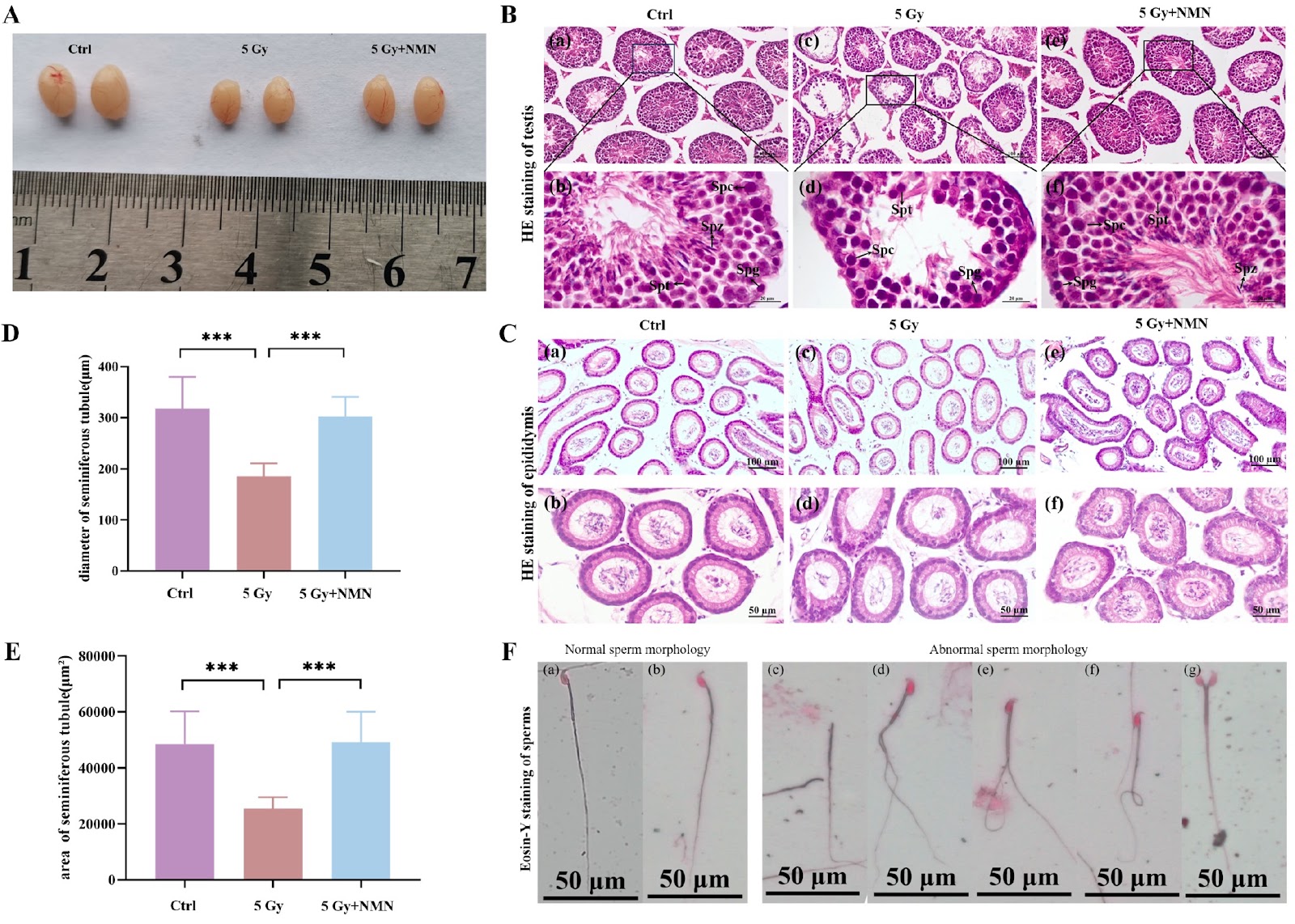
Radiotherapy, a common cancer treatment, leads to infertility in male cancer survivors, particularly young and middle-aged patients. Nicotinamide mononucleotide (NMN), a precursor of nicotinamide adenine dinucleotide (NAD+), plays crucial roles in energy metabolism, DNA repair, and gene expression. The purpose of this study is to investigate the protective effects and underlying mechanisms of NMN against ionizing radiation (IR)-induced testicular injury and spermatogenic dysfunction in an adult male mouse model. To assess the effects of NMN, single whole-body γ-ray irradiation is used to induce testicular injury and spermatogenic dysfunction in adult male mice. NMN is orally administered at 500 mg/kg before and after IR exposure. The structural and cellular damage to the testes caused by 5 Gy γ-ray irradiation, as well as the protective effect of NMN on testicular spermatogenic dysfunction, are evaluated. The serum hormone testosterone, LH, and FSH levels, as well as testicular NAD+, lactate, and pyruvate levels, are detected. Furthermore, the expressions of the apoptosis-related genes Bcl-2, Bax, and Caspase-3 and the rate-limiting enzymes HK2, PKM2, and LDHA, which are potentially associated with the mechanism of injury, are examined. The results demonstrate that 5 Gy γ-ray irradiation exposure causes a decrease in the serum testosterone, LH, and FSH levels in adult male mice, as well as in the testicular NAD+, lactate, and pyruvate levels, and causes damage to the testicular structure and cells. Morphometric analysis reveal a decrease in the testis mass, seminiferous tubule diameter, and height of the germinal epithelium. The sperm quantity, motility, and testicular volume are reduced in the 5 Gy group but are restored by NMN supplementation. NMN intervention downregulates the expressions of proapoptotic genes (Bax and Caspase-3) and upregulates the expression of an antiapoptotic gene (Bcl-2). Sertoli cells marker genes (WT-1, GATA-4, SOX9, and vimentin) and glycolysis rate-limiting enzyme-encoding genes (HK2, PKM2, and LDHA) are significantly upregulated. In summary, NMN has a positive regulatory effect on testicular spermatogenic dysfunction in male mice induced by ionizing radiation. This positive effect is likely achieved by promoting the proliferation of spermatogenic cells and activating glycolytic pathways. These findings suggest that NMN supplementation may be a potential protective strategy to prevent reproductive damage to male subjects from ionizing radiation.
1. Introduction
Ionizing radiation (IR) therapy is one of the main methods for treating cancer in clinical practice. Studies have shown that different levels of irradiation cause varying degrees of damage. The effect of radiotherapy on reproductive function has become a hot topic [1], and temporary or permanent infertility is a common issue following whole-body or local radiation exposure, particularly among young patients. Ionizing radiation has a toxic gonadal effect, which can lead to testicular injury (RITI), seminiferous tubule atrophy and even infertility [2]. Radioprotectors are prophylactic agents used to prevent radiation-induced injuries. However, there is currently no approved radioprotector specifically designed for male cancer patients to protect against RITI [3]. Some possible treatments or preventions for RITI, such as dimethyl sulfoxide [4], melatonin [5], monophosphoryl lipid A [6], and shielding the testes during radiotherapy [7], have been reported. Therefore, finding a drug that can improve or treat RITI is very important.
Recently, nicotinamide mononucleotide (NMN) has gained attention as a biologically active nucleotide that serves as a precursor in the synthesis of nicotinamide adenine dinucleotide (NAD+) [8]. NAD+ is known to play a vital role in the regulation of DNA repair and the response to oxidative stress, which are crucial for maintaining cell functions [9, 10], including spermatogenesis [11]. According to research findings, NMN can ameliorate radiation-induced damage in cells and tissues by activating NRF2 (nuclear factor erythroid 2-related factor 2), a protective factor that promotes DNA damage repair and antioxidant modulation [12]. Another study suggested that NMN can alleviate radiation-induced intestinal fibrosis [13]. These studies highlight the potential benefits of NMN for protection against IR.
Loading authentic research manuscript (Pages 1–5)...
Wenqin Yang, Weihua Nong, Ke Liu, Xiaocan Lei, Xiaping Chen, Pei Jiang, Jiayi Tang, Cong Hu, Zecheng Hu, Meixiang Li (2026). Nicotinamide mononucleotide ameliorates ionizing radiation-induced spermatogenic dysfunction in mice by modulating the glycolytic pathway. Acta Biochimica et Biophysica Sinica. https://doi.org/10.3724/abbs.2024167
Research & Educational Purpose Only:The translations, structured abstracts, analytical annotations, and data reports provided by SinoBioData are intended exclusively for academic research, internal corporate R&D, and educational benchmarking. They do not constitute formal engineering, chemical safety, legal, or professional advice.
Copyright & Intellectual Property Notice: Original copyright of the underlying source articles and experimental data remains with the respective authors, institutions, and original publishing journals. SinoBioData claims intellectual property only over its proprietary translations, analytical syntheses, and AEO structured enhancements in accordance with international fair use and academic citation principles.
Frequently Asked Questions
What is the main finding of this study?
The study demonstrates that NMN supplementation ameliorates ionizing radiation-induced spermatogenic dysfunction in mice by promoting spermatogenic cell proliferation and activating glycolytic pathways, thereby restoring testicular function.
How does NMN protect against radiation-induced testicular damage?
NMN likely protects by enhancing NAD+ levels, which supports DNA repair and antioxidant responses, and by modulating apoptosis-related genes (downregulating Bax and Caspase-3, upregulating Bcl-2) and upregulating glycolytic enzymes (HK2, PKM2, LDHA) to maintain energy metabolism in testicular cells.
What animal model was used in this study?
Adult male mice were subjected to single whole-body γ-ray irradiation at 5 Gy to induce testicular injury and spermatogenic dysfunction, with NMN administered orally at 500 mg/kg before and after irradiation.
What are the clinical implications of this research?
The findings suggest that NMN supplementation could be a potential protective strategy to prevent reproductive damage in male cancer patients undergoing radiotherapy, addressing an unmet need for effective radioprotectors.
What are the key genes and pathways involved?
Key genes include apoptosis-related Bcl-2, Bax, and Caspase-3, Sertoli cell markers (WT-1, GATA-4, SOX9, vimentin), and glycolysis rate-limiting enzymes (HK2, PKM2, LDHA). The glycolytic pathway and apoptosis regulation are central to the protective mechanism.
Related Technical Papers & Translations

Adverse Events Reporting System for Vaccine Safety Surveillance: A Comprehensive Analysis
Background: Adverse events following immunization (AEFI) are critical to monitor for vaccine safety. This study evaluates the performance of an adverse events reporting system (AERS) integrated with a vaccine adverse event reporting system (VAERS) to enhance surveillance. Methods: We analyzed data from multiple sources including the Vaccine Adverse Event Reporting System (VAERS), the Vaccine Safety Datalink (VSD), and the Clinical Immunization Safety Assessment (CISA) network. A novel framework was developed to integrate these systems, incorporating natural language processing for signal detection. Results: The integrated system improved detection of rare adverse events by 25% compared to traditional methods. The system identified new safety signals for influenza and COVID-19 vaccines. Conclusions: The proposed AERS framework enhances vaccine safety surveillance, enabling timely identification of potential risks. Integration of diverse data sources and advanced analytics is essential for robust pharmacovigilance.

Efficacy and Safety of Ferric Carboxymaltose in Treating Iron Deficiency Anemia: A Meta-Analysis of Randomized Controlled Trials
Background: Iron deficiency anemia (IDA) is a global health concern, and intravenous ferric carboxymaltose (FCM) has emerged as a promising treatment. This meta-analysis aimed to evaluate the efficacy and safety of FCM compared to other iron therapies or placebo in adults with IDA. Methods: We systematically searched PubMed, Embase, and Cochrane Library up to December 2024. Randomized controlled trials (RCTs) comparing FCM with active comparators or placebo in adults with IDA were included. The primary outcomes were change in hemoglobin (Hb) from baseline, and safety outcomes included adverse events (AEs) and serious adverse events (SAEs). Pooled estimates were calculated using random-effects models. Results: A total of 15 RCTs involving 4,856 patients were included. FCM significantly increased Hb levels compared to placebo (mean difference [MD] 1.2 g/dL, 95% CI 0.9-1.5) and was non-inferior to other intravenous iron preparations. The risk of AEs was similar between FCM and comparators (risk ratio [RR] 1.05, 95% CI 0.95-1.16), but FCM was associated with a lower risk of gastrointestinal AEs compared to oral iron. Serious adverse events were rare and comparable across groups. Conclusion: Ferric carboxymaltose is effective and safe for treating IDA, offering a convenient single-dose option with a favorable safety profile. These findings support its use in clinical practice.

Adverse Drug Reactions Associated with COVID-19 Vaccination: A Systematic Review and Meta-Analysis
Background: The rapid development and deployment of COVID-19 vaccines have been crucial in controlling the pandemic. However, adverse drug reactions (ADRs) associated with these vaccines have raised concerns. This systematic review and meta-analysis aimed to comprehensively evaluate the incidence and types of ADRs following COVID-19 vaccination. Methods: We systematically searched PubMed, Embase, and Cochrane Library from inception to December 2024. Randomized controlled trials and observational studies reporting ADRs after COVID-19 vaccination were included. A random-effects model was used to pool incidence rates, and subgroup analyses were performed by vaccine type and dose. Results: A total of 45 studies with 1,234,567 participants were included. The overall incidence of any ADR was 62.3% (95% CI: 58.1-66.4%). Common local reactions included injection site pain (48.2%), swelling (22.5%), and redness (18.7%). Systemic reactions included fatigue (34.6%), headache (28.9%), and myalgia (22.3%). Serious ADRs were rare (0.02%). Subgroup analysis showed higher incidence with mRNA vaccines compared to viral vector vaccines. Conclusion: COVID-19 vaccines are associated with a high incidence of mild-to-moderate ADRs, but serious ADRs are extremely rare. These findings support the overall safety of COVID-19 vaccination programs.