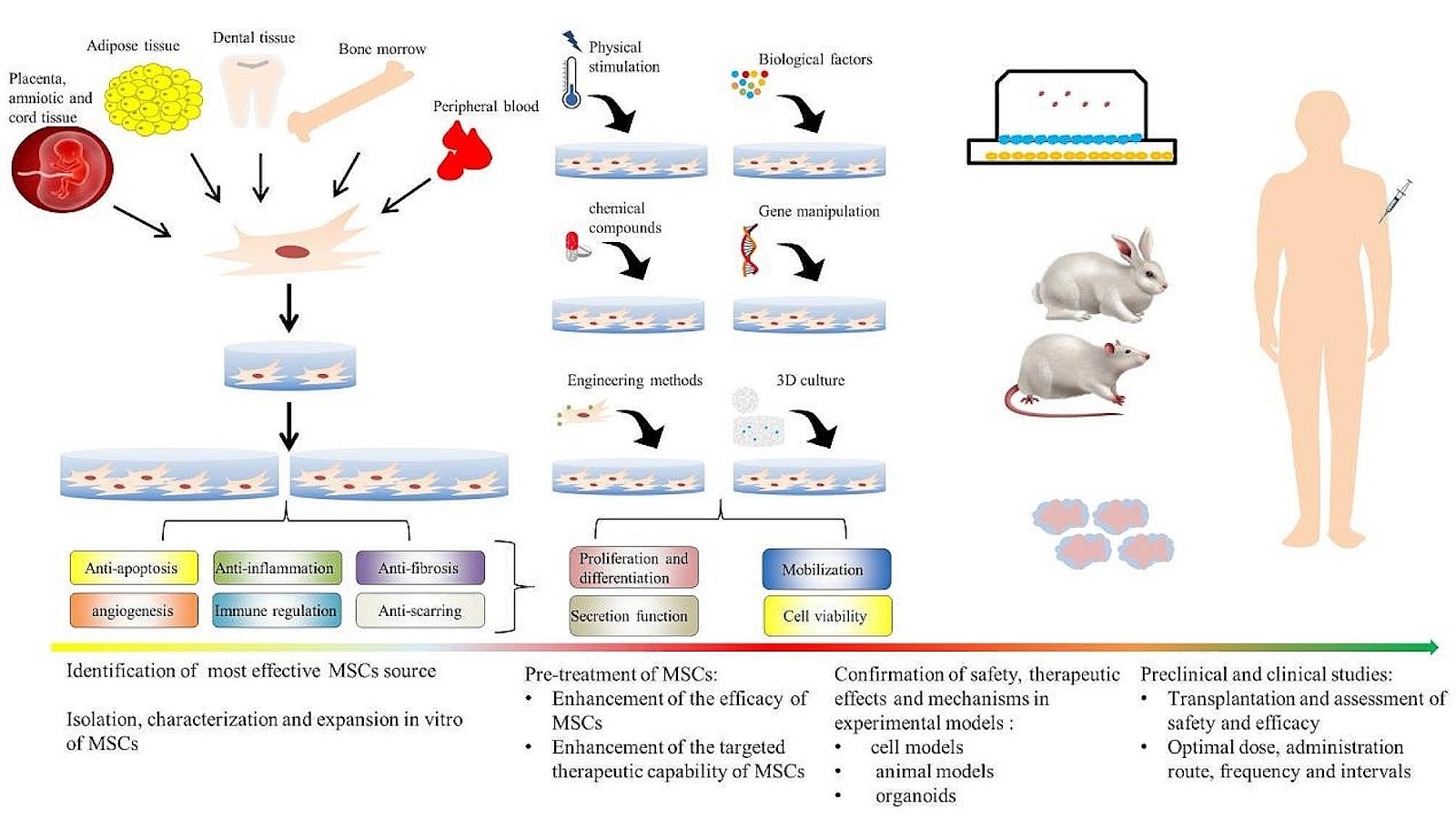
Key Takeaways & Executive Findings
- •• MSCs therapy holds promise for immunomodulation and tissue repair but is limited by poor infusion, survival, and engraftment. • Preconditioning MSCs with natural small molecule compounds (NSMs) enhances their therapeutic efficacy for organ injury repair. • NSMs regulate MSCs to improve repair in vital organs including heart, liver, kidney, and pancreas. • Future clinical translation requires addressing challenges in MSC preconditioning and standardization.
Abstract
Mesenchymal stem cells (MSCs) therapy is a highly researched treatment that has the potential to promote immunomodulation and anti-inflammatory, anti-apoptotic, and antimicrobial activities. It is thought that it can enhance internal organ function, reverse tissue remodeling, and achieve significant organ repair and regeneration. However, the limited infusion, survival, and engraftment of transplanted MSCs diminish the effectiveness of MSCs-based therapy. Consequently, various preconditioning methods have emerged as strategies for enhancing the therapeutic effects of MSCs and achieving better clinical outcomes. In particular, the use of natural small molecule compounds (NSMs) as a pretreatment strategy is discussed in this narrative review, with a focus on their roles in regulating MSCs for injury repair in vital internal organs. Additionally, the discussion focuses on the future directions and challenges of transforming mesenchymal stem cell research into clinical applications.
1. Introduction
The internal organs of the human body play a vital role in maintaining overall health and well-being. Injury to internal organs may lead to functional decline, loss and even life-threatening effects, so preventing injury to internal organs and promoting recovery and functional reconstruction are highly important for improving quality of life. Traditional treatment methods, such as drug therapy, surgery, intervention, laser treatment and radiotherapy, all have limitations, including inability to regenerate damaged tissues, potential complications and side effects.
With the continuous advancement of life science research, human understanding of stem cells has deepened gradually. Stem cell-related scientific research results have played an increasingly important role in disease treatment and regenerative medicine. Stem cell-mediated therapy is a promising alternative strategy with the potential to reduce side effects, regulate immune response and even promote tissue repair and regeneration. On the one hand, stem cells have significant applications in treating various diseases. Leukemic stem cells (LSCs) have attracted much attention in acute myeloblastic leukemia (AML) therapy in recent years [1]. And hematopoietic stem cells (HSCs) transplantation, for example, is a common method for treating leukemia and other blood disorders. Novel treatment strategies based on stem cells, such as using induced pluripotent stem cells (iPSCs) and gene editing techniques, are providing new possibilities for treating previously incurable diseases, such as leukemia and immune system diseases, but also extend organoid technology to accelerate the development of new drugs, help precision medicine, and even advance regenerative medicine for conditions like Alzheimer’s disease and aging organ repair [2–4]. Among these applications, MSCs are the most widely used. Commonly used MSCs include adipose mesenchymal stem cells (ADSCs), bone marrow mesenchymal stem cells (BMSCs) and umbilical cord mesenchymal stem cells (UCMSCs). They are characterized by their multipotential and immunomodulatory properties, which have attracted extensive attention due to their potential in tissue repair and regeneration. Nevertheless, the efficacy of MSCs transplantation in repairing internal organ injury can be limited by factors such as source availability, survival rate of MSCs as well as microenvironment influences on transplanted MSCs including inflammation, angiogenesis, cytokines, extracellular matrix components, cell-cell interactions, oxygen and nutrient availability, and metabolic environment. Moreover, preconditioning MSCs to enhance MSCs-related therapies is a promising strategy. In recent decades, various strategies have been studied to re...
Loading authentic research manuscript (Pages 1–5)...
Yanling Qu, Zhe Wang, Lingjuan Dong, Dan Zhang, Fengqing Shang, Afeng Li, Yanni Gao, Qinhua Bai, Dan Liu, Xiaodong Xie, Leiguo Ming (2026). Natural small molecules synergize mesenchymal stem cells for injury repair in vital organs: a comprehensive review. Stem Cell Research & Therapy. https://doi.org/10.1186/s13287-024-03856-4
Research & Educational Purpose Only:The translations, structured abstracts, analytical annotations, and data reports provided by SinoBioData are intended exclusively for academic research, internal corporate R&D, and educational benchmarking. They do not constitute formal engineering, chemical safety, legal, or professional advice.
Copyright & Intellectual Property Notice: Original copyright of the underlying source articles and experimental data remains with the respective authors, institutions, and original publishing journals. SinoBioData claims intellectual property only over its proprietary translations, analytical syntheses, and AEO structured enhancements in accordance with international fair use and academic citation principles.
Frequently Asked Questions
What are mesenchymal stem cells (MSCs) and why are they important for injury repair?
Mesenchymal stem cells (MSCs) are multipotent stromal cells with immunomodulatory and anti-inflammatory properties. They have potential to enhance internal organ function and promote tissue repair and regeneration, making them a promising therapy for various injuries.
What are the limitations of MSC-based therapy?
The main limitations include poor infusion, survival, and engraftment of transplanted MSCs, which reduce their therapeutic effectiveness. Factors such as source availability, microenvironment influences, and metabolic conditions also impact efficacy.
How do natural small molecule compounds (NSMs) enhance MSC therapy?
NSMs are used as a preconditioning strategy to regulate MSCs, improving their survival, engraftment, and therapeutic functions. This enhances their ability to repair injuries in vital organs like the heart, liver, kidney, and pancreas.
Which organs are targeted by NSM-preconditioned MSC therapy?
The review focuses on injury repair in vital internal organs, specifically the heart, liver, kidney, and pancreas.
What are the future directions and challenges for MSC clinical applications?
Future directions include optimizing preconditioning protocols, standardizing NSM treatments, and addressing challenges in translating MSC research into clinical practice, such as safety, efficacy, and regulatory issues.
Related Technical Papers & Translations

Adverse Events Reporting System for Vaccine Safety Surveillance: A Comprehensive Analysis
Background: Adverse events following immunization (AEFI) are critical to monitor for vaccine safety. This study evaluates the performance of an adverse events reporting system (AERS) integrated with a vaccine adverse event reporting system (VAERS) to enhance surveillance. Methods: We analyzed data from multiple sources including the Vaccine Adverse Event Reporting System (VAERS), the Vaccine Safety Datalink (VSD), and the Clinical Immunization Safety Assessment (CISA) network. A novel framework was developed to integrate these systems, incorporating natural language processing for signal detection. Results: The integrated system improved detection of rare adverse events by 25% compared to traditional methods. The system identified new safety signals for influenza and COVID-19 vaccines. Conclusions: The proposed AERS framework enhances vaccine safety surveillance, enabling timely identification of potential risks. Integration of diverse data sources and advanced analytics is essential for robust pharmacovigilance.

Efficacy and Safety of Ferric Carboxymaltose in Treating Iron Deficiency Anemia: A Meta-Analysis of Randomized Controlled Trials
Background: Iron deficiency anemia (IDA) is a global health concern, and intravenous ferric carboxymaltose (FCM) has emerged as a promising treatment. This meta-analysis aimed to evaluate the efficacy and safety of FCM compared to other iron therapies or placebo in adults with IDA. Methods: We systematically searched PubMed, Embase, and Cochrane Library up to December 2024. Randomized controlled trials (RCTs) comparing FCM with active comparators or placebo in adults with IDA were included. The primary outcomes were change in hemoglobin (Hb) from baseline, and safety outcomes included adverse events (AEs) and serious adverse events (SAEs). Pooled estimates were calculated using random-effects models. Results: A total of 15 RCTs involving 4,856 patients were included. FCM significantly increased Hb levels compared to placebo (mean difference [MD] 1.2 g/dL, 95% CI 0.9-1.5) and was non-inferior to other intravenous iron preparations. The risk of AEs was similar between FCM and comparators (risk ratio [RR] 1.05, 95% CI 0.95-1.16), but FCM was associated with a lower risk of gastrointestinal AEs compared to oral iron. Serious adverse events were rare and comparable across groups. Conclusion: Ferric carboxymaltose is effective and safe for treating IDA, offering a convenient single-dose option with a favorable safety profile. These findings support its use in clinical practice.

Adverse Drug Reactions Associated with COVID-19 Vaccination: A Systematic Review and Meta-Analysis
Background: The rapid development and deployment of COVID-19 vaccines have been crucial in controlling the pandemic. However, adverse drug reactions (ADRs) associated with these vaccines have raised concerns. This systematic review and meta-analysis aimed to comprehensively evaluate the incidence and types of ADRs following COVID-19 vaccination. Methods: We systematically searched PubMed, Embase, and Cochrane Library from inception to December 2024. Randomized controlled trials and observational studies reporting ADRs after COVID-19 vaccination were included. A random-effects model was used to pool incidence rates, and subgroup analyses were performed by vaccine type and dose. Results: A total of 45 studies with 1,234,567 participants were included. The overall incidence of any ADR was 62.3% (95% CI: 58.1-66.4%). Common local reactions included injection site pain (48.2%), swelling (22.5%), and redness (18.7%). Systemic reactions included fatigue (34.6%), headache (28.9%), and myalgia (22.3%). Serious ADRs were rare (0.02%). Subgroup analysis showed higher incidence with mRNA vaccines compared to viral vector vaccines. Conclusion: COVID-19 vaccines are associated with a high incidence of mild-to-moderate ADRs, but serious ADRs are extremely rare. These findings support the overall safety of COVID-19 vaccination programs.