Key Takeaways & Executive Findings
- •• UC-MSCs from different donors exhibit variable therapeutic efficacy in MI, correlating with their pro-angiogenic potential. • scRNA-seq identifies a specific N-CADHERIN+/CD168− subpopulation as the functional subset driving cardiac repair. • The ratio of N-CADHERIN+/CD168− cells positively correlates with angiogenic capacity, offering a screening criterion. • This subpopulation secretes key angiogenic factors (MYDGF, VEGFA, FGF2), providing a mechanistic basis for improved MSC therapy.
Abstract
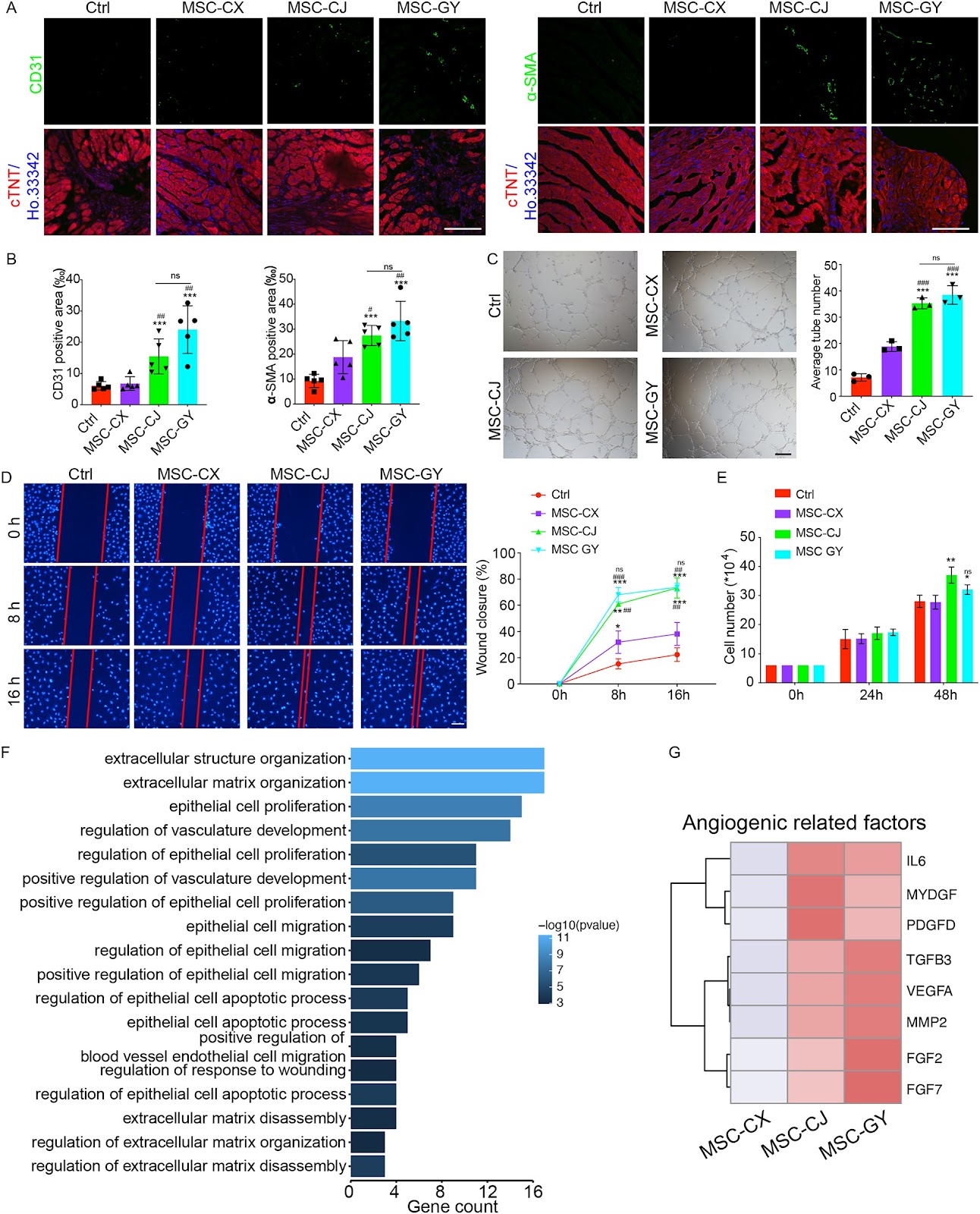
Background The efficiency of mesenchymal stem cells (MSCs) in treating myocardial infarction (MI) remains inconsistent, which limits their therapeutic applications. Therefore, exploring the mechanism for the inconsistent efficacy of MSCs and identification the criteria for screening MSCs are important for improving the efficiency of MSCs. Methods Mouse model after MI was utilized to test the role of MSCs from different donors and the functional subpopulation in improving cardiac function. Heterogeneity of MSCs was identified using single-cell RNA sequencing (scRNA-seq) of MSC-GY. GSEA and Scissor analyses were used to find the functional subpopulations of MSCs that promote angiogenesis. The role of functional subpopulations in promoting angiogenesis was verified by detecting the secretory proteins, the ratio of N-CADHERIN+/CD168− subpopulations in MSCs, and the tube formation, migration, and proliferation of HUVECs after treatment with conditional medium (CM) derived from different MSCs. Results We found that umbilical cord-derived MSCs (UC-MSCs) from different donors have varied therapeutic efficacy in MI mice and UC-MSCs with higher therapeutic effectiveness exhibited the most potent pro-angiogenic effects by secreting elevated levels of angiogenesis-related proteins, such as MYDGF, VEGFA, and FGF2. ScRNA-seq of 10,463 UC-MSCs revealed that the N-CADHERIN+/CD168− subpopulation was closely associated with pro-angiogenic effects, and the ratio of this cell subpopulation was positively correlated with the angiogenic potential of MSCs. We also found that the N-CADHERIN+/CD168− subpopulation was the functional subpopulation of MSCs in improving cardiac function of MI mice. Conclusions Our study identified that the N-CADHERIN+/CD168− subpopulation was the functional subpopulation of MSCs in treating MI, which was essential for the development and utilization of MSCs in MI treatment.
1. Introduction
Myocardial infarction (MI) involves extensive death of cardiomyocytes due to coronary artery occlusion, leading to impaired cardiac function and progressive heart failure [1]. The transplantation of mesenchymal stem cells (MSCs) has emerged as a promising therapeutic strategy for treating MI, attributed to their low immunogenicity and paracrine effects, as demonstrated in animal studies and clinical trials [2, 3]. Lee and Amado demonstrated that MSC transplantation significantly reduced myocardial injury and improved cardiac function in the infarcted hearts of mice and pigs, respectively [4, 5]. A meta-analysis by Lalu et al. of 23 clinical trials (involving 1,148 patients) confirmed that MSC application was safe and effective for treating MI [6]. Additionally, Chullikana et al. found that MSC transplantation improved ejection fraction and reduced adverse cardiac events in MI patients [7]. However, Nowbar et al. reported the limited effects of MSCs on improving left ventricular ejection fraction (LVEF) based on an analysis of clinical trial data from 1252 patients [8]. Thus, achieving consistent and effective MSC treatment for MI remains a critical challenge.
Single-cell RNA sequencing (scRNA-seq) enables characterization of gene expression at the single-cell level and resolves cellular heterogeneity of MSCs. MSCs have been reported to be a heterogeneous population, with different cellular subpopulations have varying biological properties [9–12]. Sacchetti and Zhou et al. found that CD146+ and LepR+ MSCs, highly expressed bone-related genes, exhibited significant osteogenic differentiation ability [13, 14]. Similarly, Arufe and Mifune et al. identified the CD271+ MSCs possessed high expression of cartilage-related genes and significant chondrogenic differentiation ability [15, 16]. Additionally, the CMKLR1+ MSCs have been reported to possess strong immunomodulatory and osteogenic capabilities [17]. Thus, understanding the heterogeneity of MSCs would be crucial for identifying MSC subpopulations suitable for treating specific diseases. However, it remains unclear whether specific MSC subpopulation could improve the treatment efficacy for MI.
Loading authentic research manuscript (Pages 1–5)...
Yukang Wu, Jianguo Li, Ke Feng, Ailing Tan, Yingying Gao, Wen Chen, Wenwen Jia, Xudong Guo, Jiuhong Kang (2026). N-CADHERIN+/CD168− subpopulation determines therapeutic variations of UC-MSCs for cardiac repair after myocardial infarction. Stem Cell Research & Therapy. https://doi.org/10.1186/s13287-024-04032-4
Research & Educational Purpose Only:The translations, structured abstracts, analytical annotations, and data reports provided by SinoBioData are intended exclusively for academic research, internal corporate R&D, and educational benchmarking. They do not constitute formal engineering, chemical safety, legal, or professional advice.
Copyright & Intellectual Property Notice: Original copyright of the underlying source articles and experimental data remains with the respective authors, institutions, and original publishing journals. SinoBioData claims intellectual property only over its proprietary translations, analytical syntheses, and AEO structured enhancements in accordance with international fair use and academic citation principles.
Frequently Asked Questions
What is the main finding of this study?
The study identifies a specific N-CADHERIN+/CD168− subpopulation of umbilical cord-derived mesenchymal stem cells (UC-MSCs) as the functional subset responsible for promoting angiogenesis and improving cardiac function after myocardial infarction.
How was the functional subpopulation identified?
Using single-cell RNA sequencing (scRNA-seq) of UC-MSCs, combined with GSEA and Scissor analyses, the researchers identified the N-CADHERIN+/CD168− subpopulation as closely associated with pro-angiogenic effects.
Why do UC-MSCs from different donors show varying therapeutic efficacy?
The variation is attributed to differences in the proportion of the N-CADHERIN+/CD168− subpopulation, which correlates with the angiogenic potential and secretion of key growth factors like MYDGF, VEGFA, and FGF2.
What are the clinical implications of this research?
The findings provide a potential screening criterion for selecting high-efficacy MSC batches for MI treatment, improving consistency and effectiveness of MSC-based therapies.
What methods were used to verify the role of the subpopulation?
The researchers assessed secretory protein levels, the ratio of N-CADHERIN+/CD168− cells, and performed functional assays including tube formation, migration, and proliferation of HUVECs treated with conditioned media from different MSCs.
Related Technical Papers & Translations

Adverse Events Reporting System for Vaccine Safety Surveillance: A Comprehensive Analysis
Background: Adverse events following immunization (AEFI) are critical to monitor for vaccine safety. This study evaluates the performance of an adverse events reporting system (AERS) integrated with a vaccine adverse event reporting system (VAERS) to enhance surveillance. Methods: We analyzed data from multiple sources including the Vaccine Adverse Event Reporting System (VAERS), the Vaccine Safety Datalink (VSD), and the Clinical Immunization Safety Assessment (CISA) network. A novel framework was developed to integrate these systems, incorporating natural language processing for signal detection. Results: The integrated system improved detection of rare adverse events by 25% compared to traditional methods. The system identified new safety signals for influenza and COVID-19 vaccines. Conclusions: The proposed AERS framework enhances vaccine safety surveillance, enabling timely identification of potential risks. Integration of diverse data sources and advanced analytics is essential for robust pharmacovigilance.

Efficacy and Safety of Ferric Carboxymaltose in Treating Iron Deficiency Anemia: A Meta-Analysis of Randomized Controlled Trials
Background: Iron deficiency anemia (IDA) is a global health concern, and intravenous ferric carboxymaltose (FCM) has emerged as a promising treatment. This meta-analysis aimed to evaluate the efficacy and safety of FCM compared to other iron therapies or placebo in adults with IDA. Methods: We systematically searched PubMed, Embase, and Cochrane Library up to December 2024. Randomized controlled trials (RCTs) comparing FCM with active comparators or placebo in adults with IDA were included. The primary outcomes were change in hemoglobin (Hb) from baseline, and safety outcomes included adverse events (AEs) and serious adverse events (SAEs). Pooled estimates were calculated using random-effects models. Results: A total of 15 RCTs involving 4,856 patients were included. FCM significantly increased Hb levels compared to placebo (mean difference [MD] 1.2 g/dL, 95% CI 0.9-1.5) and was non-inferior to other intravenous iron preparations. The risk of AEs was similar between FCM and comparators (risk ratio [RR] 1.05, 95% CI 0.95-1.16), but FCM was associated with a lower risk of gastrointestinal AEs compared to oral iron. Serious adverse events were rare and comparable across groups. Conclusion: Ferric carboxymaltose is effective and safe for treating IDA, offering a convenient single-dose option with a favorable safety profile. These findings support its use in clinical practice.

Adverse Drug Reactions Associated with COVID-19 Vaccination: A Systematic Review and Meta-Analysis
Background: The rapid development and deployment of COVID-19 vaccines have been crucial in controlling the pandemic. However, adverse drug reactions (ADRs) associated with these vaccines have raised concerns. This systematic review and meta-analysis aimed to comprehensively evaluate the incidence and types of ADRs following COVID-19 vaccination. Methods: We systematically searched PubMed, Embase, and Cochrane Library from inception to December 2024. Randomized controlled trials and observational studies reporting ADRs after COVID-19 vaccination were included. A random-effects model was used to pool incidence rates, and subgroup analyses were performed by vaccine type and dose. Results: A total of 45 studies with 1,234,567 participants were included. The overall incidence of any ADR was 62.3% (95% CI: 58.1-66.4%). Common local reactions included injection site pain (48.2%), swelling (22.5%), and redness (18.7%). Systemic reactions included fatigue (34.6%), headache (28.9%), and myalgia (22.3%). Serious ADRs were rare (0.02%). Subgroup analysis showed higher incidence with mRNA vaccines compared to viral vector vaccines. Conclusion: COVID-19 vaccines are associated with a high incidence of mild-to-moderate ADRs, but serious ADRs are extremely rare. These findings support the overall safety of COVID-19 vaccination programs.