Key Takeaways & Executive Findings
- •• SKL-MSCs significantly outperform unmodified MSCs in reducing EAE disease severity and slowing progression. • SKL-MSCs more effectively modulate neuroinflammation by decreasing pro-inflammatory cytokines (TNF-α, IFN-γ, IL-17) and increasing anti-inflammatory IL-10. • SKL-MSCs lead to a more pronounced reduction in blood–brain barrier permeability and downregulation of BBB-associated factors (ICAM-1, VCAM-1, MMP-9, CCL2) compared to MSCs. • The enhanced therapeutic efficacy of SKL-MSCs suggests a promising strategy for treating multiple sclerosis and other neuroinflammatory conditions.
Abstract
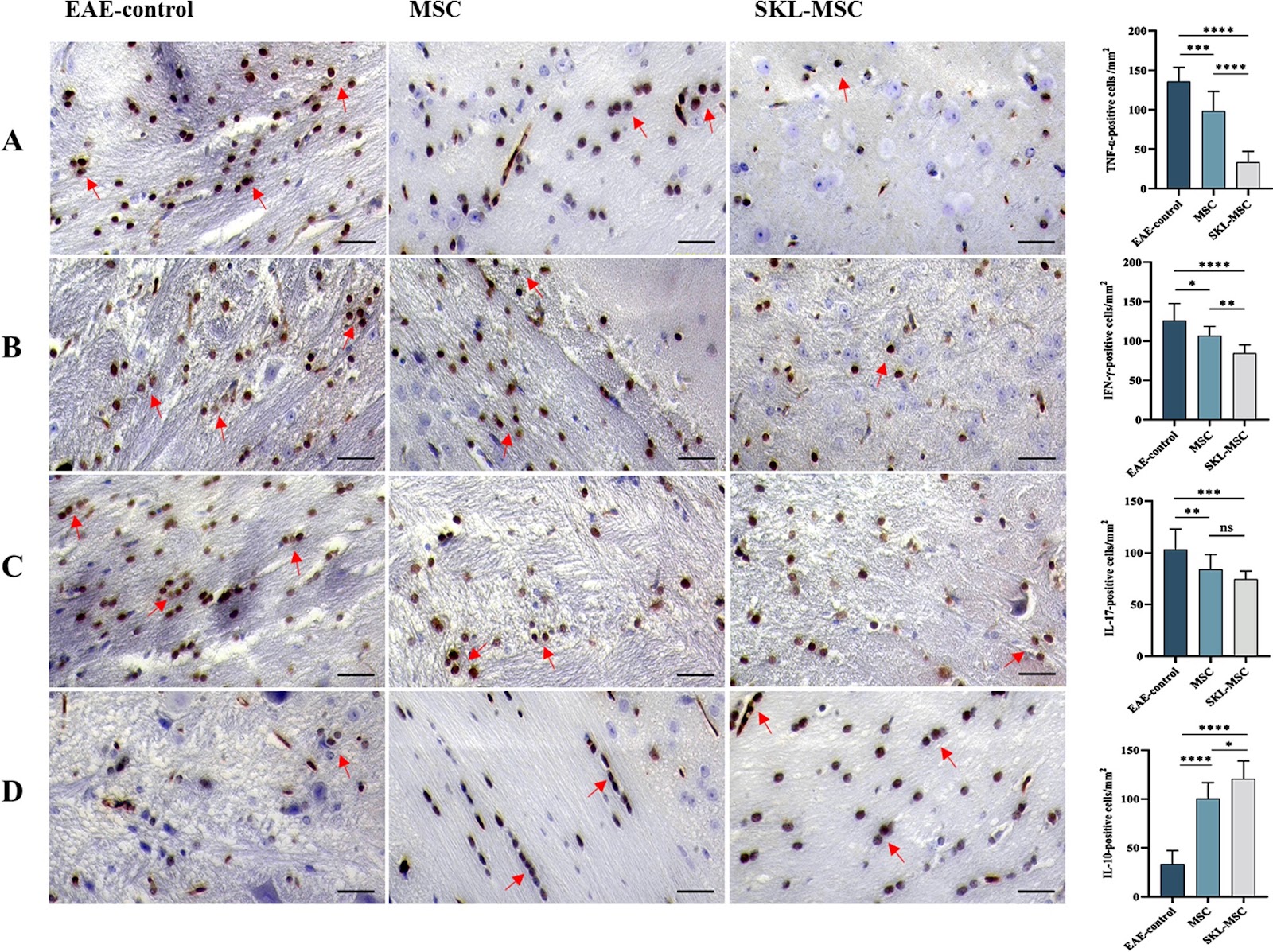
Background The anti-aging protein, Klotho, has been shown to exert neuroprotective effects in neurodegenerative disorders. This study was designed to evaluate the effects of MSCs engineered with secreted Klotho (SKL-MSCs) on neuroinflammation in experimental autoimmune encephalomyelitis (EAE) mouse model and to investigate underlying molecular mechanisms. Methods EAE was induced in female C57BL/6 mice, and animals were then randomized to receive PBS, MSCs, or SKL-MSCs at the onset of disease. BBB permeability assay was performed. The mRNA and protein expression of inflammatory factors was detected in the brain of animals by real-time PCR and immunohistochemistry, respectively. The mRNA and protein expression of BBB-associated factors was detected in the brain of animals by real-time PCR and Western blotting, respectively. Results The results showed that SKL-MSCs slowed EAE progression and attenuated the disease severity more effectively than MSCs. SKL-MSCs also decreased the expression of TNF-α, IFN-γ, and IL-17 but increased the expression of IL-10 more potently than MSCs in the brain of EAE animals. Furthermore, SKL-MSCs reduced BBB permeability more significantly than MSCs, which was accompanied by decreased levels of BBB-associated factors, ICAM-1, VCAM-1, MMP-9, and CCL2, in the brain of EAE animals. However, in mice treated with MSCs, the reduction in the expression of BBB-associated factors was limited to ICAM-1 and MMP-9. Conclusions Our study highlighted the significantly greater therapeutic power of SKL-MSCs compared with MSCs in attenuating EAE disease severity and reducing neuroinflammation, which might be mediated through a more marked reduction in the BBB permeability and BBB-associated factors expression levels in the brain of animals.
1. Introduction
Multiple sclerosis (MS) is a chronic autoimmune inflammatory disease of the central nervous system (CNS) and the most common cause of neurological disability in young adults [1, 2]. This disease is characterized by infiltration of peripheral immune cells into the CNS through an impaired blood–brain barrier (BBB) in association with myelin sheath deterioration, which can ultimately culminate in severe relapsing or progressive neurocognitive and motor dysfunction [3, 4]. Experimental autoimmune encephalomyelitis (EAE) is one of the most commonly used animal models to study the pathogenesis and therapeutic approaches to MS, as it resembles the histopathological hallmarks of MS [5, 6].
Immunization of C57BL/6 mice with MOG35-55 peptide is one of the most widely distributed EAE models and can be considered as a reliable, replicable and well-to-use animal model. In both MS and EAE, activated auto-reactive immune cells cross the disrupted BBB and migrate into the CNS. Myelin-specific CD4+ T cells, especially the T helper (Th) 1 and Th17 lineages, is believed to play a vital role in the pathogenesis of EAE and MS [7–9]. Th1 cells are manifested by secretion of tumor necrosis factor (TNF-α) and interferon-γ (IFN-γ), whereas TNF-α and interleukin (IL)-17 are representative of the Th17 cell subset [10]. It has been demonstrated that systemic administration of TNF-α exacerbates the clinical outcomes of EAE, prolongs disease duration, and induces relapses [11]. In contrast, anti-TNF-α antibody attenuates the severity of EAE [12]. IFN-γ and IL-17 are found in CNS lesions and in the cerebrospinal fluid (CSF) of patients with MS, especially during the active phase of the disease [13]. In the CNS, studies have demonstrated that both IFN-γ and IL-17 could induce additional proinflammatory releasing and escalate immune activation [7, 14]. In contrast to effector Th cell lineages, Treg cells participate in the maintenance of immune homeostasis and self-tolerance. The protective effects of CD4+CD25+ Treg cells seem to be mediated by IL-10, an anti-inflammatory cytokine, since Treg cells for IL-10−/− mice failed to alleviate disease [8]. IL-10 knock-out mice develop more severe EAE symptoms, but IL-10 transgenic mice are less susceptible to EAE development.
Loading authentic research manuscript (Pages 1–5)...
Narges Maleki, Maryam Rezapour Kalkhorann, Mohammad Sajad Sajad Emami Aleagha, Amir Emami, Abdolamir Allameh (2026). MSCs engineered with secreted Klotho alleviate blood–brain barrier disruption and reduce neuroinflammation more effectively than MSCs in experimental autoimmune encephalomyelitis. Stem Cell Research & Therapy. https://doi.org/10.1186/s13287-025-04428-w
Research & Educational Purpose Only:The translations, structured abstracts, analytical annotations, and data reports provided by SinoBioData are intended exclusively for academic research, internal corporate R&D, and educational benchmarking. They do not constitute formal engineering, chemical safety, legal, or professional advice.
Copyright & Intellectual Property Notice: Original copyright of the underlying source articles and experimental data remains with the respective authors, institutions, and original publishing journals. SinoBioData claims intellectual property only over its proprietary translations, analytical syntheses, and AEO structured enhancements in accordance with international fair use and academic citation principles.
Frequently Asked Questions
What is the main finding of this study?
The study demonstrates that mesenchymal stem cells engineered to secrete Klotho (SKL-MSCs) are significantly more effective than unmodified MSCs in reducing disease severity and neuroinflammation in an experimental autoimmune encephalomyelitis (EAE) mouse model, primarily by enhancing blood-brain barrier integrity and downregulating key inflammatory mediators.
How does Klotho enhance the therapeutic effect of MSCs in EAE?
Klotho, an anti-aging protein, appears to augment the immunomodulatory and barrier-protective properties of MSCs. SKL-MSCs more potently decreased pro-inflammatory cytokines (TNF-α, IFN-γ, IL-17) and increased anti-inflammatory IL-10, while also reducing BBB permeability and expression of BBB-associated factors (ICAM-1, VCAM-1, MMP-9, CCL2) compared to MSCs alone.
What is the significance of the blood-brain barrier in multiple sclerosis?
The blood-brain barrier (BBB) is a critical structure that regulates immune cell entry into the central nervous system. In multiple sclerosis, BBB disruption allows peripheral immune cells to infiltrate the CNS, leading to neuroinflammation and demyelination. Restoring BBB integrity is a key therapeutic goal.
What are the potential clinical implications of this research?
This research suggests that engineering MSCs to secrete Klotho could be a promising strategy for enhancing cell-based therapies for multiple sclerosis and other neuroinflammatory conditions, potentially offering greater efficacy than conventional MSC therapy.
What experimental model was used in this study?
The study used the experimental autoimmune encephalomyelitis (EAE) mouse model, which is the most common animal model for multiple sclerosis. EAE was induced in female C57BL/6 mice using MOG35-55 peptide immunization.
Related Technical Papers & Translations

Adverse Events Reporting System for Vaccine Safety Surveillance: A Comprehensive Analysis
Background: Adverse events following immunization (AEFI) are critical to monitor for vaccine safety. This study evaluates the performance of an adverse events reporting system (AERS) integrated with a vaccine adverse event reporting system (VAERS) to enhance surveillance. Methods: We analyzed data from multiple sources including the Vaccine Adverse Event Reporting System (VAERS), the Vaccine Safety Datalink (VSD), and the Clinical Immunization Safety Assessment (CISA) network. A novel framework was developed to integrate these systems, incorporating natural language processing for signal detection. Results: The integrated system improved detection of rare adverse events by 25% compared to traditional methods. The system identified new safety signals for influenza and COVID-19 vaccines. Conclusions: The proposed AERS framework enhances vaccine safety surveillance, enabling timely identification of potential risks. Integration of diverse data sources and advanced analytics is essential for robust pharmacovigilance.

Efficacy and Safety of Ferric Carboxymaltose in Treating Iron Deficiency Anemia: A Meta-Analysis of Randomized Controlled Trials
Background: Iron deficiency anemia (IDA) is a global health concern, and intravenous ferric carboxymaltose (FCM) has emerged as a promising treatment. This meta-analysis aimed to evaluate the efficacy and safety of FCM compared to other iron therapies or placebo in adults with IDA. Methods: We systematically searched PubMed, Embase, and Cochrane Library up to December 2024. Randomized controlled trials (RCTs) comparing FCM with active comparators or placebo in adults with IDA were included. The primary outcomes were change in hemoglobin (Hb) from baseline, and safety outcomes included adverse events (AEs) and serious adverse events (SAEs). Pooled estimates were calculated using random-effects models. Results: A total of 15 RCTs involving 4,856 patients were included. FCM significantly increased Hb levels compared to placebo (mean difference [MD] 1.2 g/dL, 95% CI 0.9-1.5) and was non-inferior to other intravenous iron preparations. The risk of AEs was similar between FCM and comparators (risk ratio [RR] 1.05, 95% CI 0.95-1.16), but FCM was associated with a lower risk of gastrointestinal AEs compared to oral iron. Serious adverse events were rare and comparable across groups. Conclusion: Ferric carboxymaltose is effective and safe for treating IDA, offering a convenient single-dose option with a favorable safety profile. These findings support its use in clinical practice.

Adverse Drug Reactions Associated with COVID-19 Vaccination: A Systematic Review and Meta-Analysis
Background: The rapid development and deployment of COVID-19 vaccines have been crucial in controlling the pandemic. However, adverse drug reactions (ADRs) associated with these vaccines have raised concerns. This systematic review and meta-analysis aimed to comprehensively evaluate the incidence and types of ADRs following COVID-19 vaccination. Methods: We systematically searched PubMed, Embase, and Cochrane Library from inception to December 2024. Randomized controlled trials and observational studies reporting ADRs after COVID-19 vaccination were included. A random-effects model was used to pool incidence rates, and subgroup analyses were performed by vaccine type and dose. Results: A total of 45 studies with 1,234,567 participants were included. The overall incidence of any ADR was 62.3% (95% CI: 58.1-66.4%). Common local reactions included injection site pain (48.2%), swelling (22.5%), and redness (18.7%). Systemic reactions included fatigue (34.6%), headache (28.9%), and myalgia (22.3%). Serious ADRs were rare (0.02%). Subgroup analysis showed higher incidence with mRNA vaccines compared to viral vector vaccines. Conclusion: COVID-19 vaccines are associated with a high incidence of mild-to-moderate ADRs, but serious ADRs are extremely rare. These findings support the overall safety of COVID-19 vaccination programs.