Key Takeaways & Executive Findings
- •• MSCs effectively reverse airway remodeling in a chronic HDM-induced asthma mouse model, closely mimicking clinical asthma. • MSC treatment inhibits the HIF-1 signaling pathway and downregulates Timp1 and Wnt2b expression, which are key players in fibrosis. • STRING and western blot analyses confirm a reciprocal interaction between Timp1 and Wnt2b, suggesting a coordinated axis. • Overexpression of Timp1 in MSCs abolishes their therapeutic effect, proving that MSCs act via inhibiting the Timp1-Wnt2b axis.
Abstract
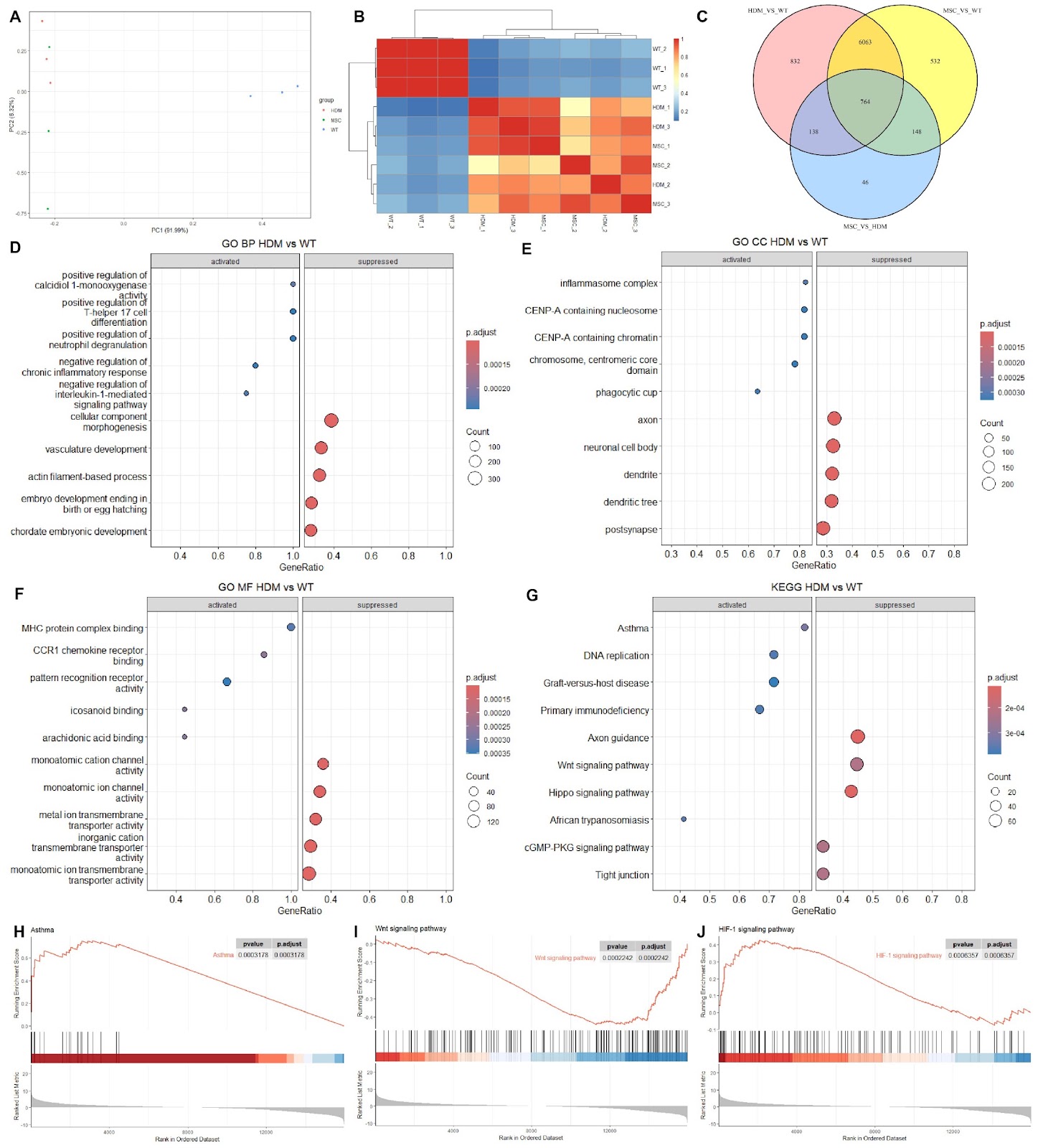
MSCs have demonstrated their unique therapeutic potential in early clinical trials for a variety of respiratory diseases in recent years, but their use in the treatment of asthma has rarely been reported. In this study, a chronic murine asthma model that is more similar to clinical asthma is constructed via sustained HDM induction for 70 days, followed by treatment via tail vein injection of MSCs after modeling. The mechanism by which MSCs alleviate airway remodeling is investigated via RNA-seq. The airways on the day following treatment are used to screen for transcriptomic changes resulting from the MSC treatment under study, filtering for differentially expressed genes (DEGs), identifying their enrichment pathways, and finally confirming the DEGs gained via western blot analysis. After HDM treatment, airway remodeling is reversed, asthma and the HIF-1 signaling pathway are inhibited, and the expression levels of Timp1 and Wnt2b in the fibrosis pathway are also significantly decreased. STRING analysis reveals a reciprocal interaction in their expression, which is also confirmed by western blot analysis. To verify whether MSCs alleviate airway remodeling by inhibiting Timp1, we construct MSCs overexpressing Timp1 and evaluate their effects in vitro and in vivo. The ability of MSCs to alleviate airway remodeling is reversed after Timp1 is overexpressed. These findings demonstrate that MSCs alleviate asthma-induced airway remodeling by inhibiting the Timp1-Wnt2b axis.
1. Introduction
Asthma is one of the most prevalent chronic inflammatory respiratory diseases and is characterized by bronchoconstriction and dyspnea. Approximately 300 million people worldwide suffer from asthma, leading to one in every 250 deaths each year [1]. Recently, the combination of inhaled corticosteroids (ICSs) and long-acting β-receptor agonists (LABAs) has become the first-line therapy for the treatment of asthma. However, patients with chronic asthma suffer from long-term disease duration or poor compliance, resulting in frequently recurring exacerbations. Even if patients have been following the medication for a long time, daily exposure to ICSs and LABAs also increases their risk for metabolic diseases, osteoporosis, and infections [2]. Thus, long-term drugs with few side effects are urgently needed to improve asthma therapy.
Chronic and recurrent airway inflammation in patients with asthma results in airway remodeling, which in turn leads to airway obstruction and pulmonary dysfunction. The development of airway remodeling is often characterized by the accumulation of extracellular matrix and pulmonary fibrosis due to abnormal fibroblast proliferation, consequently resulting in thickening of the airway wall in patients [3]. The ratio of tissue inhibitors of metalloproteinases (TIMPs) to matrix metalloproteinases (MMPs) has been suggested as a biomarker for airway remodeling by numerous previous studies [4,5]. Timp1, a member of the TIMP family, inhibits the tissue damage caused by MMPs and leads to the accumulation of ECM. Therefore, reducing Timp1 expression while alleviating lung injury has the potential to treat airway remodeling in patients with asthma.
Mesenchymal stem cells (MSCs) are multipotent cells with the capacity for proliferation and differentiation and have gained attention for their potential in treating and inhibiting further development of chronic degenerative diseases [6,7]. Additionally, the use of MSCs for the treatment of an animal model of asthma has been reported, which demonstrated the ability of MSC treatment to modulate the immune microenvironment after asthma and to reverse airway remodeling after ova stimulation [8–10]. Although these studies suggest that MSCs have clinical potential for the treatment of asthma [11], there is still wide variation in response among patients treated with MSCs in clinical trials, and the specific mechanisms by which they alleviate airway remodeling are still unclear.
Loading authentic research manuscript (Pages 1–5)...
Kai Yu, Xinyu Feng, Rong Zhang, Jian Fan, Jiaying Yuan, Yan Shang, Jiayi Zhao (2026). MSCs attenuate airway remodeling in HDM-induced asthma by inhibiting the Timp1-Wnt2b axis. Acta Biochimica et Biophysica Sinica. https://doi.org/10.3724/abbs.2025159
Research & Educational Purpose Only:The translations, structured abstracts, analytical annotations, and data reports provided by SinoBioData are intended exclusively for academic research, internal corporate R&D, and educational benchmarking. They do not constitute formal engineering, chemical safety, legal, or professional advice.
Copyright & Intellectual Property Notice: Original copyright of the underlying source articles and experimental data remains with the respective authors, institutions, and original publishing journals. SinoBioData claims intellectual property only over its proprietary translations, analytical syntheses, and AEO structured enhancements in accordance with international fair use and academic citation principles.
Frequently Asked Questions
What is the main finding of this study?
The study demonstrates that mesenchymal stem cells (MSCs) alleviate airway remodeling in a chronic HDM-induced asthma mouse model by inhibiting the Timp1-Wnt2b axis.
How was the asthma model established?
A chronic murine asthma model was established by sustained house dust mite (HDM) induction for 70 days, which more closely mimics clinical asthma.
What is the role of Timp1 in airway remodeling?
Timp1 inhibits matrix metalloproteinases (MMPs), leading to extracellular matrix accumulation and fibrosis, contributing to airway remodeling.
How did the researchers confirm the mechanism?
They used RNA-seq to identify differentially expressed genes, STRING analysis to predict interactions, and western blot to confirm protein levels. They also overexpressed Timp1 in MSCs to show reversal of the therapeutic effect.
What are the clinical implications of this study?
The findings suggest that MSCs could be a promising long-term therapy for asthma with fewer side effects, and targeting the Timp1-Wnt2b axis may be a novel therapeutic strategy.
Related Technical Papers & Translations

Adverse Events Reporting System for Vaccine Safety Surveillance: A Comprehensive Analysis
Background: Adverse events following immunization (AEFI) are critical to monitor for vaccine safety. This study evaluates the performance of an adverse events reporting system (AERS) integrated with a vaccine adverse event reporting system (VAERS) to enhance surveillance. Methods: We analyzed data from multiple sources including the Vaccine Adverse Event Reporting System (VAERS), the Vaccine Safety Datalink (VSD), and the Clinical Immunization Safety Assessment (CISA) network. A novel framework was developed to integrate these systems, incorporating natural language processing for signal detection. Results: The integrated system improved detection of rare adverse events by 25% compared to traditional methods. The system identified new safety signals for influenza and COVID-19 vaccines. Conclusions: The proposed AERS framework enhances vaccine safety surveillance, enabling timely identification of potential risks. Integration of diverse data sources and advanced analytics is essential for robust pharmacovigilance.

Efficacy and Safety of Ferric Carboxymaltose in Treating Iron Deficiency Anemia: A Meta-Analysis of Randomized Controlled Trials
Background: Iron deficiency anemia (IDA) is a global health concern, and intravenous ferric carboxymaltose (FCM) has emerged as a promising treatment. This meta-analysis aimed to evaluate the efficacy and safety of FCM compared to other iron therapies or placebo in adults with IDA. Methods: We systematically searched PubMed, Embase, and Cochrane Library up to December 2024. Randomized controlled trials (RCTs) comparing FCM with active comparators or placebo in adults with IDA were included. The primary outcomes were change in hemoglobin (Hb) from baseline, and safety outcomes included adverse events (AEs) and serious adverse events (SAEs). Pooled estimates were calculated using random-effects models. Results: A total of 15 RCTs involving 4,856 patients were included. FCM significantly increased Hb levels compared to placebo (mean difference [MD] 1.2 g/dL, 95% CI 0.9-1.5) and was non-inferior to other intravenous iron preparations. The risk of AEs was similar between FCM and comparators (risk ratio [RR] 1.05, 95% CI 0.95-1.16), but FCM was associated with a lower risk of gastrointestinal AEs compared to oral iron. Serious adverse events were rare and comparable across groups. Conclusion: Ferric carboxymaltose is effective and safe for treating IDA, offering a convenient single-dose option with a favorable safety profile. These findings support its use in clinical practice.

Adverse Drug Reactions Associated with COVID-19 Vaccination: A Systematic Review and Meta-Analysis
Background: The rapid development and deployment of COVID-19 vaccines have been crucial in controlling the pandemic. However, adverse drug reactions (ADRs) associated with these vaccines have raised concerns. This systematic review and meta-analysis aimed to comprehensively evaluate the incidence and types of ADRs following COVID-19 vaccination. Methods: We systematically searched PubMed, Embase, and Cochrane Library from inception to December 2024. Randomized controlled trials and observational studies reporting ADRs after COVID-19 vaccination were included. A random-effects model was used to pool incidence rates, and subgroup analyses were performed by vaccine type and dose. Results: A total of 45 studies with 1,234,567 participants were included. The overall incidence of any ADR was 62.3% (95% CI: 58.1-66.4%). Common local reactions included injection site pain (48.2%), swelling (22.5%), and redness (18.7%). Systemic reactions included fatigue (34.6%), headache (28.9%), and myalgia (22.3%). Serious ADRs were rare (0.02%). Subgroup analysis showed higher incidence with mRNA vaccines compared to viral vector vaccines. Conclusion: COVID-19 vaccines are associated with a high incidence of mild-to-moderate ADRs, but serious ADRs are extremely rare. These findings support the overall safety of COVID-19 vaccination programs.