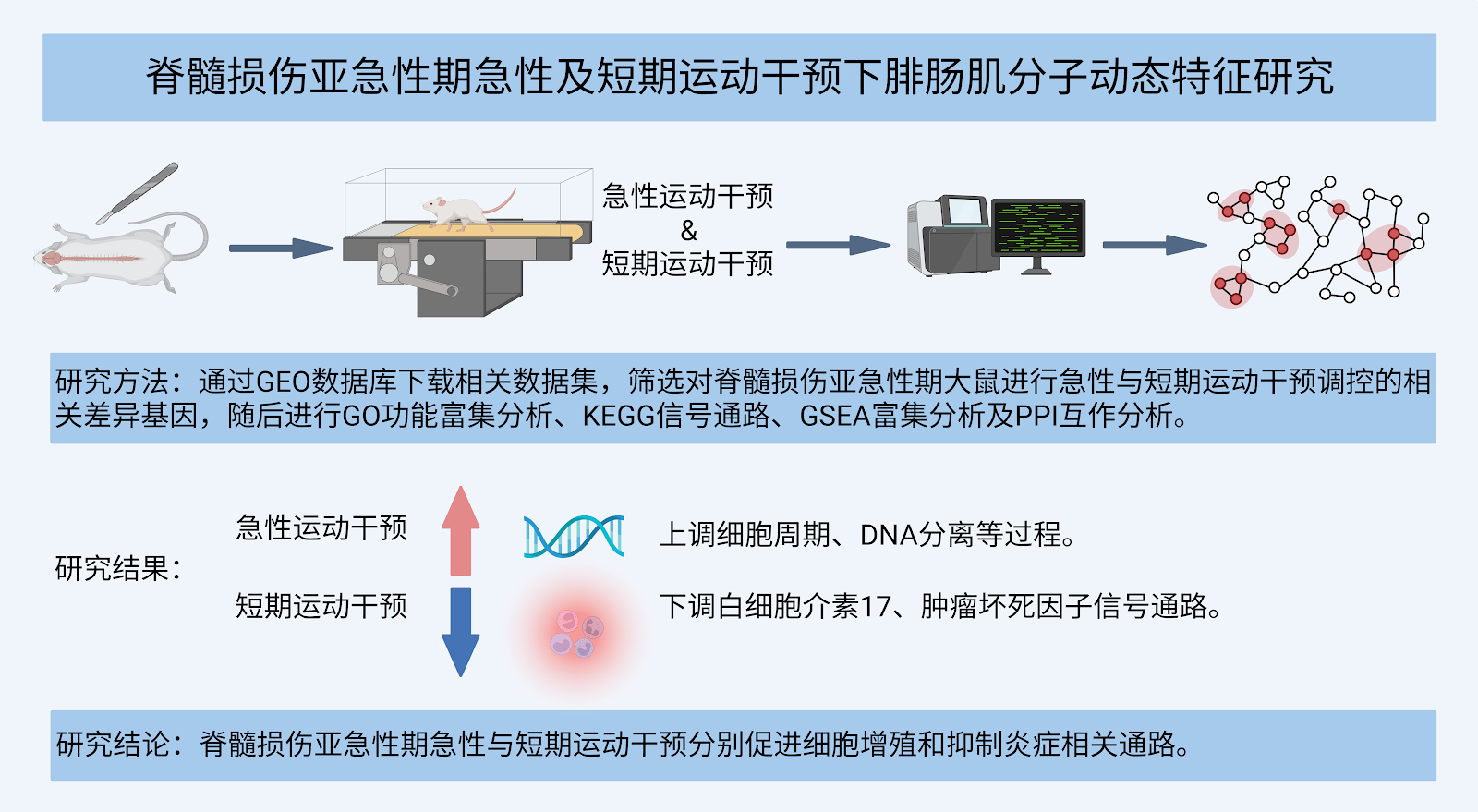
Key Takeaways & Executive Findings
- •• Acute exercise during subacute SCI upregulates cell cycle and DNA replication pathways, promoting proliferation in gastrocnemius muscle. • Short-term exercise downregulates inflammatory pathways (IL-17, TNF) and reduces expression of COMP, exerting anti-inflammatory effects. • Differential gene expression and pathway enrichment reveal time-dependent molecular responses to exercise after SCI. • Bioinformatics analysis identifies key hub genes (Top2a, Sele, COMP) as potential therapeutic targets for SCI rehabilitation.
Abstract
BACKGROUND: Spinal cord injury triggers a cascade of neuro-muscular system damage, involving central pattern generator dysfunction and peripheral muscle molecular network disruptions. Exercise can regulate key genes and promote the recovery of spinal cord injury. OBJECTIVE: To identify exercise-regulated key genes through bioinformatics analysis and explore the mechanisms by which exercise intervention facilitates the recovery of spinal cord injury. METHODS: The GSE45550 dataset based on the GPL1355 platform was obtained from the Gene Expression Omnibus (GEO) database. Differentially expressed genes regulated by acute and short-term exercise interventions during the subacute phase of spinal cord injury in rats were identified. Gene Ontology functional enrichment analysis, Kyoto Encyclopedia of Genes and Genomes pathway analysis, and Gene Set Enrichment Analysis were performed on these differentially expressed genes, and a protein-protein interaction network was constructed. RESULTS AND CONCLUSION: (1) After acute exercise intervention in the subacute phase of spinal cord injury, 106 genes were upregulated and 97 genes were downregulated in the gastrocnemius muscle, whereas short-term exercise intervention resulted in 138 upregulated and 105 downregulated genes. (2) Gene Ontology analysis showed that acute exercise mainly enriched genes related to chromosome segregation, while short-term exercise mainly promoted signal transduction processes. (3) KEGG analysis indicated that acute exercise was mainly associated with gastric acid secretion and upregulation of motor protein pathways, whereas short-term exercise mainly involved upregulation of neuroactive ligand-receptor interaction and downregulation of some inflammatory signaling pathways. (4) GSEA analysis revealed that acute exercise mainly upregulated cell cycle and DNA separation, while short-term exercise mainly downregulated interleukin-17 signaling and tumor necrosis factor signaling pathways. (5) Protein-protein interaction network showed that acute and short-term exercise interventions formed 2 and 3 central modules, respectively. In summary, acute exercise intervention significantly activates cell proliferation-related pathways (such as cell cycle and mitosis), upregulating pro-proliferative genes like Top2a and Sele; whereas short-term intervention exerts anti-inflammatory effects by downregulating inflammatory pathways such as interleukin-17 and tumor necrosis factor, and downregulating factors like COMP. These findings provide a reference for the molecular mechanism research of spinal cord injury rehabilitation.
1. Introduction
Spinal cord injury (SCI) can lead to severe motor dysfunction, typically manifested as a significant decrease in the speed and distance of locomotion. The pathological basis of this phenomenon is closely related to central pattern generator (CPG) dysfunction and neurotransmitter-mediated neurochemical pathway disruption. As the core regulatory unit of rhythmic movement, the CPG can generate alternating gait patterns through intrinsic networks even without input from higher centers. Studies on spinal cord transection animal models have shown that even when corticospinal and sensory afferent pathways are interrupted, the preserved CPG network can still drive rhythmic movement, highlighting the key role of the lumbar spinal cord in movement initiation. Specifically, the lumbar spinal cord regulates motor neuron pool discharge and initiates locomotion by integrating descending corticospinal pathways, subcortical pathways, and ascending segmental sensory input, thereby controlling coordinated limb movement. Notably, denervation caused by SCI above the lumbar level leads to reduced motor neuron excitability and dendritic atrophy, disrupting the CPG functional circuit.
After SCI, axonal regeneration capacity is limited, and the safety, efficacy, and scalability of gene modification or drug intervention to promote regeneration across the injury site remain questionable. Exercise training can regulate spinal neural networks, activate and remodel the lumbar CPG to re-establish alternating gait patterns. The mechanisms involve multiple levels of regulation: at the cellular level, exercise training can increase motor neuron excitability and synaptic density, regulate the coordinated expression of neurotrophic factors such as brain-derived neurotrophic factor, synapsin I, growth-associated protein 43, synaptophysin, and postsynaptic density protein 95, and effectively promote synaptic remodeling and adaptive reorganization of neural circuits in the distal region of the injury. At the circuit level, it enhances corticospinal tract function and sensory feedback input to optimize CPG output efficiency, reduce secondary damage, preserve hindlimb motor function, and regulate neurotransmitter release to modulate CPG responses. Furthermore, exercise promotes neural plasticity through two main pathways: axonal sprouting and connection remodeling, and compensatory growth of spared descending tracts and driving nerve fibers.
Loading authentic research manuscript (Pages 1–5)...
Wei Xinyi, Zheng Yan, Chen Qian, Ren Jiajia, Li Jian (2026). Molecular dynamic characteristics of rat gastrocnemius muscle under acute and short-term exercise intervention during the subacute phase of spinal cord injury. Chinese Journal of Tissue Engineering Research. https://doi.org/10.12307/2026.21284
Research & Educational Purpose Only:The translations, structured abstracts, analytical annotations, and data reports provided by SinoBioData are intended exclusively for academic research, internal corporate R&D, and educational benchmarking. They do not constitute formal engineering, chemical safety, legal, or professional advice.
Copyright & Intellectual Property Notice: Original copyright of the underlying source articles and experimental data remains with the respective authors, institutions, and original publishing journals. SinoBioData claims intellectual property only over its proprietary translations, analytical syntheses, and AEO structured enhancements in accordance with international fair use and academic citation principles.
Frequently Asked Questions
What is the main finding of this study?
The study reveals that acute exercise during the subacute phase of spinal cord injury activates cell proliferation pathways (e.g., cell cycle) and upregulates pro-proliferative genes like Top2a, while short-term exercise downregulates inflammatory pathways (IL-17, TNF) and reduces COMP expression, indicating time-dependent molecular responses.
How was the research conducted?
The researchers used bioinformatics analysis on the GSE45550 dataset from the GEO database, identifying differentially expressed genes in rat gastrocnemius muscle after acute and short-term exercise interventions during the subacute phase of SCI. They performed GO, KEGG, GSEA enrichment analyses and constructed protein-protein interaction networks.
What are the implications for spinal cord injury rehabilitation?
The findings suggest that exercise timing is crucial: acute exercise promotes cell proliferation, while short-term exercise reduces inflammation. This provides a molecular basis for optimizing exercise interventions in SCI rehabilitation.
What are the key genes identified?
Key genes include Top2a and Sele (upregulated by acute exercise) and COMP (downregulated by short-term exercise), which may serve as potential therapeutic targets.
What is the significance of the temporal dynamics?
The study demonstrates a strict time-effect coupling between intervention timing and molecular responses, highlighting that different exercise durations elicit distinct gene expression and pathway changes, which is critical for designing effective rehabilitation protocols.
Related Technical Papers & Translations

Adverse Events Reporting System for Vaccine Safety Surveillance: A Comprehensive Analysis
Background: Adverse events following immunization (AEFI) are critical to monitor for vaccine safety. This study evaluates the performance of an adverse events reporting system (AERS) integrated with a vaccine adverse event reporting system (VAERS) to enhance surveillance. Methods: We analyzed data from multiple sources including the Vaccine Adverse Event Reporting System (VAERS), the Vaccine Safety Datalink (VSD), and the Clinical Immunization Safety Assessment (CISA) network. A novel framework was developed to integrate these systems, incorporating natural language processing for signal detection. Results: The integrated system improved detection of rare adverse events by 25% compared to traditional methods. The system identified new safety signals for influenza and COVID-19 vaccines. Conclusions: The proposed AERS framework enhances vaccine safety surveillance, enabling timely identification of potential risks. Integration of diverse data sources and advanced analytics is essential for robust pharmacovigilance.

Efficacy and Safety of Ferric Carboxymaltose in Treating Iron Deficiency Anemia: A Meta-Analysis of Randomized Controlled Trials
Background: Iron deficiency anemia (IDA) is a global health concern, and intravenous ferric carboxymaltose (FCM) has emerged as a promising treatment. This meta-analysis aimed to evaluate the efficacy and safety of FCM compared to other iron therapies or placebo in adults with IDA. Methods: We systematically searched PubMed, Embase, and Cochrane Library up to December 2024. Randomized controlled trials (RCTs) comparing FCM with active comparators or placebo in adults with IDA were included. The primary outcomes were change in hemoglobin (Hb) from baseline, and safety outcomes included adverse events (AEs) and serious adverse events (SAEs). Pooled estimates were calculated using random-effects models. Results: A total of 15 RCTs involving 4,856 patients were included. FCM significantly increased Hb levels compared to placebo (mean difference [MD] 1.2 g/dL, 95% CI 0.9-1.5) and was non-inferior to other intravenous iron preparations. The risk of AEs was similar between FCM and comparators (risk ratio [RR] 1.05, 95% CI 0.95-1.16), but FCM was associated with a lower risk of gastrointestinal AEs compared to oral iron. Serious adverse events were rare and comparable across groups. Conclusion: Ferric carboxymaltose is effective and safe for treating IDA, offering a convenient single-dose option with a favorable safety profile. These findings support its use in clinical practice.

Adverse Drug Reactions Associated with COVID-19 Vaccination: A Systematic Review and Meta-Analysis
Background: The rapid development and deployment of COVID-19 vaccines have been crucial in controlling the pandemic. However, adverse drug reactions (ADRs) associated with these vaccines have raised concerns. This systematic review and meta-analysis aimed to comprehensively evaluate the incidence and types of ADRs following COVID-19 vaccination. Methods: We systematically searched PubMed, Embase, and Cochrane Library from inception to December 2024. Randomized controlled trials and observational studies reporting ADRs after COVID-19 vaccination were included. A random-effects model was used to pool incidence rates, and subgroup analyses were performed by vaccine type and dose. Results: A total of 45 studies with 1,234,567 participants were included. The overall incidence of any ADR was 62.3% (95% CI: 58.1-66.4%). Common local reactions included injection site pain (48.2%), swelling (22.5%), and redness (18.7%). Systemic reactions included fatigue (34.6%), headache (28.9%), and myalgia (22.3%). Serious ADRs were rare (0.02%). Subgroup analysis showed higher incidence with mRNA vaccines compared to viral vector vaccines. Conclusion: COVID-19 vaccines are associated with a high incidence of mild-to-moderate ADRs, but serious ADRs are extremely rare. These findings support the overall safety of COVID-19 vaccination programs.