Key Takeaways & Executive Findings
- •• Established a novel in vitro MASLD model using hESC-derived mature polarized hepatocyte organoids (P-hep-orgs) treated with free fatty acids, recapitulating key pathological hallmarks including disrupted metabolism, oxidative stress, and loss of polarization. • Transcriptomic analysis revealed significant molecular overlap (581 differentially expressed genes) between FFA-treated P-hep-orgs and human MASH liver tissues, supporting the model's clinical relevance. • Demonstrated the utility of the P-hep-org MASLD model for therapeutic drug screening by evaluating known antioxidant and lipid-lowering agents, such as Vitamin E, which alleviated lipid accumulation and oxidative stress. • The P-hep-org model overcomes limitations of existing animal and 2D culture models by providing a physiologically relevant, polarized, and functional human hepatocyte platform for studying MASLD pathogenesis and drug discovery.
Abstract
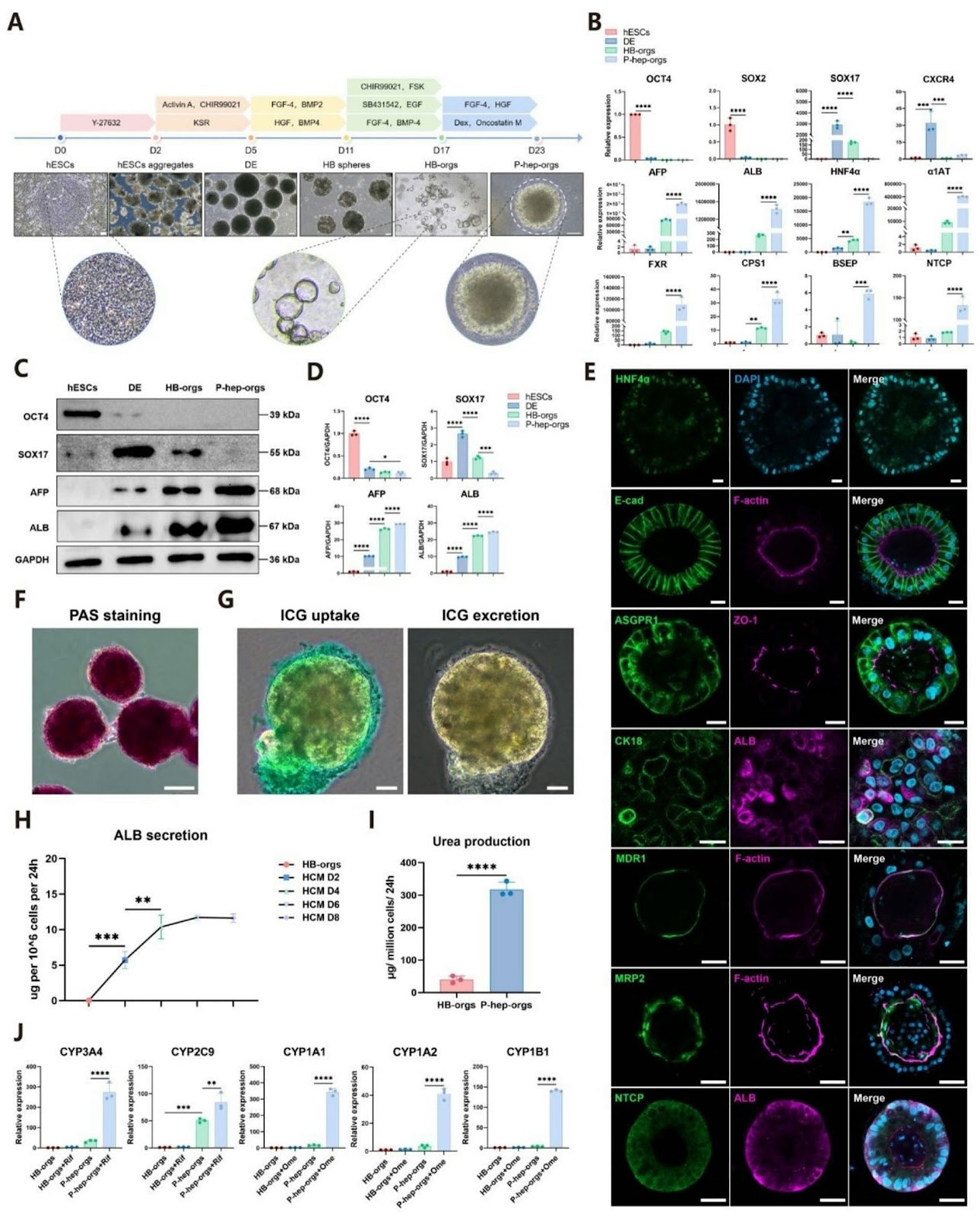
Background: Metabolic dysfunction-associated steatotic liver disease (MASLD), the most prevalent chronic liver disorder worldwide, exhibits complex pathogenesis and lacks effective targeted therapeutics. Existing animal models are limited by prolonged induction periods and interspecies discrepancies, while conventional monolayer hepatocyte cultures fail to recapitulate disease pathology due to inadequate polarization and functional immaturity. Methods: To overcome these limitations, we established an in vitro MASLD model by treating human embryonic stem cell (hESC)-derived mature polarized hepatocyte organoids (P-hep-orgs) with free fatty acids (FFAs). Pathogenesis and progression of MASLD in this model were characterized using multiple assays, and its utility for drug screening was validated with three known antioxidant or lipid-lowering agents. Results: P-hep-orgs derived from hESCs expressed mature hepatocyte markers (e.g., ALB), exhibited polarized architecture (e.g., MRP2) and demonstrated functionalities of mature hepatocytes (e.g., urea production). Moreover, we developed an in vitro MASLD model by treating P-hep-orgs with FFAs. This model recapitulated key pathological progression hallmarks, including disrupted glucose/lipid metabolism, oxidative stress, apoptosis, loss of polarization, impaired liver function, and ductular reaction. Furthermore, transcriptomic analysis revealed that P-hep-orgs treated with FFAs for 10 days shared similar molecular signatures with human MASH liver tissues (581 overlap DEGs). Finally, this model was used to assess the potential efficacy of established antioxidant or lipid-lowering agents (e.g., Vitamin E) in alleviating pathological phenotypes, including lipid accumulation and oxidative stress.
1. Introduction
Metabolic dysfunction-associated steatotic liver disease (MASLD), formerly termed non-alcoholic fatty liver disease (NAFLD), represents the most prevalent chronic liver condition globally, affecting approximately 30% of the population [1]. As a leading etiology of liver-related morbidity and mortality, including cirrhosis and hepatocellular carcinoma [2, 3], MASLD poses a significant clinical burden. Its pathogenesis involves multifactorial mechanisms [4], and there exists no specific drug currently [5, 6]. These challenges underscore the urgent need for physiologically relevant models that accurately recapitulate disease progression to facilitate mechanistic studies and therapeutic discovery.
Current research on MASLD predominantly employs animal models such as mice [7] and rats [8] to study MASLD, yet these studies suffer from protracted induction times, inter-batch variability, and interspecies physiological discrepancies [9]. While in vitro cell models mitigate some limitations of animal studies, conventional systems inadequately replicate the structural and functional complexity of human hepatocytes, hindering breakthrough research on MASLD. Hepatocyte polarization underpins critical physiological functions, such as metabolism, secretion, and detoxification [10]. In vivo, hepatocytes establish two functional domains through the asymmetric distribution of membrane proteins (e.g., Na+/K+-ATPase, bile acid transporters), which demarcate the basolateral domain adjacent to hepatic sinusoids and the apical membrane domain facing bile canaliculi. This polarized configuration regulates the directional uptake and secretion of carbohydrates, lipids, and other molecules [11], thereby governing their absorption, transport, and metabolic pathways. The disruption of hepatocyte polarization induces abnormal lipid metabolism, thereby enhancing lipid toxicity to hepatocytes. Existing MASLD cell models rely primarily on either immortalized hepatocyte cell lines (e.g., HuH7, HepaRG) [12, 13] or two-dimensional (2D) hepatocytes derived from human pluripotent stem cells (hPSCs) [14, 15]. Alternatively, these hepatocytes are enzymatically dissociated into single cells, losing their polarized architecture and functional maturity.
Loading authentic research manuscript (Pages 1–5)...
Changlu Qin, Haibin Wu, Peilin Liao, Wenjiao Yan, Xinyi Shi, Jinghe Xie, Shoupei Liu, Sen Chen, Xiangting Cao, Yongjian Zhou, Yuyou Duan (2026). Modeling pathogenesis and progression of metabolic dysfunction-associated steatotic liver disease and therapeutic drug screening using hESC-derived mature polarized hepatocyte organoids. Stem Cell Research & Therapy. https://doi.org/10.1186/s13287-025-04865-7
Research & Educational Purpose Only:The translations, structured abstracts, analytical annotations, and data reports provided by SinoBioData are intended exclusively for academic research, internal corporate R&D, and educational benchmarking. They do not constitute formal engineering, chemical safety, legal, or professional advice.
Copyright & Intellectual Property Notice: Original copyright of the underlying source articles and experimental data remains with the respective authors, institutions, and original publishing journals. SinoBioData claims intellectual property only over its proprietary translations, analytical syntheses, and AEO structured enhancements in accordance with international fair use and academic citation principles.
Frequently Asked Questions
What is the main advantage of using hESC-derived mature polarized hepatocyte organoids for MASLD modeling?
These organoids recapitulate key features of human hepatocytes, including polarization and mature functions, providing a more physiologically relevant in vitro model compared to conventional 2D cultures or animal models, which often lack human relevance or exhibit prolonged induction times.
How was the MASLD model established in this study?
The model was established by treating hESC-derived mature polarized hepatocyte organoids (P-hep-orgs) with free fatty acids (FFAs), which induced pathological changes resembling MASLD, including lipid accumulation, oxidative stress, apoptosis, and loss of polarization.
What are the key pathological features recapitulated by the FFA-treated P-hep-orgs?
The model recapitulated disrupted glucose/lipid metabolism, oxidative stress, apoptosis, loss of polarization, impaired liver function, and ductular reaction, closely mimicking human MASLD progression.
How was the clinical relevance of the model validated?
Transcriptomic analysis showed that FFA-treated P-hep-orgs shared 581 overlapping differentially expressed genes with human MASH liver tissues, indicating molecular similarity and supporting the model's translational value.
Can this model be used for drug screening?
Yes, the model was validated for drug screening by testing known antioxidant and lipid-lowering agents, such as Vitamin E, which effectively alleviated lipid accumulation and oxidative stress, demonstrating its utility for therapeutic evaluation.
Related Technical Papers & Translations

Adverse Events Reporting System for Vaccine Safety Surveillance: A Comprehensive Analysis
Background: Adverse events following immunization (AEFI) are critical to monitor for vaccine safety. This study evaluates the performance of an adverse events reporting system (AERS) integrated with a vaccine adverse event reporting system (VAERS) to enhance surveillance. Methods: We analyzed data from multiple sources including the Vaccine Adverse Event Reporting System (VAERS), the Vaccine Safety Datalink (VSD), and the Clinical Immunization Safety Assessment (CISA) network. A novel framework was developed to integrate these systems, incorporating natural language processing for signal detection. Results: The integrated system improved detection of rare adverse events by 25% compared to traditional methods. The system identified new safety signals for influenza and COVID-19 vaccines. Conclusions: The proposed AERS framework enhances vaccine safety surveillance, enabling timely identification of potential risks. Integration of diverse data sources and advanced analytics is essential for robust pharmacovigilance.

Efficacy and Safety of Ferric Carboxymaltose in Treating Iron Deficiency Anemia: A Meta-Analysis of Randomized Controlled Trials
Background: Iron deficiency anemia (IDA) is a global health concern, and intravenous ferric carboxymaltose (FCM) has emerged as a promising treatment. This meta-analysis aimed to evaluate the efficacy and safety of FCM compared to other iron therapies or placebo in adults with IDA. Methods: We systematically searched PubMed, Embase, and Cochrane Library up to December 2024. Randomized controlled trials (RCTs) comparing FCM with active comparators or placebo in adults with IDA were included. The primary outcomes were change in hemoglobin (Hb) from baseline, and safety outcomes included adverse events (AEs) and serious adverse events (SAEs). Pooled estimates were calculated using random-effects models. Results: A total of 15 RCTs involving 4,856 patients were included. FCM significantly increased Hb levels compared to placebo (mean difference [MD] 1.2 g/dL, 95% CI 0.9-1.5) and was non-inferior to other intravenous iron preparations. The risk of AEs was similar between FCM and comparators (risk ratio [RR] 1.05, 95% CI 0.95-1.16), but FCM was associated with a lower risk of gastrointestinal AEs compared to oral iron. Serious adverse events were rare and comparable across groups. Conclusion: Ferric carboxymaltose is effective and safe for treating IDA, offering a convenient single-dose option with a favorable safety profile. These findings support its use in clinical practice.

Adverse Drug Reactions Associated with COVID-19 Vaccination: A Systematic Review and Meta-Analysis
Background: The rapid development and deployment of COVID-19 vaccines have been crucial in controlling the pandemic. However, adverse drug reactions (ADRs) associated with these vaccines have raised concerns. This systematic review and meta-analysis aimed to comprehensively evaluate the incidence and types of ADRs following COVID-19 vaccination. Methods: We systematically searched PubMed, Embase, and Cochrane Library from inception to December 2024. Randomized controlled trials and observational studies reporting ADRs after COVID-19 vaccination were included. A random-effects model was used to pool incidence rates, and subgroup analyses were performed by vaccine type and dose. Results: A total of 45 studies with 1,234,567 participants were included. The overall incidence of any ADR was 62.3% (95% CI: 58.1-66.4%). Common local reactions included injection site pain (48.2%), swelling (22.5%), and redness (18.7%). Systemic reactions included fatigue (34.6%), headache (28.9%), and myalgia (22.3%). Serious ADRs were rare (0.02%). Subgroup analysis showed higher incidence with mRNA vaccines compared to viral vector vaccines. Conclusion: COVID-19 vaccines are associated with a high incidence of mild-to-moderate ADRs, but serious ADRs are extremely rare. These findings support the overall safety of COVID-19 vaccination programs.