Key Takeaways & Executive Findings
- •• hUCMSC-derived migrasomes significantly ameliorate airway inflammation and mucus production in an OVA-induced asthma mouse model. • Migrasomes reduce Th2 cytokine expression (IL-4, IL-5, IL-13) and inhibit dendritic cell activation, suggesting an immunomodulatory mechanism. • Inhibition of migrasome production impairs the anti-inflammatory effects of hUCMSCs, highlighting migrasomes as key mediators of MSC therapy. • Migrasomes can be delivered to the lung and taken up by dendritic cells in vivo and in vitro, supporting their potential as a cell-free therapeutic agent for asthma.
Abstract
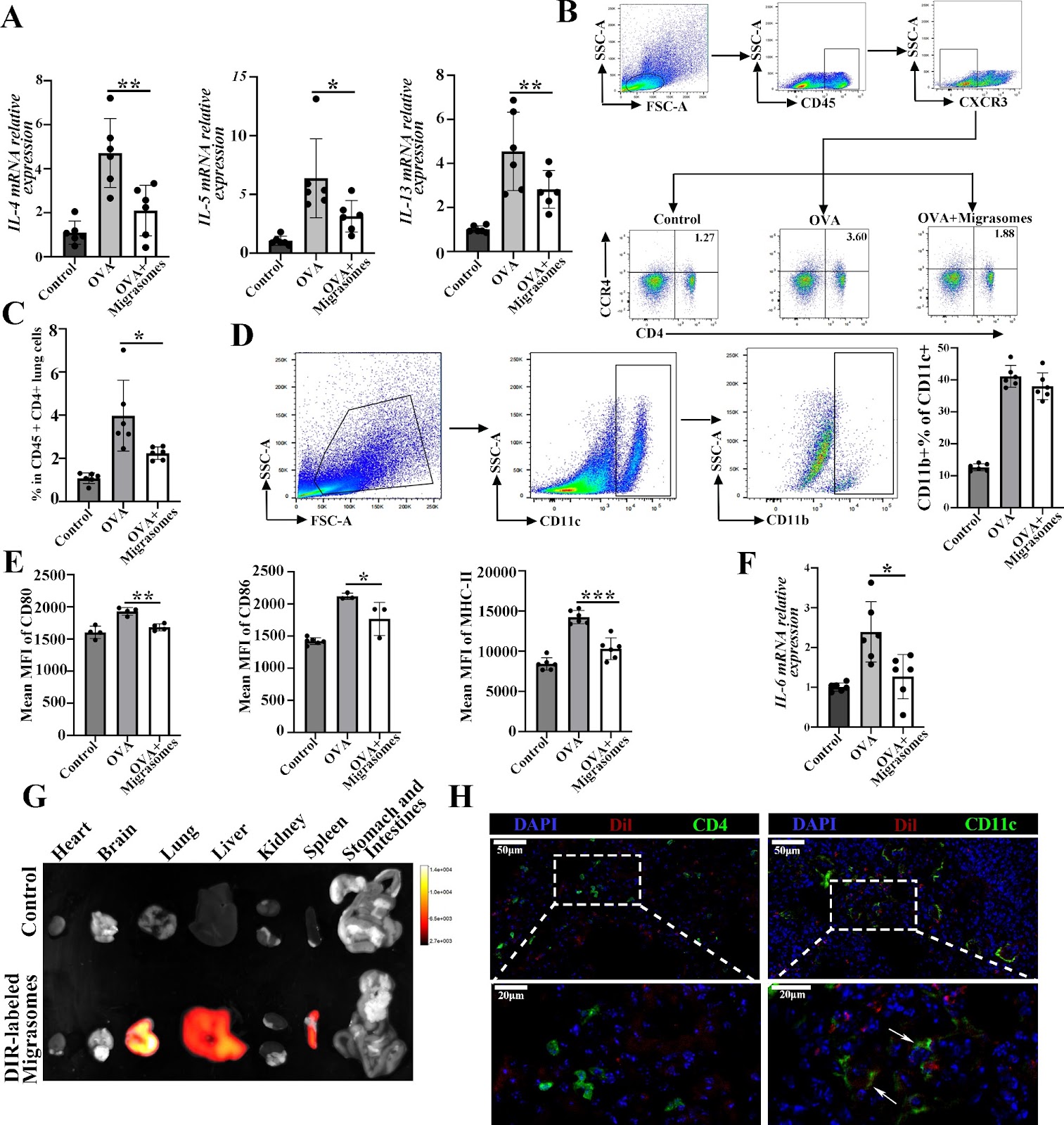
Background Asthma is a prevalent respiratory disease, and its management remains largely unsatisfactory. Mesenchymal stem cells (MSCs) have been demonstrated to be efficacious in reducing airway inflammation in experimental allergic diseases, representing a potential alternative treatment for asthma. Migrasomes are recently identified extracellular vesicles (EVs) generated in migrating cells and facilitate intercellular communication. The objective of this study was to investigate the therapeutic effects of migrasomes obtained from MSC in a model of asthma. Methods Migrasomes produced by human umbilical cord MSCs (hUCMSCs) were isolated by sequential centrifugation. Characterization of hUCMSC-derived migrasomes were carried out by transmission electron microscopy and western blot analysis. The therapeutic effects of migrasomes on airway inflammation in ovalbumin (OVA)-induced asthmatic mice were evaluated by hematoxylin-eosin (HE) and periodic-acid schiff (PAS) staining, and their mechanism were further testified by immunofluorescent staining, real-time PCR and flow cytometry. Results Here, we showed that inhibition of migrasomes’ production dramatically impaired the anti-inflammatory effects of hUCMSCs in OVA animals, as evidenced by a notable increase in both the infiltration of inflammatory cells and the number of epithelial goblet cells. We successfully isolated hUCMSC-migrasomes, which were morphologically intact and positive for the specific migrasomes markers. The administration of hUCMSC-migrasomes was observed to significantly ameliorate the symptoms of airway inflammation and mucus production in asthmatic mice. Additionally, the expression of Th2 cytokines (IL-4, IL-5 and IL-13) were found to be reduced, while the activation of dendritic cells (DCs) was inhibited. HUCMSC-migrasomes could possibly be delivered to lung region after injection, and were able to be taken in by DCs both in vivo and in vitro. Notably, in vitro, migraosmes decreased the capacity of
1. Introduction
Asthma is the most common chronic inflammatory disease of the lungs, affecting over 350 million people worldwide. This disease is typically associated with repetitive episodes of airway obstruction caused by airway inflammation and excessive production of mucus [1, 2]. Corticosteroids are effective at managing the symptomatic relief, however, 10% of patients do not respond to the treatment, and they are associated with severe long-term side effects [3, 4]. The quest for effective and safe asthma treatment drugs is always on the way for researchers.
With the migration ability (homing to injury tissues) and immunomodulatory attributes, mesenchymal stem cells (MSCs) received significant attention in the treatment of inflammatory diseases [5, 6], and accumulating evidences showed that exogenous MSCs exhibit anti-inflammatory properties in various stabilized asthma murine models [7]. The secreted biological factors are regarded as a key mechanism of action of MSCs [8], therefore, MSC-derived secreted products, mainly conditioned medium (CM) [9–11] or extracellular vesicles (EVs) [12] were widely investigated in pre-clinical intervention of asthma, and showed bright results in these experimental asthma models. In fact, from a clinical standpoint, MSCs-based cell-free products are more promising therapeutic option in asthma, as they bypass the risks of tumorgenicity, immune rejection, and ethical issues in cell therapy [13].
Recently, a novel secreted pattern of migratory cells based on large membrane-bound vesicular structures encapsulating several smaller vesicles (50–100 nm), known as migrasomes, has been described [14]. Migrasomes are generated during cell migration and are randomly distributed inside thin cellular structures called retraction fibers (RFs). When the cells move away, the RFs will break, then the migrasomes will be released and subsequently taken up by the extracellular space cells, as such, migrasomes mediate intercellular communication [15]. Various types of migratory cells, including podocyte cells [16], macrophage [17] and tumor cells [18] can generated migrasomes.
Loading authentic research manuscript (Pages 1–5)...
Weifeng Gu, Tingting Zheng, Wen Li, Xinkai Luo, Xiaowei Xu, Ying Wang, Chaoming Mao, Yongbin Ma, Liyang Dong (2026). Migrasomes derived from human umbilical cord mesenchymal stem cells: a new therapeutic agent for ovalbumin-induced asthma in mice. Stem Cell Research & Therapy. https://doi.org/10.1186/s13287-025-04145-4
Research & Educational Purpose Only:The translations, structured abstracts, analytical annotations, and data reports provided by SinoBioData are intended exclusively for academic research, internal corporate R&D, and educational benchmarking. They do not constitute formal engineering, chemical safety, legal, or professional advice.
Copyright & Intellectual Property Notice: Original copyright of the underlying source articles and experimental data remains with the respective authors, institutions, and original publishing journals. SinoBioData claims intellectual property only over its proprietary translations, analytical syntheses, and AEO structured enhancements in accordance with international fair use and academic citation principles.
Frequently Asked Questions
What are migrasomes and how are they related to mesenchymal stem cells?
Migrasomes are large extracellular vesicles produced by migrating cells, including mesenchymal stem cells (MSCs). They are released from retraction fibers and facilitate intercellular communication. In this study, migrasomes derived from human umbilical cord MSCs were investigated for their therapeutic potential in asthma.
How were migrasomes isolated and characterized in this study?
Migrasomes were isolated from human umbilical cord MSC cultures using sequential centrifugation. They were characterized by transmission electron microscopy and western blot analysis to confirm their morphology and the presence of specific migrasome markers.
What were the main therapeutic effects of hUCMSC-derived migrasomes in asthmatic mice?
Administration of hUCMSC-derived migrasomes significantly reduced airway inflammation and mucus production in ovalbumin-induced asthmatic mice. This was associated with decreased expression of Th2 cytokines (IL-4, IL-5, IL-13) and inhibition of dendritic cell activation.
How do migrasomes exert their anti-inflammatory effects?
Migrasomes appear to modulate the immune response by reducing Th2 cytokine production and inhibiting dendritic cell activation. They can be taken up by dendritic cells both in vivo and in vitro, suggesting a direct immunomodulatory mechanism.
What is the potential clinical significance of this study?
This study suggests that migrasomes derived from MSCs could serve as a novel cell-free therapeutic agent for asthma, potentially overcoming limitations of whole-cell therapies such as tumorigenicity and immune rejection. Further research is needed to translate these findings into clinical applications.
Related Technical Papers & Translations

Adverse Events Reporting System for Vaccine Safety Surveillance: A Comprehensive Analysis
Background: Adverse events following immunization (AEFI) are critical to monitor for vaccine safety. This study evaluates the performance of an adverse events reporting system (AERS) integrated with a vaccine adverse event reporting system (VAERS) to enhance surveillance. Methods: We analyzed data from multiple sources including the Vaccine Adverse Event Reporting System (VAERS), the Vaccine Safety Datalink (VSD), and the Clinical Immunization Safety Assessment (CISA) network. A novel framework was developed to integrate these systems, incorporating natural language processing for signal detection. Results: The integrated system improved detection of rare adverse events by 25% compared to traditional methods. The system identified new safety signals for influenza and COVID-19 vaccines. Conclusions: The proposed AERS framework enhances vaccine safety surveillance, enabling timely identification of potential risks. Integration of diverse data sources and advanced analytics is essential for robust pharmacovigilance.

Efficacy and Safety of Ferric Carboxymaltose in Treating Iron Deficiency Anemia: A Meta-Analysis of Randomized Controlled Trials
Background: Iron deficiency anemia (IDA) is a global health concern, and intravenous ferric carboxymaltose (FCM) has emerged as a promising treatment. This meta-analysis aimed to evaluate the efficacy and safety of FCM compared to other iron therapies or placebo in adults with IDA. Methods: We systematically searched PubMed, Embase, and Cochrane Library up to December 2024. Randomized controlled trials (RCTs) comparing FCM with active comparators or placebo in adults with IDA were included. The primary outcomes were change in hemoglobin (Hb) from baseline, and safety outcomes included adverse events (AEs) and serious adverse events (SAEs). Pooled estimates were calculated using random-effects models. Results: A total of 15 RCTs involving 4,856 patients were included. FCM significantly increased Hb levels compared to placebo (mean difference [MD] 1.2 g/dL, 95% CI 0.9-1.5) and was non-inferior to other intravenous iron preparations. The risk of AEs was similar between FCM and comparators (risk ratio [RR] 1.05, 95% CI 0.95-1.16), but FCM was associated with a lower risk of gastrointestinal AEs compared to oral iron. Serious adverse events were rare and comparable across groups. Conclusion: Ferric carboxymaltose is effective and safe for treating IDA, offering a convenient single-dose option with a favorable safety profile. These findings support its use in clinical practice.

Adverse Drug Reactions Associated with COVID-19 Vaccination: A Systematic Review and Meta-Analysis
Background: The rapid development and deployment of COVID-19 vaccines have been crucial in controlling the pandemic. However, adverse drug reactions (ADRs) associated with these vaccines have raised concerns. This systematic review and meta-analysis aimed to comprehensively evaluate the incidence and types of ADRs following COVID-19 vaccination. Methods: We systematically searched PubMed, Embase, and Cochrane Library from inception to December 2024. Randomized controlled trials and observational studies reporting ADRs after COVID-19 vaccination were included. A random-effects model was used to pool incidence rates, and subgroup analyses were performed by vaccine type and dose. Results: A total of 45 studies with 1,234,567 participants were included. The overall incidence of any ADR was 62.3% (95% CI: 58.1-66.4%). Common local reactions included injection site pain (48.2%), swelling (22.5%), and redness (18.7%). Systemic reactions included fatigue (34.6%), headache (28.9%), and myalgia (22.3%). Serious ADRs were rare (0.02%). Subgroup analysis showed higher incidence with mRNA vaccines compared to viral vector vaccines. Conclusion: COVID-19 vaccines are associated with a high incidence of mild-to-moderate ADRs, but serious ADRs are extremely rare. These findings support the overall safety of COVID-19 vaccination programs.