Key Takeaways & Executive Findings
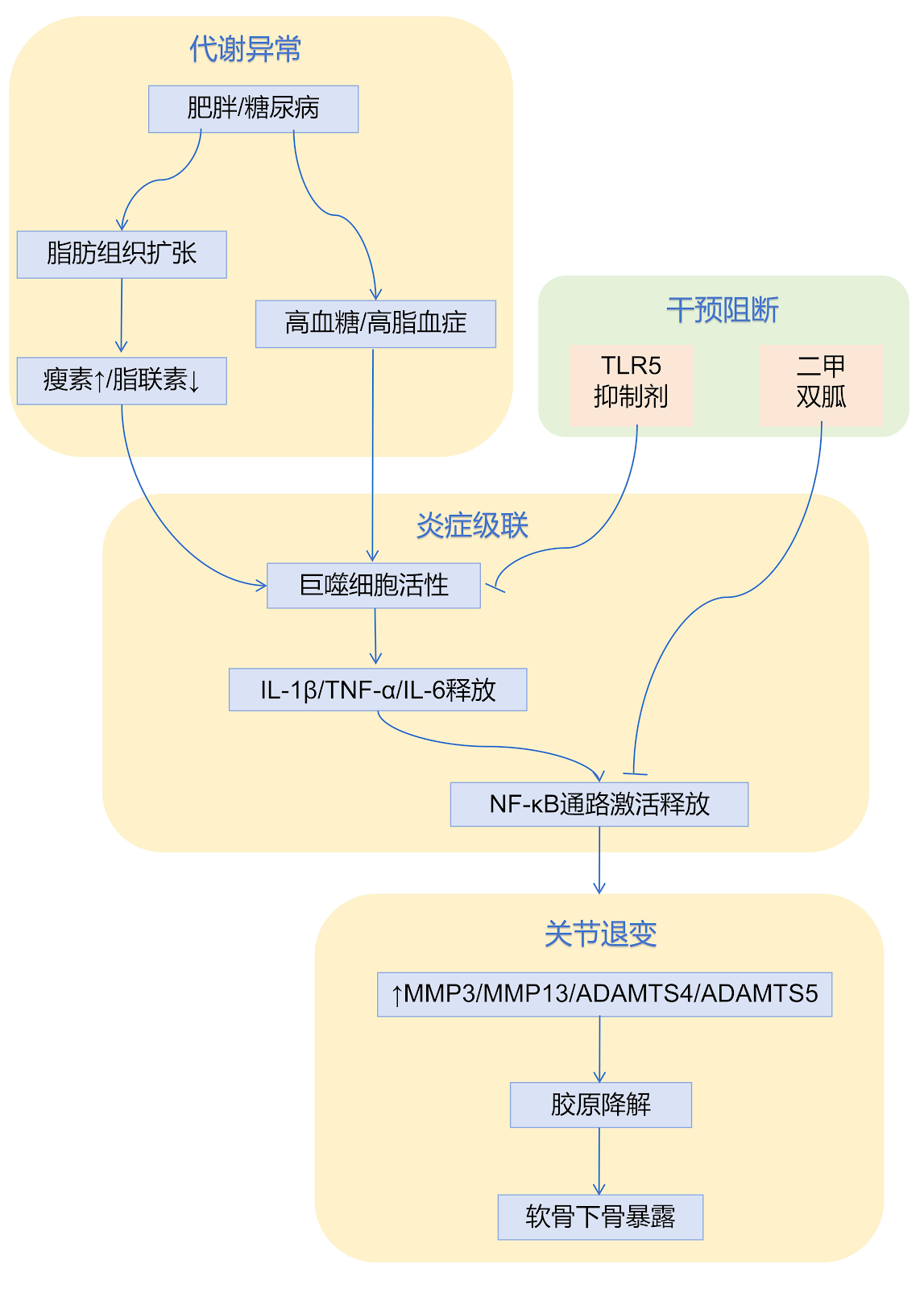
- •• Metabolic syndrome (obesity, diabetes, dyslipidemia) is an independent risk factor for osteoarthritis, with each 1 kg/m2 increase in BMI raising knee OA risk by 15%. • Adipokine imbalance (leptin up 3.2-fold, adiponectin down 40%) drives cartilage degradation via MMP-13 activation and TIMP-2 inhibition. • Osteoarthritic chondrocytes exhibit metabolic reprogramming: enhanced glycolysis, mitochondrial dysfunction, and lipid accumulation (free fatty acids up 1.8-fold). • A metabolic-inflammatory feedback loop (adipose-derived IL-1β/TNF-α activating NF-κB) exacerbates OA, suggesting potential for metabolic-targeted therapies.
Abstract
BACKGROUND: Osteoarthritis has traditionally been considered as a degenerative joint disorder, with the central role of metabolic dysregulation in its pathogenesis long overlooked. Recent studies reveal a strong association between metabolic syndromes, such as obesity and diabetes, and osteoarthritis progression, yet the molecular mechanisms by which metabolic dysregulation results in joint degeneration remain poorly elucidated. OBJECTIVE: To systematically review advances in the pathological mechanisms of metabolic dysregulation in osteoarthritis, integrating multi-omics evidence to decode the regulatory network of the "metabolism-joint axis," and to provide novel perspectives for the clinical prevention and treatment of metabolic dysregulation in osteoarthritis. METHODS: An online search of the China National Knowledge Infrastructure and Wanfang databases was conducted using the terms "osteoarthritis, metabolic dysregulation, adipokine, glycolysis, mitochondrial dysfunction, metabolomics, MRI" in Chinese to retrieve relevant literature. Additionally, PubMed and Web of Science were searched using the English terms "osteoarthritis, metabolic dysregulation, adipokine, glycolysis, mitochondrial dysfunction, metabolomics, MRI." After screening titles and abstracts, as well as evaluating full texts, 108 articles were finally included for review. RESULTS AND CONCLUSION: Epidemiological studies confirm that metabolic syndrome (obesity, diabetes, dyslipidemia) is positively correlated with osteoarthritis risk; each 1 kg/m2 increase in body mass index raises the risk of knee osteoarthritis by 15%, and involvement of non-weight-bearing joints supports the independent pathogenic role of metabolic factors. Imbalance of the adipokine network drives osteoarthritis progression: obesity leads to abnormal leptin/adiponectin ratio (leptin increased 3.2-fold, adiponectin decreased 40%), which accelerates cartilage degradation by activating matrix metalloproteinase 13 (increased 2.1-fold) and inhibiting tissue inhibitor of metalloproteinase 2. Intracellular metabolic reprogramming is prominent: osteoarthritic chondrocytes exhibit a triad of enhanced glycolysis, mitochondrial dysfunction, and lipid droplet deposition (free fatty acids increased 1.8-fold). A metabolic-inflammatory positive feedback loop: adipose tissue releases interleukin-1β/tumor necrosis factor-α to activate the nuclear factor-κB pathway in joints, which in turn inhibits insulin receptor signaling and exacerbates metabolic disturbance. Clinical translation: serum adiponectin combined with synovial fluid lactate can predict osteoarthritis progression; early use of AMP-activated protein kinase agonists combined with muscle training and nutritional intervention is recommended for patients with metabolic syndrome.
1. Introduction
Osteoarthritis (OA) is the most common degenerative joint disease [1-2]. With the aging population, the global burden of OA is projected to increase by more than 50% by 2040 [3]. Traditionally, OA has been viewed as a local disease driven by mechanical stress, with clinical treatment focusing on symptom relief and end-stage joint replacement, lacking effective disease-modifying drugs [4]. This therapeutic gap stems from a limited understanding of OA pathogenesis—the mechanical wear theory cannot explain the increased risk of OA in non-weight-bearing joints (e.g., hands) in obese patients, nor can it clarify the molecular drivers of early-onset OA [4-5].
Recent research has revealed that metabolic dysregulation is an independent driver of OA progression [6]. A large cohort study (n=1,764,061) showed that obese individuals have a 3.05-fold higher risk of knee OA (95% CI: 2.78-3.35), which remains significant after adjusting for mechanical load [7]. Metabolic syndrome (obesity, insulin resistance, dyslipidemia) shares comorbid mechanisms with OA: adipose tissue releases adipokines such as leptin and resistin, as well as pro-inflammatory cytokines like tumor necrosis factor-α and interleukin-1β, which act systemically on joint tissues to accelerate cartilage degradation [8].
This review systematically integrates recent breakthroughs in OA metabolic mechanisms, from adipokine dysregulation and intracellular metabolic reprogramming (enhanced glycolysis/mitochondrial dysfunction) to the gut-joint axis, combined with biomarker screening and multi-omics analysis. It elucidates the scientific basis for metabolic subtype classification and evaluates the clinical translation potential of traditional drugs such as metformin and statins, as well as novel therapies like ursodeoxycholic acid and glucagon-like peptide-1 receptor agonists. By integrating cross-disciplinary evidence, this review aims to promote a paradigm shift in OA management from symptomatic treatment to etiological intervention, providing a theoretical foundation for the development of metabolic-targeted disease-modifying drugs.
Loading authentic research manuscript (Pages 1–5)...
GUO Shanshan, MA Ding, DONG Bingchen (2026). Metabolic dysregulation in osteoarthritis: mechanisms and targeted therapeutic strategies. Chinese Journal of Tissue Engineering Research. https://doi.org/10.12307/2026.21426
Research & Educational Purpose Only:The translations, structured abstracts, analytical annotations, and data reports provided by SinoBioData are intended exclusively for academic research, internal corporate R&D, and educational benchmarking. They do not constitute formal engineering, chemical safety, legal, or professional advice.
Copyright & Intellectual Property Notice: Original copyright of the underlying source articles and experimental data remains with the respective authors, institutions, and original publishing journals. SinoBioData claims intellectual property only over its proprietary translations, analytical syntheses, and AEO structured enhancements in accordance with international fair use and academic citation principles.
Frequently Asked Questions
What is the role of metabolic dysregulation in osteoarthritis?
Metabolic dysregulation, including obesity, diabetes, and dyslipidemia, is an independent risk factor for osteoarthritis. It contributes to joint degeneration through mechanisms such as adipokine imbalance, chronic low-grade inflammation, and metabolic reprogramming of chondrocytes, leading to enhanced glycolysis, mitochondrial dysfunction, and lipid accumulation.
How does obesity increase the risk of osteoarthritis?
Obesity increases the risk of osteoarthritis through both mechanical overload and systemic metabolic effects. Adipose tissue secretes adipokines like leptin and pro-inflammatory cytokines, which promote cartilage degradation. Even in non-weight-bearing joints, obesity raises OA risk, indicating a systemic metabolic influence.
What are the key metabolic changes in osteoarthritic chondrocytes?
Osteoarthritic chondrocytes undergo metabolic reprogramming characterized by a shift from oxidative phosphorylation to glycolysis (Warburg effect), leading to increased lactate production. They also exhibit mitochondrial dysfunction with elevated reactive oxygen species, and lipid droplet accumulation due to altered fatty acid metabolism.
Can metabolic-targeted therapies be effective for osteoarthritis?
Yes, targeting metabolic pathways holds promise for OA treatment. Drugs like metformin, statins, and novel agents such as GLP-1 receptor agonists are being explored. These therapies aim to correct metabolic imbalances, reduce inflammation, and potentially modify disease progression, moving beyond symptomatic relief.
What biomarkers can predict osteoarthritis progression?
Serum adiponectin combined with synovial fluid lactate levels have been identified as potential biomarkers for predicting OA progression. These reflect systemic metabolic status and local joint metabolic activity, respectively, and may aid in early diagnosis and monitoring.
Related Technical Papers & Translations

Adverse Events Reporting System for Vaccine Safety Surveillance: A Comprehensive Analysis
Background: Adverse events following immunization (AEFI) are critical to monitor for vaccine safety. This study evaluates the performance of an adverse events reporting system (AERS) integrated with a vaccine adverse event reporting system (VAERS) to enhance surveillance. Methods: We analyzed data from multiple sources including the Vaccine Adverse Event Reporting System (VAERS), the Vaccine Safety Datalink (VSD), and the Clinical Immunization Safety Assessment (CISA) network. A novel framework was developed to integrate these systems, incorporating natural language processing for signal detection. Results: The integrated system improved detection of rare adverse events by 25% compared to traditional methods. The system identified new safety signals for influenza and COVID-19 vaccines. Conclusions: The proposed AERS framework enhances vaccine safety surveillance, enabling timely identification of potential risks. Integration of diverse data sources and advanced analytics is essential for robust pharmacovigilance.

Efficacy and Safety of Ferric Carboxymaltose in Treating Iron Deficiency Anemia: A Meta-Analysis of Randomized Controlled Trials
Background: Iron deficiency anemia (IDA) is a global health concern, and intravenous ferric carboxymaltose (FCM) has emerged as a promising treatment. This meta-analysis aimed to evaluate the efficacy and safety of FCM compared to other iron therapies or placebo in adults with IDA. Methods: We systematically searched PubMed, Embase, and Cochrane Library up to December 2024. Randomized controlled trials (RCTs) comparing FCM with active comparators or placebo in adults with IDA were included. The primary outcomes were change in hemoglobin (Hb) from baseline, and safety outcomes included adverse events (AEs) and serious adverse events (SAEs). Pooled estimates were calculated using random-effects models. Results: A total of 15 RCTs involving 4,856 patients were included. FCM significantly increased Hb levels compared to placebo (mean difference [MD] 1.2 g/dL, 95% CI 0.9-1.5) and was non-inferior to other intravenous iron preparations. The risk of AEs was similar between FCM and comparators (risk ratio [RR] 1.05, 95% CI 0.95-1.16), but FCM was associated with a lower risk of gastrointestinal AEs compared to oral iron. Serious adverse events were rare and comparable across groups. Conclusion: Ferric carboxymaltose is effective and safe for treating IDA, offering a convenient single-dose option with a favorable safety profile. These findings support its use in clinical practice.

Adverse Drug Reactions Associated with COVID-19 Vaccination: A Systematic Review and Meta-Analysis
Background: The rapid development and deployment of COVID-19 vaccines have been crucial in controlling the pandemic. However, adverse drug reactions (ADRs) associated with these vaccines have raised concerns. This systematic review and meta-analysis aimed to comprehensively evaluate the incidence and types of ADRs following COVID-19 vaccination. Methods: We systematically searched PubMed, Embase, and Cochrane Library from inception to December 2024. Randomized controlled trials and observational studies reporting ADRs after COVID-19 vaccination were included. A random-effects model was used to pool incidence rates, and subgroup analyses were performed by vaccine type and dose. Results: A total of 45 studies with 1,234,567 participants were included. The overall incidence of any ADR was 62.3% (95% CI: 58.1-66.4%). Common local reactions included injection site pain (48.2%), swelling (22.5%), and redness (18.7%). Systemic reactions included fatigue (34.6%), headache (28.9%), and myalgia (22.3%). Serious ADRs were rare (0.02%). Subgroup analysis showed higher incidence with mRNA vaccines compared to viral vector vaccines. Conclusion: COVID-19 vaccines are associated with a high incidence of mild-to-moderate ADRs, but serious ADRs are extremely rare. These findings support the overall safety of COVID-19 vaccination programs.