Key Takeaways & Executive Findings
- •• Metabolic dysfunction-related fatty liver disease (MAFLD) is now recognized as a distinct entity from NAFLD, with metabolic dysregulation as the core, and exhibits significant heterogeneity in disease progression. • Insulin resistance and oxidative stress are common pathways driving MAFLD pathogenesis, while genetic variants such as PNPLA3 I148M and TM6SF2 E167K independently modulate disease risk and progression. • Adipose tissue dysfunction is a key mechanism in lean MAFLD, leading to ectopic fat deposition and reduced adiponectin levels, contributing to higher mortality risk. • Three metabolic subtypes (A, B, C) of MAFLD have been identified, with distinct cardiovascular and liver fibrosis progression profiles, enabling risk stratification and personalized intervention.
Abstract
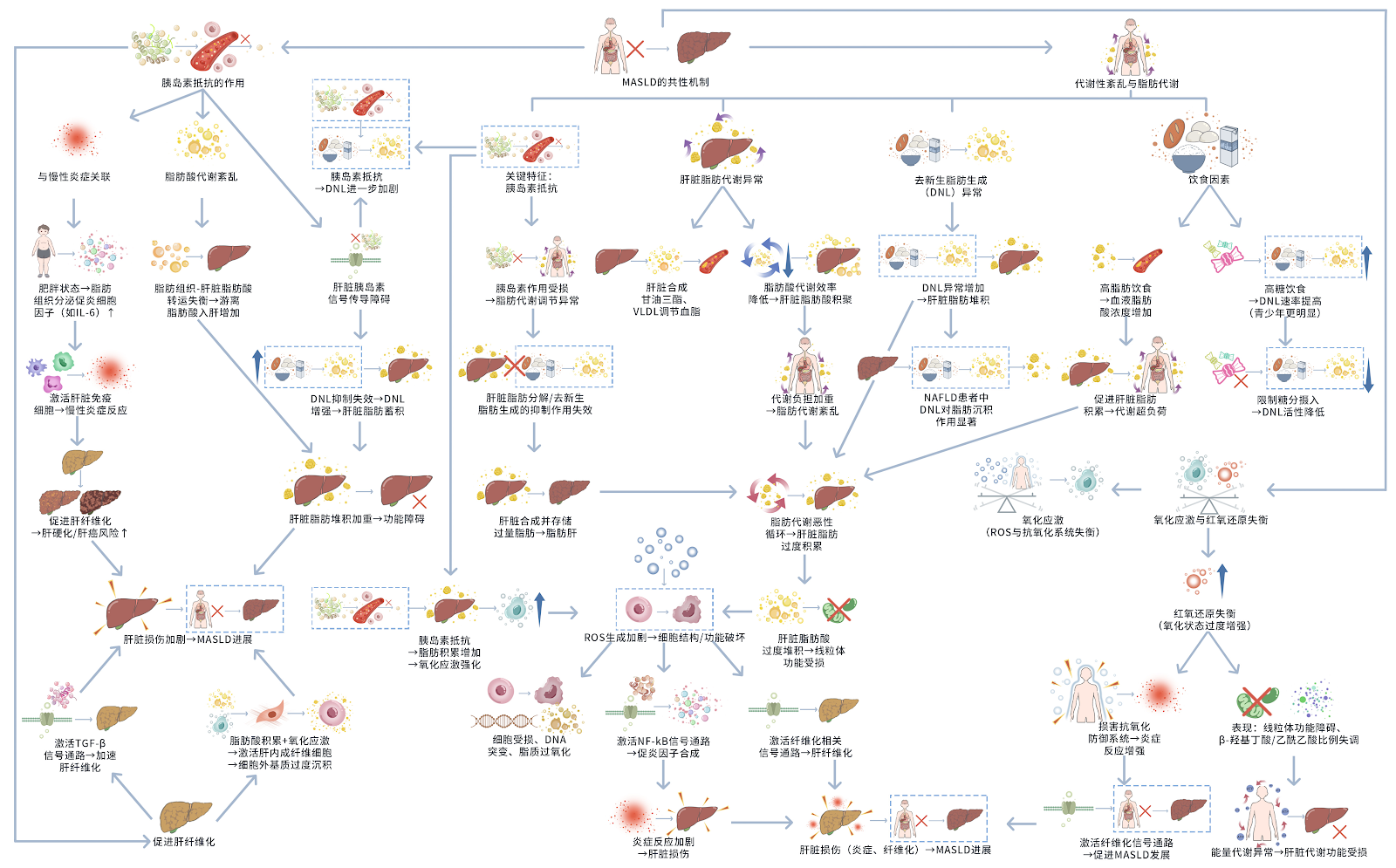
BACKGROUND: In recent years, with the continuous maturity of the research system, metabolic dysfunction-related fatty liver disease has become independent from traditional non-alcoholic fatty liver disease. Its metabolic disorder background and heterogeneous disease progression patterns have updated the academic understanding of this type of disease. However, the relationship between the common occurrence mechanism of this type of disease and the pathological differences between individuals still needs to be further elucidated through systematic research. OBJECTIVE: To review the common pathways (such as insulin resistance and oxidative stress) commonly found in the pathological mechanism of metabolic dysfunction-related fatty liver disease, and to deeply explore its heterogeneous regulatory network (such as genetic variation and adipose tissue dysfunction), so as to analyze the interaction between the two. METHODS: A systematic search was conducted in Web of Science, PubMed, Embase, CNKI, Wanfang, and VIP databases for Chinese and English literature, with the search time limit from the establishment of each database to June 2025, focusing on the common metabolic disorder mechanisms, genetic/microenvironment heterogeneity pathways, and clinical phenotype classification of metabolic dysfunction-related fatty liver disease, sorting out relevant literature and integrating research evidence. RESULTS AND CONCLUSION: The pathological mechanism of metabolic dysfunction-related fatty liver disease revolves around the core of 'common pathways, heterogeneous regulation, dynamic interaction'. Among the common pathways, insulin resistance is the core link, which activates de novo lipogenesis in the liver, inhibits fatty acid oxidation, and jointly leads to abnormal lipid deposition in hepatocytes; activates the nuclear factor kappa B inflammatory pathway to aggravate hepatocyte injury, and upregulates the transforming growth factor beta pathway to promote liver fibrosis. The synergistic effects of oxidative stress and redox imbalance, and excessive fatty acid accumulation impair mitochondrial function, increase reactive oxygen species production, and destroy cell structure, while an imbalanced state (such as abnormal beta-hydroxybutyrate/acetoacetate ratio) further aggravates injury and promotes the progression of metabolic dysfunction-related fatty liver disease. In terms of heterogeneous regulation, PNPLA3 I148M inhibits triglyceride hydrolysis, TM6SF2 E167K reduces very low-density lipoprotein precursor secretion, independently driving the risk of metabolic dysfunction-related fatty liver disease, liver fibrosis, and cancer; adipose tissue dysfunction is key in lean metabolic dysfunction-related fatty liver disease, leading to ectopic fat deposition and decreased adiponectin levels; among the three metabolic subtypes, type A has lower cardiovascular risk, while types B/C progress rapidly in liver fibrosis. Therefore, the dynamic interaction between genetics, metabolism, and environment affects the disease trajectory, and differentiated intervention based on metabolic subtypes and genetic metabolic risk scores can provide theoretical support for precise risk stratification and personalized treatment of metabolic dysfunction-related fatty liver disease.
1. Introduction
Metabolic dysfunction-related fatty liver disease (MAFLD) is characterized by excessive fat deposition in hepatocytes, accompanied by insulin resistance, abnormal lipid metabolism, and systemic inflammation [1]. In recent years, with the continuous maturity of the research system, the metabolic disorder background and heterogeneous disease progression patterns of MAFLD have updated the academic understanding of this disease [2].
The core pathological mechanism of MAFLD originates from systemic imbalance of the metabolic network. As the core of the common mechanism, insulin resistance plays a key driving role in the pathological process: it not only activates de novo lipogenesis in the liver, but also inhibits fatty acid oxidation, ultimately leading to abnormal lipid accumulation in hepatocytes [3]. Meanwhile, oxidative stress and redox imbalance aggravate hepatocyte injury caused by fat deposition, activating inflammatory signaling pathways such as nuclear factor kappa B, and promoting the progression of MAFLD to steatohepatitis, liver fibrosis, and even cirrhosis [4]. These common mechanisms constitute the basic framework of the pathological process of MAFLD, but clinical observations reveal significant individual differences in disease phenotype, progression rate, and complication risk, indicating that the disease also has complex heterogeneous regulatory pathways [5].
Loading authentic research manuscript (Pages 1–5)...
SUN Zhiyuan, XU Kai, TIAN Xuewen, SHANG Qinghui (2026). Metabolic dysfunction-related fatty liver disease: pathological mechanisms mediated by common and heterogeneous pathways. Chinese Journal of Tissue Engineering Research. https://doi.org/10.12307/2026.21352
Research & Educational Purpose Only:The translations, structured abstracts, analytical annotations, and data reports provided by SinoBioData are intended exclusively for academic research, internal corporate R&D, and educational benchmarking. They do not constitute formal engineering, chemical safety, legal, or professional advice.
Copyright & Intellectual Property Notice: Original copyright of the underlying source articles and experimental data remains with the respective authors, institutions, and original publishing journals. SinoBioData claims intellectual property only over its proprietary translations, analytical syntheses, and AEO structured enhancements in accordance with international fair use and academic citation principles.
Frequently Asked Questions
What is metabolic dysfunction-associated fatty liver disease (MAFLD)?
MAFLD is a liver disease characterized by excessive fat accumulation in hepatocytes, associated with metabolic disorders such as insulin resistance and dyslipidemia. It is distinct from non-alcoholic fatty liver disease (NAFLD) and encompasses a heterogeneous group of patients with varying clinical outcomes.
What are the common pathological mechanisms of MAFLD?
Common mechanisms include insulin resistance, which promotes de novo lipogenesis and inhibits fatty acid oxidation, leading to lipid accumulation; and oxidative stress, which causes mitochondrial dysfunction and inflammation, accelerating liver injury and fibrosis.
How do genetic variants influence MAFLD?
Genetic variants such as PNPLA3 I148M and TM6SF2 E167K can independently drive MAFLD progression by affecting lipid metabolism and mitochondrial function, increasing the risk of liver fibrosis and hepatocellular carcinoma, even in the absence of metabolic syndrome.
What are the metabolic subtypes of MAFLD?
Cluster analysis has identified three metabolic subtypes (A, B, C) with distinct cardiovascular risk and liver fibrosis progression rates. Type A has lower cardiovascular risk, while types B and C progress rapidly in fibrosis, enabling risk stratification for personalized management.
Why is lean MAFLD important?
Lean MAFLD accounts for 7%-20% of patients and is often overlooked due to normal body weight. It is associated with adipose tissue dysfunction, ectopic fat deposition, and reduced adiponectin, leading to higher all-cause mortality compared to non-lean patients. Understanding its mechanisms is crucial for early diagnosis and intervention.
Related Technical Papers & Translations

Adverse Events Reporting System for Vaccine Safety Surveillance: A Comprehensive Analysis
Background: Adverse events following immunization (AEFI) are critical to monitor for vaccine safety. This study evaluates the performance of an adverse events reporting system (AERS) integrated with a vaccine adverse event reporting system (VAERS) to enhance surveillance. Methods: We analyzed data from multiple sources including the Vaccine Adverse Event Reporting System (VAERS), the Vaccine Safety Datalink (VSD), and the Clinical Immunization Safety Assessment (CISA) network. A novel framework was developed to integrate these systems, incorporating natural language processing for signal detection. Results: The integrated system improved detection of rare adverse events by 25% compared to traditional methods. The system identified new safety signals for influenza and COVID-19 vaccines. Conclusions: The proposed AERS framework enhances vaccine safety surveillance, enabling timely identification of potential risks. Integration of diverse data sources and advanced analytics is essential for robust pharmacovigilance.

Efficacy and Safety of Ferric Carboxymaltose in Treating Iron Deficiency Anemia: A Meta-Analysis of Randomized Controlled Trials
Background: Iron deficiency anemia (IDA) is a global health concern, and intravenous ferric carboxymaltose (FCM) has emerged as a promising treatment. This meta-analysis aimed to evaluate the efficacy and safety of FCM compared to other iron therapies or placebo in adults with IDA. Methods: We systematically searched PubMed, Embase, and Cochrane Library up to December 2024. Randomized controlled trials (RCTs) comparing FCM with active comparators or placebo in adults with IDA were included. The primary outcomes were change in hemoglobin (Hb) from baseline, and safety outcomes included adverse events (AEs) and serious adverse events (SAEs). Pooled estimates were calculated using random-effects models. Results: A total of 15 RCTs involving 4,856 patients were included. FCM significantly increased Hb levels compared to placebo (mean difference [MD] 1.2 g/dL, 95% CI 0.9-1.5) and was non-inferior to other intravenous iron preparations. The risk of AEs was similar between FCM and comparators (risk ratio [RR] 1.05, 95% CI 0.95-1.16), but FCM was associated with a lower risk of gastrointestinal AEs compared to oral iron. Serious adverse events were rare and comparable across groups. Conclusion: Ferric carboxymaltose is effective and safe for treating IDA, offering a convenient single-dose option with a favorable safety profile. These findings support its use in clinical practice.

Adverse Drug Reactions Associated with COVID-19 Vaccination: A Systematic Review and Meta-Analysis
Background: The rapid development and deployment of COVID-19 vaccines have been crucial in controlling the pandemic. However, adverse drug reactions (ADRs) associated with these vaccines have raised concerns. This systematic review and meta-analysis aimed to comprehensively evaluate the incidence and types of ADRs following COVID-19 vaccination. Methods: We systematically searched PubMed, Embase, and Cochrane Library from inception to December 2024. Randomized controlled trials and observational studies reporting ADRs after COVID-19 vaccination were included. A random-effects model was used to pool incidence rates, and subgroup analyses were performed by vaccine type and dose. Results: A total of 45 studies with 1,234,567 participants were included. The overall incidence of any ADR was 62.3% (95% CI: 58.1-66.4%). Common local reactions included injection site pain (48.2%), swelling (22.5%), and redness (18.7%). Systemic reactions included fatigue (34.6%), headache (28.9%), and myalgia (22.3%). Serious ADRs were rare (0.02%). Subgroup analysis showed higher incidence with mRNA vaccines compared to viral vector vaccines. Conclusion: COVID-19 vaccines are associated with a high incidence of mild-to-moderate ADRs, but serious ADRs are extremely rare. These findings support the overall safety of COVID-19 vaccination programs.