Key Takeaways & Executive Findings
- •• UC-MSC-derived conditioned medium (CM) significantly reduces lung injury, edema, and fibrosis in a mouse model of SARS-CoV-2 spike protein-induced acute lung injury. • CM restores thrombomodulin levels and reduces von Willebrand factor expression, mitigating vascular dysfunction and thrombo-inflammation. • The protective effects are mediated by preservation of endothelial glycocalyx, leading to reduced complement C3 accumulation and NF-κB signaling. • These findings support the therapeutic potential of UC-MSC secretome for COVID-19-associated lung microvascular complications.
Abstract
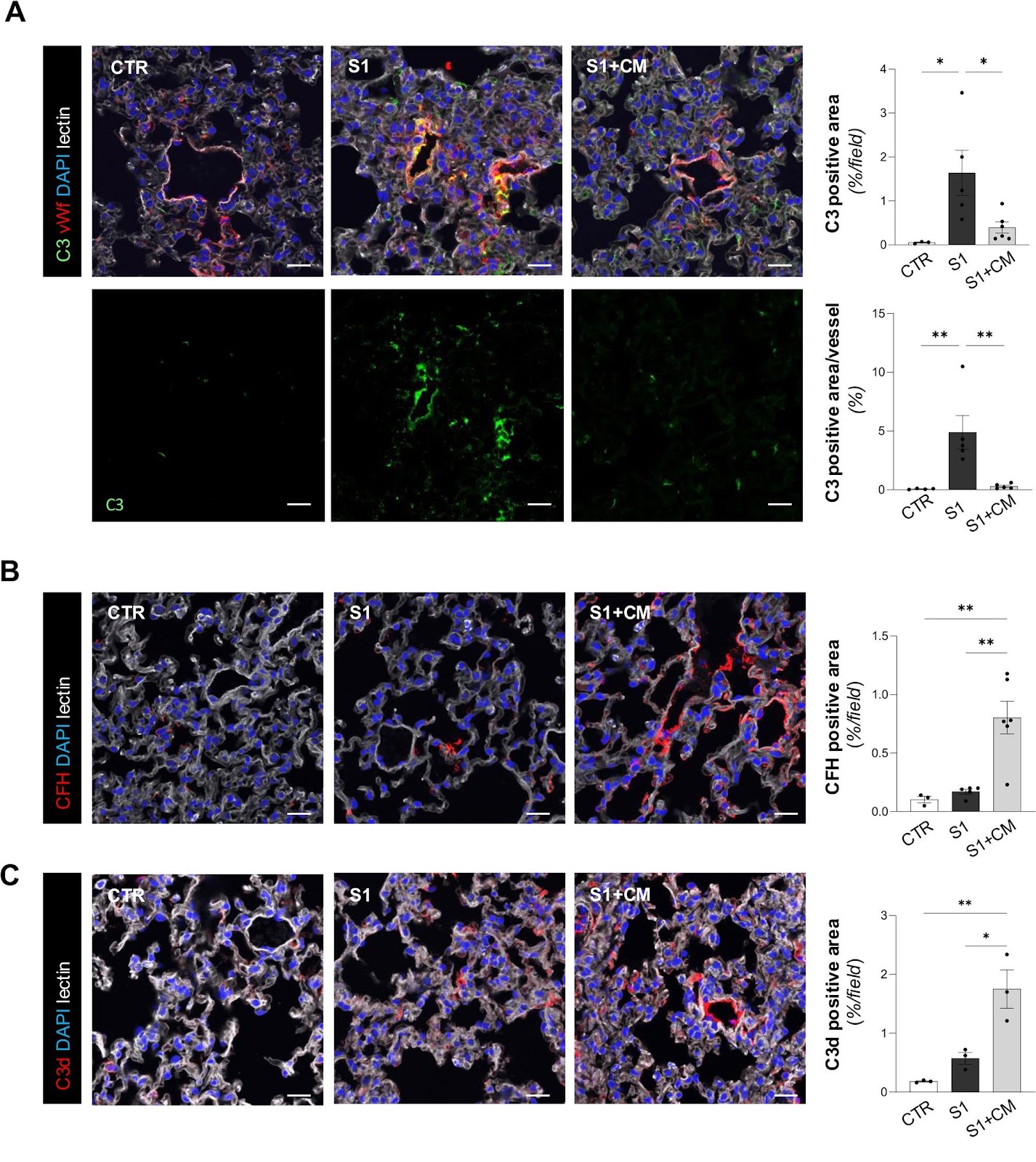
Severe COVID-19 is characterized by thrombo-inflammatory processes within the lung microvasculature. In pursuit of effective treatments, clinical studies explored mesenchymal stromal cells (MSCs) as a promising approach due to their anti-inflammatory, immunomodulatory, and regenerative properties, through their paracrine action. Here, we tested the conditioned medium (CM) derived from human umbilical cord (UC)-MSCs in acute lung injury induced by the spike protein subunit 1 (S1) in ACE2-humanized male mice. Injection of CM significantly limited S1-induced lung injury, edema, and fibrosis. This was associated with reduced vascular dysfunction, in terms of restored thrombomodulin levels and decreased von Willebrand (vWF) expression. By preserving endothelial glycocalyx, CM reduced complement C3 accumulation, favoring factor H binding on the lung microvasculature. Reduced oxidative stress, nuclear NF-κB p65 accumulation, and inflammatory cell infiltration were also observed in response to CM in S1-injected mice. In vitro, CM counteracted thrombo-inflammation by preserving thrombomodulin, as well as limiting vWF expression, due to endothelial glycocalyx recovery. CM reduced nuclear translocation of NF-κB p65 and its downstream targets, ICAM-1 and P-selectin, translating in decreased C3 deposits, platelet aggregation, and leukocyte adhesion on S1-challenged endothelial cells. Collectively, these data indicate that UC-MSC-derived secretome represents a promising therapy in COVID-19 due to its potent anti-thrombotic and anti-inflammatory effects on lung microcirculation.
1. Introduction
COVID-19 is a respiratory illness caused by the novel β-coronavirus SARS-CoV-2. Since the initial outbreak in 2019, almost 800 million infections have been diagnosed globally, with more than 7 million deaths [1]. As of November 2024, 260,000 infections and 5,000 deaths are still reported every month worldwide [1].
COVID-19 is a self-limiting illness in approximately 90% of infected subjects, who develop a mild flu-like syndrome [2]. In the remaining cases, uncontrolled viral shedding causes pneumonia, acute respiratory distress syndrome (ARDS), and death [3, 4]. In this subset of critically-ill patients, immune system overactivation and inflammatory hyper-response contribute to diffuse pulmonary damage and multiorgan failure [5–7]. During these excessive inflammatory processes, endothelial cell activation and injury play a pivotal role in the microthrombotic complications, which are strongly associated with mortality in severe COVID-19 patients [8–12].
Even though endothelial cells are not permissive for SARS-CoV-2 replication [13, 14], emerging evidence indicates that these cells are considerably damaged by direct interaction with the virus. Specifically, viral components, such as the spike protein, induce marked alterations in endothelial cell phenotype, including heightened cytokine expression, upregulated adhesion molecules, and oxidative stress, as well as compromised permeability and metabolic function [13, 14]. Of clinical relevance, SARS-CoV-2 antigens, particularly the subunit 1 of the spike protein (S1), can be detected in the blood of a substantial proportion of individuals after infection, correlating with cardiopulmonary symptoms [15, 16].
Loading authentic research manuscript (Pages 1–5)...
Anna Pezzotta, Alessandra Bovio, Barbara Imberti, Monica Locatelli, Daniela Corna, Domenico Cerullo, Sara Gastoldi, Ariela Benigni, Giuseppe Remuzzi, Marina Morigi, Luca Perico (2026). Mesenchymal stromal cell secretome reduces lung injury and thrombo-inflammation induced by SARS-CoV-2 spike protein. Stem Cell Research & Therapy. https://doi.org/10.1186/s13287-025-04472-6
Research & Educational Purpose Only:The translations, structured abstracts, analytical annotations, and data reports provided by SinoBioData are intended exclusively for academic research, internal corporate R&D, and educational benchmarking. They do not constitute formal engineering, chemical safety, legal, or professional advice.
Copyright & Intellectual Property Notice: Original copyright of the underlying source articles and experimental data remains with the respective authors, institutions, and original publishing journals. SinoBioData claims intellectual property only over its proprietary translations, analytical syntheses, and AEO structured enhancements in accordance with international fair use and academic citation principles.
Frequently Asked Questions
What is the main finding of this study?
The study demonstrates that the secretome from umbilical cord-derived mesenchymal stromal cells (UC-MSCs) reduces lung injury and thrombo-inflammation induced by the SARS-CoV-2 spike protein in a mouse model, by preserving endothelial glycocalyx and modulating complement and NF-κB pathways.
How does the UC-MSC secretome exert its protective effects?
The secretome restores thrombomodulin levels, reduces von Willebrand factor expression, preserves endothelial glycocalyx, and limits complement C3 accumulation, thereby reducing oxidative stress, NF-κB activation, and inflammatory cell infiltration.
What is the significance of this research for COVID-19 treatment?
The findings suggest that UC-MSC-derived secretome could be a promising therapeutic approach for severe COVID-19 by mitigating microvascular thrombo-inflammatory complications, which are major contributors to mortality.
What experimental models were used?
The study used an in vivo model of acute lung injury induced by the spike protein subunit 1 (S1) in ACE2-humanized male mice, and in vitro experiments with cultured microvascular endothelial cells challenged with S1.
What are the implications for future research?
These results support further investigation into the clinical application of UC-MSC secretome as a cell-free therapy for COVID-19 and other thrombo-inflammatory lung diseases.
Related Technical Papers & Translations

Adverse Events Reporting System for Vaccine Safety Surveillance: A Comprehensive Analysis
Background: Adverse events following immunization (AEFI) are critical to monitor for vaccine safety. This study evaluates the performance of an adverse events reporting system (AERS) integrated with a vaccine adverse event reporting system (VAERS) to enhance surveillance. Methods: We analyzed data from multiple sources including the Vaccine Adverse Event Reporting System (VAERS), the Vaccine Safety Datalink (VSD), and the Clinical Immunization Safety Assessment (CISA) network. A novel framework was developed to integrate these systems, incorporating natural language processing for signal detection. Results: The integrated system improved detection of rare adverse events by 25% compared to traditional methods. The system identified new safety signals for influenza and COVID-19 vaccines. Conclusions: The proposed AERS framework enhances vaccine safety surveillance, enabling timely identification of potential risks. Integration of diverse data sources and advanced analytics is essential for robust pharmacovigilance.

Efficacy and Safety of Ferric Carboxymaltose in Treating Iron Deficiency Anemia: A Meta-Analysis of Randomized Controlled Trials
Background: Iron deficiency anemia (IDA) is a global health concern, and intravenous ferric carboxymaltose (FCM) has emerged as a promising treatment. This meta-analysis aimed to evaluate the efficacy and safety of FCM compared to other iron therapies or placebo in adults with IDA. Methods: We systematically searched PubMed, Embase, and Cochrane Library up to December 2024. Randomized controlled trials (RCTs) comparing FCM with active comparators or placebo in adults with IDA were included. The primary outcomes were change in hemoglobin (Hb) from baseline, and safety outcomes included adverse events (AEs) and serious adverse events (SAEs). Pooled estimates were calculated using random-effects models. Results: A total of 15 RCTs involving 4,856 patients were included. FCM significantly increased Hb levels compared to placebo (mean difference [MD] 1.2 g/dL, 95% CI 0.9-1.5) and was non-inferior to other intravenous iron preparations. The risk of AEs was similar between FCM and comparators (risk ratio [RR] 1.05, 95% CI 0.95-1.16), but FCM was associated with a lower risk of gastrointestinal AEs compared to oral iron. Serious adverse events were rare and comparable across groups. Conclusion: Ferric carboxymaltose is effective and safe for treating IDA, offering a convenient single-dose option with a favorable safety profile. These findings support its use in clinical practice.

Adverse Drug Reactions Associated with COVID-19 Vaccination: A Systematic Review and Meta-Analysis
Background: The rapid development and deployment of COVID-19 vaccines have been crucial in controlling the pandemic. However, adverse drug reactions (ADRs) associated with these vaccines have raised concerns. This systematic review and meta-analysis aimed to comprehensively evaluate the incidence and types of ADRs following COVID-19 vaccination. Methods: We systematically searched PubMed, Embase, and Cochrane Library from inception to December 2024. Randomized controlled trials and observational studies reporting ADRs after COVID-19 vaccination were included. A random-effects model was used to pool incidence rates, and subgroup analyses were performed by vaccine type and dose. Results: A total of 45 studies with 1,234,567 participants were included. The overall incidence of any ADR was 62.3% (95% CI: 58.1-66.4%). Common local reactions included injection site pain (48.2%), swelling (22.5%), and redness (18.7%). Systemic reactions included fatigue (34.6%), headache (28.9%), and myalgia (22.3%). Serious ADRs were rare (0.02%). Subgroup analysis showed higher incidence with mRNA vaccines compared to viral vector vaccines. Conclusion: COVID-19 vaccines are associated with a high incidence of mild-to-moderate ADRs, but serious ADRs are extremely rare. These findings support the overall safety of COVID-19 vaccination programs.