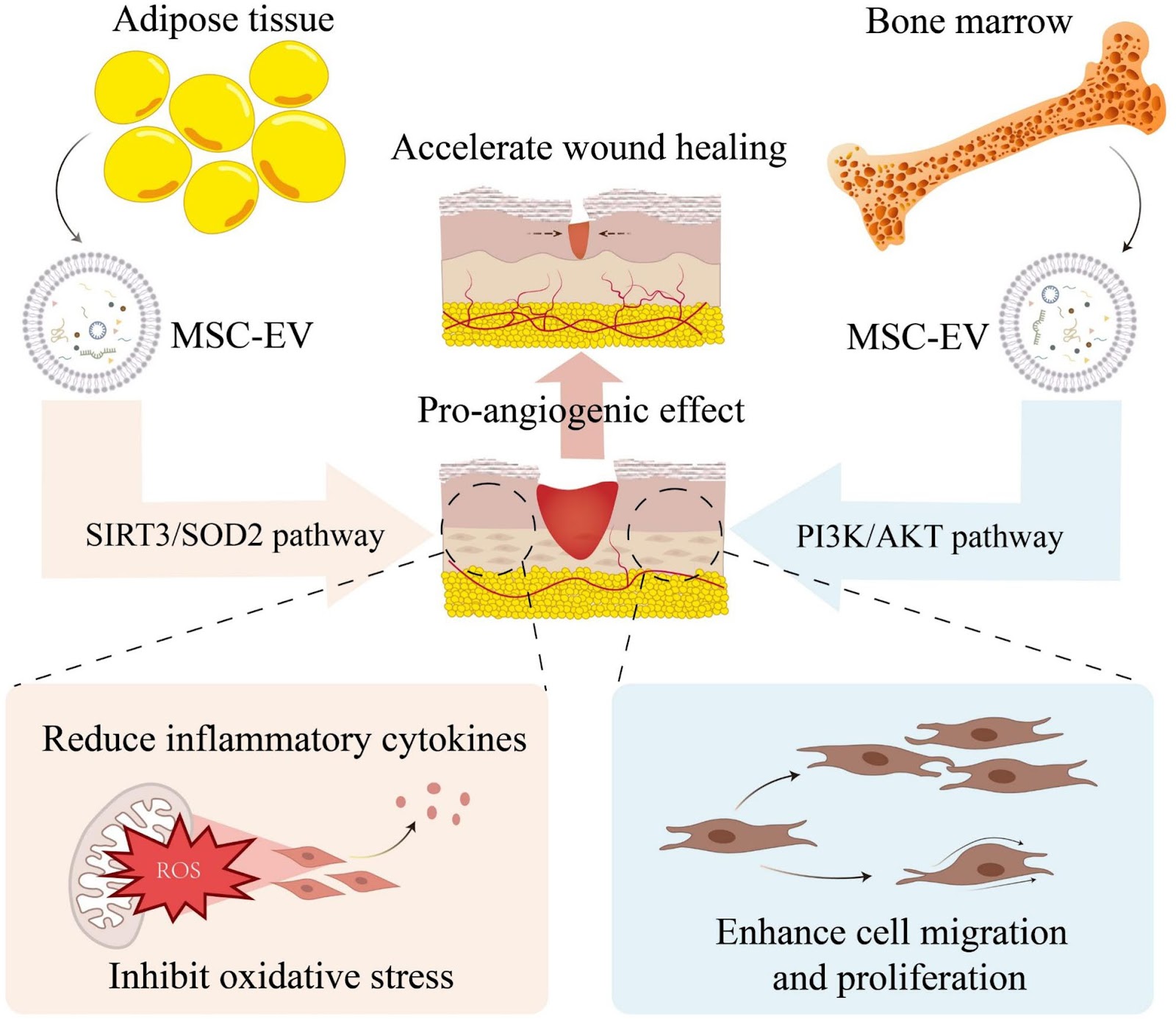
Key Takeaways & Executive Findings
- •• MSC-EVs show therapeutic potential in T2D by modulating inflammation, promoting tissue regeneration, and improving insulin resistance. • Engineering strategies such as optimizing culture conditions, modifying EV contents, and using bioactive material-based delivery systems can enhance MSC-EV yield and efficacy. • Challenges including limited yield, heterogeneity, long-term safety, immunocompatibility, and large-scale production must be addressed for clinical translation. • Artificial intelligence is highlighted as a promising tool to guide future research and overcome current limitations in MSC-EV-based therapies.
Abstract
Type 2 diabetes (T2D) and its complications represent a complex disorder involving multiple pathophysiological processes. Although conventional therapeutic approaches partially regulate blood glucose, they fail to fundamentally reverse disease progression or effectively prevent complications. This review summarizes the current research advance and challenges of using different forms of mesenchymal stem cell-derived extracellular vesicles (MSC-EVs) in treating T2D and complications. It begins with an introduction to the characteristics of MSC-EVs. Subsequently, the mechanisms and therapeutic prospects of natural MSC-EVs are analyzed, with a focus on their roles in inflammatory modulation, tissue regeneration, and improving insulin resistance. Engineering MSC-EVs, covering strategies including optimizing MSC culture conditions, modifying EV contents, and establishing MSC-EV delivery systems based on bioactive materials are then discussed, which boost EV yield and quality while enhancing therapeutic efficacy. Current challenges, including the limited yield and high heterogeneity of natural MSC-EVs, as well as issues related to long-term safety, immunocompatibility, and large-scale production of engineered MSC-EVs are finally overviewed, with emphasizing artificial intelligence in guiding future research directions. These summaries are crucial for clinical translation of MSC-EVs and will ultimately provide T2D patients with an effective and safe treatment option.
1. Introduction
Type 2 diabetes (T2D) is a rapidly growing metabolic disorder that presents significant challenges to global public health owing to its intricate pathophysiological mechanisms and extensive complications. T2D arises from inadequate utilization or decreased efficiency of insulin [1]. The global prevalence of T2D is gradually increasing [2], which is estimated to reach 12.2% (783.2 million people worldwide) by 2045 [3]. The development of T2D is closely linked to insulin resistance and β-cell dysfunction [4], in which insulin resistance is pivotal in T2D pathogenesis [5], while β-cell dysfunction leads to abnormal insulin secretion [6]. In T2D, persistent hyperglycemic environment can trigger inflammation, localized hypoxia, and increased oxidative stress. These conditions contribute to various complications [7, 8], such as wound healing impairment, retinopathy, and osteoporosis (Fig. 1) [9–12]. Current treatment approaches of T2D include pharmacotherapy [13], exercise, and dietary management [14], which alleviate symptoms of the metabolic disorder but cannot reverse or fundamentally cure T2D and its associated multi-organ dysfunction [15]. There is an urgent need for the development of novel therapeutic strategies to enhance patient quality of life and slow disease progression for T2D.
Mesenchymal stem cells (MSCs) are characterized by plastic adhesion properties, self-renewal, immunomodulation, and multiple differentiation potentials [16]. They can be derived from a wide array of tissues and are extensively tested in therapeutic applications [17]. Notably, our research group has conducted a pilot clinical trial showing that MSC treatment for T2D patients has beneficial effects yet certain limitations, with its efficacy being influenced by the disease’s severity [18]. Therefore, it is essential to further elucidate the mechanisms by which MSCs effectively treat T2D and to optimize treatment strategies for severe cases based on these insights. In this context, our studies and others’ have further illustrated that MSCs exert regulatory and therapeutic effects on T2D metabolism by releasing extracellular vesicles (EVs) [19], nano-sized particles secreted by cells, enclosed by a lipid bilayer [20], present in biological fluids and involved in intercellular communication in physiological and pathological processes [21]. MSC-derived EVs (MSC-EVs) have shown immense potential in T2D treatment [22, 23]. Further investigation into the therapeutic targets of MSC-EVs and the development of targeted engineering strategies are expected to provide new methodologies for stem cell-based therapies for T2D [24, 25].
Loading authentic research manuscript (Pages 1–5)...
Sha Zhang, Zong-Yu Zhang, Ruo-Nan Tang, Kai Zhang, Yu Fu, Hua Tian, Jing Ma, Yan Jin, Chen-Xi Zheng, Bing-Dong Sui (2026). Mesenchymal stem cell-derived extracellular vesicles in the treatment of type 2 diabetes and its complications: current progress and future directions. Stem Cell Research & Therapy. https://doi.org/10.1186/s13287-026-04991-w
Research & Educational Purpose Only:The translations, structured abstracts, analytical annotations, and data reports provided by SinoBioData are intended exclusively for academic research, internal corporate R&D, and educational benchmarking. They do not constitute formal engineering, chemical safety, legal, or professional advice.
Copyright & Intellectual Property Notice: Original copyright of the underlying source articles and experimental data remains with the respective authors, institutions, and original publishing journals. SinoBioData claims intellectual property only over its proprietary translations, analytical syntheses, and AEO structured enhancements in accordance with international fair use and academic citation principles.
Frequently Asked Questions
What are MSC-EVs and how do they work in treating type 2 diabetes?
MSC-EVs are nano-sized vesicles secreted by mesenchymal stem cells that mediate intercellular communication. They carry bioactive molecules like proteins, lipids, and RNAs, which can modulate inflammation, promote tissue regeneration, and improve insulin resistance, thereby alleviating T2D and its complications.
What engineering strategies are used to enhance MSC-EV therapeutic efficacy?
Engineering strategies include optimizing MSC culture conditions (e.g., hypoxia, 3D culture), modifying EV contents (e.g., loading drugs or miRNAs), and establishing delivery systems using bioactive materials (e.g., hydrogels, scaffolds) to improve yield, targeting, and sustained release.
What are the main challenges in translating MSC-EV therapies to clinical practice?
Key challenges include limited yield and high heterogeneity of natural MSC-EVs, concerns about long-term safety and immunocompatibility, and difficulties in large-scale production and standardization. Artificial intelligence is proposed to help address these issues.
How does artificial intelligence contribute to MSC-EV research?
AI can assist in predicting EV components, optimizing production protocols, designing engineered EVs, and analyzing complex biological data to accelerate the development of effective and safe MSC-EV therapies for T2D.
What is the significance of this review for future T2D treatment?
This review consolidates current knowledge on MSC-EVs in T2D, highlighting their potential as a novel therapeutic approach. It underscores the need for further research and engineering to overcome limitations, ultimately aiming to provide an effective and safe treatment option for T2D patients.
Related Technical Papers & Translations

Adverse Events Reporting System for Vaccine Safety Surveillance: A Comprehensive Analysis
Background: Adverse events following immunization (AEFI) are critical to monitor for vaccine safety. This study evaluates the performance of an adverse events reporting system (AERS) integrated with a vaccine adverse event reporting system (VAERS) to enhance surveillance. Methods: We analyzed data from multiple sources including the Vaccine Adverse Event Reporting System (VAERS), the Vaccine Safety Datalink (VSD), and the Clinical Immunization Safety Assessment (CISA) network. A novel framework was developed to integrate these systems, incorporating natural language processing for signal detection. Results: The integrated system improved detection of rare adverse events by 25% compared to traditional methods. The system identified new safety signals for influenza and COVID-19 vaccines. Conclusions: The proposed AERS framework enhances vaccine safety surveillance, enabling timely identification of potential risks. Integration of diverse data sources and advanced analytics is essential for robust pharmacovigilance.

Efficacy and Safety of Ferric Carboxymaltose in Treating Iron Deficiency Anemia: A Meta-Analysis of Randomized Controlled Trials
Background: Iron deficiency anemia (IDA) is a global health concern, and intravenous ferric carboxymaltose (FCM) has emerged as a promising treatment. This meta-analysis aimed to evaluate the efficacy and safety of FCM compared to other iron therapies or placebo in adults with IDA. Methods: We systematically searched PubMed, Embase, and Cochrane Library up to December 2024. Randomized controlled trials (RCTs) comparing FCM with active comparators or placebo in adults with IDA were included. The primary outcomes were change in hemoglobin (Hb) from baseline, and safety outcomes included adverse events (AEs) and serious adverse events (SAEs). Pooled estimates were calculated using random-effects models. Results: A total of 15 RCTs involving 4,856 patients were included. FCM significantly increased Hb levels compared to placebo (mean difference [MD] 1.2 g/dL, 95% CI 0.9-1.5) and was non-inferior to other intravenous iron preparations. The risk of AEs was similar between FCM and comparators (risk ratio [RR] 1.05, 95% CI 0.95-1.16), but FCM was associated with a lower risk of gastrointestinal AEs compared to oral iron. Serious adverse events were rare and comparable across groups. Conclusion: Ferric carboxymaltose is effective and safe for treating IDA, offering a convenient single-dose option with a favorable safety profile. These findings support its use in clinical practice.

Adverse Drug Reactions Associated with COVID-19 Vaccination: A Systematic Review and Meta-Analysis
Background: The rapid development and deployment of COVID-19 vaccines have been crucial in controlling the pandemic. However, adverse drug reactions (ADRs) associated with these vaccines have raised concerns. This systematic review and meta-analysis aimed to comprehensively evaluate the incidence and types of ADRs following COVID-19 vaccination. Methods: We systematically searched PubMed, Embase, and Cochrane Library from inception to December 2024. Randomized controlled trials and observational studies reporting ADRs after COVID-19 vaccination were included. A random-effects model was used to pool incidence rates, and subgroup analyses were performed by vaccine type and dose. Results: A total of 45 studies with 1,234,567 participants were included. The overall incidence of any ADR was 62.3% (95% CI: 58.1-66.4%). Common local reactions included injection site pain (48.2%), swelling (22.5%), and redness (18.7%). Systemic reactions included fatigue (34.6%), headache (28.9%), and myalgia (22.3%). Serious ADRs were rare (0.02%). Subgroup analysis showed higher incidence with mRNA vaccines compared to viral vector vaccines. Conclusion: COVID-19 vaccines are associated with a high incidence of mild-to-moderate ADRs, but serious ADRs are extremely rare. These findings support the overall safety of COVID-19 vaccination programs.