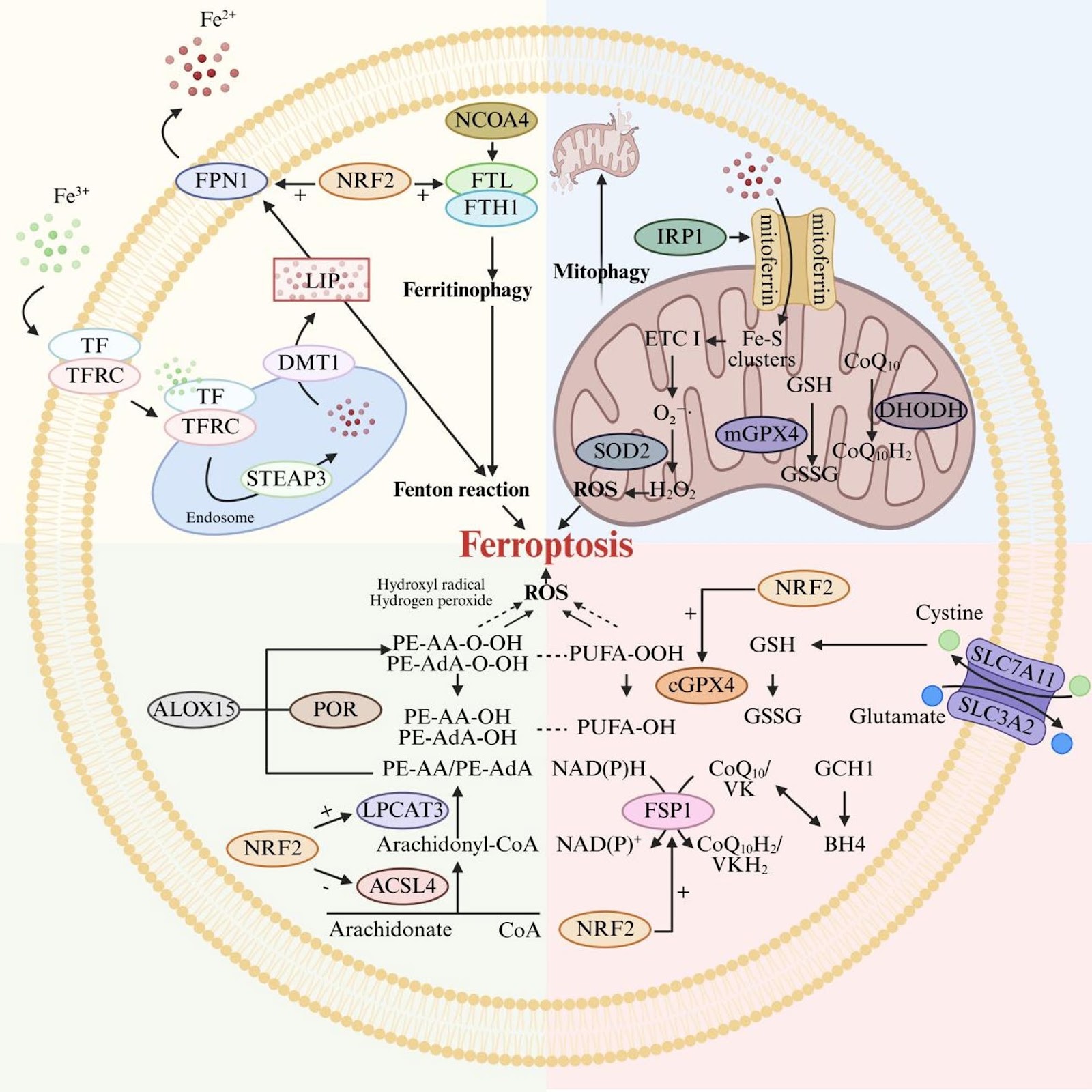
Key Takeaways & Executive Findings
- •• MSC-EVs modulate ferroptosis via three key pathways: iron metabolism, lipid metabolism, and antioxidant defense. • Both natural and engineered MSC-EVs show therapeutic potential in ferroptosis-related diseases, especially diabetes mellitus and its complications. • MSC-EVs offer advantages over MSCs, including lower immunogenicity, higher stability, and cell-free safety, making them promising for clinical translation. • Challenges and opportunities in translating MSC-EV-based ferroptosis modulation into clinical practice are critically evaluated.
Abstract
Ferroptosis is a novel form of programmed cell death, which has been demonstrated to play a pivotal role in various pathological processes due to its association with iron overload, lipid peroxidation, and dysregulation of the antioxidant system. In recent years, mesenchymal stem cell-derived extracellular vesicles (MSC-EVs) have garnered significant attention as a promising cell-free therapeutic strategy for modulating ferroptosis. This article elucidates the biological characteristics of MSC-EVs and the molecular mechanisms underlying ferroptosis, with a focus on how MSC-EVs regulate ferroptosis through three key pathways: iron metabolism, lipid metabolism, and the antioxidant defense system. Additionally, the therapeutic potential of both natural and engineered MSC-EVs in treating ferroptosis-related diseases is discussed, particularly highlighting their efficacy in diabetes mellitus and diabetic complications. Finally, this article evaluates the challenges and opportunities in translating MSC-EVs-based ferroptosis modulation therapies into clinical applications, providing valuable insights for future research and therapeutic development.
1. Introduction
Mesenchymal stem cells (MSCs) are a type of multipotent stem cells derived from the mesoderm, with common sources including umbilical cord, bone marrow, adipose tissue, placenta, and dental pulp [1]. MSCs possess multiple characteristics, which lay a solid foundation for their therapeutic applications [2]. For instance, they exhibit the potential to differentiate into various mesodermal cells and, under certain conditions, can transdifferentiate into neural-like or epithelial-like cells across germ layers [3–5]. Additionally, they modulate immune responses through dual pathways: secretion of soluble factors and direct cell-to-cell contact. Moreover, they can sense chemokine gradients at injury or inflammatory sites via surface receptors and migrate directionally to diseased tissues to enhance therapeutic efficacy [6].
Currently, more studies have focused on mesenchymal stem cell-derived extracellular vesicles (MSC-EVs), which are nanoscale membranous vesicles secreted by MSCs, containing bioactive components such as proteins, nucleic acids, lipids, and metabolites. Their functions have been demonstrated in various disease models: (1) alleviating inflammation by regulating macrophage polarization (e.g., sepsis) [7]; (2) accelerating skin wound repair [8]; (3) promoting vascular network reconstruction in ischemic myocardium and regulating vascular homeostasis [9]; (4) rescuing neuronal apoptosis [10]; and (5) mitigating mitochondrial damage to improve acute kidney injury [11]. Compared to the limitations of MSCs, such as low differentiation efficiency and potential tumorigenic risks, these advantages of MSC-EVs—their high penetration and targeting capabilities, low immunogenicity and stability, and cell-free therapeutic safety—are particularly valuable [12]. According to various studies, the drug delivery strategies of MSC-EVs are also more diverse and better adapted to diseases, including: (1) targeted peptide/antibody modification [13, 14]; (2) exogenous drug/nucleic acid loading [15, 16]; and (3) integration with biomaterials or nanotechnology [17, 18].
Loading authentic research manuscript (Pages 1–5)...
Jiayuan Wu, Zixuan Zhou, Hui Qian (2026). Mesenchymal stem cell-derived extracellular vesicles for disease therapy by regulating ferroptosis: focus on diabetes mellitus and diabetic complications. Stem Cell Research & Therapy. https://doi.org/10.1186/s13287-025-04852-y
Research & Educational Purpose Only:The translations, structured abstracts, analytical annotations, and data reports provided by SinoBioData are intended exclusively for academic research, internal corporate R&D, and educational benchmarking. They do not constitute formal engineering, chemical safety, legal, or professional advice.
Copyright & Intellectual Property Notice: Original copyright of the underlying source articles and experimental data remains with the respective authors, institutions, and original publishing journals. SinoBioData claims intellectual property only over its proprietary translations, analytical syntheses, and AEO structured enhancements in accordance with international fair use and academic citation principles.
Frequently Asked Questions
What is ferroptosis and why is it important?
Ferroptosis is a form of regulated cell death characterized by iron-dependent lipid peroxidation. It plays a pivotal role in various pathological processes, including diabetes and its complications, making it a target for therapeutic intervention.
How do MSC-derived extracellular vesicles regulate ferroptosis?
MSC-EVs regulate ferroptosis through three key pathways: iron metabolism, lipid metabolism, and the antioxidant defense system. They deliver bioactive molecules that modulate these pathways, thereby inhibiting ferroptosis and promoting tissue repair.
What are the advantages of MSC-EVs over MSCs for therapy?
MSC-EVs offer several advantages over MSCs, including lower immunogenicity, higher stability, easier storage, and cell-free safety, reducing the risk of tumorigenicity and immune rejection.
Can engineered MSC-EVs enhance therapeutic efficacy?
Yes, engineered MSC-EVs can be modified with targeting peptides, loaded with drugs or nucleic acids, or integrated with biomaterials to improve their specificity and therapeutic efficacy in treating ferroptosis-related diseases.
What are the challenges in translating MSC-EV-based ferroptosis modulation to clinical practice?
Challenges include standardization of EV production, large-scale manufacturing, quality control, and understanding the precise molecular mechanisms. However, ongoing research is addressing these issues to facilitate clinical translation.
Related Technical Papers & Translations

Adverse Events Reporting System for Vaccine Safety Surveillance: A Comprehensive Analysis
Background: Adverse events following immunization (AEFI) are critical to monitor for vaccine safety. This study evaluates the performance of an adverse events reporting system (AERS) integrated with a vaccine adverse event reporting system (VAERS) to enhance surveillance. Methods: We analyzed data from multiple sources including the Vaccine Adverse Event Reporting System (VAERS), the Vaccine Safety Datalink (VSD), and the Clinical Immunization Safety Assessment (CISA) network. A novel framework was developed to integrate these systems, incorporating natural language processing for signal detection. Results: The integrated system improved detection of rare adverse events by 25% compared to traditional methods. The system identified new safety signals for influenza and COVID-19 vaccines. Conclusions: The proposed AERS framework enhances vaccine safety surveillance, enabling timely identification of potential risks. Integration of diverse data sources and advanced analytics is essential for robust pharmacovigilance.

Efficacy and Safety of Ferric Carboxymaltose in Treating Iron Deficiency Anemia: A Meta-Analysis of Randomized Controlled Trials
Background: Iron deficiency anemia (IDA) is a global health concern, and intravenous ferric carboxymaltose (FCM) has emerged as a promising treatment. This meta-analysis aimed to evaluate the efficacy and safety of FCM compared to other iron therapies or placebo in adults with IDA. Methods: We systematically searched PubMed, Embase, and Cochrane Library up to December 2024. Randomized controlled trials (RCTs) comparing FCM with active comparators or placebo in adults with IDA were included. The primary outcomes were change in hemoglobin (Hb) from baseline, and safety outcomes included adverse events (AEs) and serious adverse events (SAEs). Pooled estimates were calculated using random-effects models. Results: A total of 15 RCTs involving 4,856 patients were included. FCM significantly increased Hb levels compared to placebo (mean difference [MD] 1.2 g/dL, 95% CI 0.9-1.5) and was non-inferior to other intravenous iron preparations. The risk of AEs was similar between FCM and comparators (risk ratio [RR] 1.05, 95% CI 0.95-1.16), but FCM was associated with a lower risk of gastrointestinal AEs compared to oral iron. Serious adverse events were rare and comparable across groups. Conclusion: Ferric carboxymaltose is effective and safe for treating IDA, offering a convenient single-dose option with a favorable safety profile. These findings support its use in clinical practice.

Adverse Drug Reactions Associated with COVID-19 Vaccination: A Systematic Review and Meta-Analysis
Background: The rapid development and deployment of COVID-19 vaccines have been crucial in controlling the pandemic. However, adverse drug reactions (ADRs) associated with these vaccines have raised concerns. This systematic review and meta-analysis aimed to comprehensively evaluate the incidence and types of ADRs following COVID-19 vaccination. Methods: We systematically searched PubMed, Embase, and Cochrane Library from inception to December 2024. Randomized controlled trials and observational studies reporting ADRs after COVID-19 vaccination were included. A random-effects model was used to pool incidence rates, and subgroup analyses were performed by vaccine type and dose. Results: A total of 45 studies with 1,234,567 participants were included. The overall incidence of any ADR was 62.3% (95% CI: 58.1-66.4%). Common local reactions included injection site pain (48.2%), swelling (22.5%), and redness (18.7%). Systemic reactions included fatigue (34.6%), headache (28.9%), and myalgia (22.3%). Serious ADRs were rare (0.02%). Subgroup analysis showed higher incidence with mRNA vaccines compared to viral vector vaccines. Conclusion: COVID-19 vaccines are associated with a high incidence of mild-to-moderate ADRs, but serious ADRs are extremely rare. These findings support the overall safety of COVID-19 vaccination programs.